

The problem with grades | A conversation with Amarbeer Singh Gill & Jennifer Curran
Grades give us comfort and numbers feel concrete. But what if our obsession with quantifying learning is actually getting in the way of…
Listen & show notes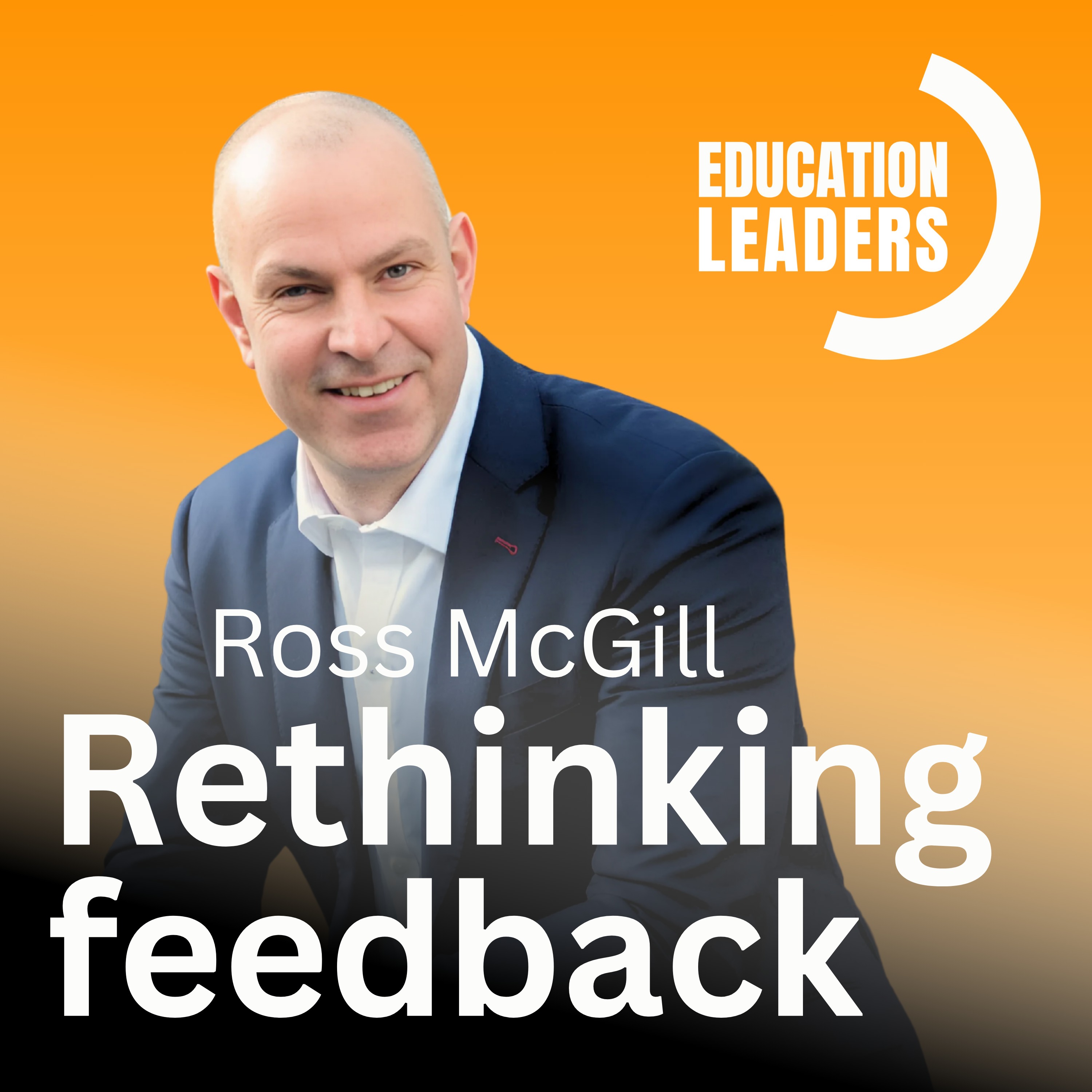
Shane welcomes globally renowned educator Ross McGill, known worldwide as Teacher Toolkit. Ross shares his groundbreaking approach to feedback and assessment, challenging traditional marking practices and offering practical alternatives that can transform how schools approach feedback while reducing teacher workload.
Ross introduces a comprehensive framework of nine different feedback approaches (feedback, feed up, feed forward × written, verbal, nonverbal) that enriches assessment practices beyond simply marking books. He shows that what matters most is whether students trust the feedback they receive and know how to act on it, not just what form the feedback takes.
You can find the full video of this conversation inside the Education Leaders Community.
The International Curriculum Association's Global.Learn.Connect Netherlands: Learn more
The University of Warwick's International Programmes | Learn more at warwick.ac.uk
Thank you for tuning in, and as always, if you found this episode useful, please share your experience. You can find me online on LinkedIn and Bluesky. My website is shaneleaning.com and email address is [email protected].
Shane Leaning, an organisational coach based in Shanghai, supports international schools globally. He co-founded Work Collaborative and hosts the chat-topping school leadership podcast, Education Leaders. Previously, he worked as Regional Head of Teaching Development for Nord Anglia Education. Passionate about empowering educators, he is currently co-authoring 'Change Starts Here.' As a CollectivEd Fellow, Teacher Development Trust Associate, and TEDx speaker, Shane has extensive experience in the UK and Asia and is a recognised voice in international education leadership. Learn more at shaneleaning.com.
Join Shane's Intensive Leadership Programme at educationleaders.co/intensive
Shane Leaning, an organisational coach based in Shanghai, supports school leaders globally. He is the author of the best-selling 'Change Starts Here.' Shane is a leading educational voice in the UK, Asia and around the world.
You can find Shane on LinkedIn.
We are a proud member of the Education Leaders podcast network. For more great education shows, visit educationleaders.co/network/
Hosted on Acast. See acast.com/privacy for more information.
Auto-generated transcript. It may contain small errors.
Is there anything more intimidating for a teacher than piles of unmarked books just waiting on your desk? For this, our 100th episode, I can't even believe I was saying that, we are going to tackle that marking bird and that is driving teachers away from our profession and offering something different. Hey everyone, I'm Shane Leaning. Welcome to the 100th episode of Education Leaders, the chat-topping leadership podcast for school leaders just like you. Can you
believe it? 100 episodes! This is such a massive milestone and I just couldn't be more thrilled to be celebrating with you today. As you know, I'm an organizational coach and in this show I get to know the teachers, leaders and innovators making a difference in education across the world. Now before we jump into this very
special conversation, I'm really excited that today's episode is supported by the International curriculum Association and the University of Warwick. Stay tuned to learn more. Alright, so for the 100th episode celebration, I can't think of a better guest today than Ross McGill. He is globally known as Teacher Toolkit.
You've heard of him. Today he's had over 90 million readers website. He began teaching in 1991, taught for many years in London and many more years as a school leader. Today he's working with teachers in schools worldwide, looking at teaching and learning, reducing workload and he's doing great work at improving teacher mental health. Now Ross is a multiple award-winning teacher. He's even
been listed in the Sunday Times as one of the 500 most influential people in Britain. Had to think of other educators who've done that. In fact, he remains the only classroom teacher to have ever featured to this day. He's ordered so many books and today we're talking about feedback and assessment and how schools should be approaching this area. I just can't think of a better way
to mark our 100th episode, so let's dive right in. I guess that evolution of thought has been, last 10 years at least, that mark in burden here in England, let's face it, has been dominated by offstead preferences even though they'll deny it to the hilt that we don't want you to do certain things. So the dialogue now is they cannot comment on your marking procedures, but that was quite a hard slog to get to that stage. So I'm kind of going back to 2010 to the 2015-16 era where that dialogue shifted. So that mark in burden, then we
switched to deep dives and I guess I'm trying not to swear here, my wife's got a brilliant expression, poo rolls downhill essentially. So if you think about that workload burden right down to classroom teacher, that marking should always be for one purpose only for the student, not for anything else, but we all know that beast becomes progress, parental preferences. So if you think about an independent sector where I might be paying £40,000 a year for my child to be educated, I might want to see parental perceptions that marking is king and if you're not marking my child's book, what's the point, you know, etc. Then you've got pressures on school leaders for inspections, progress and all those kind of headaches. So that was the kind of driver for it all.
And at the time, around 2014, in my own school as a teacher and then lead deputy head, we were building our own policy, which became the book Mark plan teach. And essentially, we were trying to eradicate all these silly fads and focus on key marking strategies that were not a waste of time that had an immediate impact. So I guess this was the early days of live marking. And what I used to get frustrated about is no matter how upskilled my colleagues were around me, my middle leaders, school leaders, that everyone had a preference or a methodology, or marking per se in maths was very different to PE. So no matter what work scrutiny
document or observation methodology came up with, I never got that genuine consistency, because it was very hard to group everyone together in a certain set of principles. So I can spend hours upskilling you how to do an effective observation that reduce your bias and all sorts of things, but I'd still never really achieve that 100% consistency. So you just get frustrated. And then obviously, throughout the years with different colleagues, different inspections, different work script needs, I just kept seeing these inconsistencies all the time. So I started to get
to a kind of place where I thought, well, if we go off into a PE classroom, or design and technology classroom, we won't always see the same amount of f that you might see in a history or a math from that's predominantly a written, heavy based type subject, because you're out on the playground or you're in the workshop banging a hammer. And there'll be lots of other forms of assessments. At the time, I can articulate this. But essentially, it would be that mark in or I speak to kids and not necessarily many things are written down in the book traditionally, or as an art teacher, I comment on your painting. And we can't write on your piece of art that's going to
go for the final piece of coursework. So long story short, I started to document these three versions, we write in children's books, we speak to them, or we give nonverbal gestures, you know, I point to you across the classroom, or I give you the thumb up or the smile and all those kind of things. And I guess in essence, we still go back to the written mark in as the champion or the predominant source of progress. I guess what we don't want to do is belittle teachers efforts in terms of how many thumbs up did you give Shane today? Because we know it
makes a difference. Can you just document it so I can see that 17 thumbs up in class actually works and you got a better exam score as a result. So I then start to do some digging. So as I was publishing mark plan teach to as I've experimented with mark plan teaching schools across the world, I thought well, there's certain things that are working. And I started
to dig deeper as I started my doctoral studies, I started to dig deeper into assessment, now reading all the classics, Hattie, Dylan, William, etc. And I discovered these three phrases feedback, feed up and feed forward. Now the world and the teaching profession is fixated on the phrase feedback. But if we think about the phrase feed up and feed forward, they've been around academically for a good 20, 30 years, but very few teachers actually know of these phrases. So just to
explain the definitions of each of these three words feedback, by definition means, if I have something I can refer back to, I can feed back on your progress to date. So in Shane's book, there's a great assignment on the Battle of Britain or whatever it might be, and I can compare it to his first effort back at the start of the academic year. That is feedback per se. Feed up by definition means if you give me a piece of work, I say to you, that's a grade four, your targets are grade six. And in schools, this typically
looks like a stamp or a sticker with a rubric on it. And I might circle the grade four and asterisk to grade six just to give the student back an immediate in some respects a summative assessment of school. Feed forward means I explain how you get to the next step. So it might be a couple of bullet points. Or I might say to you XYZ, or it might be
that this is a grade five, here's how to get to a grade six. So there'll be many versions of that. But that's what feed forward means. Did you just say that these terms have been around for a long time academically? Yeah, Ross, I totally
thought they were your terms. No, I think I'm going around attributing them to you as well. That's fine. I mean, I don't know the origins of the phrases and actually where they might have came up.
Originally, I could probably do a kind of linguistic analysis and try and find out. But I think the catalyst for this was John Hattie published a very important piece of research for Helen Timpley in 2007 called The Power of Feedback. And a lot of you listeners will know visible learning that effect size, that massive list of effect sizes that kind of inspired the profession in some respects, but also blighted the profession with a league table of strategies and feedback was right at the top 0.74 from memory as an effect size. So this was, you
know, 2007 10 ish. John Hattie is brilliant. And he kindly wrote the forward to my new book. And he published another piece of research in lockdown. And
he said, look, we've revisited the power of feedback. And actually, what we didn't do was group all the different studies. So in his meta analysis, we just grouped them as feedback. Actually, what we've now done is we've differentiated by feed up and feed forward. So
then it just unleashed a whole other way of looking at feedback mushed together as one. So I found that paper really, really inspiring. I guess that was the catalyst. This was about 2020. And this was the catalyst for me, really
digging deep into these three phases. I guess prior to that moment, I after a really nasty Austin inspection, where inspectors were not interested in the journey and teaching and learning that we've gone through over the three years, they just wanted fact, even on day two of inspection had to beg the inspector for a teaching and learning walk around the school at the time, it was a key judgment in the inspection process. Anyway, so quick whistle stop tour around the school 100 teachers 100 classrooms, probably saw about 10 or 15 had a chat on the picnic bench in the playground for two minutes. And essentially, the ultimate headline was, oh, your markings not consistent. This is what your policy says your
teachers are not following it. Therefore, teaching learning is not very good. So it was a very crude evaluation of really poor research methodology to kind of inspect in that manner. So I was really scarred by that. And
essentially, I got commissioned by UCL to conduct a piece of research on verbal feedback, because I wanted to demonstrate that art teachers, DT teachers, all teachers, regardless of subjects, actually spoke to kids. And here's how we can evidence it by outcomes without writing in a child's book. So long story short, I got 13 teachers together in seven disadvantaged schools in England, where typically, the schools from a poverty type measure, so if people are familiar with the IDACI index, the index for child deprivation, if you're working in a school that's IDACI five, so that's children with most poverty, in those types of schools, you would typically write in books, because kids need that cognitive support to process and reply to what so I understand that is necessary. But the byproduct of that is in perhaps toxic schools, teachers might be coerced into marking once a week with a particular type of pen for that consistency illusion. So essentially, these teachers
came from those types of skills. So I was very thankful to their teachers at the time to let me have the teachers for five days over the academic year, to essentially have a control class and a sample class control class, I'll mark these kids books, another very similar class, we won't mark these books all year, let's gather the data two or three times a year, and see what happens. Now it wasn't a PhD, it was a case study. And with Mark Quinn, who helped me conduct the research, we essentially got the teachers to document their journey, their progress, their resources, their techniques, with my support pedagogically, and with Mark Quinn's support in terms of an academic thinking as a teacher, how do I conduct research while I teach? So I think
about ethics, anonymity, data collection, etc. So that was quite an instrumental and it did ripple the profession at the time. I still don't think it gets enough noise. So let's give that a shout out online.
There's some evidence for people that you can talk to kids and demonstrate outcomes without writing in books. Absolutely. We can link to that as well in the show notes. So then the moment came when I looked at Hatton, I thought, well, actually, what if I have three different ways, use these phrases, feedback, feed up, feed forward, but I critique them against written, verbal and nonverbal. So in essence, I had
written feedback. So I'll talk about your journey when I assess your work, a bit of a motivational script, perhaps, well done, Ross, keep it up, or a feed up. So the sticker in the book, circle the grade four, asterisk to grade five, quick little stamp, move on, or I write in your book with a couple of bullet points, this is what you should do next, Shane. Essentially, we mush our marking strategies as one technique.
I like to encourage the profession. Let's make it a little bit richer. Let's have three different types of marking approaches. Now, we'll have all the different marking techniques we all use and all of the different catchy pedagogical names, but we could group them into these three fields.
I guess the critical one is verbal feedback. Now, all teachers do verbal feedback for many, many years. I've kind of asked this question, well, could you teach me how to do it? Because it can't just be a chat.
It needs to have a methodology that I can replicate and pass on to another colleague that's punchy because I don't have a lot of time, that actually is purposeful, that makes kids take action. And I can repeat it time and time again throughout the whole lesson and maybe use it on the corridor or parents, evens and what have you. So I've got a methodology for a verbal feedback script that I could teach you in 30 seconds. I've got one for a feed up, a reference to a grade, and I've got one for a feed forward. Here's what to do next.
So I've got three different scripts that I could teach you that you could then translate into your own context. And then the harder ones are these last three non verbal feedback. So what is that? So if I gave you a thumb up across the classroom, would we put that into feedback, feed up or feed forward? So we'd need a bit of
context to explain it. But essentially, you think about all the rich things that we do in our classrooms, gestures or cues that are silent, that make a big difference to students focusing or pause in or not about to throw the paper snowball across the room or whatever it might be. Our teachers are always doing the kind of fingers on lips, the cup around the ear, or the kind of spectacles over the eyes, kind of look at me and all those kind of things. And essentially, we've got three different potential methods there. Now, the challenge
is, one, how do you evidence all these different techniques and link them to pupil outcomes? And two, how would a school leader and an inspector that needs to upskill their pedagogy, how would they quality assure these if they came into a school? So that's what I've done in the new book, I've promoted nine different versions of feedback, feed up, feed forward. And given the school leaders something to think about in terms of developing one, they're teaching the learning policy, having a richer approach to marketing feedback. But two, how would you
quality assure these beyond the typical looking in a child's book? How would you evidence verbal feedback? How would you know that Shane, brilliant teacher that he is, is using a verbal feed forward script? And how would I see that this is making a difference to his class, even if I'm not in his classroom every single moment?
So in essence, we've got just to summarize, the feedback is how am I doing this? And that's a reflection on where you've come from a starting point. Or you've got the feed out, which is a reference to the grade or a target or an objective. Or you've got the feed forward where to next, Mr. McGill, and
that's what I should do next. And I guess here we get into metacognition, when students can start to do things for themselves. And as some sources, we've got that written approach. So the written feedback, the written feed up, the written feed forward, then verbal feedback, verbal feed up, verbal feed forward and the non-verbal. So I think
when we say market and feedback, my view is now it's a very lazy description of what teachers do. And as a profession, you know, if it's taken me 33 years of working in education to get to this point of richness, then how can I help new teachers around me, school leaders, push the profession even forward to see this ripple into classrooms as techniques and policy procedures and inspection evaluation methods before it then ripples into children in terms of their understanding, sir, can you mark my book, please? Well, we want to move away from that language. But then the bigger headache is parents, because we all fall into the trap that if you send your child to school, and their book comes home, why is Mr. McGill not
mark this book? And I fall into that trap too with my son at school. So I have to understand that there's lots of things I won't see that are happening every single day that aren't necessarily documented. So I'm going to go into schools all across the country, I don't get upset when I look in a child's book, and I don't see any marking, because I know there's a much richer approach. And I still, with
all my experience and bias need to move on, that there are many ways to provide formative assessment. This is brilliant. And I'm assuming then your book title, calling it the guide to feedback is one of the first statements in the book. It's not actually a guide to feedback. It's
yeah, that in the start. So I guess it was just that kind of alluring headline that people can, you know, the guide to mark and I think probably a traditional phrase, feedback, it'll get outdated, I'm sure. So hopefully, right? Hopefully. Yeah, I guess
it's timely. Here in England, we're fixated on live marketing and feedback. So, you know, obviously titles help for sales and things like that. But one thing I put in the introduction immediately is this is not a book about feedback. And it's taking
people on this journey. So it's still early days, the book's only been out a few months. But the school leaders that have read it, I had one academic head, in fact, probably one of the most fascinating schools that I've been to is King's School at Canterbury Cathedral. And then I remember the deputy head academic said to me, you've just thrown everything I know about marking into the ring like crunched it as a snowball and thrown it into the boxing ring. And
I've got to unpack it and rethink my whole approach to marking and feedback. And he meant it as a compliment. And I took it as a compliment. It was a great way to think about a new way of formative assessment. So
when I lead this as a training session in schools, I say, not all schools and colleges are ready for this. Because a new way of thinking plus based on your contacts, primary early years or FE, you'll need to translate this to suit your students. So not all techniques will be applicable in all subjects. But I guess pedagogically, we want our teachers to upskill their wisdom to move on beyond this marking and feedback laziness, I suppose.
Thank you, Ross, for igniting this conversation, which is obviously such a super important conversation. So you mentioned context there, and I know many listeners of this podcast are school leaders across the world, often international schools. And I know the majority of listeners tuning in are also being in international schools or in private fee paying international schools. And we'll be nodding ahead when you say, yes, the parent, that parent pressure of making sure things are marked and what feedback means is almost got a dual function in their school.
It's one feeding back up and forward to the student, but it's also too easing parents' fears. I wonder if in your experience with conversations yet, if there's any starting points you think in trying to start to shift that culture in your school, because I think a lot of leaders have got good intention and just figure like, I don't know how. Absolutely. I mean, I'm not here to say we need to abandon written marking. It has a place.
But if we want to take the heat off our teachers, let's, you know, we've got the growing retention crisis. Teachers' lives are never going to get easier in terms of workload. It's always going to be a busy job. But how can we make it smarter? Another thing
that I've advocated is, you know, as we get a lot more immersed with education research in our schools, I do believe that a teacher should have a research champion in the school that should disseminate and filter research. So that's why you see, you know, a lot of my Mark Plan teach chapters were condensed into a cartoon that's guided by my 20 million visitors, my website, they only read it for seven to two seconds. So that's about 300 words. So when I write a 20 page policy in my life as a school leader, I used to always put an executive somewhere in the front for busy teachers to read. That's now in a
cartoon format because I now know the theory of dual coding that we process through images and text. So if I think about a research lead in a school, here's a piece of research from Ross Guide to Feedback. Here's a 60 second cartoon that teachers can read in our school. But what about our parents? So I
always believe through parents evenings or parent communications, the newsletters, the most effective schools are constantly drip feeding what they're doing in their teacher training into the parental dialogue and communications. And I guess, you know, if you suddenly put out an email, we're no longer marking books anymore. You'd need to explain that and kind of share the journey before you share that clickbait headline. So that's what I used to do in our schools with pictures on Twitter and all sorts of things. So
people knew and I used to have teachers move across the country to come and work with us because they could see the work that we're doing. And a lot more schools are very good at that now. But from the parental perspective, and again, going back to the fee paying context, if I'm paying you 40,000 pound, and I want little Ross's books to be marked. At some point, they will need to be marked for me to process how to spell difficult words or how to redraft the paragraph. So it has a
place. My message is not the only place. There are other things that we do feed up and feed forward. So schools have a journey to kind of take their own teaching staff on in terms of understanding these methods. But how do they
filter into a nice, non expert, understanding parent who is not a teacher, who might still view that teachers mark books traditionally, and that's how I want you to do it with my child. But as a profession, it's taken me 30 odd years to get to this stage of thinking, how do I translate this into a parental friendly type of language that I now view that the skill is doing great things. Sometimes I'm marking my son's book, sometimes they're going to be speaking to them that I won't see. And sometimes they'll be maybe doing non-verbal gestures that I won't see. But here's how I
might see other sources of evidence. And one of the things that I put in the book is all those different sources of evidence. And we define these in our schools as outcomes. And when we talk about outcomes, we talk about attendance, punctuality, exclusions, behaviour, progress, exam scores, student voice, and what have you. So all of a
sudden, if I've got this great script that I'm using, and I'm getting around the whole class a lot more quickly, motivating kids with a script, helping them take immediate action, rather than waiting a couple of weeks to write in a book and it takes me ages to get through them again and so on and so forth. Maybe I could document the difference in students' views towards a subject. Maybe all of a sudden, instead of one option block of year 10 students opt in to study graphics or whatever it might be at Key Stage 4, suddenly there's 90 kids that need to be separated into three classes for Key Stage 4. So immediately I've got another source of outcomes. Suddenly there's
90 kids instead of 30 wanting to choose my subject as a result of certain methods or principles that we're using in classroom. So they're just very quick simple examples. But in the book I go through a lot more detail. There's lots of QR codes in the book from the schools where they've actually shown you the evidence with data, charts, student voice feedback, video clips and things like that. I don't
think it's a complete book. I think there's many more things that can be done, but I guess it's here's why I'm in my thinking. Here it is for the profession. It's now up to you to kind of translate it into your skills and take it forward. So I already
see one or two schools in their policies. It's brilliant that the language is feedback feed up feed forward and it's magic. A couple of years ago, you might never seen that and the 500 schools that I work with or so across the world, I'd probably say lesson five ever had the phrase feed forward in their marking policy teaching and learning policies. So I see that's going to change so you can hold me to account for that in the next couple of years. You
should see a lot more teachers say, yeah, of course I know what feed up and feed forward is. It's kind of old school and we do it this way. But at this stage, I think it's still very early days. I want to take a moment to tell you about this event from the ICA. It's called the
learning effect play paradox passion. And I would encourage you to join the International Curriculum Association for its two day event, which is going to bring school leaders and educators together for engaging keynote presentation and a diverse range of teacher led workshops. In this day, you'll get to explore and examine how thoughtful integration of play, paradox and passion can create transformative learning experiences all under the guidance of International Curriculum Association professionals. This is taking place in Amsterdam in the Netherlands on the 20th and 21st of March 2025. And you can
find the tickets and more information using the link in the show notes. You know, recruiting and developing great teachers is one of the biggest challenges we face in international schools. That's why I'm excited about the University of Warwick Centre for Teacher Education. Their QTS and PGCEI with QTS programs are specifically designed for international schools, combining online learning with hands on classroom experience. Check
out the link in the show notes to learn more how they develop teachers in your school. It's great to be in this time. It's the start of a conversation and the start of a shift in descriptions that just move away from written being the king or queen of feedback. Yes.
Having said that, have you done a hatty and rated them out? Have you rated the nine? Which one's the most powerful feedback? Which one's the least?
Well, this is probably the most important point of the podcast because reading lots of research and, you know, John Hattie also put me back in my place. When you read all the types of research, in fact, I'll quote John Hattie, I think in his forward to my book, he's written something like, I won't entertain what type of feedback works best. And he's quite right, because essentially, it doesn't matter what style of feedback you provide or up or forward. The number one thing is students need to trust your feedback. So I'll
give you an example. When I used to have to cover lessons of where we couldn't recruit. So in my career, I'm a designer, technology teacher, specialism and graphics. Not only have I taught all the DT areas, textiles, food, electronics, up to A level, but history teaching, psychology teaching, art teaching, and God knows what else. And I remember
teaching year eights at history, I had absolutely zero idea about what I was doing. I felt like a new teacher all over again trying to upskill some knowledge. And I knew that it put me on a back foot because I was anxious. I knew that it resulted in the students being, you know, you always got to be one step ahead of your kids. They
were literally at the same stage where I was in my thinking or delivery. So I always had the default to behavior management because I didn't have the pedagogy to push them or inspire them in history. When I provided them with feedback, whether it was written, verbal or what have you, I knew that they couldn't trust what I was saying. And if I compare that to our psychology class, my year 13s that had to go through into their A2 exams, they knew I wasn't a psychology teacher, but they also knew I was doing them a favor, revising and trying to translate to help them get through their exams. Thankfully,
they all got the predicted grades. But again, could they trust my feedback? So that's the first message. So when you're in a place of comfort where you're an expert in your field and you're delivering your feedback, whether it's written, verbal or nonverbal, do students trust your feedback? That's the
number one recommendation. The second one is it's not what the feedback is. So this is what you need to do, Shane. It's the student knowing how to act on the feedback that matters more. So if
I tell you to do X, Y, Z in your book, yeah, I can show you a few times, but ultimately I need to get the place where you can do it by yourself. And again, everything I read now, whether it's all my interests with cognitive science and memory or feedback, it always comes back to metacognition. Yeah, always. What am I capable of? What are the
tasks that the teacher has asked me to do? The problem? What are the skills available to me to resolve that problem? And then I can start to think critically having those kind of three components. So what am I
capable of? What's the task in hand and what solutions do I have to deploy to fix that problem? And then when I can critically think, you know, metacognition is a really abstract concept. I've struggled with it my whole career to comprehend what it is. But
my best definition is thinking about your direct debits or you managing your email inbox. You know, if you've got 2000 emails in your inbox and you can't find those key messages and you miss deadlines and get told off by your boss, you hopefully you learn through those mistakes. If you miss a direct debit, you get a five pound penalty from your bank and what have you or you miss paying something that's catastrophic. You learn sometimes through that adversity. So how do
you also teach students failure is a really tricky thing to consider too. But if we think about knowledge of myself, the problem and how to fix it, when I've got these things in place, I can start to regulate the learning. And that's what critical thinking skills is. And we think about executive function, so the work in memory and what have you. And that's when,
you know, once we finish this podcast, I've already planned my day, I'm going to monitor if I'm on task and complete all the different. So I've got that metacognition in place. But how do you break it apart? How do you teach that to someone who doesn't have those things? So I guess
another good example is I'm now in Yorkshire, as you know, and I've got loads of trees in my garden and I've had to buy myself a chainsaw. I've had no chainsaw training. I know that I can cut my leg at any time and God help me. Um, but how would you teach me how to use a chainsaw safely? So
there's got to be some kind of metacognition stage that I've got to reach, you know, safety equipment or heavy. So it's very interesting, but that, you know, feedback for me is trust and how to act that matters more. And that's what I've learned with all the research I've read. So school leaders listen and need to focus the reference on doesn't matter what type. If
you've got early years and kids need to read and hold a pen and write back, that's fine. Written feedback will be king, but students need to trust the teacher and know how to act once that feedback's delivered. And I think that's the key message for the whole podcast. Oh, Ross dream. That was
absolutely brilliant. So I'm now thinking those two areas, if you were going to prioritize something and feedback in your school, a good place to start is not to just get so obsessed on the feedback structures and place. But think about how are the teachers in my school really working on building that trust so that that feedback is trusted because we don't trust it. We're not going to take it in or act in it. And more
importantly, how are we stretching those kind of feedback muscles that they know when feedback is given that we know what to do with it and know how to learn with it. So it's not just a case of, you know, the old when we used to have to kind of do feedback and get them to copy out three questions at the bottom. It's that still doesn't tell you whether they're fully knowing what to do. I guess the trust comes back to relationships for teachers, you know, what's and all that's shown that you don't know all the answers or you're working through worked examples on the board and occasionally making mistakes and important to kids behind the scenes, corridors and parents evenings, you know, phone calls home, that full wholesome relationship that teachers develop with children. Because then
when you deliver that critical feedback that the child doesn't want to hear, they still need to be a trust actually, Shane's right. I'm not a grade nine. I'm not on a grade A yet. And I need to deal with it. And
then it's known how to act, how to how can I now deal with this and act forward. And I think when we think about all the brilliant things that teachers do that they've got their crib sheets and their rubrics and their assessment objectives and things highlighted and kids kind of tick things off as they go through those processes. I think our schools do those things really well already. However, I wonder if we could distinguish what we currently do, for example, a crib sheet, buy feedback, feed up or feed forward. And
that might give people a new way of thinking that if I'm looking at a crib sheet, it might still be that written feedback default, how do I move it a little bit further into the verbal nonverbals or the feed ups or the feed forwards. So yeah, I don't know the answers, but in the book, I've tried to give lots of different examples that I have for all this through. So people listen, I've got a kind of grid of nine boxes here, novice intermediate expert down the left hand column and across the top, I've got feedback feed up feed forward. So if my child's a novice, they're really struggling, and I want to give them feedback, a bit of motivation in the top left box, I've got these prompts that I'll use. So one in the
quote says, you have not yet told me an example of Battler Britain or whatever it might be. And the strategy is an influence. So for example, let's say you're an expert and you're doing really well, and I want to feed forward and push you a bit further because you're mastering your subject, you're going to secure that grade nine grade A. But your exams next week and you give me your assignment, I know it's a grade nine. If I tell you
now, you're going to have a lazy weekend and probably go out and party before your final exam. And you might put in jeopardy that grade nine. So as an influence, I'm going to delay your feedback, Shane, I'm going to tell you on Monday period two when I next see you because your exams on Tuesday. How do you measure that influence that a teacher's made? How do
I know that's going to make a difference to your grade? So these are the things I try and document in the book that you can't measure that from a teacher. So I think our evaluation processes in our schools through no fault of our own are not rich enough because we tend to focus things very thinly. So an inch deep, maybe a mile wide.
Instead, as a researcher, you need to go an inch wide and go a mile deep. And that really kind of sharpens your research lens. So how would I test in your lesson that when you delay feedback, it makes a big difference to Ross's outcomes. And that's a big thing to think about. But school
leaders don't have time to think about those things. But that's what I'd also encourage inspectors to do and enrich their understanding of marketing and feedback to that it won't always be in a book, for example. So there's that grid. And then there's this grid where I've just changed it now to written verbal and non-verbal across the columns and the top and again divided by novice intermediate expert. And
again, I've just put in some example prompts. And these would be your marking strategies or resources or your phrases or techniques that you would use in class. And I guess if I could divide this further. So for listeners, this is on the novice row. And
we're looking at the written format of how I would address a piece of feedback in a child's book. I could break this box down further into feedback, feed up or feed forward. So in there you've got the feedback prompts, but I could probably divide that box into three more boxes. So essentially I could have a matrix here of potentially three rows per box of 27 different techniques. And
it gets a bit complicated, but I'm going to let people hear what I've said. I've written about this in the book and just let them go off and play with it, because the reality is how do I make this practical in my school from several perspectives, teacher workload, school leader quality assurance, inspection quality assurance and parental perceptions. So one very last slide, I guess an academic calendar. If you think about the rhythm of the academic year, teacher workload, pinch points in the year, the summative collection points where we gather data, then write a report. So
across that top row. So for listeners, I've got September all the way through to July on the calendar, but I've added each of the nine techniques into a box. So for example, in September when I've just met my students, the methodology that teachers would use would be verbal feed forward will speak using this script and giving you the action of what to do next. And we'll do that as our chosen methodology all month.
Now, whether you decide to have no other form of written mark in per se in that month is your choice. But an early years teacher will need a different methodology to further education teacher to a maths or an artist. So my recommendation is to rip this sheet up and come up with your own calendar. But if you are a school leader, generally concerned about workload and want to have a rich approach to formative assessment and think about where you collect that data and write reports, this might be across the top row here, more balanced and richer approach to formative assessment rather than always being that written mark in dominance or plus the data collection also happens. So in October,
that one last example would be, well, we've got half term here, we've got enough work in books, at least or whatever the subject is. So we can now actually write in the child's working feedback. Now, of course, reality is every other lesson or every week, I'm doing these things anyway. But as a school leader, if I want to quality, sure, maybe this will be our chosen approach when we go off and fish in people's books and things like that as sources of evidence rather than always go into books.
Yeah. So a lot for people to think about. Yes, Ross, what I love about the work you do is you not only advocate for change in schools and for the right things for teachers as you always have done, you know, I followed your work for many years, but also you give it so practically now it makes sense. You are a graphics design teacher that says all the pieces are coming together.
Yeah, good. So thank you so much for that practical. And I think I'll figure out a way with this pod, maybe to share some of that video as well so that people can re-listen to this and look at some of those resources that you mentioned because they're incredibly useful. But thank you, Ross, for today and thank you, you know, for being such a good advocate constantly for teachers, but also for, you know, your usual humility with which you share, you know, this brilliant work and what a pleasure it is to chat with you today.
Thank you. My pleasure. It's very kind of what you've said. I guess trying to work it out.
I just love teaching. That's what it is. I'd get frustrated seeing so many teachers leave the profession unnecessarily. You know, it's a hard job and life gets in the way, you know, bereavements and families and things like that. But there are
things that we can do better. And I know we've got a lot of forces outside that kind of get in the way of our good intentions. But if your skills are in a happy place and you've got the leadership at the top willing to be innovative, you know, it's not just my ideas. There's plenty of other stuff that are out there too. But I think
anything to upskill people and move the profession forward in a world, you know, where we're all consumed by technology and, you know, our skills are very different places. So when we all grew up, and I think it's important we move from the times and if we think about mental health, teacher mental health as well as children, then we really need to work harder at doing better for ourselves as well as for our children. So my big kind of beef is that teacher workload agenda. Let's think a bit more smartly about the things that we do. And I
hope this gives people some food for thought. Wow, what a brilliant conversation we asked really challenges that traditional thinking about feedback and assessment. I just couldn't have asked for a better discussion to mark this hundredth episode. I was really struck by two insights in particular. First,
students need to trust your feedback before they'll act on it. That really highlights that importance of relationships right in education. And secondly, it's not what the feedback is, but whether the students know how to act on it that really matters. For leaders listening, I think those nine different approaches to feedback, you know, the written, verbal, non verbal, with the feedback, feed up, feed forward. That's just a
really useful framework that moves us beyond that simplistic idea of just marking books, being the only way to effectively assess. I love his practical approach. I love including the idea of looking at the academic calendar and different feedback methods being deployed throughout the year. You can find Ross online in many places, Teacher Toolkit, just Google it. And his latest book,
The Teacher Toolkit Guide to Feedback goes into great detail on what we discussed today. You can get that at all the good bookstores, but I will also pop a link in the show notes. Thank you so much for supporting education leaders through 100 episodes, whether you've been here just for a few episodes, whether this is your first episode or whether you've been here since the start. It's just been a wonderful journey and I am so grateful to have you along for it. If you haven't
already, I would love to make an ask of you. Many people listen to this episode, maybe on the website or just one offs, but it means the world. If you could hit that subscribe or follow button in your podcast app, I can't tell you how much that means and how much it really helps this podcast get in front of more people. So if you could just go ahead and do that, I don't make many asks, but this would be super great.
Education Leaders is hosted by me, Shane Leaning. Thanks to the show editor, Pete McGill, and for the original music by Guillermo Silva. Thanks so much for tuning in today. And if we don't speak before, I'll see you here next week for episode 101. If you're
interested in the work of my show's partners, the University of Warwick and the International Curriculum Association, head to the show notes to get links to learn more.
Grades give us comfort and numbers feel concrete. But what if our obsession with quantifying learning is actually getting in the way of…
Listen & show notes
In this final episode of our organisational change series, Shane explores the often overlooked aspect of change management -…
Listen & show notes
Ryan Parke (The Men's Coach) shares his personal experience with the suicide of a friend and explores the complexities of male mental…
Listen & show notes