

Should Schools Teach Gaming? | A Conversation with Dr. Khizer Khaderi & Dr. Steffen Sommer
When 89% of a population plays games and two-thirds are under 35, that's not a problem to solve - it's a medium to embrace. Today we…
Listen & show notes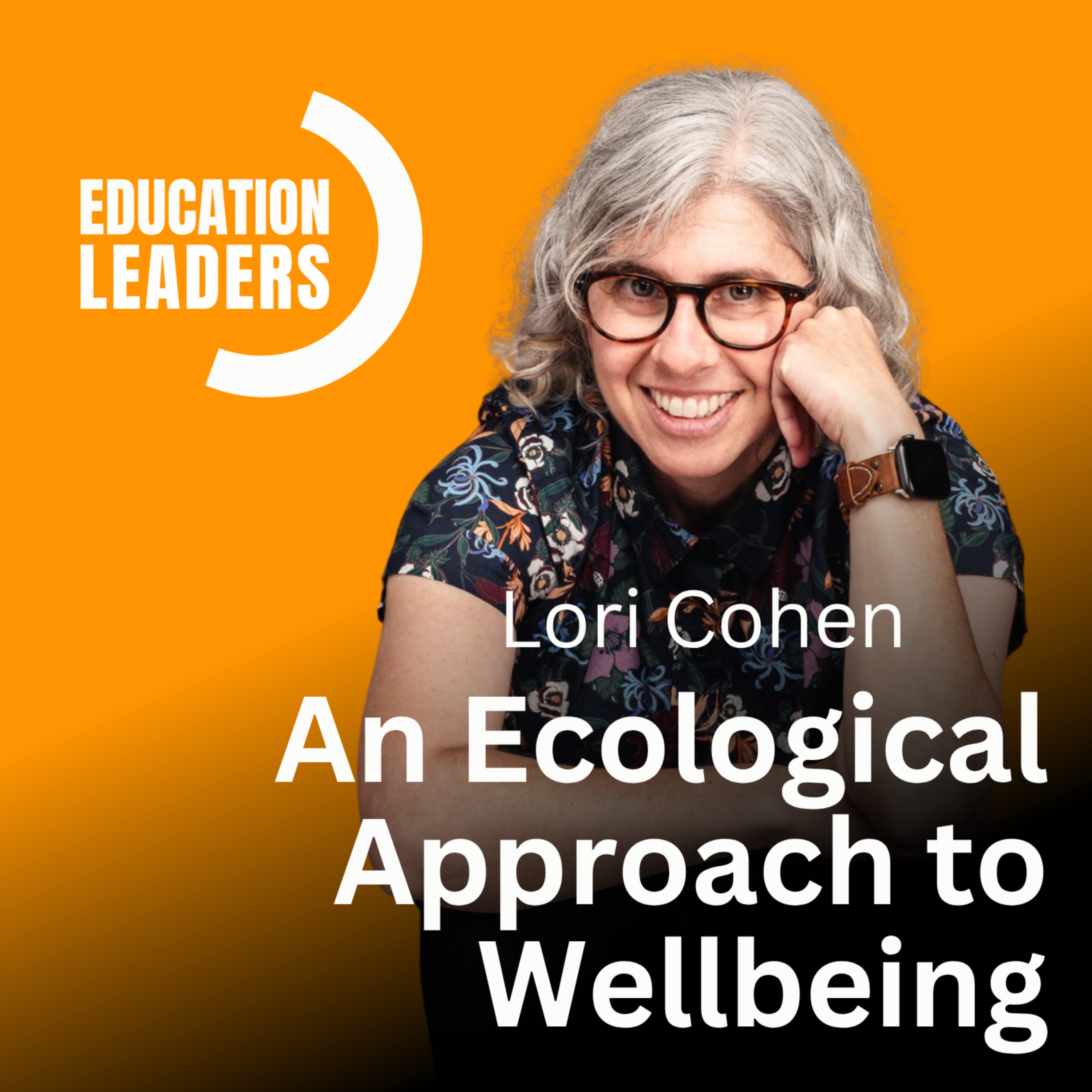
What if the secret to transforming your school culture wasn't another initiative, but learning to tend to it like a terrarium? In this episode, Shane talks to Lori Cohen about her revolutionary ecological approach to wellbeing in schools. Rather than treating wellbeing as just another programme, Lori introduces a powerful terrarium metaphor that shows how all elements of school culture work together as an interconnected ecosystem.
Lori Cohen is an experienced school leader, instructional coach, and education consultant with over two decades in education. She's co-author of "Integrating Educator Well-Being, Growth, and Evaluation: Four Foundations for Leaders."
Wellbeing as Soil, Not Another Plant
Ruptures Are Necessary for Evolution
The Fractal Approach to Change
The Eight Dimensions of Collective Wellbeing
Connect with Lori:
Additional Resources Mentioned:
The International Curriculum Association: Learn more
Join Shane's Intensive Leadership Programme at educationleaders.co/intensive
Shane Leaning, an organisational coach based in Shanghai, supports school leaders globally. He is the author of the best-selling 'Change Starts Here.' Shane is a leading educational voice in the UK, Asia and around the world.
You can find Shane on LinkedIn.
We are a proud member of the Education Leaders podcast network. For more great education shows, visit educationleaders.co/network/
Hosted on Acast. See acast.com/privacy for more information.
Auto-generated transcript. It may contain small errors.
how the building and sustaining allows us to repair, that there's enough trust and psychological safety sort of built up so that we can think about when harm happens, when there's a rupture, that the relationships are strong enough, that we're emotionally skilled enough, that we've tended to our own sort of internal ecosystems to also recognize that in change management, ruptures are a necessary part of evolution. And how do we withstand that by tending to like the collective and the individuals in our communities? Hey everyone, I'm Shane Leaning. Welcome to Education Leaders The Chat, topping leadership podcasts for school leaders just like you.
As an organizational coach, I've helped thousands of leaders across the world lead with greater confidence, make better decisions and create winning teams. And on this show, we explore the strategies that will help you achieve your goals and transform your leadership practice. Before we jump into this conversation, I'm really excited that this episode is supported by the International Curriculum Association. Stay tuned to learn more.
I'm excited about our guest today. My guest is Lori Cohen. Lori is an experienced school leader. She's an instructional coach and a consultant.
And excitingly, she's just co-authored a new book, Integrating Educator Wellbeing, Growth and Evaluation for Foundations for Leaders. Now I'm gonna link to that in the show notes, but what really drew me to her work is her ecological approach to wellbeing in schools. Instead of seeing wellbeing as just another program to implement, she's created a brilliant terrarium metaphor that helps us to understand how the elements of school culture work together as an ecosystem. And this conversation absolutely challenged my thinking.
And I know you're gonna love it too, so let's jump in. Well, it started with kind of a much broader idea that my colleague Elizabeth Denevey and I were kicking around related to supporting school culture. It started with educator evaluation, actually. And what we found was in the sort of broad scope of evaluation, there's all of these other elements that are part of it.
That evaluation is sort of the outcome of a good growth model. And a good growth model can only be a good growth model if there's enough psychological safety and sort of care for the collective. And that can only be true of the foundations of a culture, school culture, community culture are strong. And so we were kind of talking about how did these elements play together in this larger framework?
And I think it was close to a year ago now, I was sort of playing with ideas of how do we interweave this framework? And I just had come up with a series of circles. There was nothing revelatory about it. Just one thing informs the next, informs the next.
And I had shared this framework with some colleagues just to get their feedback. And another friend of mine had read through sort of the framework and heard some of my ideas. And she said, this sounds a lot like a garden, that the approaches that you're sort of describing here are more sort of garden-like in nature. And I thought, well, yeah, that's true.
I said that this feels like something that's more curated. If we're talking about how do we curate strong foundations of equity and wellbeing and growth and evaluation? And then I thought, this is really kind of like a terrarium, like a curated ecosystem that isn't simply just what we see in sort of a vast swath of garden, but in the sort of edifices of school and in the containers within which we work, there is a natural sort of interplay among these various elements. So with the wellbeing piece, first of all, I just, I don't see how school cultures can thrive in the globe today without attending to educator wellbeing.
I just think everything prior to the COVID-19 pandemic and what has ensued has just left us in a completely different trajectory and that the whole human is so essential. And as part of that, I saw that it's really like the soil of that terrarium metaphor. So if equity and culture are kind of the foundational elements of an ecosystem, then wellbeing is the soil and then everything grows from there. It's how the soil is tended to.
So that's how it became an ecological approach to wellbeing. What I really love about this kind of approach that you've created is it just, when I first heard about it when we met in Hong Kong, it just instantly made sense. And I love it when a metaphor or an analogy just goes, ah, I get it, I get it. That's a really great way to describe it.
And it's interesting how you ended up going for a terrarium. In that terrarium is a closed space as well. So you're talking about interactions happening within. Is there space for interactions happening outside of that terrarium as well?
Is that something you think about? Absolutely. I think the external forces play a role in the shaping of an ecosystem in the world around us, but also in these self-contained, more curated spaces. And the only reason it's curated at all is that human activity is such a large part of a terrarium thriving.
Yet we need to let sunlight in, we still need to water, humidity, all of the sort of external conditions of the environment and both the environment, sort of the ecological environment, but just the world as it's happening also play a role in how a terrarium can thrive or crumble, if you will, sort of in these conditions. So it's an open air terrarium and yet still sort of in this container of school, of organization. So let's talk through that then. So you mentioned to start that the soil, the foundation is the wellbeing, right?
That's the soil on which everything in a healthy ecosystem or organization can grow from. So I was just gonna say, can we dig in? Let's literally dig in to that soil. Can you explain a little bit about how that works?
And what really constitutes a healthy soil? Yeah, I will admit freely that I am not a gardener and I will also admit freely that I had to learn a lot about ecosystems when I was working on this book and sort of working on this metaphor and extending this metaphor. And so what I have determined as I look into my notes here cause I took copious copious notes on this whole process. And I think one thing that I recognized, that's at least in the soil of a school community or school culture is a lot of different elements.
Everything from sort of the quality of the rocks to how much nourishment the soil is getting to what can grow and how things are planted. All of this broad research that's out there on wellbeing, I think wellbeing once again, sort of in our broader lexicon and education is becoming sort of an overused word. I think there's a lot of ways that a lot of just terminology gets strewn about and then kind of loses its meaning. And so I thought about, okay, in a healthy soil of sort of our collective wellbeing in schools.
And I start with the collective versus the individual because I think the way that soil operates isn't just distinct elements. It's not a single seed. It's really all the different factors that play a role. And when we're talking about schools, at least in organizations, some play a larger role than others.
Some individual activity can influence versus collective systemic management. The eight dimensions that I found in the research I conducted was around wage satisfaction. The educators are getting fairly compensated for their work and that compensation is either made transparent or there are processes to understand it more effectively and equitably. What I would describe as sort of job stability or at least the, I don't know that we can always have job stability in shifting economic landscapes or with enrollment challenges in some of our schools, but really about how we communicate role clarity more than anything else, right?
What people are charged to do, what they're not doing, what are the boundaries are on that work. Workload management sort of being a corollary to that, the deliberate structures and equitable distribution of responsibilities to prevent burnout, really thinking about what feels fair in our school cultures and assessing workloads in such a way that we reimagine the status quo. And then sort of from there, when we have the opportunity to really think about what feels like a manageable workload so that I can thrive and flourish in my work, then sort of the outcropping of that is autonomy. Autonomy and self-efficacy, right?
If I can do my work well and fully, then I feel a greater sense of self-efficacy. So those kind of all sort of play well together. And then there's these ways that sort of individual actions kind of contribute to the soil as well. Inclusion in policymaking and decision-making, to what degree we involve individuals, whether at the committee level or at the whole school level to either play a role in decision-making or provide their input.
Also thinking about at the community care level, what are leaders modeling that they hope to see in the community as well? And so how are we modeling rest? How are we modeling recovery? How are we modeling boundaries within the bounds of our workloads?
And then two more elements, emotional intelligence, right? And this is sort of the, at the leaders level, not just the self-awareness of leading effectively, but sort of the relational awareness and the relationship management pieces, but also for individuals that everyone in a community exercising a high level of self-awareness and engagement with others through the way we model what we hope to see. And I think sort of the foundational element of all of those different pieces is really strong supportive relationships that we can have authentic, clear communications that we can think not only about the ways that we build relationships where we spent a lot of time in schools, we talk a lot about relationships, but we focus mostly on the building of and not on the sustaining of, much less on how the building and sustaining allows us to repair, that there's enough trust in psychological safety sort of built up so that we can think about when harm happens, when there's a rupture, that the relationships are strong enough, that we're emotionally skilled enough, that we've tended to our own sort of internal ecosystems. If we're gonna take this metaphor much further to also recognize that in change management, ruptures are a necessary part of evolution.
And how do we withstand that by tending to like the collective and the individuals in our communities? I'm literally scribbling down that note. I love that. Ruchers are a necessary part of evolution.
And in organizations like I guess I've heard it put on terms of like things like conflict is necessary or change is necessary, but ruptures I quite like that as a term in the idea that, yeah, when things need to be torn apart a little bit when damaged in some way and then recreated. Yeah, I think about it. I mean, the bleak sort of blunt way of putting it is what needs to die so that something else can be created or sort of come into being or imagined. And I think we get really clingy to fixed ideas or fixed notions of this is the way we've always done it.
This is how it has to be. And then we play around the edges of change by trying to maintain some semblance of that status quo idea. The adage that teachers in the United States I used to hear in schools all the time, don't smile until Christmas. That was kind of the core belief was that in order to earn the respect of students that you had to be serious, you had to be commanding, you had to have a strong presence.
And that idea gets so ingrained in teachers that this command and control becomes the way that we think we shape culture. And no idea is better worth sort of dying out than this idea that we can't be a whole human, right? Appropriate adult whole human. But still, I think about these sort of what are the phrases in our culture, the socialized beliefs, even the policies and approaches that we replicate from one model to the next, but we actually find are inherently inequitable or aren't helping our students sort of shift into the world as it's changing and evolving.
As I'm listening, I'm thinking, this is on the one side deeply important and these different areas of wellbeing that you describe. I'm thinking, yeah, I'm hearing you and I'm sure leaders are now listening going, I hear this important, but at the same time, it also sounds like a lot to kind of deal with. I'm thinking about all those different parts that you described, you know, wage, job satisfaction, you know, self-efficacy, inclusion in decision making. And it feels like as a leader on the ground, we might look at that and go, I see the importance of this, but I feel a little bit overwhelmed by the size of that.
Have you heard that kind of idea before with people you work with? Absolutely. And as I think about it, it kind of makes me think about the scale at which change can happen, right? If these are all the dimensions, dimensions of collective wellbeing and we want to make real change in our communities, it's not about overhauling everything all at once.
As we know in schools, initiative creep and sort of the, well, we're gonna try this thing this year and then we're also gonna try these 13 other things that are embedded in the one thing doesn't ever lead to any sustained change. The suggestion I make and once again, mirrored in ecosystems and drawing from the work of sort of the natural world, but also Adrian Marie Brown's work, Emergent Strategy is to take a fractal approach to making these kinds of changes. So by fractal, meaning sort of what we see at small scale becomes replicated over time, patterns in nature that replicate or what I learned in school growing up as the golden mean, the Fibonacci sequence, that if we think about sort of one of these elements of collective wellbeing, let's say, inclusion and policymaking. What might we do to reimagine how we include folks in decision-making strategies or how might we cultivate our collective emotional intelligence, which I wouldn't say is much needed these days, sort of at a small scale, right?
And then what would we wanna see sort of replicated or scaled over time? So it's an overwhelming sort of set of dimensions and yet the entry point for every school, for every leader, for every culture is going to be different depending on where they work and the communities they serve. So if I'm hearing right, the idea is this fractal approach is taking one of these big ideas and then just starting on something small and work on replication strategies to grow it rather than just trying to do a whole scale. Let's figure out this inclusion in policymaking and let's sort the whole thing out at once.
Correct. Does that mean in that kind of approach you can therefore work across multiple areas at the same time? You know, if I'm a school leader and I would normally maybe focus on one area in a lot of depth, does the fractal approach allow a slightly different way of working? I'm just thinking out loud.
It requires of us a patience with scale. I think that the temptation is to think, oh, well, if I'm working fractal in this way, then I could just bring these other dimensions in and work at all of these in a fractal fashion. And I think there's opportunity there for sure, right? If different people are sort of charged with tending to different parts of the school's ecosystem, there's the potential there.
And yet I would advocate against anything sort of surface and small sort of across the spectrum and rather think where can we go small and deep initially to really just sort of tend to the soil in this one area of our school culture? Because while I'm not a gardener, I have a terrarium in my office at home that I've started tending to. That makes sense. I started taking the risk of unsuccessfully, but I'm still trying to grow cuttings from other plants that I'm finding out in our garden and sort of experimenting.
And it's that we need to understand what all the conditions under which growth can happen. And I think if we plant a whole garden, we just throw a bunch of seeds into the ground, right? Some things will just grow naturally because the conditions are ready for it, but not everything will. So once again, just sort of tending, like going slow and going small, I would say sort of the two approaches I would advocate for taking.
This episode is supported by the International Curriculum Association. Now I've been working with the ICA for quite a few years, but they've been around for 30 years and they've been around championing quality, unlocking potential and improving learning in international schools right around the world. I really, really love that at their core is a model for improving learning. And this model is focused on the learning experience and they have tons of great curriculum materials, PD resources and even an accreditation pathway for schools just like yours.
So if you're interested and I really do recommend you check them out, head over to internationalcurriculum.com. Having your own actual terrarium, is that helping you explore these ideas? Because now you've got me thinking, is it a useful practice to do these kinds of things for ourselves because it can help you learn about the process more?
So one sort of set of beliefs that I operate from is that I would never ask anyone to do something that I wouldn't do myself. And I always want to model the practices I hope to see. And so when first testing out this metaphor to see if it even works, I mean, one, I sort of socialized it among a whole host of friends and colleagues, could you see this working? Where could you see this taking hold?
And then my next thought was, I can't write about terrariums and ecosystems unless I'm growing one myself. And my colleague and I in the process of writing the book, from which this metaphor comes, at the end of our writing retreat, we built the terrarium together and with the base layer and the soil and the moss and the rocks. And then I brought a succulent into the ecosystem and now it's the tending to it that I'm doing more actively. But it's also just to think about what is the literal tending and caring for something as an individual?
And what does that yield? I feel like any workshop that we give on this work in my ideal world begins with terrarium making or ecosystems creation. Because I think if we think in that kind of way and about sort of the delicate balance among things, and we think about the transfer of that into our communities, it might invite us to slow down more. It might invite us to treat all conditions with more tenderness and care.
It also might invite us to take a more curiosity-based approach and lens to the work that we do versus a, I must know it all, I must fix and solve it all versus how might this work in these ways? And what if I just tried this? And I think it would invite more risk-taking too, I would hope. I just love that.
And I wasn't expecting this from this conversation. It's for me to now be curious about actually creating a terrarium. But it feels like it's a really useful pattern disruptor for a leader like to actually throw yourself into, let's say, tending a terrarium. And there could be other ways, do it.
But just as a way to help you reflect on the way we do things around here and how you might be operating slightly differently when you can see the ecosystem so clearly in front of you and so contained. Yeah, correct. And I think that disruption, I think is once again, sort of like the necessary ruptures in communities to make meaningful change. We would rather have ruptures happen by natural evolution, but that's where we're headed versus the ruptures that happen by reactivity or by external forces that, I mean, certainly there are things in sort of our larger cultures that we can't control.
But when we have a more proactive approach to how we sort of tend to our ecosystems, tend to our school communities, then we can predict, right, where the collapses may happen or the ruptures may happen that not everything grows beautifully right away. And there's also what needs to be composted back into the soil, what needs to be pruned, how diverse plant life we're going to engage with one another and sort of how do we create the kinds of ecosystems where the different life within it can complement one another and support one another's growth versus compete too much for sunlight or resources. And so I think that there's a real benefit to tending to something and then thinking about, okay, in my larger community, what can I learn from this that can play out where I am in a way that makes me more mindful, proactive versus just doing school the way we've always done school. Yeah, and in the sense of mindful, it almost feels like a very nonjudgmental way to look at your organization as an ecosystem, to be talking in ways of interactions and in ways of growth and in ways of nurturing and learning that just as you're working with your terrarium in the minute and you're realizing some of those cuttings from the gardens are just not working and you're having to adapt and figure out that you're not judging them as bad things in themselves.
You're starting to adapt your practice and work of, well, why isn't that working in this ecosystem? What would need to change? And not just the humidity because actually that other plant over there needs something slightly different. Correct, yeah.
The nonjudgmental piece I think is crucial both in terms of our willingness to experiment and allowing things to flop. Like obviously we don't want to take risks that lead to damaging impacts. I'm speaking really vaguely here, right? But we don't want a policy change, let's say related to workload management where now all of a sudden no one is taking care of some sort of afterschool responsibility that supports like students getting extra support, for example.
But that nonjudgmental approach sort of gets us out of that. For those of us who can be more cynical, it gets us out of that mode of cynicism. And for those of us who can be hard on ourselves when our tendencies towards perfectionism fall flat, taking an observer's approach or as Zen Buddhists would describe as a beginner's mind to all of this, I think once again, it just opens us up for more risk-taking to see more possibilities, but also not to be so firmly fixed on our previously socialized beliefs about this is the way it must be done or if I can't get it right this first time around then it's just a flop, right? Well, we tried that before, so we're not gonna try it again.
Well, maybe what we tried before was actually good. We just needed a variation on the conditions that would allow this thing to grow better. So I'm in, I'm in, I love this idea. So as a school leader, where would I start?
Well, I mean, the ecosystem has a lot of entry points. I think it's about understanding and our opening chapter has what we call a landscape assessment. And I think the base-based foundation is really understanding what a school's vision is for equity, equity and inclusion, belonging, school culture support, what are the conditions under which we can care for the collective, the soil being the adult wellbeing pieces, like what needs to be clear and true in our communities so that the adults can do their best work and flourish in service of young people and the growth being the outcroppings of that and sort of what is my growth trajectory within this ecosystem and then evaluation, what do we need to do to tend to that ecosystem to ensure that all the parts are playing well? So that metaphor in mind, a landscape assessment would support leaders in considering what's working well?
Like where are we actually effective in the ways that we've shaped our ecosystems? Do we have a strong foundation of culture, strong set of values and purpose in our community? Do we actually have a really healthy adult culture because we worked really hard towards those elements or do we have a strong growth culture, a culture of lead learners in our communities? Or is our evaluation effective?
So start with what's working, I think is really important. And then I think the next is just, where's the entry point where things can be improved upon? And sort of at which level do things need to be improved upon? If our school has strong foundational elements, then let's tinker around the edges of growth and what kinds of seeds we wanna be planting towards educator growth and where a lot of schools are and once again, bringing us full circle back to the purpose for this project that Elizabeth and I embarked upon is schools might have great growth models, but what about where folks stand in relationship to a set of criteria, a set of agreed upon school practices, whether that comes from an external source, like an overarching organization or school district, the evaluation itself doesn't always feel connected to the ecosystem.
And so where a lot of folks need to begin is actually with the tending to the ecosystem. What are we evaluating for? What is effective instruction in our school? What is effective leadership?
And how are we ensuring that the folks who we've hired in to this organization are fulfilling their roles in such a way where they feel not just aware that evaluation exists, but motivated to be evaluated so that they can be excited to grow and learn. And we find that evaluations are largely divorced from what happens in the life of a school. So many entry points, but I would say assessing the landscape as a starting point, identifying what's working, identifying where's the area, one area that could use some tending and then start to take that fractal approach to how we might address that area in this way that it could be deliberate, slow, intentional and thoughtful. That makes so much sense and links so well to the idea of a terrarium.
Of course, you wouldn't just in your terrarium go, okay, you know, let me have a look and I'm just gonna dig everything up and just start again, you know, looking at what's working and what's growing, you're likely to go, well, how can I help that grow a little bit more? Or how can I let the plants just around that start to work? And it's that strength-based approach rather than having a deficit mindset on where you are as a school and starting from there. Correct.
My partner does a lot of gardening and so part of my research was just paying attention to all the plants in our household and our garden in the backyard and the plants we grew last summer. I say we, I take zero credit for the growth of these plants, the eating of, you know, the lettuces and the fruits. But attached to that is we have all these beautiful plants growing in our house, but then we started to have all these little gnats and flies in our house too. And it's not because things weren't growing, but the soil composition needed to be tended to, that it was the soil composition that was drawing in bugs from outside.
And so exactly that, what you just said, it's that sometimes even things can grow in our communities, but what is the soil composition like? When was the last time we tested it? When was the last time we looked at the foundations so that we can connect what's at the root level to what is flourishing and why that's flourishing too? You know, I really love how Lori has managed to reframe something as complex as organizational wellbeing through such an elegant metaphor, that terrarium approach, super clever, but also fundamentally different to how we usually think about school improvement.
I love the way she talked about ruptures being necessary as part of evolution as well. So often in schools, we try to avoid disruption, but actually sometimes things need to break down a bit before they can grow back stronger. And that fractal approach to change, you know, start is small and deep rather than broad and shallow, something I am definitely gonna be thinking about a lot in my own world. Practically, I really found myself wanting to actually build a terrarium after this conversation.
There's something powerful about the idea of leaders engaging with this metaphor physically as well, not just intellectually. And sometimes the best way to understand how to tend to your school ecosystem is to start by tending to an actual one. You can find Lori in her work using the links in the show notes, including her new book. And I'd highly recommend checking it out if you're interested in taking a more ecological approach to your leadership.
Education Leaders is hosted by me, Shane Leaning. Thanks so much to the show editor, Pete McGill, and for the original music by Guillaume Silva. And thank you so, so much for tuning in today. If we don't speak before, I'll see you here next week.
If you wanna learn more about the brilliant work from the International Curriculum Association, head to internationalcurriculum.com.
When 89% of a population plays games and two-thirds are under 35, that's not a problem to solve - it's a medium to embrace. Today we…
Listen & show notes
Shane Leaning sits down with Ruth Taylor from the Common Cause Foundation to explore the fascinating world of human values and what they…
Listen & show notes
My guest today is Alicia Drummond, a BACP accredited therapist and creator of The Wellbeing Hub. This conversation dives deep into why…
Listen & show notes