
How to Build a Consultancy | A Conversation with Michael Iannini
In this brutally honest conversation, Michael Iannini pulls back the curtain on what it's really like to leave the safety of education…
Listen & show notes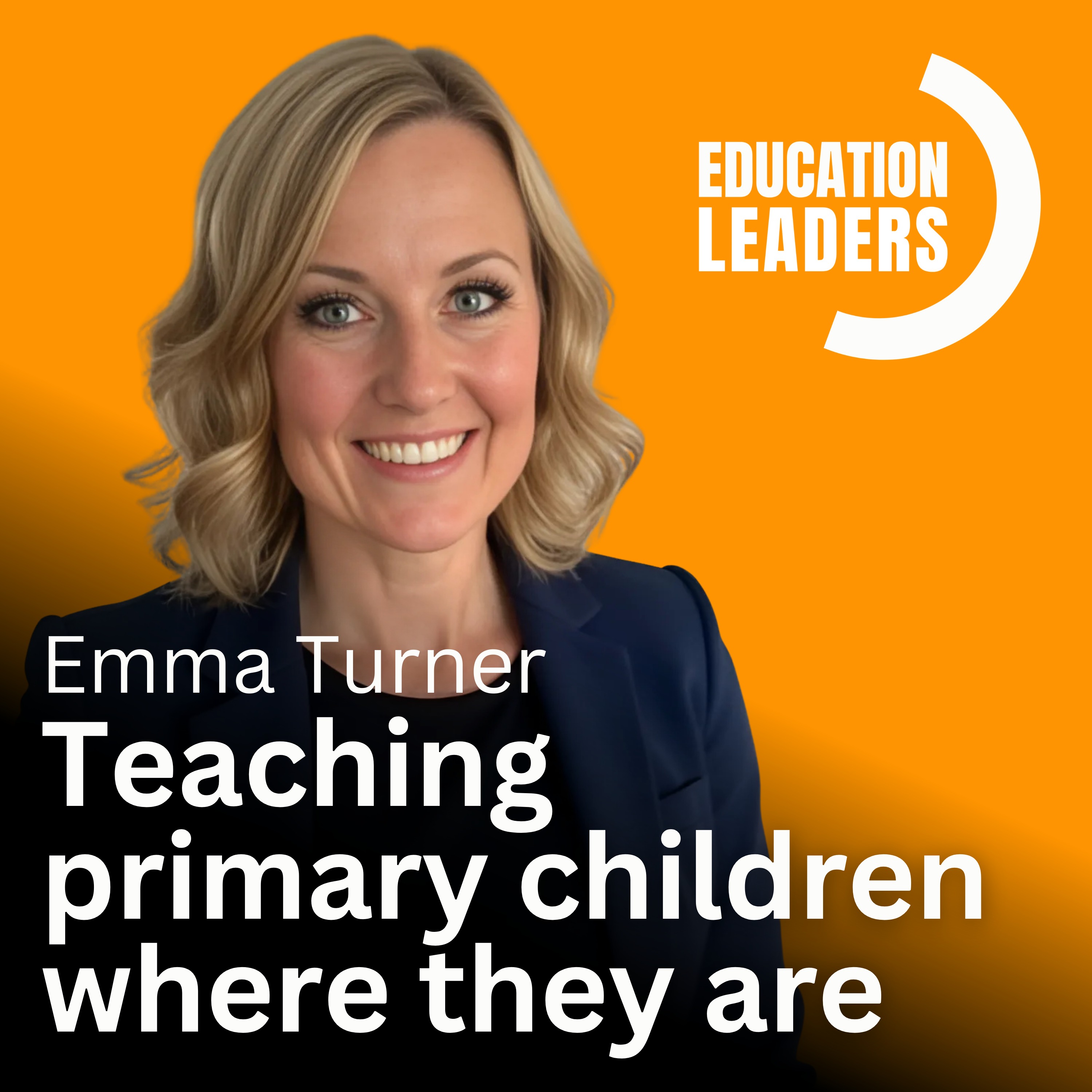
In this essential episode for school leaders, Shane explores primary education leadership with Emma Turner, a primary education expert with over 25 years of experience in school leadership development. Emma challenges the common practice of applying secondary-focused approaches to primary settings, sharing practical school leadership strategies that respect how young children actually learn. This conversation offers valuable education leadership training for international school leaders who want to improve their understanding of age-appropriate pedagogy and effective transition processes between educational phases.
Emma discusses why primary education often defaults to "secondary light" approaches and shares innovative school improvement strategies that create "academically seductive" learning environments. From managing the flexibility of primary school days to building better understanding between phases, this episode provides actionable education leadership skills for heads, principals, and teacher leadership development coordinators. Whether you're leading organisational change in schools or developing school leadership programmes, Emma's insights on the "brackish water" approach to transitions and cross-phase collaboration will enhance your school culture change initiatives.
International Curriculum Association
Join Shane's Intensive Leadership Programme at educationleaders.co/intensive
Shane Leaning, an organisational coach based in Shanghai, supports school leaders globally. He is the author of the best-selling 'Change Starts Here.' Shane is a leading educational voice in the UK, Asia and around the world.
You can find Shane on LinkedIn.
We are a proud member of the Education Leaders podcast network. For more great education shows, visit educationleaders.co/network/
Hosted on Acast. See acast.com/privacy for more information.
Auto-generated transcript. It may contain small errors.
Children are not all the same in terms of age and stage. We should meet them where they are, teach them where they are and design the curriculum for where they are. Hey, everyone, I'm Shane Leaming. Welcome to Education Leaders, the chat-topping leadership podcast for school leaders just like you.
As an organisational coach, I've helped thousands of leaders worldwide to lead with greater confidence, make better decisions and create winning teams. And on this show, we explore the strategies that are going to help you achieve your goals and transform your leadership. This episode is supported by the International Curriculum Association and the Teacher Development Trust. Stay tuned to them.
I'm excited about my guest today. My guest is Emma Turner with over 25 years in primary education, including roles such as National Strategy League, Headship and Trust Leadership position. Emma is a multi-published author, keynote speaker and also co-host Mind the Gap podcast, one of my all-time favourite education podcast with Tom Sherrington. Something that really draws me to Emma's work is her fierce advocacy for age-appropriate primary pedagogy.
She's really passionate about ensuring that resources and approaches designed for secondary are just transplanted into primary without proper consideration. And this conversation really opened my eyes to some assumptions I didn't even know I was making. So let's jump in. The thing that I noticed, not necessarily from the resources themselves, but from working with schools when I go in and look at teaching and learning or curriculum design, what I was finding was that there was a part of the primary experience that wasn't necessarily being exemplified or highlighted or really focused on alongside some of the key messages from secondary colleagues.
So secondary colleagues are a gift to primary teachers because they are specialists in their subject. They have really deep subject knowledge. They are completely immersed in the worlds of geography or history or English or whatever their discipline is. And we can learn so much from them about each individual discipline.
Where the congruence falls down a little bit is then applying that approach to subject knowledge and individual disciplines in the primary setting. So when you're working with children who are four or seven or eight, that's very, very different from working with children who are 14, 16, 18. And what was happening in a lot of places that was going was there was not due care and attention given to age and stage alongside some teaching and learning approaches and some approaches to teaching individual disciplines. And what was happening was that schools were getting this kind of mismatch where the practice or the approach to curriculum design looked and felt very secondary light, which was not quite landing with children at that age and stage.
So what I always work with schools on is what can we learn about the individual disciplines and what information can we use from resources that are designed for a secondary curriculum or a secondary approach to teaching and learning? And how can we put them through the lens and the filter of working with younger children in a generalist setup? Because most primary teachers are generalists and most primary children are taught by generalists. And how do we do this in a classroom that has to be everything?
Because in primary schools, most primary schools, your classroom is your art studio, your science lab, your DT space, your English class, your maths. So what does this look like in reality? And then thinking about the age and stage of the children, that they are not yet competent writers and readers. So that really affects the resources that we use with them.
They're not yet used to working necessarily of really happy and harmonious groups and teams. And just by the nature of them not having been alive for very long, they are novice in everything. And we have to respect that when we use resources or approaches or timetabling or lesson structure. They are all key considerations.
So that was what I started to see, that a lot of the very popular resources and very popular approaches, which were not in any way wrong, were just not being passed through the primary lens. And so some practice was getting skewed. And that's when I started to write very specifically and work very specifically with developing resources that supported those key messages, but also respected the age and stage and setup of the primary phase. That makes a lot of sense.
And I feel like I've seen some of that myself. In fact, you know, I started as a secondary teacher and then became a primary teacher later and have spent most of my time in primary. But I've seen the same. And I wondered, do you have any ideas of what it is?
What is it that's making sometimes primary leaders or primary practitioners take something that was initially designed in a secondary context and try to just replicate it in primary? There's all sorts of things. And from a kind of a UK context, there's the fact that a lot of the training materials that are used for initial teacher training and for the national professional qualifications have a generic research base so that all teachers who work in the system know the same things. But because that messaging and that resourcing is generic, then very often it's not tailored to phase.
So right off the bat, really, there's not necessarily, and depending on your provider, that opportunity to explore things through that lens, there's not that bit there. There's also the fact that in some of the structures and systems that are used in education, a lot of the very senior voices or senior positions don't necessarily have a primary background themselves. So haven't necessarily got that lived experience of having worked in a primary classroom. So very often, not with everybody, but often there's an assumption that it is the same and it's not.
And then there's the fact that a lot of the most popular published resources that are picked up and used by teachers are either generic and not tailored through that phase, or they've been written by people whose experience is predominantly in secondary. And therefore, there is an unintended narrative that this is how you do it. Yeah. So I think that unless you are really proactive in thinking, right now, as a primary teacher, what does this look like or what should this look like in my setting?
There can be a default towards that. And then there's the whole other argument that in England, the inspection framework was one framework for all. So regardless of whether you were a mainstream school AP, send a primary, secondary, early years, everybody was inspected with the same framework. And so again, there was a kind of a default narrative.
So I don't necessarily think it's any one reason why this has happened. I think there's lots of reasons why this has occurred. But I do know that lots of primary colleagues are feeling that something's not quite landing and that they need to return to what really great primary pedagogy and approaches looks like. That's brilliant.
So those three areas you talk about make a lot of sense as to why this is happening. And it does kind of feel like when we talk about generic teacher resources that often, you know, and this is also a generalization, but often potentially they are labeled as generic or labeled as just, you know, for all teachers, but because they're written by a secondary teacher, maybe not, which is interesting, because I think from the other way around, if you saw an early years or a primary thing, usually it's got early years or primary whacked on the front of the book or something. It's like you have to be explicit if you're in the younger years almost. So there is a kind of a default, maybe because of some of those reasons you mentioned.
That's why I like resources. Say, for example, there are some people who are thinking really carefully about this, for example, Sam Strickland, who's written lots of work around behavior. He in his book specifically labeled things as this is suitable for primary. This is suitable for secondary.
This is suitable for all. But he's the head of an all through school. So appreciates that difference between four to post 16. And I do think there needs to be some careful signposting and careful thought given to is this really an appropriate thing for a six year old to be doing or an eight year old to be doing?
What sense will they make of this? And do I know enough about teaching children that age and stage to say with confidence, this will work with this age group or this is the right thing to do. And I also always throw out the provocation of just because they can doesn't mean they should as in just because this five year old can do that in that way doesn't mean they should be doing it in that way. Doesn't necessarily mean it's the best way to do that.
So I think some really careful thought about congruence and transference really needs to happen. And I'm really pleased that people like Sam are starting to within their resources say this is tried and tested with this year group or this stage. And this really works. These are for all children regardless.
And these are things which work predominantly more successfully with older children. I'm so glad to hear that, that there's resources like Sam's really worth that actually signpost it because it almost reminds me. I remember visiting a school a couple of years ago and the teachers were teaching maybe six, seven year olds. And they'd used some resources that they'd gotten.
And they were talking about we're really struggling Shane to do cold calling. They were telling me and they said, you know, we know it's a right thing to do. But then when they broke it down on what they were trying to achieve and trying to develop independence in the students. And they had really good rationale for maybe adapting that quite a lot and changing that method for the children that were in front of them.
And they gave me some amazing reasons for why they wanted to practice putting their hands up and volunteering and what that meant to them. And I thought, gosh, yeah, well, that makes total sense to me. But it did send them a bit of a confusion because they felt like what they were hearing is that they should be doing X, for example. And the other thing about techniques like cold calling might turn and talk.
All of the things that we would want to be going on in class and don't always in primary have to be done in the same way as you would in a secondary classroom, because you've got the flexibility of the day, the flexibility of the setup. You don't have 45 minutes with 30 children and then another lot of 30 children and then another lot of 30 children. You can do things like cold calling, where you're talking to children as they're playing or working in a small group. You don't have to do it as a whole class on the carpet with now I'm going to do cold calling.
You can weave it into some other forms of kind of like a blended pedagogy as well. It doesn't have to look a certain way. And when children are working and learning at different ages and stages, especially early years, early key stage one, where it might be a play based pedagogy, you don't necessarily want to abandon that pedagogy and say, everybody on the carpet, everybody with a mini whiteboard, everybody with, you know, for every lesson, every point. You need some really critical thinking about when might I use this technique?
How might I use this technique with which children at which point really based on an understanding of how young children learn? And so that, yes, cold calling is great to make sure that all children are listening. It's great to use mini whiteboards. It's great to make thinking visible, but doing it in the right way with the right number of children at the right point in the lesson, because you're not constrained in the primary day in the same way that you are in secondary.
So all of those techniques can be used but used in a way that looks quite different rather than having to have set lessons because we're not a slave to the timetable and the bell that you are in secondary. So we can kind of mix it up a little bit. We can have fidelity to the technique, but also a fidelity to the way that young children learn at the same time. So I think you really carefully about what you're doing, why you're doing it and when you're doing it.
I love that. So what I really like is that you're saying look at these techniques, but contextualize it and more than that, have confidence in your knowledge of the way young children learn, as you put it, and then apply that. So you mentioned a couple of differences, one being the kind of flexibility of the school. They are not kind of just having children for 45 minutes.
Are there any other areas that come up for you when you're working with schools that make primary education pretty distinct? Have I opened up a can of worms? Oh, no, it's an absolute joy working with younger children. It's been the big enduring love of my life working with young children.
It's just an absolute pleasure. There is nothing more wonderful than walking into a room of 30 little faces, 30 little people at the beginning of their journey into formal education and thinking, I get to be with you guys all day. This is ace. It's just wonderful.
And I think one of the considerations for primary is that we are the receiving line for formal education. You know, we are the ones who welcome the children in and say, you know, come and meet history, come and meet art. Isn't it wonderful? We get to kind of create the curriculum world for children.
So I do think that we have great freedom to create curriculum that is interesting and exciting. And I talk about making it as a phrase that popped out my mouth once and I thought, well, that's a bit racy, but I kept it in anyway. We want to make worlds that are academically seductive for children. We want them to fall in love with each subject and think, I absolutely love this.
And we have such freedom in the primary curriculum. Lots of people think we don't, but we do. It doesn't tell you what artists to study, what models to make, what books to read, which exact places in the world to study. We can basically stick our head out the window and go, what shall we do?
And so we can create the most wonderful, interesting curriculums because we're not like in secondary bound by a particular book that you have to read or an exam spec. You know, we can create rich, interesting, fascinating worlds for children. And I think that the opportunity to be a curriculum designer that can root children in their local area, in their lived experience, sensitively introduce them to the rest of the world is such a privilege in terms of curriculum design. And then as we're teaching children, it's it's juggling in primary that multi novice status and recognising that when you're teaching geography, you're teaching geography to somebody who can't necessarily read proficiently yet or who can't necessarily conceptualise abstract concepts.
So the ways in which we teach are so rich and broad and diverse. Just because of the nature of a lot of time, we can't default to writing anything down because they can't write yet. We're busy doing that at the same time, but juggling all of those different elements in this kind of multi novice status and also being very, very active and movement based because our little ones are hardwired to move. So you will spend a lot of your time on your feet, on your bottom inside, outside.
I think that broad range of teaching approaches that fits with that kind of age and stage is another beautiful aspect of primary that you don't necessarily get if you're working in secondary. And also, as a primary teacher, you get children to make sense of the curriculum as a whole, because you can talk about in English what you've just been doing in history, or you can link the maths that you were just learning to the data that you're looking in science. So you get to weave the whole curriculum together for children, getting to see it as a more kind of a global curriculum endeavour rather than an individual subject overview. So I think that's an absolute joy.
And that in itself, in terms of lesson design, lesson content, sequencing, lends itself so beautifully to doing things very differently as children gradually make sense of the world and weave it all together in primary. I can absolutely hear the joy in your voice and the smile on your face when you talk about it. And, you know, that is something that is often talked about, like spending the whole day, spending that time and and also the creativity around designing something that's local and bespoke for the young people in front of you. This episode is supported by the International Curriculum Association.
Now, I've been working with the ICA for quite a few years, but they've been around for 30 years and they've been around championing quality, unlocking potential and improving learning in international schools right around the world. I really, really love that at their core is a model for improving learning. And this model is focused on the learning experience and they have tons of great curriculum materials, PD resources and even an accreditation pathway for schools just like yours. So if you're interested and I really do recommend you check them out, head over to internationalcurriculum.com.
Today's episode is supported by the Teacher Development Trust. TDT's associate qualification in CPD leadership is so perfect for international school leaders. It's fully accredited and it's delivered online over 10 months. In it, you'll create an actual CPD.
That's Continuing Professional Development Strategy for your school based on research that shows well-planned PD improves pupil outcomes and teacher attention. And I actually did this program myself. And hands down, it's some of the best professional development I've ever done. So much so that I am delighted to be co-delivering this special Asia cohort, which starts in November.
If you want to learn more, go to TDTrust.org or click the link in the show notes. Is there a tension like you work with lots of leaders across kind of primary schools, for example? The secondary might seem to be more because it's got some exams at the end of it or this kind of thing to be kind of syllabus based or whatever it is.
Is there pressure sometimes to implement that style in primary schools? Yeah, and you get it throughout the system. But what we need to do is kind of respect the stage that the children are at. Teach them in the way that's appropriate for the stage that they're at.
Not use that stage as a preparation for the next. Get the stage you're in right and getting that stage in right will prepare them for the next stage. So respect the space you're in and get that bit right. We're not constantly looking at the next bit.
What you do need to have an awareness, though, as a teacher, regardless of what stage, phase, age group your teaching is, is where if children come from and where are they going to so that you can build on what's come before and also have one eye on the coherence of the journey. Because the only constant in our teaching system is the child. They are the only one that's going to experience all stages of it. As a teacher, you don't mean you do move around in primary a little bit, but you don't suddenly go from being the year one teacher to being the year nine teacher.
You don't do that. That's not how it works. So we've got to be mindful of what children have done before because all learning is predicated on connection. So we want to weave what we're doing neatly into what they've done before.
We also want to have one eye on what are we getting them ready for so that we can use language, we can signpost key concepts or key learning or emphasize things that they will be doing or will encounter next. But we have to respect the stage they're in and teach them for the stage that they're at. But it's really interesting when I work on transition with schools to do a lot of work on transition when I ask teachers from the primary phase what's in the secondary curriculum? And I ask the same question of the second region.
What's in the primary curriculum? And very often there's a disconnect because people are busy. They are deeply involved in the work that they're doing in their own phase. We're so time poor that looking at what somebody else is doing isn't necessarily very high on people's radars.
But understanding where you're going and where you've come from is so important. So I think that, yes, people have a tendency to get children ready or emulate the next phase in their current phase. But that shouldn't be what that phase is about. It should be about familiarising children with aspects that may come up, but it's being where you are.
You're not going to get that day again. You've got to do what's right for that day, not what's right for six months down the line. So you want to build confidence, you want to build coherence, you want to build competence. But what you don't want is a bad tribute act to the next phase because that's not how it's going to work.
So it's understanding what people are going to be doing next so that you can think carefully about what might be useful for children. But it's more about understanding that journey as a professional rather than trying to emulate that in your classroom. That's an incredibly helpful way to think about it. You know, many schools I work with, you know, being based in Shanghai and international schools, a lot of them are all through schools.
So, you know, all the way from, you know, age two to 18, you know, often these schools are. But they're split into their phase. So they'll still have a primary school and a secondary school. And many of that I've worked with sometimes.
I mean, this has been so common and maybe it's replicated in the UK where school leadership teams have said, you know, OK, the secondary teachers have sometimes felt I'm not happy where the student is when they enter secondary school. And so the response has been, can we turn year six, let's say, if that's the last year or grade five into like a secondary preparation, does that happen sometimes in the UK? Like this kind of shifting backwards. And what would you say to that?
There's always a top down pressure. And there are elements that you want to develop with year six is the last year in primary school here, where you want them to potentially become more independent, to get used to a more formal type of day. But that would come very late in the year. What you do find is that, especially in upper key stage two, there may be elements of the curriculum where it would really benefit the children to be taught by a specialist in that area, like music or languages, where there is a very specific body of knowledge that a generalist might not necessarily be the right person to teach those children.
So you sometimes get a slight shift in upper key stage two that there might be a few more specialists teaching those children. But we can't forget that some of the children in year six or last year in primary are still only 10. They are not 11, 12, 13, 14. They are 10 years old.
So they still need to be taught in a way that's appropriate for a 10-year-old. So it takes courage and confidence in what you're doing at primary school to say, do you know what, this isn't right for our children. And our year sixes, some of our year sixes are still not even 11. They're still little.
So they need to be taught like the little. What we need to do is to think carefully about how we might prepare them and avoid that pressure to do top down. Because we've still got to deliver the statutory curriculum for primary, not the statutory curriculum for secondary. And then it's working really sensitively with colleagues across from six to seven, so from primary to secondary, about what might the differences be when they come up.
What is it important for them to be able to know, to be able to do, to be ready for? And I do a lot of work on transition. I talk to a lot of children in year six, done lots of projects around transition. And the things that they're worried about most of the time are actually that the work will be too easy, the teachers will be too strict and they're going to get lost.
So that's what the children tell me that they're concerned about. So what teachers between the phases need to do is to ensure that children feel confident, that they feel competent and that the work is pitched at the right level from day one, be that not making sure it's too challenging or too straightforward. So again, that's about conversations between phases, understanding the standard, doing cross phase moderation, looking at work children produce from year six and having a good understanding of the standard of year six. And then when children move into the year seven, supporting them through what are going to be a lot of logistical and operational challenges and differences during the day, rather than trying to make year six secondary light.
Yes, you can hear that. And what I really, really liked what you were saying is you talked about that you speak to the students, you speak to year six children about what they're feeling. And I love those three things you said, they're like those different anxieties that they have. Well, that's really powerful information.
Is that what we're designing our transitions on based on what the students are feeling or is it something else? That seems like a really useful starting point. And it's really difficult for secondaries and I totally get it because some secondaries will pull from one or two big primary feeders. Some of them are pulling from 28, 38 separate organizations.
Some children will come up from a primary school and there'll be 30 of them and there'll be people that they recognize. Some children will be coming from a little village primary school and they're not the only one from that school. So it's never going to be a perfect approach transitionism but what we do need to appreciate is the only constant in any situation is the child. They're the only one that's going to be.
So we have to ask them, what do you think would be useful? What are you worried about? What would make you feel better? What's your concerns?
And getting them involved in the dialogue. And if it's not possible with every feeder that you have for your secondary phase, making sure that you've got as many contacts as possible to really get under the skin of what would be helpful for students? What are their concerns? What are they worried about?
What do they want to know? All of those things and involving them in the conversation because they are going to be the most important person in that transition. It's their big shift. So it's making sure that their voices are part of that consultation, part of that approach.
Emma, do you think the shift is too big? Do you think primary is too different to secondary? I genuinely think this is child dependent. I've taught in year six from very many years and there was children who from about October, November time would have been fine in a secondary setting.
They would have just taken to it like a duck to water. They were ready. There were other times when I've taught children in July and I'm thinking, oh my goodness me, you could do with another year in primary. You're just not, oh, you're just not ready.
So I've taught hundreds of children in year six and it really is a child by child basis. But I do think what's really key is six and seven primary and secondary teachers really understanding what's going on in both phases to kind of smooth out the bumps, to make it so that children don't feel overwhelmed or don't feel bored or don't feel all at sea when they move. I think an appreciation of standards, of pedagogy, of logistical and organisational differences, of the cultural zeitgeist of a 10, 11 year old, what are they interested in at primary school? It's really interesting when you walk around a primary school and you'll see all the lunchboxes and bags with the characters and this, that and then six months down the aisle, I won't be seen dead with that.
But it's really appreciating that your youngest children in a secondary setting are still little children and also appreciating that they've gone from a very independent big fish in a small pond. They are our biggest and our best in primary and building on that for secondary. So I think the more secondary and primary can understand what children are like at that age, what the curriculum requirements and focuses are, what the pedagogical differences or areas of congruence might be is so important. I worked on one project when I was in year six with my high school that we fed to on transition and all of the secondary teachers came down and watched me teach my year six class.
All of their heads of department from their course of this came to watch. They looked at the children's books, we did cross-phase moderation and then when the children moved up to secondary, I went back and watched them teach in their new settings and then had them all back with me within the first few weeks in the library with the head of year seven and me to talk about what's different, what's working well, what's bothering you, what's the pitch like, what was it like on the first day to really kind of unpack how to smooth that transition over and then for them to be very honest and they spoke to me with real honesty in those first few weeks at secondary because I was a really familiar person to them. I taught them for two years because I had them in year five and year six and they were very, very honest about how they felt and it was amazing the conversation that we got out that the head teacher and the heads of department could then refine the way that they were working on transition and also for me as a year six teacher to say, do you know what, this is where the bumps are so I need to prepare the children more for that but that was a really powerful model where we worked together over a period of time to see what the transition actually looked and felt like. It's an incredibly powerful model.
It's really nice to hear that it was genuinely two way. I'm really curious, like what was noticed in those conversations? A lot of it was that because of the familial environment in primary, it's not quite as formal necessarily a lot of the time that children's responses in primary, they were more willing to speak in class, they were more willing to speak in extended way because obviously they know their peer group, they know their teacher, the standard of work as well that the children were producing in primary, everything from presentations to complexity within mathematical concepts to amounts of writing that the children could complete in a set amount of time were all really surprising for the secondary colleagues because obviously when children go into secondary, kind of their cognitive load is off the charts. They're trying to work their way around the building, make new friends, make sure the ties on, not get lost, learn all the new teacher's names.
So a lot of the time their work can take a dip because they're just concentrating on so much. So it was really useful for year seven colleagues to see the standard of work that when children were settled and hadn't got all of this going on, they were capable of producing. So that dip was not as big a dip because they got those reference points there about what the children were actually capable of. I also had a look at the types of language that was being used in lessons in secondary, the amount of non-fiction reading that they were actually being asked to do, how they were expected to note, take in certain lessons.
So there were elements that I could use back in my practise to really smooth over those cracks. The pedagogies were quite different because obviously if you've only got children 45 minutes, you've got to get through what you've got to get through. Whereas there's a slightly different approach in primary. So there were so many things that were thrown up during that project, but that were really eye-opening and really helpful to make sure that our year six colleagues and the year seven teams were really focused on that kind of, not necessarily alignment, but an understanding of how and where the differences might be and making those more recognisable and actionable.
I think that's a really helpful framing. It's understanding rather than alignment. What a more useful way to see it is can I have an understanding, not just what goes on in primary, but what that child's experience is within that setting compared to mine. And I thought that was really powerful that you said one of those observations was that the secondary teachers were surprised to see how much more they were producing.
And it's just an appreciation of that cognitive overload that happens during that transition time. And yet we can make very early judgements or evaluations of what the students are like, where they're at in secondary. And maybe we're jumping a bit too quick into making those. And one of the other things that we did alongside that was we did cross-phase modulations of English, maths and science.
So the feeder primaries would get together, bring all the work up to the high school and the heads of department would look at the work from multiple feeders primary schools across English, across maths, across science. So that really helped to get a feel for what are these children working on? What are they capable of? What are their likely curriculum experiences likely to have been?
So how can they make those links as children move into year seven? And then we also had a look at the year seven work and then the key stage three curriculum so that we could see what children were coming up for. So it was a real shared understanding and a shared endeavor and a shared exploration of what was happening across our phases. It was never, we're right, you're wrong.
You need to do it like this. You need to do it like that. It was an appreciation of the differences between each of our phases, but trying to bring together, how can we understand what's going on so that we can make it so that when children move up, they are empowered to learn as quickly as possible because they're not completely overloaded by the process of transition itself. Well, how lucky we are to have people like you working on this transition because we're not quite there, are we?
There still can be a feeling of tension between these transitions and misunderstandings that can happen. And what really strikes me about your approach, Emma, it's not about one phase kind of saying this is how we need you to prepare for us. It's about the phases having an appreciation and an understanding of each other and then generating something that is generally helpful for the only constant, which I'm stealing from you, the only constant, which is a child. Yeah, and I often say it's a little bit like, you know when fresh water comes down to the ocean and you get kind of the estuary where this kind of brackish water in the middle, which is kind of not salty, but not, that's what it should feel like.
It shouldn't feel like children are running into a wall at a transition. There should be a gradual change from one to the other. And you only get that if you get a mixing and an appreciation of what each other is doing. And I think that's partly because when I've trained, I trained as a seven to 14 teacher.
So I did a lot of my training and thinking with one foot in the primary camp and one foot in the secondary camp. They don't do that course anymore because I am actually a dinosaur, Shane. It was just me, Moses, Nefertiti, and two dinosaurs, I'm like. But I've always had this viewpoint of this coherence within the curriculum and within teaching and learning, not a kind of a boxing off of this and that.
It should always be this gradual change as children grow, develop, make sense of the curriculum and basically make sense of the world. And we should be really mindful that children are not all the same in terms of age and stage and that we should meet them where they are, teach them where they are and design the curriculum for where they are. And you have to have an appreciation of where they've come from and where they're going. And so it's never, this is right and that is wrong.
It is what is right for children at this age, this stage, this understanding of the world. What's it like to be six? What's it like to be eight? What's it like to be 11?
What's it like when you go up to secondary? And how do we teach children in a way that matches where they are based on really sound understanding of how children learn, how curriculums are sequenced and the organizational and logistical challenges of the organizations in which we work. You know, this chat with Emma really has stuck with me. Her phrase about creating academically seductive worlds for children, I mean, how brilliant is that?
And the image of primary teachers is the receiving line for formal education. And it just reminds me as a former primary teacher myself, what a privilege and responsibility that is. Something that challenged me was Emma's point about just because children can do something doesn't mean they should. We often celebrate when young children can perform at really high levels, but how we actually serve in their development best.
It's really a question worth sitting with. And that idea of brackish water, that metaphor for transitions, the gradual change from fresh to salt water, you know, rather than children just running into a wall, it really got me thinking about when I'm working with schools and how we can support students to move between the phases. If you are working in primary education or leading transition between phases, I really would encourage you to connect with Emma's work. You can find links to her books, podcasts, social media, using the show notes.
Education Leaders is hosted by me, Shane Leaney. Big thanks to my show editor, Pete McGill, and for the original music by Guillermo Silva. And thank you so, so much for tuning in today. If we didn't speak before, as ever, I'll see you here next week.
If you want to learn more about the brilliant work of the Teacher Development Trust and the International Curriculum Association, you can find them using the links in the show notes.
In this brutally honest conversation, Michael Iannini pulls back the curtain on what it's really like to leave the safety of education…
Listen & show notes
In this powerful conversation, Stephanie Lill from Mindful Sparks completely reframes how we think about compassion in schools. Far from…
Listen & show notes
Ever wonder why brilliant educational ideas don't always translate into classroom reality? In this conversation, Shane Leaning sits down…
Listen & show notes