
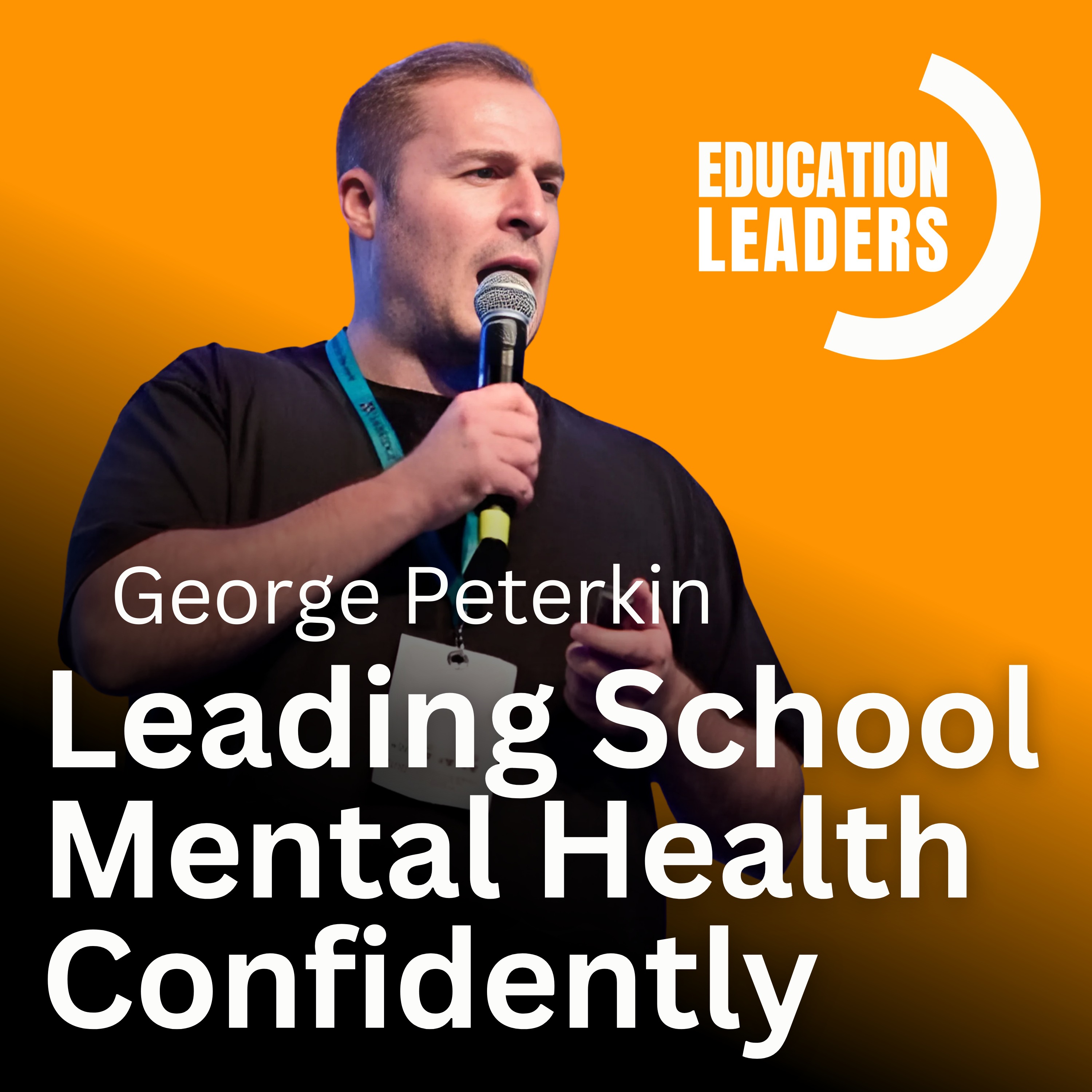
Leading School Mental Health Confidently | A Conversation with George Peterkin
This conversation with George Peterkin challenges how we think about mental health in schools. George introduces the three pillars…
Listen & show notes
Struggling with staff meetings that spiral into problem talk? This episode explores solution-focused communication and how school leaders can transform their school culture by changing the questions they ask. Vicky Essebag and Tara Gretton share practical strategies for shifting from deficit-based conversations to hope-filled dialogue that actually moves your team forward. You'll discover why asking "what's wanted?" instead of "what's wrong?" creates the conditions for real change in your school community.
We dive deep into how solution-focused approaches can help school leaders build stronger relationships with staff, students, and parents. Learn about the power of noticing small wins, creating fresh starts each day, and why those quick corridor conversations matter more than you think. Whether you're dealing with challenging parent meetings, staff frustrations, or student behaviour concerns, this conversation offers a different way forward that focuses on strengths, capabilities, and collective vision rather than endless troubleshooting.
Resources & Links Mentioned:
Vicky Essebag:
Tara Gretton:
International Curriculum Association
Join Shane's Intensive Leadership Programme at educationleaders.co/intensive
Shane Leaning, an organisational coach based in Shanghai, supports school leaders globally. He is the author of the best-selling 'Change Starts Here.' Shane is a leading educational voice in the UK, Asia and around the world.
You can find Shane on LinkedIn.
We are a proud member of the Education Leaders podcast network. For more great education shows, visit educationleaders.co/network/
Hosted on Acast. See acast.com/privacy for more information.
Auto-generated transcript. It may contain small errors.
When we're focusing on what people want and what's working, then that changes. It builds people's self-efficacy, so it becomes almost contagious, so the teachers express an interest in it, and then the leaders want to know more about it as well. Hey everyone, I'm Shane Leaning. Welcome to Education Leaders, the chart-topping leadership podcast for school leaders just like you.
As an organisational coach, I've helped thousands of leaders worldwide lead with greater confidence, make better decisions, and create winning teams. And on this show, we explore the strategies that are going to help you achieve your goals and transform your leadership. This episode is supported by the International Curriculum Association and the Teacher Development Trust, so stay tuned to learn more. Now, I am dead excited about today's conversation because it's challenged my thinking in the best possible way.
My guests, Aviki Essabag and Tara Greten, two incredible solution-focused practitioners who work with schools around the world. Vicky brings together backgrounds in education psychology, she's been a teacher, guidance counsellor, consultant, admin, and solutions-focused coach, and she's also president-elect of the Solution-Focused Brief Therapy Association. And Tara is the founder of Solution Revolution, working with children, young people, families, and schools using solution-focused practice. And you may be wondering, what is solution-focused practice?
What is solution-focused communication? And that is what we're diving into today. We're exploring why we might be a little bit too obsessed with fixing problems, how shifting from what's wrong to what's wanted can create contagious positive change in your school. And seriously, in this conversation, I've been frantically taking notes.
I think you all love it too, so let's jump right in. The solution-focused approach was born out of psychotherapy in the late 70s, early 1980s. And the key founders were in Sue Kinberg and Steve DeShaisa. And it starts before that with the likes of, there's somebody called Milton Erickson and the Mental Research Institute.
And the Mental Research Institute was a place where lots of therapeutic approaches were founded. But solution-focused really came from a shift from a more problem-focused perspective to a solution-focused perspective, as in the name. So it was really shifting from analyzing problems within therapy to finding out what people want. So solution-focused is very much about what are we working towards.
And the language has evolved a lot over the years, but it's around what are our best hopes? If things were to be better, what would be happening instead? What do we want to be different? Which kind of makes an awful lot of sense, doesn't it, really?
When you think about going into therapy. And a big part of it is, so kind of that picture of what's wanted, what are we hoping for? And then also utilization. So this was a kind of term coined by Milton Erickson, utilizing what's there already, what's working.
So we talk about what's wanted, what are the resources? What's working already? And by finding out what's working, amplifying that, and building on that, then we are able to move towards that hopeful change. This makes a lot of sense to me.
And yeah, my eyes light up when you talk about what's working already. It's certainly a lot that gets me excited with my work with schools. It's also, it's bringing back memories from me. I used to be an English language teacher and working with multilingual learners from different backgrounds.
And it reminds me of the shift in approach in language teaching from a deficit mindset of what they can't do to what they bring. It sounds a very similar kind of feel, right? Yes, it's that whole idea of what are individuals doing that is working? And if it's working, we don't need to fix it.
We don't want to be fixing the things that are working. What we want to be thinking about is what we can be doing differently if they're not working. And so with students, we want to look at what are their strengths? What are their assets?
What do they bring to the learning experience? And we can do the same thing with teachers. What are they bringing to the classroom experience? And how can they use some of those strengths and assets to really enrich their programme?
And for students, what can they do to enrich their learning? And how can the teacher facilitate that? You're both working very deeply in this space. What have you found have been some kind of tangible benefits for the people you work with in schools?
It's interesting. I was kind of thinking ahead of this conversation today. You know, that often within schools, what has been found, and in Stukinburg, one of the founders, noticed that solution-focused approach usually comes into schools as a counselling, as a therapeutic approach. It starts there.
And it almost has a sort of contagion. So in those individual conversations with students, that when people start to notice the change, because it used to be called solution-focused brief therapy. So it's a brief intervention and it can have quite quick impact so that people start to notice the difference. You know, it makes so much sense when we're focusing on what people want and what's working, then that changes.
It builds people's self-efficacy. It changes that person, how they relate to their environment, how they relate to the teachers. So it becomes almost contagious. So the teachers then express an interest in it.
And then from that, what we've noticed is that then the leaders want to know more about it as well. So it does have this contagious effect. It just has such an instantaneously useful impact. Yeah, we develop narratives about our classrooms.
We develop narratives about our students, about our job as educators. And sometimes we get mired in that. We have a particularly challenging class or things just aren't going well. And we live that narrative.
And every day we drag ourselves into the classroom with this mindset of, oh, my goodness, you know, it's another day with this difficult student or this challenging classroom experience. But what Solution Focus does is it helps to shift that perspective. So it helps to shift to, OK, well, you know, when things were working better for us in the classroom, when we had positive experiences in the classroom, when we were feeling like a wonderful teacher, what did that look like? What did that mean for us?
And so just that shift in perception could change the way we then subsequently bring ourselves back into the classroom. Because now we're thinking about, oh, yes, you know what? I am a good teacher. I did do amazing things in the classroom.
I'm perfectly capable of doing that and I can do it again. And I can manage that learning experience so much more productively for my students. And guess what? It's not just what I brought into the classroom, but I had many students who benefited from my teaching and who told me so.
And this is how they showed it. And so I know that I can access those types of students again and I can shift that type of experience in the classroom. And the amazing thing about it, you know, Tara talks about infection. That's exactly what it is.
As soon as teachers start behaving differently, more positively in the classroom, students do the same. And the same thing happens as soon as students start behaving differently in the classroom, teachers follow. So it is quite an infectious experience and a very productive indeed. That's speaking to culture work, really, isn't it?
Like, you know, developing a culture within an organization often starts with modeling a practice or delivering something. And I like the idea that it's infectious. So someone's listening now, they're a school leader in a school, maybe, you know, they've got a department, for example, and they're leading their department. So I imagine they're listening with maybe two reflections.
One, they're going to be thinking, Crikey, when I think about my practice, maybe I'm thinking a lot about what I'm not doing or not achieving. And that sometimes stifles me or I get into that rut like that you described. And I'd like to free myself from that. But also, secondly, they'll probably be thinking, I've got a team who I'm leading as well, who I'd like to help them more with a more solution focused.
Is there a place to start? Is this one of those things where you have to start on yourself before you work on others or where do you think? I think what's really wonderful about the solution focused is that it enables the school to have a collective vision. I think leaders can bring their teams, you know, their staff together and everybody can contribute to that discussion around what's wanted.
So bringing a school community together. And obviously, again, you talk about sort of community, Shane, but you can kind of by asking the school staff, the students, the parents, what are our best hopes? What do we hope for in our school, you know, for our school, for our students? You know, so often parents are coming in with problems.
You know, teachers have got challenges and they've got their issues. As she was saying, that deficit kind of model. And, you know, that becomes really difficult for leaders to manage your troubleshooting or it's that crisis kind of management where with solution focused, I mean, you can have it with a meeting with parents. You know, parents have come in, you know, or staff are coming into a meeting.
They've got so much that they're frustrated about. They want to be able to say, talk about that. And then the leader is like, so what are our best hopes? If this was to be a useful meeting, what do we hope to be different afterwards?
What are you hoping for from this? You know, then that can just completely change that climate, that culture. And from that point, everybody being able to contribute to that. And then inviting into that.
And I think this is something that I notice really when I'm bringing in solution focused training into schools is to always remember, actually, let's talk about what's working already. So then everybody to contribute to that story, that narrative. What do we want? And then what are we proud of?
What's working already in our school? What are we just building on? What are the small things that we do that happen in our everyday interactions? What do we do on a larger scale?
What are we pleased to notice? And I think that can just really make a difference to how we communicate, how we relate, and it really humanizes interactions within the school community. This is incredibly helpful to me if I can just check I've got this right as well. Like so to me, I'm hearing that perfect example of parents coming in and you're worried about this as a lady, I think, oh gosh, this is going to be a difficult.
So it's about the questions you ask to kind of guide that into a solution focused narrative and that starting question, you know, of what do we want? What do we want to achieve out of this? It reminds me of when I'm coaching my clients, it's always the first question. What would make this a really powerful session?
Or what would we achieve in this hour today? That would make you feel like we've spent some good time together. It's a similar thing, isn't it? We're setting ourselves up to move towards a solution rather than what's on your mind.
What's the problem? What do we have to fix or deal with? And then it's OK as we're moving towards that. What's working already that we can build upon rather than where are we starting from scratch?
Have I heard that right? Yes, you know, what we're really referring to here is not giving voice to people in school communities, but how we give voice, how we give them voice, how we invite conversation. So usually an administrator might reach out to staff and might say, OK, what are the issues? What are the problems?
What's going on? What would you like to talk about? And the administrator believes that they're giving the staff voice. But all they're really doing is opening up a forum for problem talk.
And we know that that just becomes a vortex. I mean, we've sat around meeting tables where, you know, you start by opening up with the problem and that's all you talk about for an hour and nothing ever gets resolved. So how we give that voice when we say what's working, what do you want or what do you want instead? Right. So instead of the problem or the issue that you're experiencing now,
what do you want instead? What we're doing is we're opening up a conversation that is about hope, that is about strategy, that is about potential. And suddenly everybody's excited to talk. Everybody wants to be part of that conversation because it's an illuminating conversation.
It's a hopeful conversation. So that's really, to me, is it's the purpose that we put behind how we engage. I'm having so many like book moments in this conversation. I hope you don't mind.
My eyes are going everywhere as I'm listening because I'm frenzily taking notes. And it's really wonderful. So one thing I wrote in big letters, you know, we all might give voice to our staff. Most leaders will say, well, I give voice.
But it's the how that is making the difference, right? You can give voice, but it's the way you give that voice that is going to really allow them to show up, allow them to be a part of the conversation and allow them to actually move forward on a journey. This is really, really powerful. I've got a question that's kind of coming up as we're talking.
So we're talking about solutions. We're talking about problems. Do you think we're a bit too obsessed with fixing problems? That's a good question.
It's interesting asking T Solution focus practitioners that space. We would be like, no, but yes, I think generally people are. As solution-focused practitioners, we don't ask why. We don't get into the detail.
Sometimes we don't even need to know what the problem is. Really? What do you ask? So what are you hoping for?
So it's about the presence of what's wanted rather than the absence of what's not wanted. I love that. Imagine asking a young person who's being bullied. So think about how young people being bullied, all we want to do is talk to them about the bullying.
What happened? What type of bullying? How are you feeling about it? We want to just talk about the problem.
And of course, that is a perfect way to alienate a young person who's experiencing bullying. They don't want to talk. They don't want to engage. They don't want to deal with it because it's upsetting.
Why would they want to talk about something that's upsetting? But if we say instead, when things are different for you, what will that look like? Well, they are going to share the problem inadvertently because they're going to say something like, well, they won't be making fun of me on social media. Or they won't be pointing me out at recess time and saying that I don't know how to play basketball.
Or they won't be calling me names. But they'll be doing this instead. Maybe I'll be able to make some friends. Maybe I'll be invited into the play.
Maybe I'll be feeling like I belong. And so interestingly, Tara is saying that we don't talk about the problem. This is true. Yet the problem inadvertently gets raised.
It just gets raised differently where the person wants to be engaged in the conversation because it's a hopeful conversation. This is really, really, really powerful for me. What are you thinking, Tara? Well, I was just going to add to what Vicky was saying is that we have sort of like key beliefs, key assumptions as solution focused practitioners.
And one of them being that we see people as experts for their own lives, that people have the strengths, capabilities, resources to know what they want. And they have existing ways of coping, of managing that can be built on. So like Vicky said, you know, we're not problem-phobic. There is lots of space for people to be able to talk and to have that validated.
You know, some would describe the solution focused approach as a listening approach. So there's so much space. But what we're listening out for in amongst all of that is what's wanted and what's working. And we are gently eliciting that and amplifying that.
And in effect, people are leaning into their own expertise or organisations leaning into their expertise. And we talk about people gaining self-efficacy. So that's self-belief. And you can kind of think about this as an individual or a group or an organisation, imagining having a conversation about this is what we want, this is what we're working towards.
We've all contributed to that. Students are involved, the community is involved. Let's talk about what's working. And then we're in a really strong position to take some small steps forward because everybody's coming from a place of this sort of great sense of belief.
You know, I kind of see hope as relational. Hope is relational and interactive, that it happens between us. So when we're talking about what's wanted and what's working rather than the detail of the problem, then we're going to feel much more able and positive to be able to take some steps forward and to be able to come up with them together, to be able to negotiate as well, that we can co-create, co-construct change because we're coming from a much more positive place. This episode is supported by the International Curriculum Association.
Now, I've been working with the ICA for quite a few years, but they've been around for 30 years and they've been around championing quality, unlocking potential and improving learning in international schools right around the world. I really, really love that at their core is a model for improving learning. And this model is focused on the learning experience and they have tons of great curriculum materials, PD resources and even an accreditation pathway for schools just like yours. So if you're interested and I really do recommend you check them out, head over to internationalcurriculum.com.
Today's episode is supported by the Teacher Development Trust. TDT's associate qualification in CPD leadership is so perfect for international school leaders. It's fully accredited and it's delivered online over 10 months. In it, you'll create an actual CPD, that's Continuing Professional Development Strategy for your school based on research that shows well-planned PD improves pupil outcomes and teacher attention.
And I actually did this program myself and hands down, it's some of the best professional development I've ever done. So much so that I am delighted to be co-delivering this special Asia cohort, which starts in November. If you want to learn more, go to tdtrust.org or click the link in the show notes.
This is great and it's speaking to like the purpose of a leader. I'm thinking in my office at the school, I would almost want to stick up what's wanted, what's working. So that when that person comes into my office and they come in and say, Shane, I'm really not happy about this new policy that's come out. I'm really struggling with this thing that I can as a leader get myself into a mind frame of trying to ask questions to go, what is it you're after here?
What would look great? And then tell me, well, what's working now that'll help us get towards that? That's actually a lovely scaffold for a conversation just to get you right in there. What's wanted, what's working.
And another aspect of solution focused, which is really key is about small change. And kind of Vicky can kind of add to this, but we think about the tiny, tiny, tiny, tiny steps. Because sometimes when, you know, there's big things happening and or there's a big problem, you know, being able to kind of think about what's wanted and affect change, it's just like, wow, this is just too big. Where do we start?
You know, but if we've got a picture of what's wanted, and then we focus on what would be a tiny, tiny first step, what would be a small first step? And you can imagine that in a therapeutic setting, but also in an organization as well with leaders, you know, that just taking those small steps forward and that that will lead to greater change. And celebrating them, right, noticing those small steps and celebrating them in ourselves and in others. So to be able to positively notice something small that a teacher has done or something small that a student has done, or maybe it's not something that they've done, maybe it's just a personal quality and a tribute, an ability, right?
That it's almost like we're just shining a light on a very small detail and saying, wow, look at that. Look at what you've accomplished. And people sit back and say, oh, yeah, that is really something that I can feel proud of. And the more we can do that with each other, the more that we encourage positive things to happen.
It also speaks to fresh starts, how we can notice the positive in each other every day. So imagine an administrator in a school who actually comes into the school every day saying, it doesn't matter what happened yesterday in terms of all of the problems that were apparent the day before. None of that matters. Today's a fresh start.
Clean slate. Everybody has an opportunity to be their best self. Imagine a teacher doing that in a classroom. It doesn't matter who was misbehaving yesterday.
It doesn't matter who showed up late. It doesn't matter who threw a wrench into the lesson. Today's a fresh start. And when individuals in schools know that every day is a fresh start because that's the message, they sleep better the night before, they're less stressed, they're more positive, and they really believe that today is a better day.
And when people believe that, today is a better day. I'll tell you what, this conversation is like a little personal therapy session for me. One of my challenges is I'm a master procrastinator. You know, I just love to procrastinate on other stuff.
It's probably why I've got a couple of podcasts and this and that and that because I just keep saying yes and procrastinating onto different tasks. But it means that sometimes like I get a bit overwhelmed with like completing big projects, for example, and I know like something that's worked for me recently has been starting with a really small task. Like I did it this morning when I first got to the office. I set myself a small task to do and I was doing that self-talk, but it speaks to exactly what you were saying there about those small first steps and then celebrating that when you've achieved that.
That's pretty good. You did that. And the second thing I liked was that every day is a fresh start and it's something that goodness knows has helped me a lot that kind of mantra when you come into a new day and go, okay, we're starting a new today. It might have not felt so good yesterday, but how great would it be if you had a leader who was reminding you of these small steps that you were making prompting you for the small steps celebrating and with you and reminding you that we're forward-looking here and today is a new day.
Like how empowering. Yeah, absolutely. And kind of as you were talking then Shane, I kind of think about there's a school that I work in here in Bath and that focus on that kind of small and a new day and the way that we've tried to sort of infuse the school with solution focused is we've done staff training, but then it's the tiny, tiny, tiny everyday interactions and we kind of call it the corridor conversations, those really small moments that as you're passing in the corridor. And like Vicky was talking about the noticing, so often those tiny interactions are focused on what children aren't doing.
I don't know what it's like in other countries, but for in the UK, that sort of obsession with uniform, you know, tuck in your shirt or, you know, where's your blazer or any, and you imagine sort of that accumulative effect of those tiny, tiny interactions. They're going to have a negative effect and are going to have an effect on behavior. And that's what young people are telling us in the therapeutic sessions. So imagining those tiny, tiny interactions where you're noticing what they're doing well, you know, thinking about catching them doing what's working or what they're doing well.
And so, oh, wow, you've got your shirt tucked in today. Oh, great. You've managed to come in for period one. How did you do that?
You know, those tiny, I think it speaks to kind of co-regulation as well, that in those tiny interactions, we're connecting with people. And I think that's so much about solution focused as well, that it can be done in that, on that tiny, tiny, everyday interaction scale to that bigger, more strategic scale as well, and create such a difference across a whole school climate. This is super powerful. So I guess I'm wondering, where would a leader go to kind of start themselves on this journey or to go to find out a bit more?
So the wonderful thing about solution focus is that while it started out as a therapeutic approach over the years, it has evolved, it's evolved into education and business and healthcare, into coaching. And that's effectively what Tara and I do is we coach in solution focus in schools and school systems. So what I would say to administrators is look for the coaching opportunities. There are a variety of different solution focused coaching opportunities.
We know that you can find it for sure with the ICF. And wait a second, there is the ICF in Singapore, isn't there, Tara? Yeah. That specializes in solution focus.
So that would be a great training opportunity. Tara, do you have any other ideas? Well, obviously they could contact us as we provide solution focus coaching training. So, I mean, there's so many wonderful organizations and there's the SFBTA, which is a solution focused brief therapy association that is founded in America.
And then there is SFIO, which is SF in organizations. And that is just a brilliant resource because it talks about, there's lots of examples of solution focused in education and brilliant examples of it being implemented across a school. And also I wanted to mention a couple of things. The journal of solution focused practices often has the latest research, the latest conversations about solution focus.
Also, Tara mentioned the SFBTA, the solution focused brief therapy association. I'm actually president elect of that association. It's a North American organization. And again, it is about therapy.
It started off with its roots in therapy, but it has also hugely branched out. And we are having a town hall and professional learning opportunity on May the 2nd. And our speaker is Terri Pichot who has an incredible history and solution focus, a very knowledgeable woman. And this is a free professional learning opportunity that administrators can engage in.
And I think there is a $25 membership fee if they want to join. So it's basically $25 and I have advertised for this on my LinkedIn page if people are interested in finding out more about that. This is awesome. And I guess what I'm picking up is like if you've not come across the term solution focused, I'm assuming if you Google it, there's going to be a lot because it's a big talk about stuff.
You're going to find a lot of really good stuff. Listen, this has been enlightening. I'd love to ask you one more question. When you're going into a solution focused conversation, like what's your mantra?
What are you thinking when you're going in there? I'm curious as to what's on your mind. I always think about the solution focused assumptions as coursing through your veins. When you have those core beliefs, then that affects what comes out of your mouth.
When you believe that people are experts for their own lives, you believe that people come with strengths, capabilities, resources, and that you believe that, you know, the small change can lead to big change that no problem happens all of the time. There are always times when the problem isn't happening. I think when you go into a conversation, you know, and I think to sort of abbreviate that there's hope and possibility for all, you know, and you can't change the past, but the present and the future is both created and negotiable. I think those are the core sort of beliefs that you have and that makes a difference to the outcomes of that interaction that you have with that person or that organization.
Thank you, Tara. Tara and I work focusing on how we communicate and the kinds of questions that we ask and how we engage people in conversation. But what seems to surface for me is how do we bring ourselves to the relationship, first and foremost, because, you know, sometimes you can teach people a wonderful communicative skills, you can give them all the tools that will work. But if they're not bringing themselves to the interaction in a positive way, none of those tools will be effective.
And that's where sometimes you'll hear people say, you'll hear administrators say, I can't get from my staff in this particular professional learning or in this particular staff meeting. I just can't get them to engage in the way that I would like them to engage. Or you'll hear teachers saying that about their students. I think it's really incumbent upon them to think about, well, okay, then how are they bringing themselves to that space?
And that, to me, supersedes what comes next and how they engage in the kinds of tools that they use for engaging. Now, I told you this conversation was going to challenge you thinking, well, it certainly did for me. And what struck me most was this idea that it's not enough to simply give people a voice, it's how we invite that voice that makes a big difference. So when we're opening meetings asking what's the problems, we're essentially, we're creating a forum for problem talk that can become a bit of a vortex when nothing gets resolved.
But when we ask what's wanting or what do you want instead, we're opening up conversations about hope, we're opening up conversations about strategy and potential. I loved that example about working with young people with bullying and instead of dwelling on the bullying itself, instead asking when things are different for you, what will that look like? That gets them engaged in a hopeful conversation about belonging and friendship and that fresh start mentality. Imagine being a teacher knowing that every day your leader sees you with fresh eyes, celebrating those small steps.
How empowering would that be? If you want to learn more about solution focused approaches, please go check out the links in the show notes. There's so much good stuff there that I know you're going to find useful. Education Leaders is hosted by me, Shane Leaving, thanks to the show editor, Pete McGill, and for the original music by PMA Silver.
And thank you as ever so so much for tuning in today. It is an honor to have you here. And if we don't speak before, we'll see you here next week. If you want to learn more about the brilliant work of the Teacher Development Trust and the International Curriculum Association, you can find them using the links in the show notes.
This conversation with George Peterkin challenges how we think about mental health in schools. George introduces the three pillars…
Listen & show notes
Professional development is happening in schools everywhere, but is it actually working? In this episode, Bethan Hindley from the Teacher…
Listen & show notes
Ever left a fantastic professional development session feeling completely energised, only to find yourself back to square one a month…
Listen & show notes