

Your Top Picks: Most Listened Episodes
As 2025 comes to a close, Shane reflects on the year by counting down the five most listened to episodes of Education Leaders. The podcast…
Listen & show notes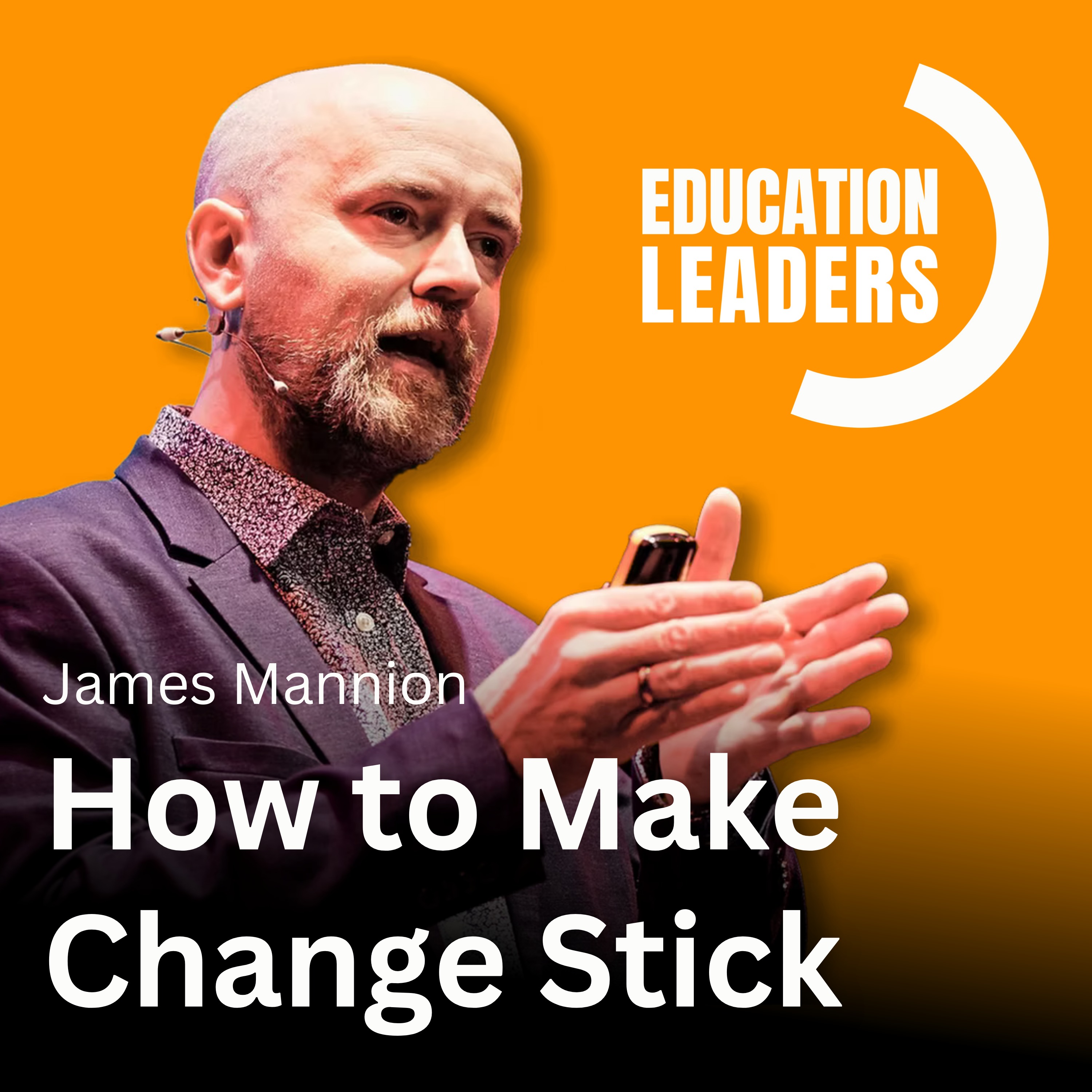
Dr James Mannion has noticed something telling when working with school leaders: ask them what proportion of change initiatives actually improved anything. Most estimate 10-20%, but when pressed about sustainable change with real evidence, that figure drops to nearly zero. Dr James Mannion, author of a comprehensive programme on implementation science, explains why this failure rate persists despite everyone knowing about it and more importantly, how schools can break the cycle. James reveals two deep-rooted issues: leaders aren't taught change management, and we default to top-down approaches that violate people's fundamental need for autonomy.
You'll learn why healthcare takes 17 years to achieve just 14% uptake of proven practices, how to build slice teams that bring genuine representation to decision-making, and the power of five-minute interviews for surfacing concerns without fear of repercussion. Shane and James discuss the difference between implementation science and improvement science, why sceptics make valuable team members, and how to create ground rules that prevent groupthink. If you're tired of watching initiatives fail despite good intentions, this conversation offers a practical roadmap for change that actually sticks.
Resources & Links Mentioned:
International Centre for Coaching in Education (Use discount code SHANE5 for 5% off)
International Curriculum Association
Join Shane's Intensive Leadership Programme at educationleaders.co/intensive
Shane Leaning, an organisational coach based in Shanghai, supports school leaders globally. He is the author of the best-selling 'Change Starts Here.' Shane is a leading educational voice in the UK, Asia and around the world.
You can find Shane on LinkedIn.
We are a proud member of the Education Leaders podcast network. For more great education shows, visit educationleaders.co/network/
Hosted on Acast. See acast.com/privacy for more information.
Auto-generated transcript. It may contain small errors.
Everyone knows most change fails. We roll our eyes, we smirk, we mutter. This tune shall pass under our breath. But then we charge headlong into the next thing anyway. Today
we're asking why that happens and what we can actually do about it. Hey everyone, I'm Shane Leaning. Welcome to Education Leaders, the chat-topping leadership podcast for school leaders just like you. As an organizational character, I've helped thousands of leaders worldwide lead with greater confidence, make better decisions and create winning teams. And on this show, we explore the strategies that are going
to help you achieve your goals and transform your leadership. This episode is supported by the International Center for Coaching in Education and the International Curriculum Association. Stay tuned to them all. I'm excited about today. My guest is Dr. James Mannion. He is an all-sport podcaster like me with
the Rethinking Education podcast and director of Rethinking Education. But importantly, for this conversation, he spent the last 10 years writing a book about why change fails in schools and what we can do about it. Sound familiar? Yes, I love this book and I love James' idea. He's been a huge inspiration to me
and a huge inspiration towards where change starts here. We're going to talk in this conversation about moving away from heroic leadership towards something a bit more distributed, more data-driven and frankly, more likely to actually work. So if you're intrigued, well, let's jump in. It was really interesting, like just like looking at like the very opening sentence in your book and actually in the foreword by Jonny Utley says, it is a sad truth that the education system is full of change that has failed. And what's really interesting is that
everybody knows that, right? So as I've been working with schools over the last few years, I often start by saying that if you look back over your career, like what proportion of change initiatives would you say actually improved anything in a meaningful way? And first of all, even before anybody answers, people laugh at the question. They sort of, you get this like nonverbal stuff.
People roll their eyes, they tuck, they pull weird facial expressions a bit as they try to think about successful things. And then almost everybody says roughly like 10 to 20% of change initiatives actually turn the diet on outcomes. But then if you really push people and say, you know, I'm talking about sustainable change that's still happening now, that, you know, you've got evidence for that, you've got some sense of causation, you've got a sense of what it is that you actually did or perhaps stopped doing to bring about those improvements. And at that point, people often dial their figure down often to zero or to like 5% or maybe they just start pointing at one or two things and they say, oh yeah, I think like read, write, ink or whatever it might be, phonics or retrieval. We think that that really
did actually help things, but like, that it's basically like you can count them on the fingers of one hand. But what's really interesting about this, the opening chapter of my book is called The Mind-Blowing Question. What I find so mind-blowing about that is that A, everybody knows it and B, that doesn't ever seem to stop people from charging headlong into the next thing and the next and the next. And so we have this churn that everybody's familiar with. Everybody knows this, this phenomenon that goes by a few
names like initiative-itis, innovation, fatigue, this too shall pass, this phrase that teachers sometimes mutter under their breath, you know. And everybody's, we're so sort of stuck in this cycle and it's not just an education thing, you know, my brother is a doctor, he describes the exact same scenario in health, we see it in the political world, in people who work in business. To be honest, I think the businesses are a little bit more forward thinking when it comes to change management, which we could maybe get into, but it's a fascinating problem. It's really fascinating how you frame that. So we know that most change
fails and we all know it because you are so right. That smirk that everyone gives as soon as you bring that up, everyone knows it. So what are we doing? Like, what is that disconnect?
Yeah, I mean, there are so many reasons. The first thing to say is that change is really hard or rather like, we need to be clear, I think about the difference between change and improvement. Vivian Robinson is really good on this, like, change is not good in itself. Like, if you can change things for the worst, you need to actually improve things. So improving things is really, really
hard. Even when it's yourself, right, you know, New Year's resolution syndrome, you can go to the gym for a few weeks or set a reminder to read 50 pages of a novel every night, but it often peters out after a while. It's really hard to change things with creatures of habit. And that's if it's just yourself. And so if you're talking about, you know,
something as complex as a school, which is very complex, indeed, you're talking about getting maybe 100, sometimes 200, how many people all to start changing their ways and pulling in the same direction. It's a very, very challenging thing. And so I don't think that we should beat ourselves up to too greatly. And often when you talk to school leaders, why is it that this is the case, they often sort of point to external factors or things that are sort of not always in their control. They often point at things like staff
turnovers really high, or competing agendas, or there's like budget cuts or whatever it might be. There are loads of reasons, you know, you could list them all day, but in the book, I identify two, which I think are quite deep rooted issues that no one really talks about that much. And they're both really fixable as well. One of them is that school leaders are not taught this stuff. You know, in this
country, we have these the NPQs go, they were sort of rebooted. So the vast majority of existing school leaders in this country who were trained in this country, went through the old NPQs. And in the old NPQs, there was barely any mention of implementation science, to talk a little bit about Michael fullen, you know, the stages of grief cycle, you know, the ends in acceptance and all that, but there was no sort of practical guidance on how to implement change. And then more recently, they rebooted the NPQs. And they
basically copy and pasted the implementation guidance from the EES, the Education Endowment Foundation, they've got this four stage cycle, sustain, develop, deliver, whatever it might be, there's four stages to it. And they essentially just like literally copy and pasted it and bolted it onto the end of each of the NPQ framework. And there's some good stuff in the EF guidance, but it's very high level. It's only about like 40 pages, it does not contain the granular detail or the practical like strategies and case studies and stuff that people need in order to, you know, examples and non examples and all of that, the granular guidance that you need in order to actually implement change in a complex environment. And so that's reason number one,
teachers and leaders aren't taught this stuff. And that's a large reason why I've spent the last 10 years writing this book. And it's a book of a program really. So there's a program that I've run for schools. And the book is the book of a
program. And then the second massive reason, which I suspect may end up taking up quite a lot of the rest of this conversation, is top down. We just default to top down change. And again, that's not just in education. We live in a
pyramidal world, don't we, like where there's just a small number of people at the top of all organizations, we sort of labor under the myth of the heroic leader, who will come in and sort of save everybody from themselves. And we, you know, people talk about super heads and what have you. And again, this happens in health and politics and business. And there's something that just is sort of quite fundamental about the human nature, I think, which is that people don't like being told what to do, even when it's a good idea. There's this very hard
wired need for autonomy in human beings, this desire to have a small amount of say, to essentially to be trusted, to have some judgment that doesn't need to be challenged and questioned and scrutinized, to be trusted to be able to have a small amount of say. And it does only need to be small about what they do and when and how. And, you know, that becomes apparent from a very young age, doesn't it? I don't know if you've got kids, but, you know, that they're sort of two or three year old who goes like, no, let me do it. You know, when you're trying to be them
or put their shoes on or whatever it is, and there's this stubborn sort of like, I want to do it. I want to be my own boss, as it were, which is literally what autonomy means. And autonomy in the workplace, there's loads of research on this. And it's very, very clear that like people value it even more than how much they get paid. It's
like, do they have a bit of trust in them to make decisions? And when decisions are sort of made behind closed doors, as they often are in schools by senior leaders, and then they're sort of just announced to people, then they just seem to come out of the clear blue sky. And politicians are doing this all the time as well. We've just got digital ID cards have just been announced, and we're going to have digital ID cards. Really? Where did that
come from? Where was the conversation? Where was the consultation? Where's the about bringing people on board and helping people to understand this issue from both sides before you sort of bring them with you on the journey?
Again, this is basic stuff. We shouldn't really need to be having this conversation, but we do endlessly because, as I say, we live in this top down pyramidal world. And so there are ways in which we can go about making decisions which are not anti leadership, you know, leaders are still involved very importantly, but we can have much more inclusive models of decision making that overcome all of that sort of the us and them dynamic that often exists in schools, right? It's like, oh, the senior leaders are up there, and they don't remember what it was like to, you know, be on the chalk face and to have all this marking and all this scrutiny and all of that. And you often get this
two tier sort of mentality because of that top down dynamic. I love how you put that. So leaders are not taught this stuff. We're not necessarily experts in change. And I
think that speaks to your point about maybe in the business world, this being a little bit, you know, still a challenge, still a lot of change fails in the business world as well. But maybe when you go in a business, this is a bit more part of your repertoire of skills needed to go into the business world. And it's accepted in MBAs and things that you would learn sort of this stuff. And it's a bit more new to us in education. And you talk about
the MPQs in the UK, but like internationally as well, like it is quite absent or it's touched upon in a very high level way, like you said. But then that second point is so much changes top down. And I really have empathy for leaders because when you've got to change, not only do you get quite excited, like, because it's a change and you feel like this is going to be great. And we get optimism bias, right? And like,
there's so many filters in the way of you seeing that your team may receive this somewhat differently to you because you've got it kind of mapped out in your head. So it's almost natural. Yeah, completely. And these structures, like there's so much about schools, it just predates our entry into the profession. So it's
just it's assumed, you know, when we were at schools, there were middle leaders and senior leaders. And you just sort of assume that like, if you work your way up and you are a loyal servant and a team player and so on, that you will get to have a seat at the big table and then you'll get to implement a load of changing issues that don't actually work. We don't necessarily have the space or the imagination. And I sort of stumbled upon this 11 years ago, 2014, I just stumbled upon this information. I was at
university. There was a conference about implementation science. I didn't know what it was at the time. It looked a bit like it was to do with health and psychology more than education. But I decided to go
along to this one day conference and it just blew me away. And so I learned that day that there is this field of study called implementation science. And if people haven't heard of this, it's a health care field. So there's an implementation science journal and it's a health journal. And it was only
created in about sort of 2005, 2010. So in terms of academic fields, it's basically a newbie. It's not been around for too long. And it's really focused on how to scale up what works.
So like often in schools and in health care, in health care in particular, there's this massive problem where, you know, we've got a very good idea in health care, I think more so probably than in education, as to what works, like what is gold standard practice, you know, you don't think you can just do the quantitative stuff a bit more easily in health care. Does this drug make more people die or less people die than this other drug? Does the tumor grow or shrink? It's sort of got measurable outcomes. And this
question of like, to what extent is this gold standard practice actually happening out in the world in health care? There's this huge, huge gap. The statistics, it's hard to quantify this because we're talking about loads of different disciplines across lots of different settings, different countries and so on. Naturally, there's vast variation, but the best research that I found on this by Dean Fixson and colleagues who are sort of leading lights in this world of implementation science, say that on average in health care, it takes 17 years. So
people often talk about the 17 year lag to achieve 14% uptake. And the 14% is the worst bit. It takes 17 years to achieve like less than 15% uptake across the health care system as a whole, which of course means that in health care, you are very likely, overwhelmingly likely to be given a suboptimal treatment, despite the evidence being available that the better treatments are out there. And again, this is fascinating, right? Because it's not for
want of trying like people who've done these studies, they publish the findings in the journals that get pushed through people's letter boxes and never get taken out of the cellophane. They run CBD courses that some people go on, but even the people who go on it, it often doesn't really change their habits. They put them into national guidelines, which are often ignored. And so the people are really trying to turn the dial on this stuff, but it's just a fascinating question.
And so implementation science is this field that has emerged to close this gap and to sort of to think about how can we take these ideas that we know are effective and make those routine, make those normal. And so it's about this, this upscaling and translating things into routine, like everyday practice so that it's just part of what we do around here. And we no longer even really have to think about, for example, the fact that surgeons, you know, scrub up and wash their hands. Now, that wasn't happening for a really long time. And even
after that research had first been done, it took about another 50 years for that practice to be widely used in the medical world. And millions of people died, you know, as a result of that. And you, James, you differentiate between implementation science and improvement science, as well as almost two slightly separate fields of study. Yeah, that's right. So I
soon found when I started reading about all of this stuff that, yeah, implementation science is not the only game in town. And as I say, that's really about scaling up what we already know to be effective. Improvement science comes earlier in the process and the book is really an attempt to synthesise these two fields of study, along with ideas from elsewhere to bring them together. So improvement science comes earlier in the process and it's about taking an individualised view of a problem. So like, how
does this problem play out for that child in year seven with dyslexia who can't access the written text that they're being presented with? How does this play out for the parent, for the NQT, for the Senco or whatever it might be, the special needs coordinator? And so understanding the problems at the level of users. So it's very sort of person centred way of understanding the world rather than looking at systems and so on the scaling up. It's very
data driven. It's really based around iterative cycles. They're often referred to as PDSA cycles, like plan, do study, act. Anthony Breich is probably one of the leading lights or has been, I think he's retired now, the Carnegie Foundation in the United States, the sort of the most forward thinking centre that I've come across on improvement science. But
there are also overlaps that they talk about Nix, these networks, improvement communities and implementation science. You see people talking about slice teams, which are basically the same idea where you have like representation in the decision making process. So you've got that kid, that parent, that NQT, that middle leader, that Senco, as well as school leaders and head teachers all feeding into the decision making process. And that is absolutely transformational when you approach change in that more inclusive way. There's two big
reasons for that. Number one, you get better decision making, right? Because you've anticipated how this is going to play out for all those different types of people. And number two, what's really amazing about this is that you really bring people with you. So you get buy in,
right? So that way, as we were talking earlier about that us and them dynamic and people not liking being told what to do, people really come with you on the journey and they can see that they are represented in this change team. You know, there is somebody like them who with whom they can interact throughout the change process. And so people naturally feel respected and listened to and understood and they come with you and they're willing to adapt to these ideas and to play a role in coming with you on this change journey. And
that I think for any school leader, they would recognize that that buy in is like the X factor really, isn't it? It is like that is the thing that decides whether or not your thing will work or not. Did you manage to bring people with you as slice teams is the best way to do that. This episode is supported by the International Curriculum Association. The ICA
have been around for 30 years now championing quality, unlocking potential and improving learning in international schools. And what I really love is that right at their core is the model for improving learning. This is a model focused on the learning experience and they have got tons of great curriculum materials, PD resources, and even an accreditation pathway for schools just like yours. If you're interested, head to internationalcurriculum.com.
This episode is supported by the International Center for Coaching in Education, and I am actually on their current cohort. I don't recommend anything I don't believe in, and I am genuinely excited to be strengthening my coaching practice this year. The ILM level seven certificate in executive coaching is built specifically for senior leaders in international schools. It's fully online, really practical and honestly, learning alongside other school leaders who get the context we work in as being brilliant. If
coaching is something you want to develop properly, not just dabbling, head to the icce.org or click the link in the show notes and listeners to this podcast get an exclusive 5% discount using the code Shane five. That's Shane five. Your book, James, what's great about it?
You can tell it goes with your program. So it's the make and change stick program as well that you run. And for anyone listening, like it reads in that way, like taking you kind of almost step by step through change. But also it works in a way where you can dip into different parts of the change process. Like
you've done a really nice synthesis of some of Thomas Cuskey's work in the professional development section, for example, like, so like you can kind of dive into that and go, how do I make this PD work as part of this change process? And I really like that. I mean, there's so much, it is such a comprehensive bug. But what I would really like to dig into is what you've just started to talk about is overcoming that top down change through representation. And yes,
you advocate for slice teams. So I would love it if we could just kind of over the next 10 minutes, talk about where do you start in setting up a representative team for your next change and through your slice teams. So with an open invitation simply to everybody in that community. So you might say, for example, so there's this one thing, like there's a school that I've been recently talking with.
They want to work with me on this, making change stuff around school meals so that we know that we're really not across this. It's an area that we've not really nailed, like the quality of the food we're not happy with. We think we need to bring it in house, but we don't really know how to do that. We need to be sensitive to people's dietary needs and so on. And so you might
say, right, everybody, we've got this, this area of our school improvement that we really want to focus on. And we don't really know the answers at the moment. So we want to, we want to put a team together of people so that everybody throughout this community is represented. So we'll have lunchtime supervisors and dietary experts and, you know, we'll get some local chef in. We'll have
representation from every level of this organization. And we're going to undertake quite a lengthy process. And that's one thing to mention is that like this program, the full fat version, as you say, you can, you can dip in and out of it. But the full program usually takes about 24 hours across a year.
So if you say something like eight, three hour sessions, 12, two hours, or however you want to divide it up. So it really is quite a sort of a painstaking process. And I'd make no apologies for that because the alternative is a 90% failure rate, right? Like each of the chapters, each of the tools in this program, I think are vital potentially. And you
could do a really good job of implementing change. But if you overlook just one of these things, if you don't do a pre-mortem, for example, where you anticipate problems in advance, if you don't think about habit change and how to turn the dial on habit change, each of those tools is super important. And if you overlook any one of them, that could be the reason that this thing doesn't work. And so it does take a while.
And so you would put out an open invitation and say, right, so we want to work with a slice team over the next year or so. There was a bit of a time commitment. And, you know, you could talk about how you can find the time. I did an interview recently with a school leader and he does it all before three o'clock. He runs
loads of slice teams and it all happens within the school day. So nobody's having to give up time after school. But, you know, you can figure out how that works and then ask people to apply and say, like, you know, apply and we'll interview people. But what you want to do in that appointment process is to have representation from across the school, of course, but also representation in terms of how on board people are or how skeptical people are. You know,
some people are really, really keen to go in their early adopters and they're just right for it. And they're really on board and they really want to go. And that's great. You want those people on board, but you don't want to have only those people, right? Because
otherwise you're just like preaching to the choir. You also want young people who are a bit just ambivalent about it. And some people perhaps who are really quite skeptical about it. And that's something that's worth mentioning because skeptics really care.
Skeptical people really care about stuff or else they wouldn't express their skepticism. They would just slide into apathy and they would just switch off and wash their hands of it. People who express skepticism really care. And often those people want to be a part of this. Schools often
tell me that it's surprising the people who come forward and volunteer their time because they really do want to make this work and they can see that the usual cycle of change is the reason that they're so skeptical, right? It's like the rational response to initiative items is to become jaded. So you want to have representation of people who are sort of in different levels of the organization. If you're in a primary school, you know, from early years, you know, key stage one, key stage two, if you're in a secondary school, try to get as many different subjects or faculties in the team bearing in mind that you don't want it to have like 20 people in it. So usually there's
sort of about five or six people in a primary school, maybe eight to 10 people in a secondary school. Oh yeah, bring in those skeptics. So you've brought in this great community that's kind of spread across and I guess depending on the change will depend on the slight makeup of the slice teams, because maybe parents will be involved in certain change or maybe students are involved. Like it would depend on the team, right?
Yeah, absolutely. Yeah, yeah, of course. Yeah. So something that's about budget, right?
You're going to have the bursar in there. Yeah, I was bringing kids in. I really, really recommend. And one thing to say is that people are often a bit resistant to do that because they don't necessarily want the kids to see under the bonnet.
They don't want to see that there is disagreement within the staff body about X, Y or Z. We might talk about that in a moment, perhaps about what happens when there's disagreement within the slice team or parents, for example, to protect our reputation. People might go on a sort of a slightly defensive footing. And I can understand that. And I think that
you need to carefully manage it. And perhaps you wouldn't bring parents and students into every part of the conversation, but you can certainly bring them into some parts of the conversation in a way that's safe. And I'd really, really recommend that you do so. And on that, how much of the change conversation would a slice team be involved in? Are you saying
we just get a slice team together to kind of scope out our goals and then we'll meet together for a checking or or are they actually really, really involved in the step by step implementation? So there's basically three levels. The only thing that I've thought since I wrote the book that I thought, oh, I wish I'd said this then and it hadn't occurred to me until afterwards was that there are essentially like three levels, I think, at which you can use a slice team. And the book is really only focused on level three.
So level one is just a consultation. Right. So you just it's essentially a focus group. You assemble that slice team and you say, right, everyone, let's just like share your ideas about school dinners and we'll write it all down and then we'll probably ignore most of it and we'll do whatever we think.
Right. So that's like consultation is often not done particularly well. The middle level is like a steering group where essentially the senior leader is driving most of the process, but they check in and there's like accountability. And so maybe they meet like three times a year or something a little bit like school governors or something, which I think is fine.
It's better than nothing. But my preferred option is level three where, yes, the slice team is absolutely responsible for this whole aspect of school improvement. And there's like a sort of semi devolution process. The school leader is still involved in it.
So let's say this is about improving behavior and relationships or the pastoral system say the senior leader responsible for that area of school life is still a part of the team, but they don't have a veto. And that's really important to make clear. If they exercise a veto, the whole thing is a waste of time. And you might as well just go back to essentially just top down back to where we started.
And so it has to be an inclusive decision making process. And you can have votes, you can have disagreements, you can have compromise. There's all kinds of ways in which that team can arrive at decisions bearing in mind that this is a very data driven process. So you might sort of say, right, well, we recognize that there's disagreement here.
We're going to go with option A for now and we'll collect some data and we'll come back to this conversation in three months time. And we recognize that we might need to change course. So you sort of it's like this agile approach to business leadership, essentially. Like following the data.
And I guess that's what you're saying as well, which is really important to anyone listening. It's not that, okay, great. The idea of get a team together and just go like you really need some structures around this. You really need to know how that leader works with the group that needs to be explained clearly.
And it's about data driven insights going forward. You don't just say, hey, get together focus group and you're going to decide what the future of the school is in this change. Because that would freak a lot of leaders out understandably. Yeah, of course, you know, and and also, you know, likewise, like the people on that slice team have not been taught this stuff either.
And so there's a huge benefit that comes through that once you've been through this process, do you create this huge capacity of like with the people within your organization who understand how change can be implemented effectively and that changes you in terms of your personal life. One thing there was a happy consequence of this for years, all of that stuff that I mentioned earlier, the New Year's resolution syndrome. My personal life is so much better shape now than it was before I wrote this book because I just learned all of these things that I now sort of understand in my bones and I get the importance of like setting reminders and writing notes to myself and just making my future life easier to make good decisions. So it helps people on an individual level.
It helps you to build this capacity within the organization and therefore to improve future changes more effectively. Yeah, I think that's super, super useful. So look, James, we just swung very quickly towards the end of our chat and I would really recommend people check out either your program or the book to kind of really get the depth on this. But is there one takeaway around putting together this team who were going to lead change through your school?
If there was one piece of advice you could give to people setting up this kind of focus. What might that be? Yeah, so ground rules are really important, right? So you need in a way that you don't just fall into the group think that senior leaders often fall into.
And so you want to have a set of ground rules that says, for example, everybody's voice is really valued. We want to hear from everybody, even if you just pass and just regularly just go around the table. Does anybody got anything to say about this so that you don't just have, like, dominant personalities sort of taking over? You say things like all relevant information will be shared, especially if that's inconvenient information, if you like.
If I want to disagree with my boss, people often don't do that, right? They don't disagree with their boss in a public forum, perhaps for reasons of self-preservation, you know, perhaps it may be socially awkward to do so. But, you know, if your boss says, right, I think we're going to do this. And there are people in that room who've got reasons in their mind that this isn't a good idea.
I've seen this at my previous school. I've got evidence to the contrary, whatever it might be. You need to be able to have that out. And so you create a forum where you sort of say, we will share all relevant information around this table.
We will have robust discussions without fear of repercussion. And, you know, it's really interesting. People love it when you establish those criteria. And of course, still some of those concerns remain.
But one thing, I'll just leave you with this lovely little practical tool. We do this thing called five minute interviews. So let's say at the start of this thing, you might say, right, a bunch of questions. Do you agree that we should be changing school dinners?
Is this a priority for this school at this point in time? What ideas do you have about this school dinners thing? What questions do you have? What concerns do you have, for example?
And then each member of the size team goes away and has a conversation with like, say, three people who are like them, right? So the midday supervisor talks with the midday supervisors and so our middle leaders talk to the middle leaders. And then they bring that information back to the size team next time you meet. And they feed that information back anonymously.
And they can roll in their own views in with this anonymized data. And so you're not saying, oh, Shane thinks this is a terrible idea. We need to sort out behavior and marking, right? You just say, oh, people are concerned that this isn't really a priority at this point in time.
And perhaps we need to look at these other things first. And so you create this lovely mechanism by which people can have that sort of robust, honest exchange of views in a completely safe way. And the school leaders that I work with often say, that's just so amazing. Like we really feel like we understand what the school is thinking.
And often I've noticed that you sort of get this sharp like course correction following that process. And you're like, oh, wait a minute. Yeah, we're framing this wrong. The language is problematic.
People aren't understanding what it is that we're trying to do here. And very, very powerful learning that can come through that. So yeah, really recommend the five minute interviews. Right, so there is a lot in there.
So let me pull out a few things that were really stuck with me. First, that opening question, of course, what proportion of change initiatives have actually improved anything in a meaningful way? Can you ask yourself that, honestly? Not what you hoped it would work.
Not what you tried. What actually stuck and made a difference. For most of us, it is a pretty depressing answer. And James is right, we all know this.
We all know this. But somehow, it never stops us from tragic into that next initiative. The thing about top-down change that really got me, we have this myth of a heroic leader who swoops in and saves everyone. But people fundamentally don't like being told what to do, even when it's sensible.
So we end up with this cycle in our organisations where leaders announce things, teach a smile or nod, and then nothing actually changes, and it's the surface. The slice teams concept, well, that is interesting because that's not just about getting a focus group together and let them decide everything, which I know would freak most leaders out, understandably. It's structured. There's still senior leader involved, but they don't have a veto.
That's crucial. If this resonated, check out James' book, Making Change Stick, and is programmed through a briefing in education, you can find all the details using the links in the show notes. His book is well worth checking out. Go get it if you haven't already.
Education Leaders is hosted by me, Shane Leaning, thanks to the show editor, Pete McGill, production assistant, Skylar Rose-Sturman, and for original music by EMA Silver. And thank you so, so much tuning in today. Happy New Year, and if we don't speak before, I will see you next week. If you're interested in the work of the International Center for Coaching in Education or the International curriculum association, check out the links in the show notes.
As 2025 comes to a close, Shane reflects on the year by counting down the five most listened to episodes of Education Leaders. The podcast…
Listen & show notes
When Dr. Tamara Yuill Proctor began researching curriculum integration at secondary level, she quickly discovered that successful change…
Listen & show notes
Welcome to our December edition of Education Leaders LIVE, where Chris Scorer and Shane Leaning reflect on the month's episodes. This time…
Listen & show notes