

Education Leaders LIVE | March Reflections
Shane and Chris are back for this month's Education Leaders Live, recording from Shanghai and Newcastle respectively, to unpack some of…
Listen & show notes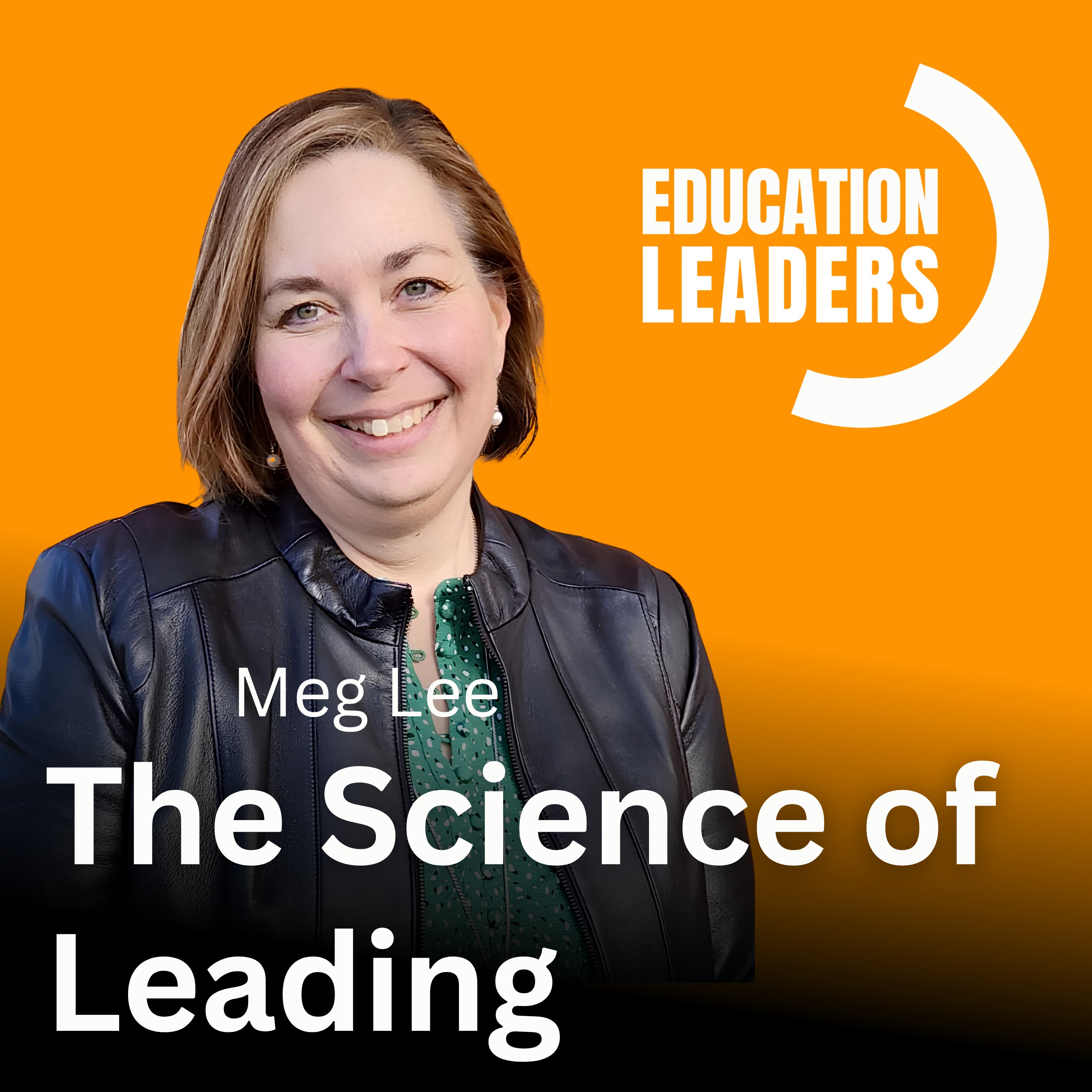
What if the principles that help students learn could also transform how you lead? This episode explores the powerful concept of the "science of leading" with Meg Lee, co-founder of Learning Science Partners and an internationally recognised advocate for evidence-informed teaching and professional learning. Meg explains why our leadership moves often fail when we act on "brittle knowledge," just enough understanding to be dangerous, instead of fostering the deep, flexible understanding needed to navigate complex organisations. This is a critical conversation for any leader feeling the tension between urgent action and sustainable implementation.
You'll learn how core principles from cognitive science, such as cognitive load, prior knowledge, and effortful thinking, directly apply to leading schools and systems. Meg, a 30-year public education leader, author of Mindsets for Parents, and US ambassador for researchED, shares practical strategies, including how to simplify your school's focus, make small incremental moves in the same direction, and build a shared language for change that honours your team's experience. If you want to move beyond initiative fatigue and lead change that lasts, this episode provides the evidence-informed framework you need.
Resources & Links Mentioned:
Episode Partners
International Leaders Conference
Join Shane's Intensive Leadership Programme at educationleaders.co/intensive
Shane Leaning, an organisational coach based in Shanghai, supports school leaders globally. He is the author of the best-selling 'Change Starts Here.' Shane is a leading educational voice in the UK, Asia and around the world.
You can find Shane on LinkedIn.
We are a proud member of the Education Leaders podcast network. For more great education shows, visit educationleaders.co/network/
Hosted on Acast. See acast.com/privacy for more information.
Auto-generated transcript. It may contain small errors.
What if everything we know about how children learn could completely change how we lead our schools? Well, my guest today says the science of learning doesn't just belong in a classroom. It belongs in every leadership decision you make. Hey, I'm Shane Leaning. Welcome to Education Leaders The Chat Topping international podcast for leaders in schools around the world.
I'm an author and an organizational coach and in this show I bring you the practical ideas and honest conversations to help you lead with confidence and clarity. This episode is supported by the International Curriculum Association and teaching walkthroughs. Stay tuned to learn more. All right, my guest today is Meg Lee and Meg are excited. Meg Lee is co-founder of Learning Science Partners.
She's one of the most experienced leaders I know with a lot of time in the public education system in the US. Meg spent her career doing something deceptively simple but genuinely rare. Helping schools bridge that gap between what research says and what is actually happening in classrooms and staff rooms. She works alongside cognitive scientist Dr. Jim Heale as well to help large districts build coherent evidence-informed approaches to teaching and learning.
Go on, let's just jump in. For many, many years, I think we've focused in education on beliefs rather than evidence. And it strikes me that we do a lot of belief-focused leadership as well. And while I think beliefs are really important, evidence really cuts it in a way that beliefs don't.
So I think the science of leading is really thinking about what do we know about learning and how does that impact how we lead both in schools and in other types of organizations? And so I've been spending a lot of time thinking about that recently. This has been a conversation that I've been so geeky about, Meg, because this is just really, really exciting concept for me. And I know you're a super geek about this. So this is brilliant.
So let's just dive into that idea of the science of leading because a lot of people talk about science and learning. And I know leaders, their ears are going to have pricked up when they hear this idea of science of leading. So one of the areas maybe if we start off is something you talk about a lot in the science of learning hat on is the idea of knowledge being brittle and understanding flexible. So I wonder if we could kind of just focus what is that brittle knowledge and what does that look like for school leaders as opposed to learners?
Well, Shane, this comes from a quote that I heard from Dan Willingham a couple of months ago where he really talked about this idea that a little bit of knowledge is really a brittle concept. But the deeper your knowledge becomes and the more it turns into understanding, the more flexible it is for decision making. And that really resonated with me because my experience as a leader really helped me to understand that when I had just enough understanding of something, just a little bit of knowledge, I often would move to make big changes. So I might hear of something that's really promising and I start to move very quickly in that direction, only to realize that I really had a very fragile understanding of what it is that I was trying to implement.
And as I got further down that path, I realized that I did not have a deep enough understanding to be able to be flexible. And I've always worked in large organizations, Shane, and large organizations require a lot of flexibility. And you hear people say, I know just enough to be dangerous. And really, I think that's true when it comes to leadership moves.
Sometimes we hear something that we think is the path we should take our school or organization down because we are passionate and we want to do the right thing for children. And we think it's so urgent that we need to move or we have external forces, our evaluators saying you need to move right now. And so we make these sort of quick moves that often have a lack of buy in. Sometimes they don't suit our context correctly.
They might lack sustainability over time because we sort of didn't build it on a strong foundation. And so I think a lot about how the same principles of how we learn things really can be applied to how do we lead in organizations because organizations have very similar qualities that would seem to me. And so I'm starting to sort of think about learning science principles, but what they look like as applied to organizational change and leadership. And so I think when you build on a brittle foundation, you get uneven implementation, you get misunderstanding, you get initiative fatigue and lack of buy in because you've really built on enough knowledge to be dangerous and making a quick pivot to implementation without really an understanding of the nuances behind the ideas.
So when I work with large organizations, I think about how do we keep the sense of urgency, but also slow people down so that they're very deeply thinking about what does this look like where I work? What are the nuances of this idea so I don't miss implement and what's the capacity of my team to carry this out? And when we start to think like that, we move from brittle knowledge to flexible understanding. So well explained.
And as you're speaking, I'm literally picturing so many leaders who I work with or have worked with. The classic is they go to a conference or we all do it, right? You go to a conference and someone teaches you something and you go, ah, I need to implement that. And you go back and then you make that quick move, but it's a big change, as you say, and then it just falls apart.
And you are just thinking, what on earth is going on? And I guess from what you're saying, that's because you didn't really have that solid foundation. You didn't have that flexible understanding of how that thing works. You just had a bit of brittle initial knowledge, right?
And the flexibility is what's required for implementation over the long haul, Shane. Flexibility is the ability to respond to people who are struggling with the change or people who are questioning it or people who want more information. If you can't bring those things to the idea because you don't really have a strong enough foundation, you're not able then to sustain whatever that changes. And so what ends up happening is we end up just falling into that pattern over and over and over again.
And I think that really frustrates leaders because they want to do the best. And they think when they hear these brand new ideas, oh, I want to implement that right away. And I see it all the time. And I know that people hesitate when I say we need to slow the roll.
We need to slow things down because they do feel that sense of urgency. But it's about the quality of implementation and bringing everyone along is not a fast process. It feels like almost a bit of a paradox, Meg, is it not? Like, how can you have urgency and slow down at the same time?
Right. Well, an urgency really, I believe when you're dealing with something as important as a child's life. And this comes from Reed Lyon, one of the fathers of science of reading. You know, when you're dealing with something as critical as a child's life, beliefs don't cut it.
Evidence cuts it. So do you really have a deep understanding of what does the evidence about learning tell us about change, not just for children, but for adults? And how are we going to implement that? This is already so powerful for me.
I'm almost thinking now, when you're a teacher, you don't just think of the knowledge of your subject. You think about your pedagogical content knowledge, like the knowledge that you are able to adapt in lesson because you're a science teacher and you know, the misconceptions that you're going to maybe come up and you know how to kind of weave your pedagogical knowledge around that. I'm almost now thinking that's kind of like what we're describing on a leadership level. You might just have learned something new, but do you have that adaptive knowledge to understand how it plays within your context, within your school?
That is absolutely a chain. And I think without considering the nuances of ideas, the places where people are going to potentially struggle, what are the pitfalls with implementing a certain idea? If you don't consider those little nuances, then you're not ready when that flexibility is required. And when you're working in a district of 50,000 students and you're dealing with 4,000 teachers, you need to be able to answer their questions and respond to their concerns and recognize that their conditions and their classrooms are all dramatically different.
And so the leadership move moving forward is I better not initiate an idea until I really feel like I understand it and I can articulate it well. And I also have support. So who are the other people that I can lean on when I don't have that flexible understanding? Because it's not all about one person.
It's about building the organization's flexible understanding. So it's about what is your plan to deepen the knowledge? What is your plan to provide resources and opportunities for people who want more? And then how do you sort of build that cadre of people so you can move large organizations forward?
So it's multi-layered leadership, but I think it's very effective to look at the design of how learning happens in the brain and then map it on to how learning happens in organizations. Great. We're on fire. This is brilliant.
We could stay on this one point for the whole conversation, but I'd love to kind of touch on some of these other areas from learning science. And one that we talked a little bit about before was the idea of cognitive load. We all think about cognitive load for our students in front of us, but how might this principle play out when we're thinking about leadership? Well, certainly adults in organizations have cognitive load just like children.
So we need to think about how many things that are complex thinking tasks adults are juggling at one time. And I think it's really important, Shane, to make a distinction that cognitive load and workload are not the same thing. So in education, we all know what workload feels like, but you can be doing a lot of tasks that are not cognitively demanding. I'm really talking about the cognitively demanding tasks.
And let's just be honest, teaching is a very complicated job. And so when we're thinking about this inherent complication of a job, and then we layer on other cognitively demanding tasks, might be new curriculum resources, could be new policies in the school, could be really complex child needs that are in the classroom. All of these things create a higher level of complexity. And so adding more items for teachers to juggle that are highly complex and require deep thinking is challenging.
But just like the teacher has cognitive load, I'd like to take it a step further, Shane, and say, I believe organizations themselves have cognitive load. And so when we think about leading large organizations, how many things are organizations having to collectively think deeply about at any one time? And I think this is really where we deal with initiative fatigue in education, right? How many heavy and effortful tasks are we asking an organization to take on at one time?
And there's some ways we can mitigate that. Just as in the classroom, we can mitigate cognitive load by building routines. In an organization, we can build similar routines. We can make sure that the people in the organization know what to expect.
But another way we can sort of mitigate cognitive load in an organization is thinking about alignment. So thinking about how do things work together? What do we need to stop doing that might be out of alignment with this idea? So the subtraction principle comes in.
But also, how do we help the organization see things as connected and not as independent kind of one-off ideas? And again, that idea of sort of slowing down and understanding something deeply may mean that I'm not asking adults to juggle seven different big ideas at one time. I'm going to say, let's pare back and let's look at two. And let's really groove ourselves on those two things.
And that's going to be for our whole year. And guess what? When you come back to the classroom next year, we're going to still be talking about those two things. It's not going to be, OK, those are over now.
And now we're moving on. So I think this idea of helping to alleviate the cognitive load of the adults, but also the cognitive load of the organization as a whole has been really helpful concept for me to think about and to try to share with districts that I have the privilege to work with. Leaders tell me all the time that they struggle to find a practical way to get evidence-informed practice into every classroom. And that's where teaching walkthroughs come in.
They transform the most effective teaching techniques into five-step visual guides that are actually easy to follow. And what happens when your team use them? Well, enthusiasm spreads, teachers improve their craft, and they genuinely love using them. And I do, too.
That's why I'm proud to be a consultant for Teaching Walkthroughs. You can find out more at walkthroughs.co.uk or using the links in the show notes.
Quick one before we continue. I am really excited to be partnering with the International Quicklym Association on the International Leaders Conference 2026. If you're serious about growing as a leader, this is the one event you need in your calendar this year. We have got some of the biggest speakers in education coming together for this.
And because we know our audience is literally all over the world, we're running it twice across different time zones. So wherever you are, you can be there live. It's the 7th and 8th of May. Head to internationalleadersconference.com
or grab the link in the show notes. I'm thinking of a school I recently worked with, actually, who were looking at behavior systems. And they realized that every teacher was kind of doing their own thing. And while that was good in a way, because the teachers had agency and autonomy, and then they felt it was the right thing, it was also creating conflicts between expectations, between what happens in classroom, corridor, playground, conflicts between when students moved from place to place.
And even though the teachers, they were getting stressed, but that was as a result of this cognitive overload, I guess, of the organization. Because the organization just couldn't handle all of that difference. And actually, this school ended up simplifying under a few set structures that they agreed to. And yeah, it might not have meant that each individual teacher was running their perfect system.
But as a whole, all of a sudden, everything settled down. And it's like the school felt like it could hold a little bit more. Yes. And that, again, illustrates the point that that cognitive load imagining, it really started with students.
Because when you're a child in a classroom, and you're not sure what to expect in teacher A's room versus B, C, and D, and it's different everywhere, there's inherent cognitive load there. But then thinking about that at the teacher level, and then at the organization level, great example. So this is really good. And I think many leaders in one way or another know that simplifying is right.
You hear it a lot. You shouldn't do too many things. But there must be barriers in the way to leaders making that decision. Is it to do with picking?
What do we focus on this year? Do you have any thoughts around that? Yeah, I do. I think it actually applies to another learning science principle, Shane.
So one of the learning science principles that Jim Heal and I talk about a lot is prior knowledge and the importance of prior knowledge. I think, again, there's a bit of a paradox here for leaders. Because organizations also have prior knowledge. And that's sort of the, we've always done it this way, principle, right?
Or let's just build on our current practice. And in some ways, we have to be cautious because our prior knowledge could be built on shaky ground. So maybe a lot of the prior knowledge of our organization is built on myths about learning and myths about organizational change that we need to confront. And that we need to say, you know what?
We thought this because this is what we knew 30 years ago. But we have better evidence now. And we know that it's not the case. So we do have to acknowledge where we've been.
And we have to think about what prior knowledge does the system bring to a problem or an instructional practice. So I'll give you an example. Jim and I were working in the school district a few weeks ago, where we were talking about some education myths. And someone raised their hand in this huge auditorium audience and said, well, just last year, someone came here and gave us a presentation on how to give a learning styles inventory to all of their students.
And she's like, so that's where our district has been. And it was interesting because I could immediately sense that the room was kind of like, oh my gosh, this person brought up the fact that we were just talking about this last year. But Jim and I said, hey, we understand it's okay. But we have to move forward from where we are today.
The evidence doesn't support that anymore. And so we're not going to shame and blame anyone, but let's sort of take that out of the map. So I think acknowledging where you've been is part of understanding what prior knowledge people bring and what prior knowledge the organization brings. And it also keeps us from snapping back into old routines.
Shane, from a leadership perspective, that's really easy to have happen, right? We're just kind of all going to acquiesce back into what we've always done. And so that's really where this idea of just as we have children practice and we talk about the importance of teachers modeling and practicing things they're going to implement in the classroom. I think we also in the organizational world need to be thinking about how are we going to hone and groove our practice in ways that are consistent so that we keep the prior knowledge that's really helpful, jettison the prior knowledge that's not really knowledge anymore, and move forward.
That's really helpful because teachers, I always say they're the most eye-rolly of all the professions, I think. I think we just have natural eye-rolls because we've got a lot to roll our eyes about in many senses. We do. And one of those things is the amount of change that's done to us or sometimes this feeling that a lot of teachers have rightly or wrongly that there is like a cycle.
You know, that classic teacher phrase of well, this is just that repackaged that we've done before. Right. And often it's not necessarily that repackaged. Like, you know, a lot of people saying, well, isn't this new science of learning just old stuff we used to do, just kind of like keeping kids silent and just answering questions.
Teacher in the front, isn't that that recycled? And the answer is no, like it's quite different what we're thinking about. But it is important to acknowledge that prior knowledge because that's affecting the teacher's response to the new thing. Absolutely.
And I think particularly with the science of learning, one of the things that has been really exciting to me is that that prior knowledge is so valuable because I think about my own teaching in my own classroom when I was teaching seventh graders. So I had 12 and 13 year olds in front of me every day. And Shane, I know I was a decent teacher, but I could have been even better because what I know now is that a lot of the things that I did that worked, they worked because they are grounded in what we know about how learning happens. I just didn't know that at the time.
Now I'm able to look back and say, well, I always did that and I knew it was good for kids, but I didn't know why. And I think in some ways, that's the magic of what we do because I think it's important for teachers to not feel like everything is new. What are the things they already know work? And now let's give them the evidence to say if I tweak it just a little bit or if I do it more often now that I know that this is grounded in evidence, that's a lot more inviting for teachers to think about implementing in classrooms than saying, let's do this in completely new thing that you've never seen before.
So I love the idea that teachers' prior knowledge and that expertise and experience that they bring along with their professional judgment really is the secret sauce that makes things happen in classrooms. And I think it's the same for leaders. So leaders also have inherent leadership knowledge. They've been through the disaster, right?
They've also been through the success. And so prior knowledge, it is super valuable what you bring to the table, even if you bring it in a different context or in a different career, it's all valuable, but you have to be able to sort it and understand the nuances of where it fits. Make this conversation is like ding, ding, ding, ding, ding, ding. It's one of those conversations.
And so listeners, by the way, Paul Robert Megg is up at the crack of dawn, like right at the beginning of the day. I'm at the end of my day. Now, disadvantage for you, Megg, because you had to get up super early, but disadvantage for me, because I know I'm not going to be able to sleep tonight because I know my mind is going to be racing from this brilliant conversation. So we've got three things there, like from science and leading things.
So we talked about brittle knowledge, talked a bit about cognitive load, and then prior knowledge. These are three brilliant principles that are just so easily map onto our organizational thinking. I think that's brilliant. So go on, give us another Megg.
So I think one of the other principles that cognitive scientists talk about a lot is effortful thinking. You know, how are we going to make our tasks for students really targeted and connected and effortful? And I think organizations also need to think about how they think effortfully too, Shane. And again, this applies to leading adults and designing professional learning too, but this idea that at the policy level, we have to think about the fact that we have competing priorities.
But one of the principles of effortful thinking is keeping people at the site of thinking for long enough, its duration. And so we want to keep students at the site of effortful thinking long enough. We want to keep teachers at the site of effortful thinking long enough when they're learning something. But we also need to keep organization at the site of effortful thinking long enough.
And this means we can't be ping-ponging from one initiative to another. Because in that sense, we are doing a little bit of thinking about a lot of things rather than really focused, nuanced, targeted, connected thinking about that thing that we feel is really going to move the needle. And so I think we have to recognize that we need to monitor and collect data about things that we are changing in education. It's one of the leader's critical tasks.
But we also need to recognize that implementation data often shows shifts in teacher's knowledge and capacity and classroom practice long before their student data illustrates that same shift. So we need to think very deeply about how often we are moving from one thing to another and think about what does it feel like to stay at this site of effort on this particular idea for long enough to make it effective. In your experience with the schools you work with and leading large groups of schools, do you think that's something that we can be good at as schools? Or do you think it's a scenario of weakness at staying at that point of effortful thinking?
I think it is challenging because we are given, as leaders, a lot of priorities that we have to focus on. I think it's also challenging in some contexts, Shane, because the leadership changes in organizations. And so it can be difficult as a new leader coming into a new job as a head teacher or a school superintendent, whatever that may be, to sort of think about what's come before and what are those small moves that I can make. I like to think about change through the lens of how you move a large ship.
And so I come from a Navy family. And I remember the first time I was able to go up on a bridge of a large vessel. This is silly, Shane, but I was really looking for like the big pirate wheel, you know, the big spooks and the big wooden wheel. I thought, you know, is that how you move a ship?
It's not. The wheel on the bridge of a ship is actually really small. And I asked a question about how do you turn this ship? And they said, you make lots of small moves in the same direction.
And I thought, that's what I know about moving systems. Moving large systems is lots of incremental moves in the same direction from across the organization. So one of the school systems that I have the privilege to work with right now, Shane, Jim and I are working with Montgomery County Public Schools in Maryland, which is one of the largest districts in the United States. It has 160,000 students.
And when you're talking about implementing something like evidence-informed practice and learning science in an organization that is that large, it can be a really overwhelming task. But one of the things that that system is doing very well, and I'm privileged to be able to help support that, is really looking at what are the small shifts that can be made in different aspects of the organization to move the needle. And so it's small moves, but they are organized in the same direction. So it's curriculum leaders and professional learning leaders and school leaders all working together.
But then it's also, what are our teacher leaders doing? What are our department heads doing? How do we sort of make sure that everyone has a shared language and a shared understanding? And how do we caution against moving too quickly because we don't want to overwhelm people, but we want to make those small incremental shifts so that really we're creating sustainable change, looking at what does it look like to sort of groove this from the bottom up?
So let's start thinking about what does it look like to be a new teacher in an organization that is as large as that? And how do we sort of make sure our new teachers come in sort of understanding the culture of an evidence informed school system? But how do we also think about how does it show up in our materials? How does it show up in our coursework?
What about our credentialing for our administrators? How all these things work together so that we have a cohesive plan, but that this is really aligned and allows us to stay at that site of effortful thinking about these topics long enough. I think that might be one of the most powerful statements of advice for schools going through change is doing lots of small moves in the same direction. I absolutely love that.
And how often, ironically, even though we know that's how you move a system forward, how often are we trained at just kind of the idea of hero leadership, if you like? You know, you can just kind of lead it from the top and if you just passionate enough, it'll come through your organization. It doesn't work in complex systems and schools are complex. Never mind groups of schools, which most schools are part of nowadays.
Absolutely. So 30 minutes, how quick does that go? Hey, Meg, I'm just now thinking, what are you hopeful for in this space, Meg? What are you hopeful for in the way schools and organizations move forward?
Well, I'm really excited about these ideas. Obviously, I love learning science. It's a passion of mine, but I've spent 20 years in school leadership at the school level, at the system level, at the executive level. And so leadership development and how leaders implement change is something that's also near and dear to my heart.
And so the ability to combine both of them and to have a job that enables me to help advance the practice of instructional equity, but to do it through both working with theory and Jim Heale's amazing background in helping people take cognitive ideas that are challenging and complex and translate them into things that teachers can hold and groove and use. Getting to work next to him every day and sort of bring an implementation lens and think about what does this really look like to do it well in a classroom, to do it well in a school, to do it well in a school system. And then, Shane, the pie in the sky is really to do at the policy level. So we're very fortunate that in the United States, Maryland is the first state in the United States to formally adopt learning science as something that every teacher needs to know.
It's in the law in Maryland. And that is a huge shift. We are really excited and hopeful that other states will come on board here in the U.S.
But I'm also really interested in how change at scale, particularly around evidence informed practice, looks across the world. And so I hope some of these ideas get some play beyond the United States and people will reach out and connect with Jim and me because we're thinking about how learning science applies to large systems and the science of leadership. Well, I'm really excited about the work you're doing, the work you're doing with Jim. And I know listeners to this podcast who are spread right across the globe will also be very intrigued.
So we'll make sure that we include your details in the show notes so that people can get in touch and share their thoughts and ideas with you. I would love that Jim and I both have a presence in different parts of the world. And it's exciting. It only helps our work to hear about your work wherever that happens.
So that is delightful. So I love that Shane. Thank you for that. Wow. So this conversation
really got my mind racing. I was thinking about how often we ask schools to change without giving them the deep understanding they actually need to make change stick. I think there are a lot of things worth sitting with from this episode. First, I think that ideal of brittle knowledge versus flexible understanding.
Before your next big change, your big initiative, ask yourself honestly, do I understand this well enough to be flexible when things get hard? Second, have a think about the cognitive load of your organization, not just your teachers. How many big complex ideas are you asking people to hold at once right now? And third, that's ship analogy, right?
Lots of small moves in the same direction. That might just be the simplest and the most powerful thing I've heard about leading change in a long time. I loved it. You can find Meg and her amazing work using the links in the show notes.
Please do go. Check her out. Education Leaders is hosted by me, Shane Leaning. Thanks to the show editor, Pete McGill, production assistant, Skyler Osterman, and for the original music by Guillerme Silva.
And thank you so much for tuning in today. If we don't speak before as ever, I'll see you here next week. If you're interested in learning more about teaching walkthroughs or the International curriculum association, check out the links in the show notes.
Shane and Chris are back for this month's Education Leaders Live, recording from Shanghai and Newcastle respectively, to unpack some of…
Listen & show notes
England spends £1 billion a year on teacher professional development, yet a poll of school leaders found that just 1% said it led to…
Listen & show notes
How do we truly know if someone is a good leader? If your school relies on visible presence, constant busyness, or even a certain "look,"…
Listen & show notes