

Shane Leaning's Journey (Guest Episode)
GUEST EPISODE Shane Leaning is interviewed by Chris Jordan on The Leading, Language and Literature Podcast. We discuss: 1. What made Shane…
Listen & show notes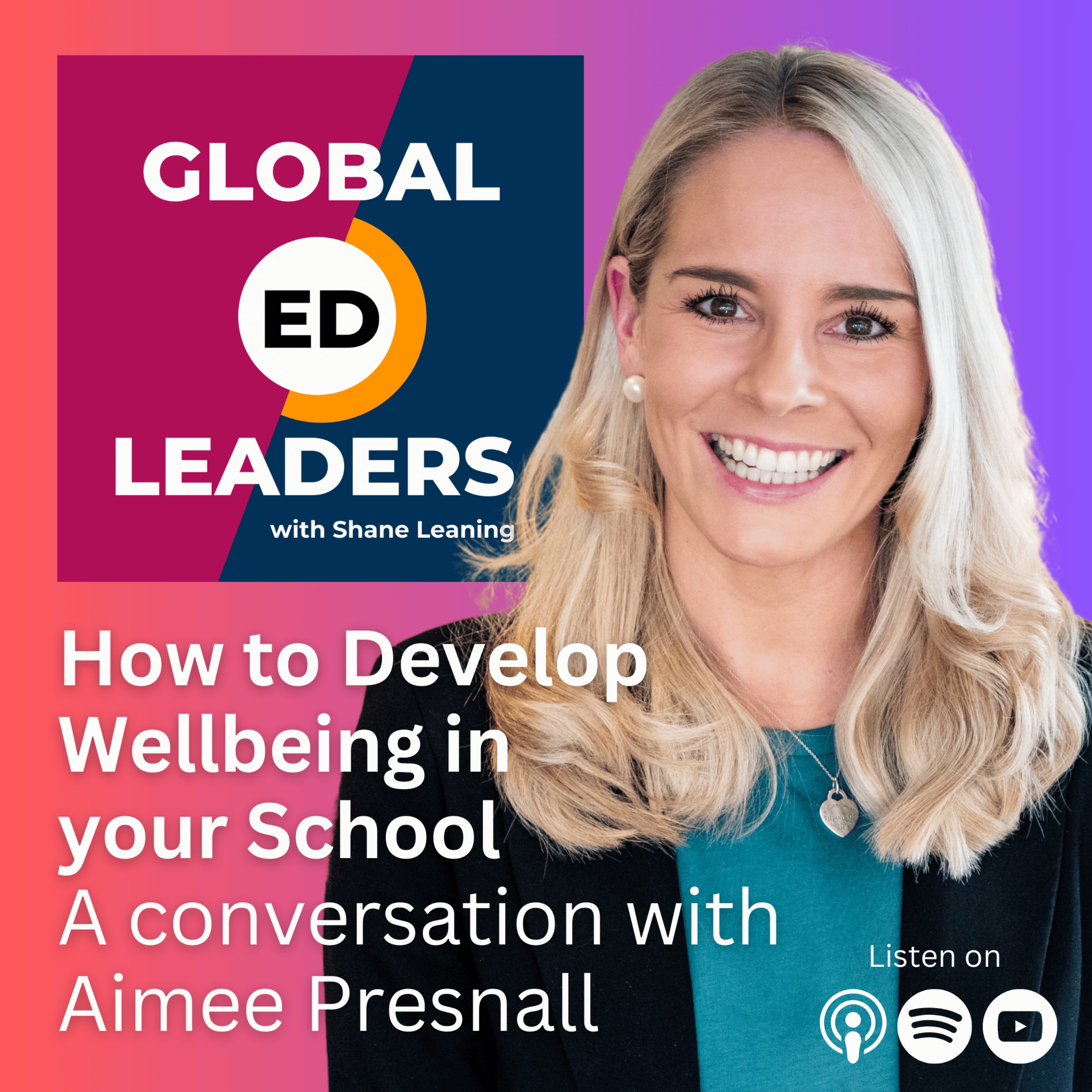
Shane and Aimee explore well-being in schools. Aimee shares her passion for well-being and how it started during her early years in school leadership. They discuss the importance of both feeling good and functioning well in order to achieve well-being.
They also explore the distinction between wellness and well-being, with wellness focusing on physical health and well-being encompassing mental and emotional states. Aimee emphasizes the need for a collective understanding of well-being in schools and the importance of individual and collective responsibility.
The conversation highlights the need for school leaders to establish a shared vision and purpose for well-being before implementing any initiatives. The conversation focuses on the importance of creating a collective strategic vision and goal to support the well-being of staff in schools.
LinkedIn: Aimee Presnall
Website: www.well-nest.com.au
Book 30min Staff Wellbeing Chat
Instagram: well_nest_collective_co
This episode is supported by the International Curriculum Association. Click here to Register For The International Curriculum Conference 2024
Thank you for tuning in, and as always, if you found this episode useful, please share your experience. You can find me online on X (@leaningshane), and LinkedIn. My website is shaneleaning.com and email address is [email protected].
About the host
Shane Leaning is an independent organisational coach based in Shanghai, collaborating with international schools and agencies globally. He co-founded Work Collaborative, a community dedicated to inside-out change in education, and hosts the chart-topping podcast, Global Ed Leaders. Previously, Shane was the Regional Head of Teacher Development for Nord Anglia Education’s China bilingual schools, overseeing professional development across 11 schools. He holds an Executive Master’s in International Education from King’s College London and is a certified organisational development coach.
Passionate about creating agency in schools and empowering leaders, Shane is co-authoring 'Change Starts Here,' due for release in Summer 2024. He is a CollectiveEd Fellow, an Associate of the Teacher Development Trust in the UK, and a TEDx speaker. Living internationally since 2012, with extensive experience in China and Asia, Shane is a recognised voice in international education leadership.
Join Shane's Intensive Leadership Programme at educationleaders.co/intensive
Shane Leaning, an organisational coach based in Shanghai, supports school leaders globally. He is the author of the best-selling 'Change Starts Here.' Shane is a leading educational voice in the UK, Asia and around the world.
You can find Shane on LinkedIn.
We are a proud member of the Education Leaders podcast network. For more great education shows, visit educationleaders.co/network/
Hosted on Acast. See acast.com/privacy for more information.
Auto-generated transcript. It may contain small errors.
How would you rate the well-being of staff in your school? If you'd like to make it just that little bit better, I know you are going to take huge value from this episode. Hey everyone, I'm Shane Leaning. Welcome to Global Ed Leaders, a podcast about education across countries and cultures.
I'm an organisational coach and in this show, I get to know the teachers, leaders and innovators, making a difference in schools around the world. Before we kick off, I'm delighted that today's episode is supported by the International Curriculum Association. Stay tuned to learn more about this year's International Curriculum Conference. My guest today is Amy Presnell and we are talking wellbeing.
Amy is an internationally sought-after speaker and her voice resonates right across continents. She advocates for the prioritisation of staff wellbeing in schools. She's established an online community called Wellnest, dedicated to bolstering the leadership wellbeing and career progression of educators and leaders. And she also hosts the brilliant Reflections of School Leaders podcast.
Her mission, to plant wellbeing at the heart of who schools are and what they do. So let's get straight into it. It was many, many, many years ago, really early in my leadership career in a school where I stepped into school leadership really young in my career. I had only been a teacher for a year and a leadership position had arose and I was approached as a candidate, someone that they were keen for me to step forward and put my hand up, which I did because I was very ambitious.
But Shane, I hadn't yet consolidated my only teaching practice. And in those first few years, I was just an absolute mess, a jumbled mess because I hadn't actually consolidated how I ran my own classroom, how I manage my own student-teacher relationships, how I manage my own teacher-parent relationships. And a year into it, I was not only managing my class, but also other classes and the year group as a whole and staff and parents. And so the first few years whilst I drove mainly on adrenaline, I was really struggling and I never put my hand up for help.
I pretended everything was okay. And I think from the outside, it looked okay. My feedback was positive. The team and the grade were doing really well.
But inside, I was a mess and we went on a leadership retreat one year and the theme was vulnerability. And it was just an extremely powerful retreat where I was exposed to leaders of all levels in the college. And I sat back and it was the first time I ever felt like I'm not alone. No leader had ever told me that they were struggling or the difficulties of the role.
And I sort of just felt like I was struggling on my own until I got to this retreat. And leaders of all levels were really vulnerable and honest about what they were struggling with. And when I got back on the bus and went back to the college, it was two things that resonated with me. One, the college needs to do something. School leaders are struggling. And this was over 10 years ago.
School leaders are struggling. We need to do something. But I also had the realization that I'm not looking after myself. And it was the first time I started to really get interested and involved in caring for self at work.
And so my endeavor to end up in the well-being space probably started back then without me realizing it. And I was extremely passionate about staff looking after themselves and for speaking up when they felt like they needed to to let leadership know how they're doing on a whole range of different topics. But that's where it started. I think that's quite a common experience, especially when you're thrust into a new position like middle leadership, for example, that for a while the energy just carries you.
You're feeling OK because you're just going for it. Yeah, there's adrenaline running through you. But that's not sustainable. Eventually, that's going to wear off. And then you're going to be left in this position of going, gosh, what am I doing?
You know, where am I? This is challenging. And then where do you turn? And it seems like that moment, that retreat came at quite a good time for you.
Yeah, it really did. And look, it didn't happen overnight. Well-being, as we know, is not a short term quick fix. It took me years and years. But over those years, I learned so many lessons and was able to then support colleagues as well who were either new in a leadership role or were actually very experienced in the role, but had put their hand up for a little bit of help of how to navigate things.
Yeah. So when you discovered that well-being was actually important to you, what did well-being mean? What were you thinking it was at that time? Not dissimilar to the definition that I utilize now about feeling good and functioning well. It's so simple, but it's so complicated.
For you to feel good and to function effectively at work seems, oh yeah, yeah, I feel good. Yeah, I function all right. Like, I'm not great. It's not really bad.
But you know, it's kind of in between. But when you actually sit and unpack how you're feeling and you actually unpack your effectiveness, it's so complicated. And so I think back then I just wanted to feel good. You know, I was just absolutely exhausted running on like this fight or flight constantly, like constantly putting out fires.
I was more reactive than I was proactive. Like all these feelings of just feeling on edge all the time. And something that so many teachers and educators love about their job is you never know what you're going to get on a day. You never know what a kid's going to say, what experience you're going to have in the classroom, what's going to make you laugh, an email you're going to get from a parent, a new approach or a new vision the school are taking for something like you really don't.
And that was for so many years for me, so exciting. But it also was extremely draining. And so even back then, I just wanted to feel good and be effective in what I did. And I wasn't feeling good. And I knew there were ways that I could be more effective.
I really like the two parts of this. From my perspective, the initial thinking with wellbeing is you initially go to the feel good part. It's about feeling well. But you actually extend that to it's not just about feeling well, it's about functioning well as well. They're both important component. Why do you need the both?
Because I think people might be looking after their sleep, so getting enough sleep, looking after their nutrition, staying hydrated, physically exercising, doing all the things that are making them feel good. But they're actually not functioning well at work. They're not productive. They're not collaborative. They're not doing all the things that's making them in their role, achieve a certain whatever it is that either is expected of them or that they want to achieve.
So you can actually do what we call all of the wellness side. So there's wellness and wellbeing. Wellness is traditionally what we as a society have been focusing on, but also what schools have initially tried to put into a little bit of a tick box. So that's the whole the state of being. That's where we're getting a lot of yoga on a Friday afternoon or chocolates in the staff room or meeting free weeks and all of those things are actually important.
It's what schools have initially started to do and they're ticking those bits off. And Pfizer at the beginning of this year, Pfizer defined wellness as the act of practicing healthy habits. You can do all of these things to practice healthy habits in order for you to be well. But what about your wellbeing, which is the state of your mind, which is more around your emotional, your psychological and your physical safety and health.
You're talking about the quality of your life, your meaning, the purpose in what you're doing, the relationships you've got, the connections that you've got, how and why you do what you do, the energy that you've got, thinking beyond ourselves in a work environment. So the wellbeing side is the state of our mind and then the wellness side is the state of being. And so I think I was back then very heavily focusing on the being part, which is equally as important, but a massive, massive problem that we've got in workplaces and schools being one of those at the moment is the lack of that state of mind, which again is that feeling part. The feeling part of that feeling good and functioning effectively is, you know, your motivation and your purpose and your meaning and your connection and your belonging and what you're doing as a really powerful part.
That distinction is so useful for me actually, it's so useful to frame this discussion between wellness and wellbeing. I haven't heard it articulated in that way before and that's a bit of a light bulb moment for me. And I really liked how you talked about some of the wellness initiatives that maybe schools have jumped on initially, like yoga after school or putting cakes in the staff room. I like the way you said that they are important and they need to go further and more because I've seen online or when talking with someone, I almost feel sometimes schools get shamed or berated for doing these things like, oh, you're not doing wellbeing properly because you're just putting cakes out.
That's a problem because the schools aren't doing anything wrong in doing those things. Those things are good things in themselves. It's just not the complete wellbeing picture. It's one part of a pretty big puzzle. And again, I think people are being very judgmental by saying schools are as you've just shared, like they're going down the wrong path.
They're not, but it's actually can be very detrimental for a school to say we're focusing on wellbeing because that's the term that they're using. We're focusing on staff wellbeing. We're going to implement all these wellness things and there's no improvement. It's almost more can actually be sometimes more detrimental if you just do the wellness part and you're not focusing on the state of mind for people because it's assumed or it's a little bit of a tick box that we're doing it.
And then there's tension and blame and resistance within the workplace because leaders in schools are saying, well, we're doing it. We're doing something and teachers are saying, that's not helping, you know, with our burnout levels, with our teacher attrition and retention rates and all of these things. So there's sometimes it actually creates more tension, not that schools are doing anything wrong, but they've got to be very careful because it can create more tension and more blame within the workplace if we're not conscious of doing both. You almost can't just label yourself as we're doing wellbeing by doing a few wellness activities.
Just say it as it is. Say we're putting in a couple of wellness activities rather than saying we're prioritizing wellbeing because that's just going to set people up to feel frustrated and disconnected. Absolutely. Yeah, it's so important. Shane, I think one of the biggest, almost common conversations I have with school leaders is around everyone having a collective understanding of what wellbeing and wellness is.
It's one of our, like, number one go-to workshops is actually getting someone in, like us at Wellness, to come in and actually educate leaders and staff collectively so everyone hears it at the same time. It still can take staff time to process what's shared and that there is individual and collective responsibility when it comes to wellness and wellbeing. And whilst we do have a lot of tension and blame in schools and a lot of finger pointing on what leaders are not doing, I also like to reframe it of what are the teachers doing? Yes, the leaders need to do things, but as an individual of your own being, what are you doing both at home and in the workplace to look after yourself?
So that collective understanding is by far where majority of the world is sitting at the moment when it comes to workplace wellbeing because it's, again, can be just as detrimental to just bring in someone in and just put all these things in place. But people don't actually understand their own responsibility and you're going to get nowhere. If schools are doing all these amazing things, but teachers aren't looking after themselves and leaders aren't looking after themselves, it's not going to work. So it's very much a collective thing.
And I know I think a lot of people naturally understand that and know that, but to actually live and breathe that and show in your language and your behaviours on a day-to-day basis that you actually understand and believe it are two very different things. This is like almost a perfect step one because potentially school leaders can run before they're walking because they haven't established some of the solid ground. And maybe the solid ground is, as you said, it's a collective understanding of what we mean by wellbeing. And maybe before we even try to implement anything, would you say that's the first step, collective understanding?
I think there's a step before that. Okay. There's so much power that comes from school leaders sharing a shared vision and purpose for what you're doing. So it's all well and good for you to get someone in to educate stuff on what wellbeing is.
But that means nothing and actually creates more tension if it hasn't been shared, that there is a collective strategic vision and goal to support the wellbeing of staff in this school over the next however long the strategic plan is. So there's so much power that's got to come from people at the top sharing really vulnerable and honestly in a trustworthy space that we've identified that there's an area of need here. And we're going to do something about it. And this is why.
And our first step is to educate everybody. It's so important that it has to be strategic. It can't just be a tick box. It has to be strategic.
And we can't just say that we're going to work on a staff wellbeing policy and then we're going to be all good, which is what is happening. Which often happens. Which is often happening. Like policy is the written part of culture.
You can have any kind of policy written by any kind of expert. But if the behaviours and the language and what you're expecting from the policy is not being seen on a day-to-day basis by everybody, nothing's going to change. So I think even before you get someone in to get everyone to have a collective understanding, there has to be genuine shared vision and purpose from the top that this is a focus area and this is why. And Shane, globally, we've got alarming statistics of teacher shortages.
I was only recently speaking to someone the other day who was very passionate and I totally agree with her about we don't have a teacher shortage. We've just got teachers that don't want to teach. Yeah, that's a different framing, isn't it? Yeah, it's a very big difference between there being a teacher shortage and we've actually got so many teachers.
They're just choosing to do something else. And for a lot of school leaders, their initial drive to get into contact with us is around them genuinely wanting to look after their staff because they're feeling like they're losing their staff. As one of the big catalysts for like, oh gosh, we've always known that we have to look after our people, but we actually need to look after our people more than ever because we're really struggling. And often that is the catalyst to actually take this seriously.
And listeners to this podcast are mainly in international schools around the world and also feeling that same teacher shortage that I know is happening across continents. And yet the way you framed it is so right. It's not a teacher shortage in that we haven't got enough teachers. It's that we can't retain those teachers.
They don't want to stay in teaching, which is why it does frustrate me. I see policies put in by governments of trying to just recruit new teachers. And it's like, what? Just to recruit them into a system that they're not going to stay?
Absolutely. That's not where we should be looking. So it's great that people like you were doing the work that you're doing, really focusing in on the wellbeing of teachers, not just the wellness, but the full wellbeing. Yeah, absolutely.
I want to take a moment to tell you about the International Curriculum Conference that is coming up from the International Curriculum Association. It will be held from the 11th to the 13th of November in 2024 in Kuala Lumpur in Malaysia. It is so exciting. The theme of this is global perspectives, local impact.
And I was at their conference last year. I can't recommend it highly enough. This is a focal point for the global community of schools, part of the International Curriculum Association. There is going to be amazing keynote speakers and a wide range of school-led workshops delivered by classroom teachers sharing their practice and experience.
Seriously, with the incredible insights and showcasing of learning, I really do recommend the International Curriculum Conference because it offers a unique level of enrichment connection and learning for all. If you're interested, check out the link in the show notes to register. Please go there. It's going to be great.
I was speaking to a school leader, Shane, the other day who was frustrated that they've got some applications coming in for a new role and every single applicant has asked how they look after their staff. And one particular applicant was quite vocal about their response, like what they shared they do to look after their staff. And then this applicant had quite an opinion on why that wasn't good enough. And the principal was very frustrated and I think a little bit overwhelmed by what questions this person asked and they didn't know what to say back.
And I think back to if I was studying teaching now and I'm watching the news, reading the media, speaking to teachers who are literally in a profession that they want to leave, I would be asking exactly the same questions. Yeah, people are getting very defensive about why people are. And I think but we need to look at the perception they've got of the industry and of the profession and changing that narrative to being more positive and more. Yeah, hey, we've had a few difficult decade or two. But hey, this is what's changing. This is what we're working on.
This is how we are the system. We can't wait for the system to change. The people that are in it are it. This is what we're doing.
But I totally actually do. If I can step back and remove all my emotions and thoughts and perceptions. If I was a new grad looking in, I would be very intrigued to know what's happening so that I don't burn out, so that I don't spend all these years investing in this profession to then get in and leave. I guess it comes all the way back to why leaders need to think about that first step about purpose and intention.
Is this important? I guess is the question to ask, is this important to you? And if so, why is it? What is that driver?
Is it because you're struggling to keep teachers? Is it because your teachers are not performing at their best? Is it because people are not hanging around? Is it just because you just generally see tired teachers in front of you or teachers with low morale in front of you?
What's your why? And start from there, step one, and then step two is then to go, how do we create a collective understanding around what wellbeing means to us as a school? And then I guess once you've got that, then you would move into some sort of implementation or strategies to start to address that challenge directly. Yeah, assessing the current state of how things are, you know, using data because nine times out of ten when I speak to school leaders and then I speak to their staff, they've got very different opinions about what's happening.
And so you need to get that collective understanding through an assessment. And at Wellness, we use the WOW accredited assessment tool, which is one of the leading global assessment tools that provides detailed insights, valuable insights for not just the school as a whole, but we can then break it down into teams and then we can break it down into individuals. And so you can often see which teams might be needing the most attention, and then those that are doing really well, those that need a little bit of help, and then how's the organization going collectively. And look, some schools we speak to just go for the whole college. They don't want teams, they don't want it breaking down that way. But the cool feature about this tool that we use is that we can break it down into as many parts as we want, or we can keep it as a whole, whatever the school's looking to work towards.
But often, not only are schools looking at the staff well-being, but they're looking at, as you said, the productivity, the collaboration, the team dynamic, all of that has such a huge impact on how people feel and function at work. And so a lot of the time, a lot of the work, just like you do through coaching, comes in to actually how are leaders navigating the complexities of their team dynamics, whether that be that they're executive leaders or that they lead a smaller group. It's extremely powerful, and so much of that middle management drives so much strategic vision and direction, and they just hold so much powerful impact on a school community. And so often, sometimes, schools do want to see how different teams are functioning in order to build an environment that's engaging, that's productive, that's innovative, that builds this overall culture that they're looking for is so important.
So assessing the current situation is a really big part of those initial first steps. That makes sense, and it speaks to the complexity of schools. Really, when you think that there's multiple teams operating in any school, and sometimes the mistake we can make as senior leaders in schools is to think that there is a general issue across the school. And you might actually find that the music department over there, they're pretty happy.
They've got a leader who's kind of maybe managing, and they've got some things in place. But actually, the English teachers over here are totally burned out because of X or the PE teachers, or even it might be that the teaching assistants have a particular contextual issue that they're dealing with in their wellbeing. So sometimes, while it's useful to have the general at the top, sometimes you really, I guess, have to do the digging into the teams, because that can be where certain issues come out. Absolutely. And look, some schools don't have the capacity at the time to focus on all these things. It all just gets a little bit too much, but it depends on a whole bunch of things.
But it's also so important that once you gather the data, that school leaders don't pick the priority areas without staff having a voice. And this is where a lot of schools are making mistakes. They're making it feel like staff are being heard by doing a survey and gathering information from the survey about how staff are feeling. And then deciding, as the leadership team, based on all this data, this is what we're going to focus on.
And then staff feel unheard, because they feel like, look, yes, I've shared, but then all of a sudden what you're working on is not what I think is most important. So it's so important that actually there's a pulse survey once you've got all the data from the initial survey, and you sort of unpack it all. And then you actually do a pulse survey out to staff. You share very honestly and vulnerably what the results were, which I'll come back to in a second.
And then picking priority areas, depending again on the capacity, some schools pick one, some pick three of what the priority areas are, and everyone has picked. So it's whichever gets the most votes, because otherwise there's so many things will pop up in the survey, depending on how many staff you've got and how many areas of concern there are. It can be quite overwhelming getting that kind of data back. You've asked staff to be honest. They're honest, but you're not really sure that you want the feedback.
And when you get the feedback, it can often be either not at all what you thought it was going to be, or so much more than you thought it was going to be. And so collectively deciding on what the priority areas will be and then going from there is so important. And I think a lot of school leaders get overwhelmed by two things, Shane. They get overwhelmed by having to vulnerably share what comes back from the data.
And I think that's a huge reason why there's resistance to getting involved in this space, because they know there's tension within the workplace. They know that teachers are craving it and that it's all over the global news. And, you know, it's a hot topic at the moment. And they're nervous and scared and apprehensive to put out there a survey that's so personal, which wellbeing is, to then get it back, to then feel like they're responsible for everything that comes back.
And they're not. And this is why I love the WoW assessment tool and the way that we do it is because there's so much that can be seen on an individual level. And of course on a collective, but it's trying to reframe for them around resourcefulness versus resources. So I think leaders get really overwhelmed, not only with the vulnerability initially, but then what do we do with it all, Amy?
Then what? You know, we're already at capacity. We already don't have enough time to do this, this, this and this. And we're worried that, you know, this data is going to come back and all these things need to flip and change.
And it's that actually we want to be resourceful with what we've already got. Just tweak it a little bit in order to make small gains over time. So I'll give you an example. I was working with the international school and we gathered the data and it was really confronting data because the data came back to say that a high percentage of staff didn't trust executive leadership.
Trust is number one. And for that to come back as an issue was very confronting for the leaders. And we had to do a little bit of unpacking around that. But trust actually came up as a really big thing.
But so did communication as something that was making staff feel stressed. Now, again, we're talking about feeling good and functioning effectively. If I'm starting my day feeling stressed because of some kind of process or system that the school's got, it's impacting that beginning part of my day. So I'm coming to school not feeling good because I'm apprehensive about whatever this is that appears every morning in my inbox.
And I'm then not able to function effectively for the rest of the day because it's caught me so off guard. There's so many things to do. And so one of the things that we identified was the bulletin, you know, like one of those morning messages that goes out to all staff to update them on who's coming in for a tour this morning. And, you know, you need to do this for your class. And we need all that kind of communication that goes out as school leaders feel that they're being communicative, right?
We're sharing all of this. We're not putting deadlines at the last minute. There's all these really positive things that school leaders are trying to do when they're talking about how they're communicating with their staff. But have they ever actually stopped to think how that's making their staff feel of a morning, the way that it's laid out at the time?
So this particular bulletin was just a bunch of stuff. But you could scroll and scroll and scroll and scroll. And some of it was for students and some of it was for parents. And you need to do this and fill out this and do that.
So when staff got to work and opened up their laptop, they were so overwhelmed every morning about this list. And we ended up trialing to categorize. So not changing the bulletin, not trying to recreate the way that we communicate because it's stressing our staff. But how could we utilize and be resourceful with what we've already got to make it even better?
And that was to categorize the bulletin. So if you're, you know, an elementary teacher, you read here. If you're middle school, you read here. Like it was sort of categorized more.
And stuff instantly felt like, okay, when I open up my laptop, I know the section I've got to go and read. I can read that, write down what I've got it to do and can get on with my day. So it's just, leaders get so overwhelmed by going down this avenue because they're so worried about what's going to come back. And yes, sometimes often the data is quite confronting.
But there are ways that you can be resourceful with what you've already got and just tweaking it slightly so that your staff can feel good and function effectively in the simplest form, honestly. I love this. And it cycles back to what you started with, talking about vulnerability and your experience. And I guess creating a culture of vulnerability or a trust in that can go a long way to helping you deal with some of these things.
But what I've really loved about this conversation, Amy, is that it's a wellbeing conversation where we haven't focused on strategies. We focused on strategy. That for me is much more helpful. You know, a lot of time, you know, as an organizational coach, I'm very passionate about not going in with the answers for schools or, you know, do this, do that.
And I think so many times when we think of wellbeing, we can think of lists on Pinterest of things of wellbeing activities. Like, you know, you know, the posters and wellbeing stuff. You just need to do some of this wellbeing stuff or, oh, look at this great school. Or, for example, even the example you've just given, you gave an example of simplifying a bulletin.
The reason that was impactful there is because it was contextual to that school because they'd done the strategic work to work it out. Not because that strategy could just go and pop in another school and improve the wellbeing there. So really, you have to follow that process. You have to think about your purpose.
You have to then get a shared understanding. And then you have to survey and get to know what those issues are before you implement any wellbeing initiative or activity or change or tweak. I like how you talked about tweaks. It's not just about adding stuff into the school.
That is the last thing that we want to do is to create truckloads of work on top of what's already happening. That doesn't mean that initially there's not work that has to be done, of course. But that's why we're really, really focused at Wellnest on being resourceful with what's already there because schools are already doing incredibly amazing things. They've got amazing, in many ways, a lot of systems and processes that are awesome, but they need to be tweaked.
They haven't taken the time to sit down and think about how it's impacting how people are feeling and functioning at work. They've kind of just gone, oh, this is a good collaborative tool to use so that everyone can access it and everyone can do this. That's awesome. That's amazing.
But hang on a minute. How is it shared with staff? When's it shared? All those kinds of things.
So, Shane, no school principal, head of school executive wakes up or is constantly every day going to work, trying to make work an unhappy place for people. That is not what they're waking up and going to work to do. But there is a lot of blame and there's a lot of tension out there. And the disgruntledness is causing a lot of blame on leaders for not doing enough.
And that's also a narrative that we need to change around the complex role, as you and I know, of a school leader. But so much of it comes from purpose and vision. And, you know, if you want to survey your staff yet you haven't shared that vision, people are either going to get either two things. You know, people that are not honest in the survey and they just go, oh, I'm not going to be honest because nothing's going to be done or I'm not going to be honest because what are the ramifications for me being honest?
There's a lot of work in some instances that needs to be done before you're pushing out that survey. There's so much around that shared vision, purpose, trust and what currently exists before you start to just push out a link to a survey because it's just got huge implications if it's not set with the tone from the beginning and the energy that you're looking for. Have you heard of Michelle McQuaid? No, tell me.
Michelle McQuaid, amazing wellbeing practitioner. And I had her on the Wonders of Wellbeing podcast ages ago and her and I were talking about navigating change. And she shared so much about how we navigate change, not manage change. She's very passionate that we can't manage it, we navigate it.
And so much of how we navigate change is determined by our energy. And there's so much in that for school leaders who are approaching staff wellbeing and the energy and the tone that they set from the first conversation they have with staff about it. The very first conversation has to have the tone and energy that connects to the vision that they've already got. Not, oh, I'm going to stand up and share this in the staff meeting today because I think we might start to look at it and we want to.
No, no, no, you have to be so clear on what your vision and mission is for the school before you approach staff so that that energy is consistent from the very beginning that automatically builds that sense of trust for staff is just so important. Amy, what I've loved about this conversation today is you've really talked through the process and you've really given so many practical tools that I think a leader could pick up to really structure their thinking as they move forward with their wellbeing journey. Navigating that change that has to happen and that we can't wait for governments or organizations outside of schools to change. We have to be the change makers in the school and you've really brought a really great call to action with that.
So I'm so incredibly thankful for this conversation. Amy, it's been very powerful. Thank you so much for sharing my absolute pleasure and thank you so much for having me. There's a few other parts, obviously, to that process beyond the survey part.
But if that's a really good chunk for people to get started, that's awesome. And please, Shane, anyone out there who's in the international schools, who's a leader who's just really feeling unsure, please just reach out. I love jumping on and chatting about staff wellbeing. So if I can help anyone in any way to do a bit of brainstorming, I'm always here.
Wow, I really took a lot from our conversation today. I love the distinction between wellness in terms of physical health and wellbeing, your mental, your emotional states. And there really is an individual and a collective responsibility for wellbeing. As a school leader, you need to think about establishing a shared vision and purpose for wellbeing before implementing any initiatives.
Needers need to share vulnerability and honesty to create that collective strategic vision and the goal for staff wellbeing. Strategic action is necessary to address staff wellbeing rather than just ticking boxes. So you need to think about how you set the tone and energy right from the beginning and navigate change with a clear vision and a mission. You can find out a work with Amy by going to her website well-nest.com.au and pop those links in the show notes.
Global Leaders is hosted by me, Shane Leaning. Huge thanks to my show editor, Pete McGill, and for the original music by DMA Silver. If you like this show, go ahead, follow and subscribe on your podcast app to keep up to date with the latest episodes. And as ever, if we don't speak before, I'll see you here next week.
Remember to find out more about the International curriculum Association and that fantastic international curriculum conference in November. Check out the links in the show notes.
GUEST EPISODE Shane Leaning is interviewed by Chris Jordan on The Leading, Language and Literature Podcast. We discuss: 1. What made Shane…
Listen & show notes
Is your school's literacy strategy doing more harm than good? In today's episode, educational consultant Chris Scorer joins me at a local…
Listen & show notes
In this episode, I explore principles that can guide every international school leader. As educators, we are public servants, and it's…
Listen & show notes