

Want Better Solutions? Start with Bigger Dreams | Change Series 1.7
Think you've got that next big project all sorted in your head? Hold that thought because today we're going to explore why sometimes those…
Listen & show notes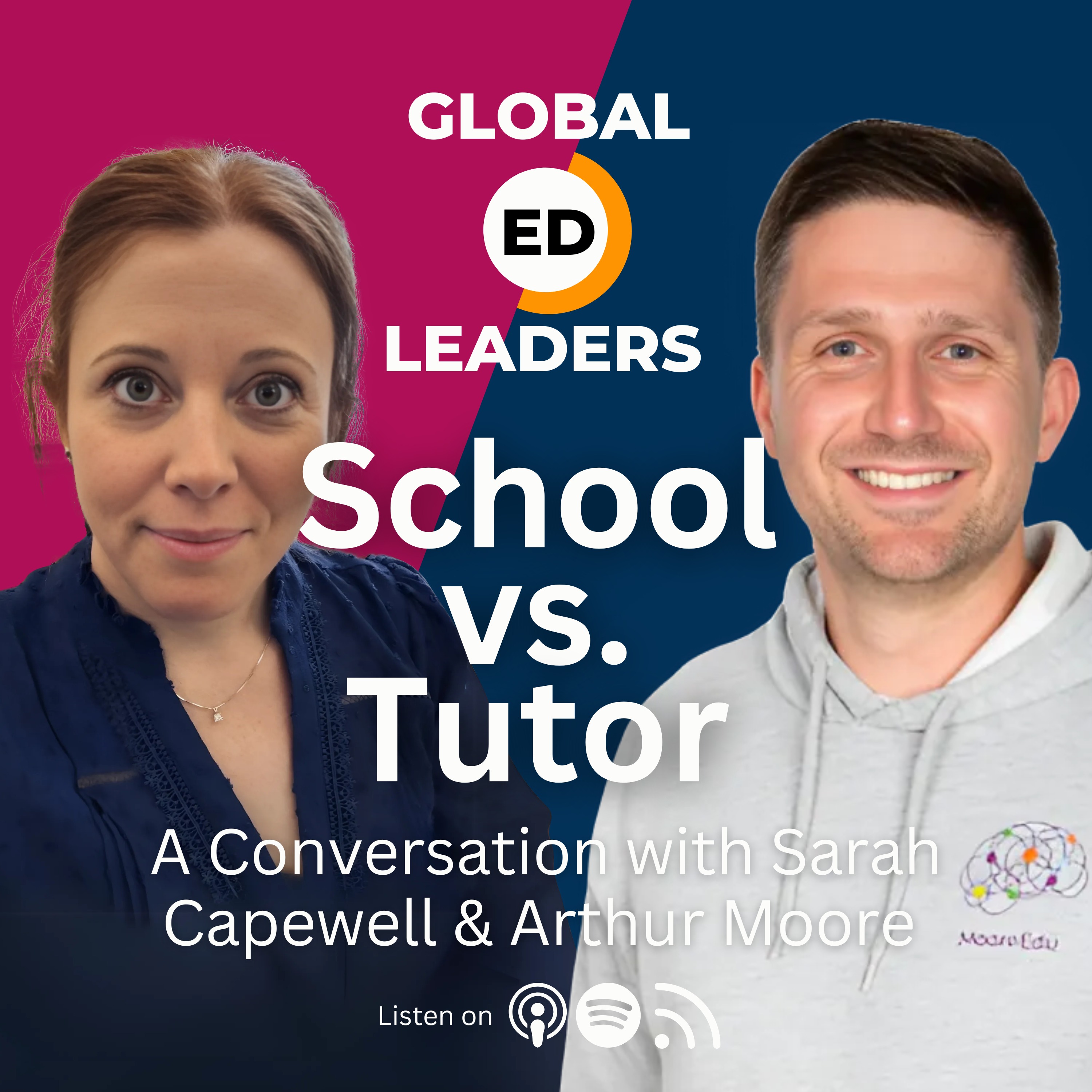
When some families see tutoring as non-negotiable and others as a last resort, how should international schools approach this complex topic? Sarah Capewell (founder of Aster Academy) and Arthur Moore (Professional Tutor of the Year 2024) unpack the challenges and opportunities around tutoring in international education.
The International Curriculum Association | Learn more at internationalcurriculum.com.
The University of Warwick's International Programmes | Learn more at warwick.ac.uk
Thank you for tuning in, and as always, if you found this episode useful, please share your experience. You can find me online on LinkedIn. My website is shaneleaning.com and email address is [email protected].
Shane Leaning, an organisational coach based in Shanghai, supports international schools globally. He co-founded Work Collaborative and hosts the chat-topping school leadership podcast, Global Ed Leaders. Previously, he worked as Regional Head of Teaching Development for Nord Anglia Education. Passionate about empowering educators, he is currently co-authoring 'Change Starts Here.' As a CollectivEd Fellow, Teacher Development Trust Associate, and TEDx speaker, Shane has extensive experience in the UK and Asia and is a recognised voice in international education leadership. Learn more at shaneleaning.com.
Join Shane's Intensive Leadership Programme at educationleaders.co/intensive
Shane Leaning, an organisational coach based in Shanghai, supports school leaders globally. He is the author of the best-selling 'Change Starts Here.' Shane is a leading educational voice in the UK, Asia and around the world.
You can find Shane on LinkedIn.
We are a proud member of the Education Leaders podcast network. For more great education shows, visit educationleaders.co/network/
Hosted on Acast. See acast.com/privacy for more information.
Auto-generated transcript. It may contain small errors.
For some families, tutoring is non-negotiable and for others, it's a last resort, but for schools, well, it's complicated. Today we're going to explore how to navigate that tutoring conversation in our international schools. Hey everyone, I'm Shane Leaning. Welcome to Global Ed Leaders, the chat-topping podcast for international schools.
I'm an organizational coach and in this show, I get to know the teachers, leaders, and innovators making a difference in education across the world. Now, before we jump in today, I'm excited that this episode is supported by the International Curriculum Association and the University of Warwick. Stay tuned to learn more. Okay, so my guests today are Sarah Capewell and Arthur Moore.
Sarah is a former head of English and she is the founder of Astartuition, an international tutoring business. She actually stepped away from full-time teaching in 2021 as built a global tutoring enterprise. And Arthur, who actually introduced me to Sarah, is a secondary teacher and also in the tutoring world. In fact, in 2024, he won the Professional Tutor of the Year.
You may have heard of him because he speaks at educational conferences and if you are a geek about education podcasts like me, you cannot have missed his tea and teaching podcast. And he also has another podcast called Tutoring Tips. And today I have so many questions for them both about tutoring in an international school context. So we started the conversation by thinking about those perceptions and misunderstandings that school leaders have about tutoring.
Let's jump in. Well, from my perspective, Shane, tutoring is part of education. And what I mean by that is sometimes people talk about tutoring as this thing that happens outside school is completely separate. Whereas I see everything we do is kind of in this big umbrella of education and schools pay a huge, huge part of that.
But tutoring is within that umbrella as well. And sometimes it's within the umbrella of schools or outside school. So it is part of the education landscape and we all have our own perceptions upon tutoring, normally due to our own background and how much we use it in our education. So that's kind of where I see it's part of the overall educational journey of a student and it can play very specific, it can play wide roles, it can come in for a moment, or it can take course over a number of years.
It's funny you say that it's part of it, I agree. Do you think though that some schools just see it as a school and themselves see it as outside and maybe even a bit of a nuisance? Like is there that perception? I don't know what you feel, Sarah.
Yeah, I have been on both sides of that. So that kind of resonates with me. So I'm going to tread very carefully also. When I have been involved in tutoring, it was normal practice for me.
I had a tutor when I was at school. My children have had tutors and they've both gone through the prep and boarding school system and when I was head of English, I knew that many of the students who were under my care were also having tutoring and I would liaise with the tutor because it felt to me like they were supporting me and what I was trying to do and we were all there to try and get the best out of the child. So I've always had a very positive kind of relationship with tutors, both as a parent but also as an educator. So that's definitely given me a real sense of perspective when I started my tutoring business.
So yeah, very positive, which definitely helps me. But I can totally see how there could be slight issues either side. I have come across some teachers who see tutoring as a bit of a nuisance. I think that's probably the best way to put it and getting in their way.
I love that. Arthur. I think I've been that teacher, Sarah. So I never had tutoring growing up in kind of a state school system.
I don't know anyone who was tutored. It wasn't even a conversation point. So I think my first understanding of tutoring was when I was in the classroom and students had come to me with an extra bit of work that they'd done, being like, oh, I've been struggling this or I've been working on this with my tutor. When are we going doing this?
And I think for a naive teacher, especially in my early years of teaching, I'd look at the paper and my instant reaction was Shane would be like, well, this isn't on my curriculum at the moment. We're not doing this. I don't want to teach this right now. This is annoying that you're doing something completely random and you're asking about me. And obviously my perception has changed from that.
But I speak to a lot of teachers over the years who have a very similar initial reaction to tutoring because sometimes they see it as maybe a reflection upon themselves. So if if I hear one of my students is having tutoring and I'm sure I did this, I would go, well, why are they having tutoring? That must be that someone has decided that I'm not doing a good enough job to therefore be as a comment on me as a teacher, which is absolutely not the case. But I can definitely see why some teachers might initially have that case in some people within schools.
That makes a lot of sense as a misconception. Actually, thinking about it is it plays on your anxiety as a school or as a teacher that why do they need tutoring? Oh, enough forgetting that it's actually part of a lot of the makeup of the education landscape, as we call it. I'm curious, then, Arthur, to come back to you.
What would be your response now as a teacher? Then you said that's kind of how you used to feel when they came up to your desk with that work. Like, what do you think the response should be? I think the response should be, isn't it great that you are getting you're so passionate about this subject or you're so passionate about your own learning that you're doing extra stuff outside the classroom to get even better.
And the way I would flip it is if you were a PE teacher and a student came to you and said, oh, I'm doing an after school club with football and I'm going on Saturdays to play football and here's some of the stuff I've been working on. I suspect most PE teachers would be like, that's awful. Why are you playing more of this sport? That's not good.
So I think that's how it's kind of flipped me kind of from my maths perspective would be like, isn't it great that you're kind of exploring these other areas with a teacher who's maybe got a slightly different background, a slightly different perspective from me, and can kind of cover stuff in more depth or in more breadth or has that autonomy to support you? So I think it's not a reflection upon me. What it is, it's a reflection upon the student of the fact that they want to learn or the fact they're embracing learning another way. So I would flip kind of who it's a reflection upon and I would see it as going from a negative reflection upon myself to a positive reflection upon the student.
I like the way you frame that. And Sarah, I see you nodding. Have you got any reflections to build upon that? Yeah, I completely agree with everything that Arthur has said.
And that's a really good analogy, actually, with the PE. You wouldn't ever say, oh, my gosh, I can't believe you're doing extra practice. It just made me smile. And I think it never once occurred to me to think that it was a reflection on me as a teacher, not out of any position of arrogance.
It's just that I'd always been around tutoring in one form or another. So it never occurred to me to think it was a reflection on me. And I think that probably framed a lot of the conversations I then had with parents and the tutor. So it was absolutely fine for the tutor to include me in emails.
I would share homework and I would say what's worked and what hasn't, because I just saw it as an extra level of support, an extra layer of support. And we were very much operating as like a team around the child. That's how it worked. And in the best cases, it gave that child even more confidence when it came to being in the classroom with me.
So it was definitely sort of a win-win all round. But it was definitely framed by my experience, I think, growing up. This is really interesting to me. Of course, it's framed by our own experiences.
And I think I maybe would have had a similar feeling to you, Arthur, when I was teaching, like I definitely saw tutoring as this outside thing because I had not experienced it. So it was just new to me and alien to me and I didn't know how to approach it. And I guess I also didn't really know what my school's position was on it, which maybe is something that school as a leader, you need to think about. Have you got a clear message on where tutoring fits into your ecosystem as a school?
And a teacher is really aware because teachers are going to be the ones who are interacting with students who bring in that tutoring work or who mention tutoring or at the parent-teacher conference where tutoring is mentioned or when in China. I know, Sarah, you work with many schools in China, but sometimes when I used to be on parent-teacher conferences here, a tutor would be brought with the parent and me. Have you heard of that before? Yeah, I mean, I've been asked to attend these meetings online.
And then when they've come over to boarding school in the UK to be that kind of third person. And that, for me, felt a little bit strange. I sort of felt like it was encroaching upon a slightly different dynamic. But yeah, that's sort of from one extreme to the other.
It's like tutoring is this hidden thing. And you must not mention it to write your part of the whole group. And we want you to be there to liaise with the teacher and the parents. So, yeah, it sort of covers every end of that spectrum.
And you're in that area a lot at the minute, Sarah, with being a tutoring provider. So do you have preferences on how tutoring is set up between the school and the tutoring? Is there an ideal relationship there? I mean, any positive relationship, anything is better than nothing.
It very much depends because a lot of the work I do is through agents. So when there are educational agents involved, you've suddenly got several people involved in that situation. So it does become more difficult to have that dynamic. You're not necessarily liaising with the parents.
You're a few steps removed. And that does make it more difficult. And it's almost like there are maybe not gatekeepers, but if the parents don't speak much or any English and the only conversation you're having is with the agent or with the student, it does become more difficult to kind of foster a relationship with the school, for sure. I'm interested. What is the role of the agent in the kind of tutoring process?
Yeah, it sounds a bit nefarious, doesn't it? I keep forgetting, like, you're talking about this really shady back world. So it very much depends. But in essence, an agent is sort of the middleman and they often will start working with a family many years before they've even decided which school or university or American college a child wants to go to.
But fundamentally, they're there to provide support in accessing the best school for that child. And that then involves everything else around it. So the tutoring is part of that. So the agent, from my experience, they're involved about three to four years before a child is moved, whether that is to an international school and then on to a college.
But the end point is always Ivy League or a G5 university in the UK. So if they start at four plus or seven plus, there's always that end goal in sight. So the agent is there to kind of hold the hand of the family and make sure they've got everything in place to give that child the best chance of success. And tutoring plays a huge part in that.
And that's where you were, which is mainly with China, right? Yeah. After, is tutoring running a similar way in the UK or is it slightly different in terms of expectations? I think it comes back to what Sarah is saying.
It's so much about your own experience and perception upon tutoring. I know plenty of students who have had a tutor. Let's just call it from day one, day one of their educational, formal educational journey. And it wouldn't even be seen as a weird or an extra thing.
It's just, well, as part of your educational process, you're going to have a tutor. And that might start as a tutor, just kind of overall start with and then kind of become more specialised, much in a way, since a lot of our students will have music lessons from very early on, because it's kind of part of the fabric of the family. It's just something they want them to do. Sometimes that might be sport for some families.
I think what we have in kind of our education system is that difference between the state and kind of the private, independent school in the UK is it's just different expectations and different norms for the family. So a lot of the students I taught when I was teaching in schools to even mention the idea of having a tutor wouldn't even been a conversation started. We're just being a thinking point. Whereas I've worked with other students, whether it's internationally or in independent schools in the UK, who it's not a question to not have a tutor.
So it's a very disparate kind of idea within education. And that's one of the things we're kind of talking about today. It's like, what is tutoring? And we all have our own perception upon what tutoring is and the role it plays.
So it's a really hard question to answer, Shane. From my experience, especially the UK is very focused on kind of exam moments. So my 11 plus, I need a tutor for my 11 plus. That's a big, big market in the UK.
My GCSEs are coming up. I need a tutor for my GCSEs. So it's kind of more built around moments rather than a whole, as Sarah's kind of alluded to. Right. You're in year five.
Let's really start thinking about what you want to study at university and which student you want to go to. And let's get a tutoring team and kind of get them in now so we can board towards that goal. Sometimes in the UK, maybe it's a bit more reactive of like, oh, GCSEs, next week, quit, get a tutor, which is what I get a lot of. That almost speaks to maybe where tutoring sits within the society or the culture as well.
Like, and it's funny, like, because I think a few years ago, you know, in the UK, there's been a rise of tutoring. That's definitely been happening, that trend. And it's been advocated by the government and different agencies. Right. And in China, where there was a very established tutoring place,
they almost had a bit of a crisis a few years ago where the government kind of went, oh, I'm not sure we're comfortable with this and put some restrictions in place as well. But interestingly, in China, the parents are still very used to the concept of tutoring, which is where I assume a lot of your conversations are happening. Sarah's parents are still needing this service, especially because they're thinking about long term international trajectories, which I guess are most of the clients who you work with. Yeah, absolutely. For us, yes, there was obviously
the double reduction policy and the Chinese government looking to reduce the burden on students. But fundamentally, that sort of the Chinese culture is very much that we're going to work really hard in order to get success and its future prosperity. So that hasn't changed or shifted at all. All that's happened is that parents are perhaps looking elsewhere for that support.
And I think there's an understanding that actually it's needed in order for the child to get wherever they want to get to. And it's part of the fabric of their lives. I liked what you said, Arthur, about exam moments. I was nodding along to that because that's definitely our U.K. audience.
It's all about that. It's I've got my 11 plus in nine months. I've got my GCSEs in three months. And it's a sense of we are prepping for this one moment and then we'll see what happens.
Whereas my experience with Chinese families has been, OK, we're planning many, many years in advance here. So therefore the tutoring is just a natural part of that journey. So nothing has shifted in terms of that support at all for me. This episode is supported by the International Curriculum Association.
The ICA have been around for about 30 years now championing quality, unlocking potential and improving learning in international schools. And what I really love is that right at their core is the model for improving learning. This is a model focused on the learning experience, and they have tons of great curriculum materials, PD resources and even an accreditation pathway for schools just like yours. If you're interested, head over to internationalcurriculum.com.
You know, recruiting and developing great teachers is one of the biggest challenges we face in international schools. That's why I'm excited about the University of Warwick Center for teacher education. Their QTS and PGCEI with QTS programs are specifically designed for international schools, combining online learning with hands on classroom experience. Check out the link in the show notes to learn more how they develop teachers in your school.
So if I can shift our conversation a little, I know a lot of people who are tuning in now are going to be school leaders, international school leaders, and often the school is that first part of coal sometimes for a parent when they're starting to think about these things. So they go, oh, I want tutoring. They may then go to one of the school leaders or a teacher and just ask them what's your advice, you know, where do I go? And I guess there's good advice and bad advice when looking for tutors.
And I'm guessing also that the tutoring industry, if you were to call it that or market is also very varied and diverse as to what you can get. So are there any things that kind of come to mind for you that school leaders should be sharing with parents who are considering tutoring? Maybe start with you, Sarah. Yeah, I think you've made a good point that it can be a bit of a minefield and there are huge variations in quality and experience in terms of tutors.
That's the same with any industry. You know, you should really do your due diligence. But I think this is where it would be fantastic if kind of schools could liaise with tutors who understand that market inside out. So my expertise and my team's expertise is really 13 plus support for UK boarding schools.
It's quite a niche. But I think if school leaders were able to have this kind of list of tutors, OK, these are experienced in IGCSC mass. They've got great expertise behind them. They have got great knowledge.
These are people that you'll go to for that. I think that would make a big difference. But in a way, we need to try and get some of these tutoring businesses or tutors into those schools so that they recognize and appreciate that. Because I certainly spoken to school leaders, particularly in Southeast Asia.
And they've said, well, we just wouldn't even know who to look to. We wouldn't even know. Is there a body of sort of regulated tutors? Is there an organization we can turn to?
Because if you look on any social media platform, there's just thousands of people offering tutoring support. So where do you go to? So I think definitely there is a sort of a first step of, right, we need to have these tutors who've got the background, the experience, all of the safeguarding measures in place, everything you need that you would expect when you recruit a teacher that you would want for your tutor. And I think that's the first starting point.
And then obviously there's other things you could do beyond that. But that would be the first thing I'd want to do. And that's why having a positive relationship is crucial, because many of the school leaders I speak to, they've said to me things like, well, we wouldn't even know where to start. We wouldn't even know who to recommend.
We don't even know where to look for. And it becomes then a hugely overwhelming process. I like that. So actually build a relationship with some tutor, you know, with people who know what they're doing and start a conversation almost to understand it a bit more.
Am I assuming from what you said, is it not a very highly regulated place or is there a body that we should be looking out for? Arthur's smiling. I'm going to go to you for that one. Let's take the UK, for example, fairly established global economy, part of the Western world tutoring is completely unregulated.
Anyone can call themselves a tutor. Anyone can open their kitchen door and say, I'm a tutor, come in and we'll do some English, let's do some maths. So completely unregulated. And that kind of builds into what Sarah is saying.
Like earlier, so you described as an extra layer of support, which I think is a brilliant way to think about it. That support, if it's happening, they're supporting your students with their learning, which predominantly takes place in your school building. So why wouldn't you want to have layers of support that you trust and you know what you're going to get from them? A really easy example of this is if a student is looking for tutoring and they go to someone who they just have seen on Facebook or online or whatever, and they say, right, I'm, I'm doing IB maths.
Can you help me with the A and A course? And the tutor goes, yeah, yeah, definitely. If they don't know what the IB is and how that works, then that extra layer of support might not actually be very supportive. It might actually be detrimental, not a comment on the tutor, but just a comment upon their knowledge of how that exam board and how that spec works.
So that's just an example where if you have some people you can recommend, or at least people you can recommend they go talk to, at least you know, they have the qualifications and the experience and the safeguarding checks to go with that. So alluding to what Sarah was saying, like it's always better to at least have an idea of how the market looks in your area rather than to have no idea of something that's probably going to be happening anyway. Just a kind of a slight segue here. I'm also an educational agent, so I also place children in schools.
And in order to do that, I had to go through quite a few processes. So you have to, depending on the organisation that you go with, you have to provide references, you have to provide proof of your qualifications. You have to get schools to vouch for you, and you have to get parents who you've worked with to kind of give a reference. And that's the same if you want to work as a guardian, if you want to host children in your home in between school holidays, then you can work with organisations which are recognised globally to give you that accreditation. And these kind of global accreditations exist for placing
a board in schools internationally and for guardianship. But I don't think there's anything in the same guise that operates internationally for tutors. And I think that's the thing that is lacking. And then it would allow it to be sort of a globally regulated industry in the way that you can approach it as an educational agent or as a guardian.
Gosh, that makes it so challenging. Are there people who are trying to do this at the minute or do you see hope for the future? So I think in the UK, again, an example, I'm going to talk about the UK because that's probably where my kind of mark is, there are associations that are building a kind of credibility ministry. So I'll take the example of the Tutors Association, which is a member I'm part of, government approved body, and they're saying to be a member of the Tutors Association, you need to be able to fulfill criteria as XYZ, one of them being you need to be DBS enhanced.
So if you reach out to a tutor in the UK, it may say, I'm a member of the Tutors Association, here's my certification number. You know that tutor has gone through some level of proving they are DBS enhanced and they've got that status there. So it's little things like that, that although it's not regulating industry, is helping parents make the correct choice for their child, which is what's fair thing with, it's not necessarily having a big blue tick against your name, but at least it's got, look at this person's qualifications and they're members of these organisations that say they have to have these qualifications in order to be a tutor. Got it.
And for international audience, DBS enhanced, that is to do with safeguarding? Yes, safeguarding qualification, very similar level that you would have as teachers in school. So we have DBS and DBS enhanced. DBS enhanced would be a similar to anyone who's working with young people in schools.
Got it. That's good. And I guess you're just looking for as many referrals from them, or if you can speak to previous people who've been tutored or knowing that they've got links with schools, all of these things add up, right? You know, you're probably just trying to look for a few things when you're speaking to them, given we haven't got these fully centralised bodies in the way that we'd like them yet.
So can I pick up on something that you mentioned about what the tutoring is actually on? So you talked about kind of links to the curriculum. What's their outcome? For example, I'm thinking of my experience that I've had.
So, you know, when I was teaching, I was English teaching. And sometimes in our school, in primary school, we'd be teaching English as an additional language. It's an international school. And we'd be teaching in a way that was going thematically, maybe through different units.
And the way our progression was structured by the school. And then some students would go and get external tutoring in English, where they'd follow maybe a very different programme, like a Cambridge English programme or something like that, where they were doing very different tests. And sometimes the parents would kind of hold us to account on these tests that they were taking externally and going, that doesn't match with your assessment. And it was creating this bit of attention in school.
I don't know if you've ever come across tensions between the outcomes of a tutoring agency and the outcomes of a school before. Is that, Sarah, something that you've come across? Yeah, I think that there can be a disconnect. I mean, from my experience, it's probably much easier because all of the students that we worked with, either when I was head of English or as a tutor, we are preparing them for a specific exam.
So the 13 plus exam to enter a UK boarding school, for example. So the topics would be pretty much clearly prescribed. So there would be no issues there. What we'd be doing as a tutor is adding perhaps more to that or going into a bit more detail because it's a one-to-one lesson as opposed to being in a classroom.
But there hasn't necessarily been a disconnect. I've not come across that at all. The only time I've perhaps come across that is when I've been told that a child is studying for one exam board and it comes out that it's another when I'll get an email saying, oh, actually, why are you doing this? It's not the exam board you're supposed to be doing.
But that's when we've been given partial information. And again, usually, that's when there's several people in a line there. So perhaps the agent has misunderstood what the school has said or the parent has miscommunicated. So sometimes we've had that and that has caused a few issues.
But usually, they've been resolved fairly early on. It highlights communication to me again. Like, I think sometimes tutoring, it's really making me think, gosh, schools really need to know what tutoring students are getting. You should be involved at least in a conversation so that there is alignment and to stop the risk of these things happening.
Arthur, I saw you pointing with your pen. Like, was this an agreement point? That was my non-sutter way of going, yes, yes, yes, yes. So often I've heard from tutors anecdotally or I've even had to experience myself where just someone's got the exam board wrong.
So I've been told I'm studying A-level maths, I'm doing the OCR. I've gone, duh, duh, duh, duh, duh, duh. A couple of lessons there. I put something up on the screen.
I'm like, what's that? I'm like, well, OCR, A-level maths, probably know what this is. And it turns out they're doing an OCR MEI. Sounds the same.
Sounds the same to everyone, but it's very different and there's going to be differences in those specifications. So that's when, as you said, communication is so key. And one thing I've speak about a lot is when parents reach out to schools about their child getting tutoring. So take a step back.
If a parent asks me to contact a school, I actually leave it to the parent. I say, you be that point of contact. I can ask the questions and you go in. But if we had another person into this email for this conversation, something's going to get lost.
So I'll ask the questions. And the parent comes and goes, my child is getting tutoring. Are you happy to share their scheme of work they did last year? Are you happy to share their assessment that they did last year so I can get them to do a bit of extra work with the tutor?
There's two ways you can see this as a teacher or as a school. This links back to what we spoke about earlier, is if you see tutoring as a threat or a comment upon your school tutoring, you're going to say, no, I don't want to share their assessment because I don't want someone else looking at it. I don't want to share the scheme of work because someone's looking at it. Whereas if you see that as I'm not giving information to my student so they can support their own learning, then that's going to have a detrimental effect upon the student, which is the one thing that absolutely links us all as educators.
But also, they're going to then come into class and go, well, why are we not doing this? I was doing this the other day. Oh, I'm not doing this. And then the miscommunication starts.
And then that miscommunication leads to mistrust. And that's when this starts to break down. So if we share information, we can build that trust and we can see that we're all coming from different angles. But the one thing that supports us is we are all trying to help that student with their educational journey.
So this is why the first thing we kind of spoke about was like, don't see tutoring as a threat, see it. And I'm going to use various words again as that extra layer of support, that extra member of the team who kind of comes in and helps out. So if a student parent is reaching out to you, especially as a school, especially as it comes to the head of year when I was ahead of year or the head of department, don't see it as a threat. I shouldn't share this information because of XYZ.
Think about it. Well, I need to share this information because of XYZ. How am I going to share that information? So that's how I would kind of have this as an international school leader conversation.
Have a discussion with your middle leaders of like, we're going to get requests from tutors, tutoring agencies, parents about tutoring. How are we going to manage those conversation? What is our school policy? Rather than fighting against it, because it's probably happening anyway.
I guess when you're starting that as well, if you're not sure, just having the conversation and listening and trying to understand is going to help in the first place anyway, rather than shutting your door and saying, tutoring is not part of what we do here. Just engage in a conversation. It will probably, if anything, just reduce your anxiety as well as a leader, right? Sarah, is there anything that we haven't shared that you feel would be useful to a leader around thinking about tutoring?
I don't think so. I think Arthur's covered quite a few of those and I think in our conversation, we've gone through it in depth. But I would just welcome an initial chat. And I think if it would be an open discussion about how we can work as a team, that for me would be a brilliant way in.
Because parents are always going to seek out the tutoring. And if it could be done in tandem with the school, it would make the outcomes for the child so much better. And there wouldn't be the miscommunication. There wouldn't be the misunderstanding.
And I think if school leaders were able to see us as a partner, that would be amazing. And I would really welcome that. Even if it's an initial discussion, that would be brilliant. Honestly, I'd be happy with that.
This conversation really got me thinking about that integral role that tutoring actually plays within our school context. I loved our discussions around the perceptions of educators, also those cultural differences in tutoring practice and the need for regulation in the future in the tutoring industry. But what really struck me was the importance of building collaborative relationships between the schools and their tutor. In Arthur and Sarah's mind, the tutor should be viewed as a really supportive element in the child's education, rather than a threat to teachers or a threat to schools.
And starting with that in mind can really help empower and supercharge that relationship. You can find out more about Sarah and Arthur's brilliant work in the show notes. Global Lead Leaders is hosted by me, Shane Leaning. Thanks to the show editor, Pete McGill, and for the original music by Guillerme Silva.
I am so thankful that you tuned in today. And if we don't speak before, I'll see you here next week. If you're interested in the work of my show's partners, the University of Warwick and the International Curriculum Association, head to the show notes to get links to learn more.
Think you've got that next big project all sorted in your head? Hold that thought because today we're going to explore why sometimes those…
Listen & show notes
In this episode, organisational coach Shane Leaning sits down with AI in education expert Dan Fitzpatrick to explore practical ways school…
Listen & show notes
In this special Christmas Eve episode, host Shane Leaning reflects on a remarkable year of Global Ed Leaders, highlighting some of the…
Listen & show notes