
When Do You Know Enough? | Change Series 1.8
Shane Leaning explores the delicate balance of learning enough to implement change without falling into analysis paralysis. He emphasises…
Listen & show notes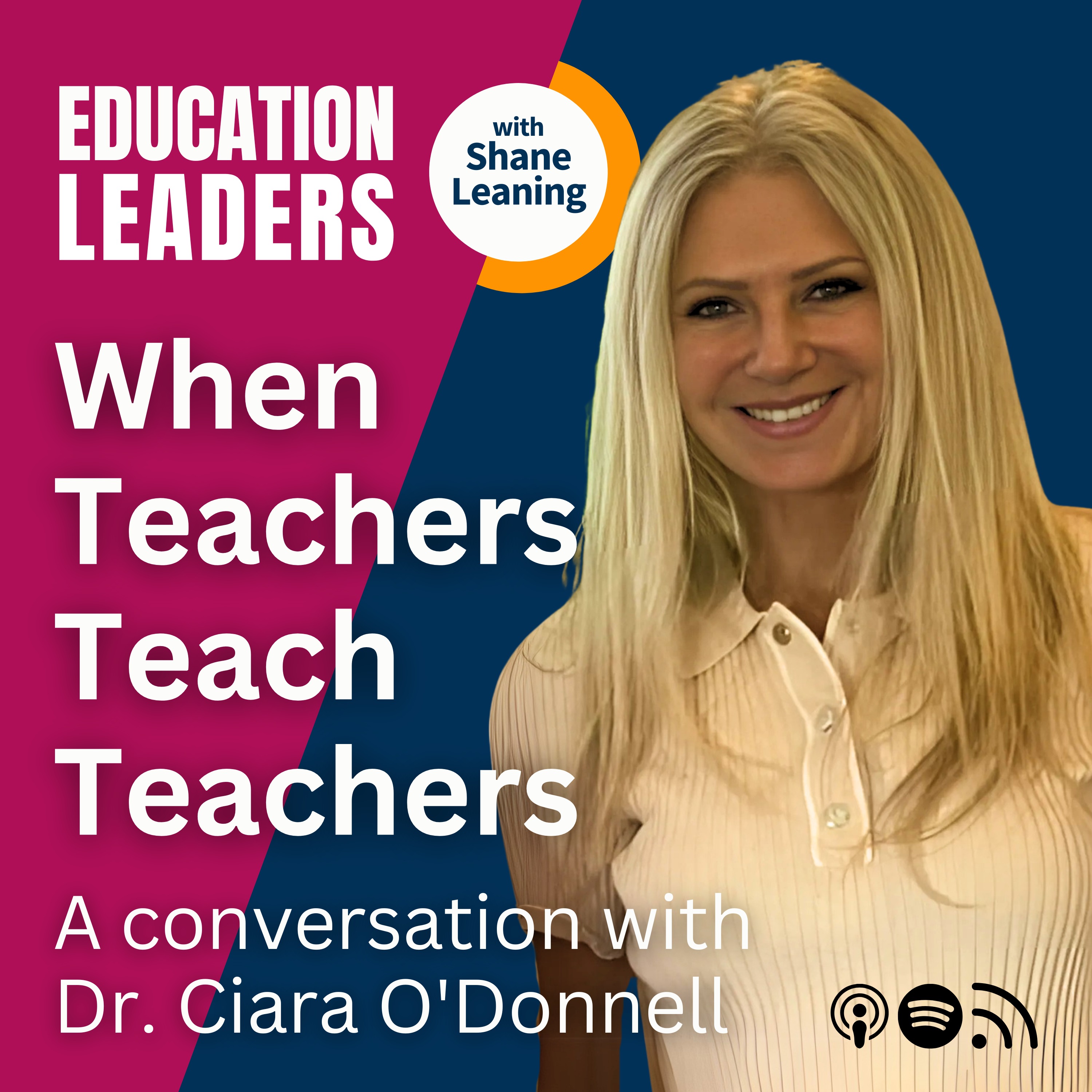
This conversation explores the role of teacher educators, their unique challenges, and the dynamics of career transitions within the education sector. Dr. Ciara O' Donnell discusses the identity transformation that occurs during secondment, the impact of educational policies on teacher retention, and the skills required to effectively educate teachers. Our discussion highlights the importance of professional learning and the privilege of working with fellow educators to drive meaningful change in the education system.
Takeaways
The University of Warwick's International Programmes | Learn more at warwick.ac.uk
The International Curriculum Association's Global.Learn.Connect Netherlands: Learn more
Thank you for tuning in, and as always, if you found this episode useful, please share your experience. You can find me online on LinkedIn and Bluesky. My website is shaneleaning.com and email address is [email protected].
Shane Leaning, an organisational coach based in Shanghai, supports international schools globally. He co-founded Work Collaborative and hosts the chat-topping school leadership podcast, Education Leaders. Previously, he worked as Regional Head of Teaching Development for Nord Anglia Education. Passionate about empowering educators, he is currently co-authoring 'Change Starts Here.' As a CollectivEd Fellow, Teacher Development Trust Associate, and TEDx speaker, Shane has extensive experience in the UK and Asia and is a recognised voice in international education leadership. Learn more at shaneleaning.com.
Join Shane's Intensive Leadership Programme at educationleaders.co/intensive
Shane Leaning, an organisational coach based in Shanghai, supports school leaders globally. He is the author of the best-selling 'Change Starts Here.' Shane is a leading educational voice in the UK, Asia and around the world.
You can find Shane on LinkedIn.
We are a proud member of the Education Leaders podcast network. For more great education shows, visit educationleaders.co/network/
Hosted on Acast. See acast.com/privacy for more information.
Auto-generated transcript. It may contain small errors.
In this podcast, we talk a lot about teachers and leaders. But what about teacher educators? What's it like for them? And once you leave the classroom, is it possible to return?
Hey, everyone, I'm Shane Leaning. Welcome to Education Leaders, the chat-topping leadership podcast for school leaders like you. I'm an organizational coach, and in this show, I get to know the teachers, leaders, and innovators, making a difference in education across the world. Before we jump in today, I'm really excited that this episode is supported by the University of Warwick and the International Curriculum Association. Stay tuned to learn more.
Now, my guest today is Dr. Keira O'Donnell. She's worked in teacher education for almost 20 years, and during that time, she's been National Director of Ireland's first cross-sector and multidisciplinary professional development support service. She now works as an independent teacher education consultant specializing in teacher education, PD strategy, curriculum, and leadership, and she is really passionate. You're going to hear this about the role of teacher educators
within our profession. She has done some groundbreaking research, which explores particularly the common of teachers to teacher education. And today, that's what we explored. We explored the role of teacher educators in our sector, their unique challenges, and the dynamics of career transitions. I think you're going to find this interesting,
so let's jump right in. Well, first of all, Shane, they're a very diverse group, but they're also a very distinct group within the profession. And they were once called the hidden professionals at one point because their visibility wasn't all that great. There wasn't a great understanding of who they are or what they did. And descriptions of teacher educators up to fairly
recently have kind of been confined to the academy and, you know, people who work in universities, whereby teacher educators constitute a group much broader than that. I mean, obviously, you do have teacher educators who work in the academy with student teachers, but you're also with teacher educators who work with those teachers who are newly qualified and are in that probationary inductive space. The group that I worked with and the role that I had myself at one point was the teacher educator in the continuing professional development space. Those teacher educators don't work with experienced and seasoned teachers throughout their career with regard to perhaps reform, system change, but also as professionals in lifelong growth around their own self-identification of their professional development needs.
So although the three groups all have something in common, which is obviously the development of teachers and the teaching and learning of students has been inherent to that, they have very distinct spaces and roles on that continuum. And there is a kind of a move actually lately, and it kind of does move into this leadership space of the school-based teacher educator. Teacher educators who still remain in school and carry out the role of teacher educator to their peers. It's another unrecognized one, but it's gaining a little bit of visibility and they would very much hold a kind of a teacher leadership space or stance within the spoon with regard to development of their colleagues, you know.
I'm curious now, is this something that is always someone who has been in a school and then move into it, or do some people kind of go in the teacher education direction straight away from scratch? Yeah, really very interesting because I don't think you can talk about this actually without alluding to career dynamics actually, and the whole idea of teacher life phases as Christopher Day and Miles Rubinman spoke about, because a number of theories actually help us make sense of why teachers make decisions that they do, to go into leadership or to move as you were saying, you know, sideways or laterally, whatever. Edgar Schein for instance talks about career anchors, that there are certain things that push or pull people towards a career. And certainly when you look at teachers at mid-career, which are somewhere between the sixth and the 20-year stages of experience, they reach a point of either peak performance or proficiency or stagnation where they either decide, you know what, I'm happy with what I'm doing or I'm destabilised and I just need something else. And that something else tends to be anchors
associated with more autonomy, a desire to have greater influence, broad horizons, professional development stretch. So all of these kind of factors come into play. Typically, certainly what I've read about teachers who move into teacher education, some of them are pulled towards those, but some of them are also pushed by the limitations of what they've seen in their own school. It could be dissatisfaction with leadership, it could be dissatisfaction with cultures that make them feel perhaps like they are other and that they just don't share the same values or orientations as the people they work with. There's kind of a
disparity of their view of where things will go and I will touch on that later because that actually touches on attention sometimes within staff of betrayal where teachers who show this interest in roles like this can be perceived by their peers as abandoning the profession. In other words, you can't be a teacher and a teacher educator, you're a teacher, removing away from us into another realm. So there's a binary view of not being able to inhabit both spaces. It's funny that because I see this narrative can often play out on the online space as well on social media in education where teacher educators are viewed as the other and sometimes almost as the enemy like, oh, you're outside, you're a problem, you're not with us anymore, you're against us, or you're on the other side. It doesn't sound a very attractive
place to go to. We find it on the dark side, you know. On that, when you think about the things that do push teachers away from, let's say, from school environment and you look at the whole idea now of trying to retain teachers, Andy Hargreaves talks an awful lot about the need to retain those teachers in the middle. The teachers that reach that watershed of will I stay or will I go?
And that there are certain conditions that need to be looked at because teaching is quite a flat career trajectory. There isn't an awful lot of opportunities to pursue leadership in a school, unless you want to be a school principal and everybody wants to be a school principal. I mean, there's all the ways to lead in education. That really speaks loud to me as well because, you know, I know in my particular career, when I moved out into, I guess I called it the adjacent space, so I worked in like a group level for schools. So moved out from a school into a
group level. So leading teaching development at a group level, you know, I definitely felt like it was because I wasn't really wanting to become a principal. That wasn't really in my trajectory, but I was wanting another option, wanting another route. And I guess this is what you're alluding to. The teacher educators sometimes find this is their path or this is the path they'd
lead at least like to try. I think it's important to say that it's not that all of them are unhappy in their current role either. I mean, you know, there's push and pull factors. I certainly wasn't unhappy in the classroom. I loved it. It was a very good leader who was
leading me that recognized something she thought I might be good at doing. And I didn't intend to do it forever. And we'll talk about that later. Well, let's talk about that now. Because I think
that's interesting because your background and a lot of the research you've been doing is actually around the idea of secondment and actually about the concept of in some places, you can second out of a classroom role or an educator role into a teacher education position. And you found some fascinating things in the regard of people who think they're making a temporary step, right? Yeah. I mean, in Ireland, the system we have is like there isn't other jurisdictions. Teachers are seconded temporarily from their school to national support services
with the intention of returning to the school and spreading the news and being that agent of change, et cetera. That's the whole philosophy underpinning the five-year limit. And well, first of all, in my experience, that wasn't happening. I was managing a team of 200 people and there was ongoing attrition simply because these people invariably underwent a huge identity transformation. Their professional development skills were really pretty much off the chart.
They had learned leadership, influencing skills, project management, you name it. And even their pedagogical content knowledge, all of that was greatly enriched. So you had that and you had a transformation of identity. And then you had a gradual disconnection from who they were in their school, whether they left school because they wanted to or, you know, for negative reasons or not, they found themselves in a space where they were going, you know what, this is not what I thought. I don't think this is for me. And I hate to use the word going back
to school, but they talked about it in retrograde terms. If I go back, I'm at risk of not using these skills. If I go back, whatever I am now might be jeopardized. And I like this space.
So the paradox that I discovered was that these people had a maximum of five years. By the time they got to year three, they had cracked it. But they weren't going to wait for another two years for somebody else to decide their career for them. Their desire was not to return to school, and they would have liked to have stayed in the service, but the service could not give them what they wanted, which was permanence. So as a result,
they sought career options that I suppose transcended both a return to school and the instability of their current career. So can I find somewhere that gives me the best of both worlds, gives me all the anchors that I want, but gives me permanence as well. What like? What were these options? What do they want?
Universities, the inspectors, education agencies, curriculum development, those options are open up more and more, certainly in Ireland anyway. I think they are everywhere. So my frustration with the system is that the whole premise upon which succulment is built is that these people will return to school. But I can tell you that of the, I have a figure here, I have a sample of 98 people in my research. 13 of those returned to school. The others went
elsewhere. And I can tell you that of those 13 now, because this was four years ago, none of them are in school now. They have moved on. Gosh, this is so interesting. So you've got a situation where succulment has been set up,
and it sounds like it makes sense. Like let's get these people as teacher educators. That's great. It's not just people who've just gone through the university system. And while they're
doing that, we know that they're going to learn a lot. And you know that your knowledge of teaching will go up because you're also engaged in teaching that, right? And then the irony is that then they just don't want to return. Or is it that they also can't return? Is there that at play as well?
Well, as well as the five year limit, Shane, succulment has to be annually sanctioned by the department if they still want that person. And if the school is willing to allow them to stay out. So you've got two masters here determining the fate of these people. I know people listening to this from Ireland who have done this work will relate to this, that when January comes, they're thinking, oh, I wonder what's going to happen next year. And the anxiety and the unrest
begins to start. And that's when you see people starting to look beyond, and they're starting to think of their exit, which in a way is a bit sad because these people have just reached a point where they're on the cusp of their best work as teacher educators. Because all of the research will say it takes three years to master the role of a teacher educator. Suffice to say, that's the level of transition that's required. And my old research completely backed that up.
Everybody with that exception said three years. And yes, that's the point at which they also ironically start to plan their exit. But actually they've got so much more to give teacher education, where they're not willing to raise around for somebody else to call the shots and basically be pawns of fate. That's right. And so where does that leave of is we have this group
that are then kind of leaving the classroom, leaving the space. It's not really helping with teacher attention. I assume in that case. No, I mean, it gets bad press for that reason.
Right. I see. And understandably in a way, but you know, the teacher supply issue over here has happened. That people who have been on secondment have been temporarily pulled back. I mean,
I lost half my team during COVID when the team were pulled back and they were very willing in solidarity with the profession to help their colleagues in schools who got assured to teachers. But my view is that the teacher supply issue, CPD should not be a casualty of that. The teacher supply issue was rooted in far greater policy mistakes than a sticking plaster of say, hey, let's get this guy back. These people are second for a reason. A good reason.
Yes. But that's a bit of a sensitive topic at the moment in Ireland, because yeah, there are over 400 people at the moment out on secondment. Now I'm not in that space anymore, but there's also a teacher supply issue. And again, there's that binary view of what are you doing out with them? I mean, of course you can from a human point of view.
I just don't think it's proper that professional development should be something. Okay. Once or twice fine, but to be continually relying on that. Yes. Yeah. I mean, there's two things here.
First of all, the five year rule, which I have argued against for years, given the impossible task of trying to keep a team of experienced people going, constant nutrition, training people up as leaders for every other organization in the country, except my own. Now you might say, oh, that's great. Isn't it brilliant to bring this behind a second. That's not really helping me as an actual director or an organization responsible for 4,000 schools. So let's look at that piece first. So five years is too short. So the first thing is
that needs to be extended. Yeah. In my view. And in many cases it has been, I have been given exceptions, but it's always year by year, piecemeal. You're never told you can have this person
for another three years. It's where we see next year, next year. So it's always tenuous. It's always tentative. It's always unsure now, but here's the core of this. Whatever about extending
this a common tenure and the moving elsewhere, the whole idea of these people returning to school for me is a very, very good one. So what is it about school that for some reason does not seem to serve career aspirations? I think it's a question that we need to ask. I mean, because it speaks to the whole retention issue of teachers overall. We have
no problem getting teachers into the profession over here, Shane. We have graduates coming out of our ears here retaining the issue. So they're looking at the anchors that I spoke about earlier on, the limitations of the classroom, the limitations, the constraints of a school. People said to me when I interviewed them, oh, that school bell. My day is dictated by that bell.
As a professional, I just feel so constrained. I want to take a moment to tell you about this event from the ICA. It's called the Learning Effect. Play Paradox Passion. And I would
encourage you to join the International Curriculum Association for its two day event, which is going to bring school leaders and educators together for engaging keynote presentation and a diverse range of teacher led workshops. In this day, you'll get to explore and examine how thoughtful integration of play, paradox and passion can create transformative learning experiences all under the guidance of International Curriculum Association professionals. This is taking place in Amsterdam in the Netherlands on the 20th and 21st of March, 2025. And you can find the tickets and more information using the link in the show notes.
You know, recruiting and developing great teachers is one of the biggest challenges we face in international schools. That's why I'm excited about the University of Warwick Centre for Teacher Education. Their QTS and PGCEI with QTS programs are specifically designed for international schools, combining online learning with hands on classroom experience. Check out the link in the show notes to learn more how they develop teachers in your school.
Do you feel it's like, therefore, they get into their secondment, they get a taste for potentially a bit more autonomy in their practice or something, and then they go, do you know what, as a professional, this is what I want. I might be deeply connected to education, but as a working professional, that wasn't the life and it's not the life I want to go back to. And again, you know, when I have this conversation, I use the word back, I always have to be very careful. And I think that's been levied at me, has been well, if these people aren't with you for too long, beyond five years, they're going to lose touch with the classroom and they become de-skilled as teachers.
Now, I always come straight back in with two responses to that. And one little bit facetious, the first one's not. The first one is that the group, certainly that I worked with, and that I managed, were in schools every day. The professional development they did was not that transmissive type where people are taken out into an event, sheet dipped, basically, with a bit of information. And then, you know, that's it. We didn't favour that episodic model.
Our team worked in school every day at the core face of classrooms. So I want to debunk that myth. The second one is, if you're going to levy that argument at teacher educators who are out of the classroom for more than five years, then I would ask, could you possibly levy that same argument to the inspectors who are visiting schools, by the way, evaluating quality and yet have not been in a classroom for a long, long time? I'll leave it a question.
Well, but it's right, though. And it gets me thinking, you know, that argument comes around a lot, okay, they're out of the classroom or they're not a teacher or whatever. They haven't got a teaching schedule. And I go, is there really an alternative to this full training of teachers where, you know, they're actually in school teaching? Does that exist?
Yes, it does. And it is a model that I would have advocated for years. And I'm not privy to what's happening now because I'm not in that space. But I would sincerely hope that it's a model that continues because it was contextualized in the environment of the practitioners.
So it was meaningful to them. It was collaborative because it was groups of teachers working together. And most importantly, Shane, it was continuous. So it was in line with this whole idea of school improvement and goal setting as a deliberate attempt over time to bring in meaningful and embedding change. And the literature is pretty indisputable when
it talks about the value of contextualized collaborative and in particular, continuous support. So yes, that does exist. Well, it did exist and or maybe it still does. Well, that's very interesting to me because, yeah, I don't really know of it existing at scale, really.
Yeah. When we first started in service, you know, Shane, that old word, our training, and I really, really don't like using the word training. I think it's very technical. But back in the day when we did have that model, and to be honest with you, it was all we had and we felt, my God, this is great. We saw the shortcomings of it.
You know, pretty, pretty superficial level in terms of having any impact. Yeah, sure. I wonder if we can take a little step back then. I'm interested, you know, you work with teacher educators all the time, you know, day in, day out. For some people who
are listening to this, they might be at that point where they go, do you know I'm considering some kind of move and this would be something that would interest me. But I don't know if I've got what it takes to be a teacher educator. Are there certain kind of qualities that you think would make a good teacher educator? Yeah, I think it's a really, really good question. Let's start with this assumption
that being a teacher automatically means one will be a good teacher educator. I think that's the starting point here. Of course, it stands to reason if you have experiential knowledge, classroom experience, credibility, all the human capital of an educator. Of course, it helps to bring that to the table. But the research and certainly experience tells us it
does not translate automatically into being a good teacher educator because being a teacher educator has its own identity and its own distinct set of skills. And it has been proven to be a very fraught transition, even for those who felt, you know, this is going to be a walk in the park for me. There is a reality shock involved. So what I be saying to those people is, yes, be confident and believe in your pedagogical and all of that and prowess, but know that you will now be working with adults and we look at adult learning. And although there's a lot of similarities between
adult children and student learning, there are also things that make adults distinct learners. We know that they have a wealth of experience. They have six assumptions and beliefs about stuff that can be hard to challenge. Right. And they're very goal orientated. So I identify them as a
trilogy of shifts. The first one about learning. The second one, moving from the first order space of being a class teacher to the second order space of being a teacher of teachers. Now, that sounds very crude, but basically it's not a pedagogy for teaching. It's a pedagogy
for teachers as learners and an understanding of how teachers learn best. And the third one was one that a lot of my colleagues and myself grappled with when we started the role was, as teachers, sometimes we do have this feeling that we are the sole fans of knowledge. There is that tendency maybe to provide as opposed to facilitate. And in an adult teacher learning environment where you're faced with people with a vast amount of experience, you really have to resist that compulsion to tell. And although some teachers will say, oh, look, no,
just give us the answer. You're doing them a disservice by doing that because the whole idea of good teacher education is that it's constructed in the room by the professionals who are there. That's when you know you've mastered it. That's the term I hear as well that stood out is professionals. You're now working with working professionals. So you may have expert subject
knowledge in how to teach your subject, but it's not just a case of transmitting it, I guess. You can't just say, this is what I do. Gosh, that would rub people up the wrong way, wouldn't it? Yeah. And you know, we all know that that kind of professional development just doesn't go down
well at all. But on that, I mean, I make a case here for teacher educators who work in the continuing professional development space. They stand apart from the other two sections of university and the induction because they're dealing with very experienced established staff. That's a scary place to be, you know, and frequently. Some of these staffs can be very
irate about change and can be very resistant for good reason a lot of the time. But some people that you've got disaffected audiences, you've got audiences who feel, hang on a minute, the way we're doing things here is just fine, thanks very much. So you're challenging habitual behaviors. You're challenging deep entrenched cultures. And that's not something you do in
a one-off wholesale event. Yes. And that takes a bit of attention skills, Shane. Yeah. Well, tell me some of these skills, because I'm hearing that it would require
patience for one, but what specifics are we speaking to here that when you're working with these teacher educators that are tough ones to develop? First of all, you have to be extremely diplomatic. I always remind my team, you are with your peers here. And remind them of that from the start. I am a teacher educator, but I am still fundamentally a teacher who happens
to be doing this kind of work in the same way I'm a teacher who happens to be doing EAL work or learning support or whatever. So let's get that fundamentally straight first. But very often the people in the teacher educator space find themselves as the frontline messengers of something by the way that they did not decide or construct. And they are the lightning rot of anger or disaffection or any of those things. So we have to be resilient to that.
And we have to accept that that comes with the territory. So the skill here is it's a negotiation. It's empathizing and saying, I get what you're saying. And this actually is a news to this whole third space tension that I spoke about in my own research, where when the teacher educators are faced with this isolation from their peers in that way, that they struggle between holding the space of teacher educator or holding the space of teacher. And a lot of them would say
that when they've experienced like that, that's when they really feel sense of imposterism around the role. Why did I go into this job? I was a really good teacher and now I feel I'm not very good at it. But actually we have to tell them this is a huge part of the learning.
Yeah. So I guess a lot of like going into it is understanding that challenge that's coming away and understanding that these situations and I love the way you talked about that kind of imposter feeling. It makes sense living in that third space and feeling questioned by your colleagues, your teachers. They're your colleagues. You feel like you were them at one point.
That's tough. Absolutely. And I think cracking that and everybody does eventually. Cracking that is when you reach a space where you can publicly empathize with these people and still remain true to the policy message. But policy has a role to play here as well
in terms of giving teachers that time and space. And I know that I and my colleagues often felt torn between policy and practice in perhaps addressing audiences about policies that we weren't really comfortable with ourselves, Shane, and saying, you know what, I can't get this. I'm publicly talking about this, but I'm privately questioning it in my own head. That's tough. But here's an opportunity for teacher educators to assume a role as
interventionist leaders here, because the group that I manage and I worked with and I was part of, we had access to policy circles frequently, right? So we would get sight of new policies probably earlier than a lot of other people. And as we became more confident in our role, Shane, we start to question those policies and go, do you know what, I'm not sure we should be going out with that message. I think we need to think about this a bit more.
So we were able to throw a critical eye on something before I went out there. Now, we didn't always get our way, but we got sight of it. Then you're out there, you're facilitating your message. The fact that we worked in schools every day was crucial, because we would get a sense from schools how things were going down. And we could feed that back to policy,
because policy were removed from what was happening on the ground. We were that intermediate conduit that really gave us a, for me, a key leadership role in the system as actors of players in bridging policy and practice. In a way, that's quite an exciting place to be and a quite exciting place to stand. And I wonder if we might finish on, you know, what's great about being a teacher educator? Is there stuff that you found where you hear from people where they just
go, do you know what, this is where I love to be? And you know, what is it that makes it a place where people want to stay longer than that five years? Yeah. And they kind of realise it early enough, until obviously the shock hits them about the other stuff. But ultimately, it is definitely the exposure to professional learning. I mean,
certainly in the group that I worked with, we were on the cutting edge of policy. We were on the cutting edge of research. We were research informed, but also research engaged. Now, how many teachers do you know they get a chance to do that? We had deep conversations as colleagues that teachers
only get to have at a photocopier. We were with like-minded people. I'm not saying that, you know, that teachers are another group of people, but generally people who move towards this tend to have a shared value system. And there is that whole move outside the sheltered life of a school, that there is a broader world out there. And that is exciting. So there's all
of that. So there's a professional development, there's the opportunity to see the broader world. And yeah, I mean, it's a very attractive role for that reason. And it's one of the reasons why a teacher educator thinks that any of that might be lost, or they'll have to relinquish it. You
know, they just want to stay as a result, you know. It is the privileged role of working with your fellow professionals in such a transformative space. And making a difference at that policy level. It's so privileged to walk into different schools every day, because we learned more from the schools we went into. They did for us. What really struck me from this conversation is that
life as a teacher educator is both a privilege and a challenge. And there's many reasons why you might choose to go into this field. Maybe it's career dynamics, maybe it's life phases, but it's worth considering that's the common into teacher education, or even transition into a teacher educator role can really lead to identity transformation and disconnection from previous roles. It's also interesting how policies surrounding so common can really impact teacher attention negatively. And educators face a lot of challenges, including navigating their
often complex roles and responsibilities. But what's clear to me, teacher educators play an absolutely vital role in bridging policy and practice. And this is a space we really need to invest in, explore and have good quality conversations just like the ones Kira's having. You can find out more about Kira's brilliant work using the links in the show notes.
Education Leaders is hosted by me, Shane Leaning. Thanks to the show editor Pete McGill and for the original music by Guillermo Silva. I'm so glad you tuned in today. And as ever, if we don't speak before, I'll see you here next week. If you're interested in the work of my show's partners,
the University of Warwick and the International Curriculum Association, head to the show notes to get links to learn more.
Shane Leaning explores the delicate balance of learning enough to implement change without falling into analysis paralysis. He emphasises…
Listen & show notes
In this episode, we dive deep into school culture with Joel Abel, author of Teacher First Management. Joel shares practical insights on…
Listen & show notes
In this episode, Shane Leaning explores five powerful strategies for educational leaders to break out of their professional bubbles and…
Listen & show notes