
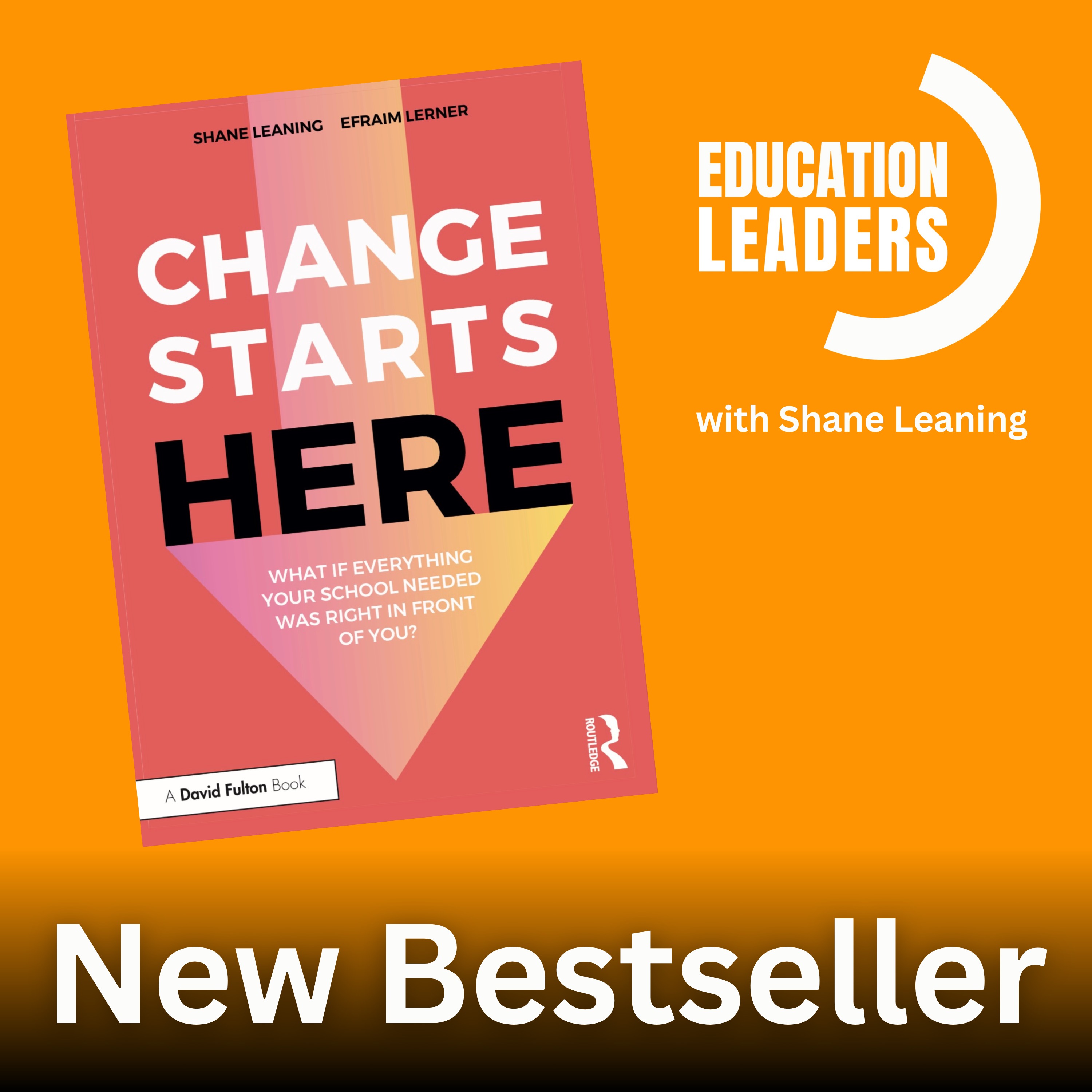
New Bestseller: Change Starts Here
In this special episode, Shane Leaning discusses his new best-selling book "Change Starts Here: What if Everything Your School Needed Was…
Listen & show notes
My guest today is David Harkin, CEO and Founder of 8billionideas, which has impacted over 500,000 students in 26 countries. David is a two-time TEDx speaker, author of 'The Ripple Effect', and was ranked 8th globally by ISC Research for his contributions to the education sector in 2022. Before entering education, David was an IBM executive and was the youngest globally to receive their CEO award.
In our conversation, we explore:
David's outlook for education is optimistic: "The next decade is the most important decade in educational history...never before have we had the opportunity to transfer lessons as quickly as we possibly can and collectively make change."
The International Curriculum Association: Learn more
Join Shane's Intensive Leadership Programme at educationleaders.co/intensive
Shane Leaning, an organisational coach based in Shanghai, supports school leaders globally. He is the author of the best-selling 'Change Starts Here.' Shane is a leading educational voice in the UK, Asia and around the world.
You can find Shane on LinkedIn.
We are a proud member of the Education Leaders podcast network. For more great education shows, visit educationleaders.co/network/
Hosted on Acast. See acast.com/privacy for more information.
Auto-generated transcript. It may contain small errors.
Did you know that many big corporations dedicate about seven or eight percent of their budget to innovation, while schools, well they even struggled to find one percent. Today my guest breaks down how you can foster innovation in your school without breaking the bank. Hey everyone, I'm Shane Leaning, welcome to Education Leaders, the chat topping podcast for school leaders just like you. I'm an organizational coach and I've helped thousands of leaders across the world to lead with greater confidence, make better decisions and create winning teams.
And on this show, we explore the strategies that help you achieve your goals and transform your leadership. Now before we jump into this brilliant conversation, I'm really excited this episode is supported by the International Curriculum Association, stay tuned to learn more. Alright so my guest today, it is David Harkin, he is the CEO and founder of 8 billion ideas he's super passionate about giving students the skills and belief to change the world through what he calls a critical curriculum and he focuses on things like entrepreneurship, future skills, career education, performance and well-being. His company's actually impacted over half a million students now and he's a TEDx speaker, in fact I've seen him speak on the stage too and the author of the ripple effect.
So in our conversation today, we look at what entrepreneurship really means in education and how schools can really foster that innovation spirit. So let's jump in. So for me entrepreneurship is hugely misunderstood, firstly by using the word entrepreneurship and forgetting the second word entrepreneurship mindset, that's what we really need to be talking about in education. So the world needs entrepreneurs, an entrepreneur by definition is somebody who starts a business in the pursuit of profit, the world needs social entrepreneurs, those people starting social enterprise to create charities and do good in the world and the world needs intrapreneurs as well, those people who act like entrepreneurs but within businesses, public sector organisations, governments and so on.
Whether or not you're an intrapreneur, a social entrepreneur, an entrepreneur or a teacher preneur or any otherpreneur, the world needs all of that, needs that type of individual in the world right now because fundamentally the world needs more problem solvers and creative people. So when we talk about entrepreneurship, Shane, we're really talking about that mindset and not just starting a business, which of course is just one element of it, but it's how can students really leave school, confident, act on all types of ideas, not just ideas which start a business. So I mean, that's the first place to start really, when we're talking about entrepreneurship, let's not forget the second word, which is an entrepreneurship mindset. And go on, breakdown for me then, you mentioned that word intrapreneur then.
So where does that come from and where are you coming from when you talk about that? I can take full credit for, no, I didn't come up with it. No, I read a blog in my previous life before coming into education, I was in the corporate space, I was working for IBM, I was on the director's path and I was just buzzing with ideas in a big corporate, now this is a huge corporate, 400,000 employees globally at the time, it's like a country. And I was always coming up with ideas, trialing new things.
And somebody said to me about an article in the Times about intrapreneurship. And I was like, what's that? And it was where somebody acts like an entrepreneur, but within a business, somebody who is being creative, trying to make change, trying to innovate. So that's what that term means.
It's all the characteristics from an entrepreneur, but not taking any of the financial risk or starting a business. And if you think about it from a teaching perspective, so extending that to the teacher printer phase, which I definitely did make up, and now a few schools are using, which is great. But that's a teacher in the classroom who, again, is taking different risks in a different way, trying new projects, being even more creative on a lesson and just taking risks in the classroom. So when you break down the characteristics of entrepreneur, intrapreneur, and teacher printer, and you try and say that quickly a few times, you definitely mess it up.
If you try and look at the characteristics, they're very similar, there's just different elements of risk associated. The listeners of this podcast are school leaders across the world, so in a leadership position. So I'm wondering from your perspective, like we hear about this entrepreneur mindset for students, and you've just mentioned, teacher-preneur, love that, love that. Could we extend that to school leaders in how they run their school?
Would they be a principal? A principal? We're trying. We're trying.
That was great. I don't think I can say a principal-preneur, but the thing that people don't like to say, but the reality of it is every school on the planet is a business, but in the business of world-class education, and I don't know why people don't like thinking about that. If you think about your product as great education, an entrepreneur's product might be something completely different, right? But actually, in education, our product is what does our school provide?
So I think having that mentality as a principal-preneur is absolutely key, and equally, there's that fundamental business side of running a school. It's the P&L, it's the enrolment, it's what we're spending in the return of investment on marketing and positioning, the amount of entrepreneurial characteristics, business characteristics which are required to lead these international schools around the world now are phenomenal, and I don't think there is anywhere near enough training in the education sector for people on that pathway, because I've had a lot of conversations with heads which have suddenly realised, wow, okay, this is what headship and leadership means in education, and until they're in a position where you're suddenly managing multi-million pound budgets, and you've gone through your educational career, it can be quite daunting. So, yes, absolutely, if you look at the characteristics of the leaders of our principals of schools around the world, there is obviously a huge amount of business within them and entrepreneurship characteristics which are required to make sure that their schools can be standout, can be competitive, have their USP in the market. It's funny you say that, because I was actually speaking to a leader only last week on a call, and it was a coaching client, we were talking about that they felt very comfortable operating their school, like just on an operational level, and we were talking about the qualification frameworks for leaders, they're the MPQs in the UK, so they've done like these qualifications, they felt like they had a fairly good idea with operationalising their school, but innovating, they felt a bit uncomfortable, like the idea of kind of bringing new things in, and I wonder whether, you know, that's something where this entrepreneurial mindset, if you like, would have helped with them leading their school to kind of think, how do I bring in new things, or when I am approaching that budgetary challenge, how can I be created within this space rather than kind of just following the set playbook, if you like?
Yeah, but if you think about it from a business perspective, R&D, some research and development budgets will be allocated in like, we're talking big corporates, there'll always be a percentage of their turnover which will be going, right, we need to invest in the future, you know, whether or not it's five, six or seven percent, I think it could be around the seven or eight percent is the average, I'd have to double check, but I'm pretty convinced most principals don't have that kind of surplus to requirements that they're spending seven or eight percent on it, but even one or two percent you can do quite a lot, and equally you can be innovative without spending a significant amount of money, but yes, it's a slight mindset shift in terms of, okay, if a big corporate business is being run like this, what can we learn from it? What could we steal with pride is a phrase that I like from Anne Hayden, the head of Heron Kong, she shared with me a number of years ago, you know, you see things in different industries, why don't we take it? So yeah, being innovative, I think you've got two things, operationally innovative, so when you look at just the generic running of a school, there's definitely marginal gains and definitely better ways that we can do that and still challenging typical processes which are out there, I'd like to see more of that in our schools around the world, but finding budget and finding time is key to keep innovating, and we have to, right, yeah, particularly in the international schools, the rest of the world needs the international schools to find a way of innovating, because if the international schools in all parts of the world are, then the rest of the sector is never going to benefit, so it's always got to start from somewhere. Yeah, and it needs to, it's something that I talk about a lot, these kind of changes within our sector need to start with the schools, not just with the kind of outside voices which we could very easily be dominated by, and I talk a lot about the challenges of some of these big tech companies like Google and things, they want to lead education too, and who's going to be actually dominating the direction of education, is it going to be their school leaders, or is it going to be those external organisations, and I would say as school leaders we have a responsibility not just to our schools, but to the whole sector moving forward as well.
Do you know what's interesting, because there's maybe been predominantly free voices which have been heard about the future of education, and there's arguably been little traction, well there hasn't been enough traction if we're just being true, so yes we haven't found a voice, a collective voice from the teaching community being heard, number one, we're getting not necessarily the right voice from the big corporates and the tech companies and the financial companies out there on the planet, so a lot of governments will lean on big companies for advice about what do they need for their future, what do we need for the future workforce, and they've missed a complete trick because the vast majority of children will be in the micro business economy, the start-up economy, small business economy, which is very different to working for Barclays or Google, right? So we're not asking the start-up, scale-up world what they need, so we're missing a trick there, and then lastly the governments aren't quick enough predominantly around the world for change, because they might have an idea or direction, but the execution factor isn't coming in, so the fourth area which I feel can bridge a gap is the ecosystem, the partner, the supply community, the sector, and that's what we're trying to do, Shane, in a way that we feel very blessed to be able to work currently in 25 different countries, at the moment half a million students, but cross sector, cross curriculum, cross age groups, which means that we're seeing a lot, and one of my big ambitions in the years ahead is to really help with change, is to bring a lot of the lessons together into one place and re-simplify what's needed going forward in terms of innovating. We haven't brushed on, it hasn't changed the reality, but we've got pockets of great success in some of our schools around the world, but that's in isolation, you know we've got to be thinking about millions of students, two billion children on the planet, like what can we do from the international school sector, which in 10 years time quicker can be out there for the vast majority of children across the planet. I think you're absolutely right, David, on working with partners kind of to get that global presence, all that global conversation on, you know, connecting ideas from between schools, because you can't do it as an island, I guess, so you need to kind of figure out ways to get into these networks, whether that be if you're in a school group, or whether it be partnering with organisations to kind of work collaboratively, that sounds super useful.
Have you written a checklist manifesto? I think it's a really interesting one. I haven't read that, I did see it on the Waterstones bookshelf recently. Yeah, we partnered with Woodward, who's, in my opinion, the most phenomenal sporting coach on the planet, because he's got success in different sports, from not just rugby, which is what he's known for, but in the Olympics, in football, in skiing now, and so in winter Olympics, as well as summer.
And he recommended that he said it's the only book he's ever read twice, and that's what I'll give it a read. But one of the opening chapters is about how innovative and how safe the airline industry has become over four or five decades, comparing itself to the healthcare sector, and the lack of transferable lessons in the healthcare sector globally, compared to there being transferable lessons consistently in the airline industry, because if there's a safety protocol which has been identified or a marginal gain, it's shared, doesn't matter if it's with your competitors. It's out there for everybody to learn from, because fundamentally, if something happens to a plane, it's devastating impact. But it's interesting when you think about that, about transferable, great lessons being shared, no competition, let's just get it out there.
That doesn't happen in education, right? So if you put airline health and education against one by one, you know, we just haven't got that going at the moment in the sector. So you even see islands within school groups, right? You see that competitive nature within a school group that even ideas are not even being shared across multiple schools, which are all part of the same kind of ownership structure.
So we do need to think differently. I think it's more than possible. For me, just a few simple things need to be done to really transform education. I like how you said it's a few simple things to be done, because in your words, it's ripples, isn't it?
You're creating ripples. And I've got your book in front of me, David. So the ripple effect, I wonder if we might talk a little bit about how we might start creating change within our sector, using that concept of small mindset shifts or ripples. I'd love you to talk me through the ripple effect as it were.
Yeah, thank you for taking the time to read it. And anybody who has read it, I really, really appreciate it. It actually started off over the last 10 years. Sometimes I've had the urge just to write blogs, you know, I just come up with an idea and was taking advantage of LinkedIn articles, which was great and being dyslexic.
And, you know, sometimes the writing isn't always easy, but sometimes blogs were for me. And then I looked at all my blogs and started to see some consistency there in terms of what I was talking about, which was kind of attitude, innovation, and mentality. Someone was asking me a good number of years ago, where do you get your energy from, David? It's kind of infectious, and it has that impact on other people around you.
And it made me really think and, you know, just the kind of pebble kind of story, dropping a pebble in the pond every single day, it makes new records. And that's where it kind of started off of just thinking about why, at the end of the day, I can make good or bad ripples on a day-to-day basis. What am I going to go do? It's much more fun to make good ripples.
But people do remember your bad ripples, so you're not really allowed a bad day off as a leader. But then when I was thinking about, you know, my business and how it was developing over time, I was really genuinely realizing that you can have a great idea, right, or an idea which needs to develop. But it's all the small things which count around it. It's about the graft, the resilience, the shift that you're prepared to put in, and finding your own marginal gains on a day-to-day basis.
And it comes back to mentality, that ability to listen well. So that's where the kind of ideas started to come from, like little phrases I've come up with, which, you know, seem to have gone down quite well, like being brilliantly busy. You know, when you're asked how you are and you say that you're busy, everybody kind of says it in a negative way. But I kind of said it as a joke that, actually, I'm brilliantly busy.
And people kind of laugh and smile, and that you can make them think. But actually, if you have that mindset compared to I'm being busy, it means you're going to put a little bit more energy into your work, and it's probably going to produce a better outcome. So I'm a big believer there. And when you bring it back to education, you know, we have completely overcomplicated 100 million people work in this sector, in about five million schools globally.
And we're seeing the consistent problems in our top school, you know, whatever school it might be. And so I kind of get carried away, if everybody was to work for me for one day in education globally, what would I do? What I 100% would start with the teaching and non-academic members of staff in schools, and take an assessment on the mentality of the global workforce in education, and think about small tweaks I could make to motivating them more. So there's a lot of energy in CPD, but I think there's not enough energy in CPD about like really strong motivation, and how do we motivate and continue to motivate a workforce in a brilliantly busy, terrific guitar in world such as a school.
So start off with any strategy about how do we make changing more ripples in my international school or school around the world is what am I doing? To motivate the 100, 200, sometimes 400, 500 employees in my school, and it can be small things, recognitions, bank cues, whatever it might be. That is a very simple ripple which costs absolutely nothing to implement. Then you move on to the next one, the next one, the next one, and all these small things can add up and have a big impact over time.
That really resonates, and it's also when you're thinking of the ripples, you're thinking about slowly building a culture as well, rather than just the big fancy initiative or the big whatever it is, and actually every pebble you throw just moves things forward in a little way. This episode is supported by the International Curriculum Association. Now, I've been working with the ICA for quite a few years, but they've been around for 30 years, and they've been around championing quality, unlocking potential, and improving learning in international schools right around the world. I really, really love that at their core is a model for improving learning.
And this model is focused on the learning experience and they have tons of great curriculum materials, PD resources, and even an accreditation pathway for schools just like yours. So if you're interested, and I really do recommend you check them out, head over to internationalcurriculum.com. I just love your phrase of being brilliantly busy, and you've got a chapter on it in the book as well.
So could we kind of explore that a little bit? So to take a step back, what is being brilliantly busy? What does that look like to you? I do call in the second ways, I'm brilliantly busy and terrifically tired.
I've been being brilliantly busy. Fundamentally means, you know what your wine life is that you're getting up out of bed and you seem to have that energy compared to your peers or friends or whatever it might be, which is a bit different. And you go actually, maybe it's because I've got a huge amount of purpose to my work and I really, really believe in it. And then it means consequently, you see time differently, Shane, like you see time is very valuable.
You want to optimize every single day as much as you possibly can from the moment you wake up and brush your teeth to the moment you go to bed. You are packing it in, right? It's not about burnout, but you just built into your DNA to be brilliantly busy because you know your work is really important. And you find yourself as a brilliantly busy person, maybe doing three or four days worth of work in a day compared to your peers.
You know, I genuinely believe I do a mum's work in a week and a week's work in a day because of the way that I'm brilliantly busy in my mindset is kind of set. Someone who's not brilliantly busy might be doing half a day's work in a day or less. They might just be watching the clock running down waiting till five o'clock and leaving the office or getting out of school as soon as they possibly can. They're not leaving it all out there.
So being brilliantly busy for me is something that all of us can possibly be. It's not about burnout. It's not about, you know, working yourself into the ground. It's about finding something you're passionate about and getting yourself out of bed on a daily basis to do great work.
I know listeners are going to be listening going. Yeah, I want to do a month's worth of work in a week and I want to do a week's worth in a day's. But maybe some are going but I just feel like I can't be brilliantly busy at the minute. With people you work with are there barriers that come across?
I'd love to kind of try to unpick how we might move a step closer to what you describe. Yeah, look, let me be honest. It can be tough at times, right? You know, we're building something and we do not talk about the challenges in leadership right now.
So if you're listening right now as a leader, hugely well done, right? Because there is not enough research post-pandemic to pre-pandemic and how leadership has changed and it's changed, right? And it's changed dramatically and nobody else knows how much it's changed than if you're a leader of a school or a business right now. And it's changed fundamentally because you are more accessible than any leader in the history of humankind right now.
And what I mean by accessibility is that device on your phone means you're accessible 24 hours for somebody to approach and drop a problem on you, right, fundamentally, leaders are problem solvers constantly. You're accessible in a physical world from walking down your school corridors and you're accessible from a virtual world, which means as a leader in 2025, you are being judged around the clock, around the clock. And, you know, there's an element of performance, you know, if you go into your schools looking tired and a little bit grumpy, which you're more than welcome to be at times, what will people do? They'll talk about it, right?
If you go onto a Zoom and your body language isn't great, you know, and you haven't got all the energy there, people will talk about it. Leadership is hard right now because it's changed and therefore your own well-being plan, what you're eating, drinking, sleeping, is really, really, really key there. And you have to find time now for me, time in the week, it's a non-negotiable, like, for me, it's Monday mornings, right? I've got three boys at home, Shane, and we do comms at 10 o'clock on a Monday morning as a business, but before 10 o'clock on a Monday, I don't talk to anyone.
I'm still working, but I need that transition from dad to CEO, because as soon as I jump on there, people are impacted by my mood by being positive or negative. They're reading into everything, right? Which makes it hard because you don't want to walk into that first staff briefing or team meeting or whatever with a little bit of negativity because you're tired because then the rest of the week will just have those negative ripples because of your mood. So being brilliantly busy is tough.
It's tougher as a leader, without a shadow of a down, and leadership is harder than ever before because of the accessibility that's good things that you can do is easily move better, right? Get that exercise in. And number two, just think about how accessible do I need to be, you know, with that device as well? Do I need my emails on a Saturday, right?
Or something, you know, delete them or get them off your phone, find some time that you're not accessible all around the clock because it's not easy because people will more often not drop a problem for you to think about. And if you're a passionate leader, you won't stop thinking about it, but it will have an impact on you unless you put those controls and those discipline rules around you to kind of protect you going forward. Sorry, Shane, I've gone off on a bandwagon there, but I don't think this topic of leadership in 2025 is being we're taking a lot of leaders for granted right now. And we've not thought about actually leadership 10 years ago was very, very, very different.
You know, WhatsApp wasn't pinging at me all the time. Yeah, I wasn't expected to be on Zooms so much in a day compared to meeting and greeting teachers and parents. Yeah, that's really, really resonating with me. The system has changed, hasn't it?
The system around us has shifted and yet we're still working on principles of leadership of before. And it's funny that a lot of my work is in leadership development. I see a lot of leadership programs and I note those kind of similar things that are coming up when I'm trying to be a leader now. Like the programs are being run in much the same way and yet we're living in a world that has shifted certainly in terms of communication channels, which is half the battle with leadership, right, is how we're interacting and communicating with other humans.
I found that really helpful to kind of reflect on and I think listeners will feel the same. I wonder about when leaders are also approached by those teachers who are coming with good ideas in their school. Like, do you have any ideas on how to help them turn their good ideas into success? Get on with it.
This is what I would say. Trying to build a culture of action and then ask for forgiveness is something which I was told early on in my career as like a graduate. If it's a good idea, don't ask me if you should be doing it. Just get on with it and then ask for forgiveness afterwards now.
Yeah, that balancing right. But fundamentally, you know, I was on an internal call yesterday when somebody said, do you mind if we do this, Dave? And I was like, why are you asking me that? Like, that is a good idea.
The fact you're asking me and you've sat on that for a week has frustrated me. I said, do not do that again, right? I said, if it's a good idea and you know it's a good idea and you might sound often, you know, a member of the team, just go with it. Just run with it.
So you'll have teachers come forward and you will be brilliantly busy and they'll want the time or the reassurance from you that you've got your blessing. And I think if they've got to share it and they go, fine, you know what Shane, that sounds cool. Run with it, right? And try and get that.
Just do it vibe and then come and let me know the kind of impact or the potential ROI so that return of investment and think bigger, right? Because, you know, if you can get teachers just acting on good ideas, then that's a good start. It means they're not coming to you for permission and then they're coming to you and sharing the progress. But then equally, the second thing I would be is try and encourage in your rhetoric, your narrative, your languages, whenever you're speaking stuff, that tiny and small ideas do count because you'll have a lot of teachers who will see something so small and they go, we should be doing this or we could save two minutes a day doing why.
And they just don't do it because they haven't done the maths. They go, actually, if I say I found a process that I've seen, which is going to save me five minutes a day and I've implemented it, but nobody else in the school is going to really care. Well, I don't look at it like that. If it's a five minute saving and there's 100 employees in a school, that's 500 minutes of time which could be saved on a daily basis, two and a half thousand minutes a week, 10,000 minutes a month, right?
So, if you've got a little win, little cheat that you found which is saving you a little bit of time to make yourself more productive or could impact tens if not hundreds of member staff share it. So, two things there. If you've got staff in your school, find a way of like, just go do it, you know? Just do it, right, Vi?
And then come back and tell me about the progress and secondly, make sure your staff realize that in a brilliantly busy school where there's too much to do, marginal gains, do you make an impact? Make those marginal gains, those tiny and small ideas and equally share those as well. I love that. So, and I'm thinking what that really requires as a leader is for you to be able to feel more comfortable letting go of a bit of control, letting staff innovate and I'm thinking that also changes that mindset of a leader from someone who may feel that they need to direct to maybe someone who needs to coach instead to someone coming to you and you'll be able to just ask a great question to help them just make their next step rather than directing them.
Yeah, Shane, I think just break down you can have different types of innovation in a school, right? You know, we've fallen into the trap of thinking about to be an innovative leader. What am I bringing in which is new like AI, robots, you know, blah, blah, blah, blah, blah, blah. But there's two types of change and innovation.
There's transformational and there's incremental. In fact, there's three. There's kind of transformational accelerated incremental change and incremental changes in school. So you can have different innovation strategies in those three different areas.
Transformational might be there's a big area of this school. We want to get right. We want to invest in entrepreneurship. We want to invest in X ones that we want to get that right.
But this is a big play. That's where the principal's head should really be like assessing where the school situation then there's accelerated incremental improvements, right? There should be looking at my middle leadership senior leadership team. What are the next layer of projects that have been on the list for a while?
Let's just get them done because we would be a better school. And then you kind of got just gradual incremental changes which can come from everybody. And that's where the theory of marginal gains can be really adopted. But your staff, unless they're aware what a marginal gain is, you might not be aware that those tiny little ideas or thoughts in the back of their head like actually if we move the printer over there, it's going to save me X amount of minutes every day.
They need to be educated that innovation isn't just about robots. Innovation has these different layers. And you need to know this is how we are going to improve this school. So as a leader, your innovation strategy can be broken down into transformational accelerated incremental projects and incremental how encouraging just gradually incremental changes in our school.
That is your innovation strategy, right? And you have different approaches in those three different areas. That's an incredibly empowering message to say that your innovation doesn't have to be that full scale massive transformation. Incremental is still good change.
And in fact, probably I would imagine a lot of the best organizations work in that way most of the time, right? Actually just making those marginal gains and getting the whole team. Yeah, if you give you three examples at the top of my head, it could be transformational, it could be a new pillar of education, new department, new bit of tech you're bringing in. Accelerated incremental could be a frustration which has just been crept around for a while.
Like our corridors are bland, right? They're not inspiring, but you know how to fix it. Someone's just not taking that by ownership and making sure let's make our walking spaces more inspirational. You go fix it, shame for me, right?
That is something you know how to execute, but it just needs an owner. And then that kind of small incremental like little improvement will just be maybe a little bit of a well-being and productivity small couple of minutes changes which can come from the hundreds of employees in your workforce. So just break it down and delegate in certain areas whether it's educating everybody in marginal gains, whether it's going you're in charge of that. Incremental change project.
Just go make it happen, shame, right? It's been sitting on the shelf for a while and I'll take care of this. And then those three layers can have a big impact in a short amount of time in a school. Listen, David, I think that's a perfect place to pause our conversation and I'd love to chat with you more again sometime.
It's been super useful today and I know there's lots of actionable insights in there, but also just that bit of inspiration to not necessarily just jump into big new things, but to take a step back and evaluate how we're inspiring change in our schools. And I feel pretty hopeful. I don't know about you for the future of education. I think, you know, we've got a good journey ahead of us if we approach it in some of the ways we've talked about there.
It's the best section on the planet, shame. We get the opportunity to work with amazing students and colleagues on a day-to-day basis creating memorable moments in schools around the planet. It is 100% the best place to be. The next decade is the most important decade in educational history, in my opinion, because never before have we had the opportunity to transfer lessons as quickly as we possibly can and collectively make change if we grasp it.
Like, this hasn't happened before that tech is there. The ability to share ideas as quickly than ever, but it doesn't need a cohesive community with a collective vision in communities all around the world to kind of move forward. So to me, it's the most exciting era of education that's ever existed if we take the opportunity to jump on it. So just keep doing what you're doing out there, leaders.
Keep pushing hard, but just keep thinking about a few of the things we talked about today, particularly the transfer of ideas and particularly your own well-being because you fundamentally are the most important person in your school. If you're in a good place and good energy, that will have the ripple effects across everybody. Students, teachers, parents in your community. Now, I found this such an energizing conversation.
I really like David's perspective on how innovation, it doesn't just have to be big, big transformation. It can be those incremental changes that create ripples throughout your school. It's really interesting and it's gotten me thinking a lot on his thoughts on leadership now and how it's changed because we're constantly accessible. There's a balance, right, while being brilliantly busy as he talked about.
I liked the discussions around entrepreneurship, intrapreneurship, and teacher-preneurship and love that idea of creating a culture in a school where staff feel empowered to just do it with good ideas. Those marginal gains also really, really useful for us leaders and of course that big message on prioritizing your own well-being is so important for creating great ripples throughout your organization. Now, if you want to learn more about David, you can check out his work Googling Eight Billion Ideas or you can pick up his book The Ripple Effect and I've linked to both of those in the show notes. Education Leaders is hosted by me, Shane Leaning, thanks to the show editor Pete McGill and for the original music by DMA Silver.
I'm so thankful that you tuned in today and if we don't speak before, I'll see you here same time next week. If you want to learn more about the brilliant work from the International Curriculum Association, head to internationalcurriculum.com.
In this special episode, Shane Leaning discusses his new best-selling book "Change Starts Here: What if Everything Your School Needed Was…
Listen & show notes
A Call Across the Pond- Guest Appearance Shane Leaning appears as a guest on another podcast. Time zones don't matter when the…
Listen & show notes
In this episode, I speak with Christina Hidek, an expert in parent engagement, about the vital role of parent communities in schools. We…
Listen & show notes