
The Truth About Metacognition | A Conversation with Nathan Burns
Shane sits down with Nathan Burns, widely known as "Mr Metacognition," to tackle one of education's most discussed yet frequently…
Listen & show notes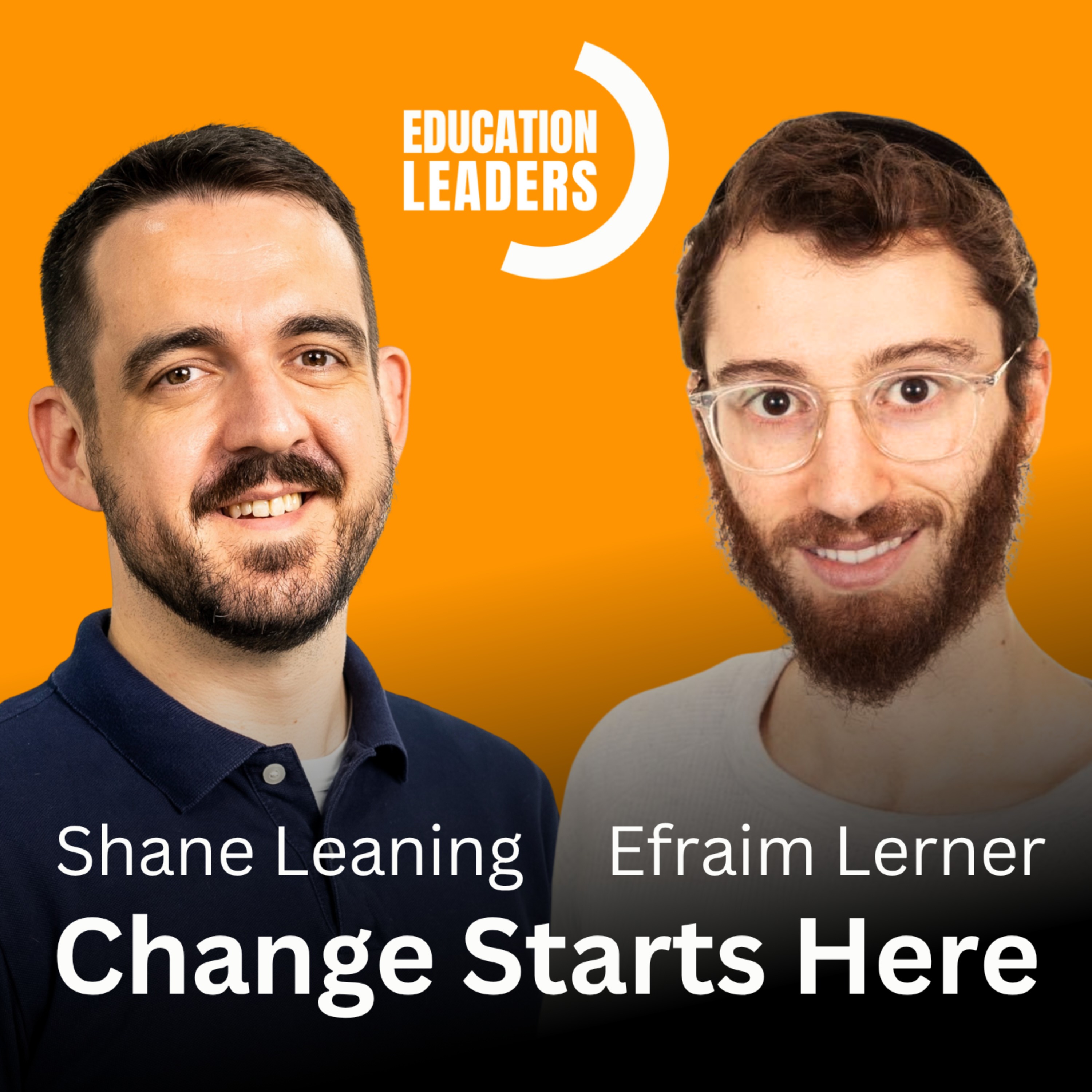
What if everything your school needed was right in front of you? In this special extended conversation, Shane sits down with his co-author Efraim Lerner for an unfiltered chat about their upcoming book "Change Starts Here" and why they believe schools need to rediscover confidence in their own communities.
Shane and Efraim dig into how schools have gradually outsourced their decision-making, creating dependency on quick fixes and outside solutions. They challenge the assumption that expertise must come from outside, arguing instead that schools create the most powerful change when they leverage the knowledge already within their walls - from teachers and students to parents and support staff.
They talk through their question-driven approach to change, featuring 40 questions that help schools discover what they already have rather than telling them what they need. Why do most change initiatives collapse within three years? How can schools create "resonant" change that feels authentic to their community? And why must schools build internal confidence before they engage with external consultants? These are the questions driving their thinking.
Order "Change Starts Here: What If Everything Your School Needed Was Right in Front of You?"
Work Collaborative
Connect with Efraim Lerner
Join Shane's Intensive Leadership Programme at educationleaders.co/intensive
Shane Leaning, an organisational coach based in Shanghai, supports school leaders globally. He is the author of the best-selling 'Change Starts Here.' Shane is a leading educational voice in the UK, Asia and around the world.
You can find Shane on LinkedIn.
We are a proud member of the Education Leaders podcast network. For more great education shows, visit educationleaders.co/network/
Hosted on Acast. See acast.com/privacy for more information.
Auto-generated transcript. It may contain small errors.
What if everything your school needed was right in front of you? That is the subtitle of my new book and today I'm sitting down with my co-author F.A.M. Lerner for an unfiltered hour-long conversation about why we believe change
should start from within your community, not from outside. Hey everyone, I'm Shane Leaning, welcome to Education Leaders, the chat-topping leadership podcast for school leaders just like you. As an organizational coach I've helped thousands of leaders worldwide lead with greater confidence, make better decisions and create winning teams. And on this show we explore the strategies that are going to help you achieve your goals and transform your leadership. So today's episode is something completely
different. It's an extended, unscripted conversation between myself and my co-author F.A.M. Lerner. We are both the co-founders of Work Collaborative and we are just about
to release our book called Change Starts Here. What if everything your school needed was right in front of you? Now this is my longest episode yet at around an hour but honestly we got so deep into the conversation that we really didn't want to stop and we've got so much more we want to talk about still. Here we explore the thinking behind our approach to school change.
Why we believe that most change initiatives fail and how schools can build the confidence to lead their own change. If you're feeling overwhelmed by external pressures, if you're tired of quick fixes that don't stick or if you're a little bit curious about what community-led change might look like, this conversation is for you. Let's dive in. We have had it said to us that why are you writing a book on change given there's so many books already on change out there and when I say why have we written a book on change for people listening we don't actually remember when we decided to write the book so it's going to be a very difficult origin story to tell.
I think in some ways that that represents our our connection. We sort of just started a conversation and continue the conversation and it's still going now. I never really had like a clear start point or an important saying this is what happened when we decided okay we're going to do a book because the conversation was already happening for months before and I think that's something that I've been thinking about. Although we might not have a very specific moment in time that we said okay we're going to be putting this into book format. It was this moment of
clarity that we had alongside continual moments of clarity and how ironic that we're speaking about change and change being a natural process. We can sometimes think that we need something that's monumental that starts at one point and ends at another point and that's what change is. Whereas change can be that subtle creeping experience that starts to become a part of how you do things and I think that's what happened with our book. We sort of started with this model for change and then we're like well we need questions and then the questions became well we need to explain why those are good questions and why they're useful questions and that decided to flesh out this whole book and it took a life of its own.
It really did and we had it's really lovely to actually think back but yeah there has been just a natural evolution and it's kind of why we set up Work Collaborative as well because we just want this kind of conversation to keep continuing and the book is just a part of that conversation which is quite exciting because we actually finished writing the book nearly a year before its publication date and pretty much and so we were talking just before this call that oh how much has our thinking changed? I don't think our thinking has deviated at all from the book but there's so many more things now that are on our mind which is pretty cool. I love how you said that Shane about the evolution of our own thinking and how the fundamentals, the values are there and you mentioned earlier about the Common Cause Foundation and having those values at the heart of what we do but at the same time our thinking has definitely changed from when we started the book to now and I've been thinking and I want to ask you we know we're getting a criticism for the book it's a conversation starter that's the exciting part of it but what would you say to someone who might come back and say well this is not practical enough or this is not helpful enough and we want a guy that's going to tell us step by step of what we should be doing? Well do you know what if someone comes and says that I think I'm really happy to say I can point you in the direction of some brilliant stuff that could help you with that for example you know I still do a lot of work with schools using John Cotter's framework for change which for me is extremely practical really forward driven and gives you very a lot of step by step of implementing through something and it would have been a bit weird if we'd have just tried to make a new model for change you know just trying to recycle something that clearly works in its ways if you're wanting just to be told this this this and this and to give you your best chance of success then there are some great models out there for me what we've tried to achieve is something different firstly saying that might work for x percent of organizations but it's obviously not working for a lot of people and why is that? That's really interesting it's peak type curiosity why is so much change not
happening why does so much change feel done to you and why does so much change not feel distributed within the communities that your change is situated and it's that why that we've tried to explore and I think very early on in the book when we were writing we made a decision even though we have a model that we've followed to really help us frame thinking and and that comes from design thinking we made a decision to utilize questions as the main tool which when you look at other models they're not necessarily question driven they're action driven and this being question driven opens up a slightly different face of change doesn't it's asking you to reflect on your position to reflect on the dynamics of the team that you're with it within your situation and then going so what you're going to do about that I think that's really exciting it's much more hands off from us in a way and much more you have to get your hands really on in your situation there's a big difference between those two styles I think you've brought up such a good point about the focus and the question the approach of questions as opposed to answers I think we live in a time where so much of what we get has to be spoon fed or is expected to be spoon fed it's this is what you need to be doing we have the answers and you should listen to us and it takes away that value that is already within an organization and it's losing that power or control that's often in a dynamic where you have a change of management book or a changed approach which can tell you step by step of what you should be doing but we will never know what you need to be doing and I think that's something from our conversations that has really flourished which is the ability to trust the team wherever they may be whatever context they may be in to trust their own environment to trust their staff trust their parents to trust their students to really get that community that's there already that can sometimes be overlooked when it comes to a change initiative where an outsider is relied on before if thought it through themselves I think that ties in so brilliantly to the first part of our book as well which is the perceived challenge how often we go in with an idea of what we think the challenge is and yet we think that's the challenge whereas there's so many other perspectives that need to be considered I do want to ask something there on that if it's all right oh you keep asking me questions and I just want to ask you one but okay yeah go on I think for me the challenge I've been facing recently is with organizations there's an expectation on leadership to have absolute clarity and to feel this level of confidence when guiding others through a change process and they're the ones who must be in control of that process how might it reflect on a leader who doesn't have that confidence or doesn't appear to have that confidence by asking the community at each stage of the journey to get involved I love that question and it speaks to I think the two-pronged approach that we've taken with this book I mean Ephraim it's been such a privilege to write this with you because we have taught a lot about how we've come from slightly different angles I still remember very clearly when we were first speaking how we were speaking around our passions about good quality change in schools good quality organizational change but we were very much coming from two slightly different places and the leaders of the schools are I kind of I feel like they're sandwiched in the middle of both of where we were coming from so we've got the leaders here and I feel I was coming from here like all this pressure that is coming down on leaders to make decisions and how difficult that must be for them and how they're feeling a reduction in their agency and their confidence and their knowledge to be able to lead schools and you when we spoke you like came from underneath saying well what about the community that lives within this leader's realms like how much are they influencing that leader and influence in the school and I would love for you to talk through a little bit about where this idea of community like how you got thinking about that where this came from because I think it's fundamental to our book and has shaped so much of it. You're very kind and I think one of the many aspects of writing this book together I really loved is just spending time together to learn from you there's this unique perspective that we both come from but at the same time there's that shared value of what we're trying to do and for me the question of where that approach came from I remember that first conversation we had vividly I remember where I was sitting I was in Florida at the time I was at a family event I flew over from from the UK and I was in the balcony I think at 1am looking over the sea and I was just speaking to you and I felt like a bit of a dream to be honest could have been the hour but it was this moment of I feel like someone's getting me but we're coming from a different lens and the same problem that we're trying to address which is that educational communities are often filled with so many expectations there's the pressure that comes in from a leader to be able to deliver specific results for students to be able to achieve some outcomes there's the expectation from outsiders it could be a government body such as Ofsted in the UK or the independent schools association that they've got their their requirements there's so many different factors that come into contributing to what goes on day in day out in the school and having been a leader in a school on the ground what I recognized was you've got the pressure from on top which you're describing quite vividly and you've got the pressure from underneath where staff students parents are often being discussed in a process and they're being informed about a process but very rarely are they a part of that process in the first place and having been a teacher on the ground as well as a leader I was quite young into leadership so I was conscious of that that experience that I had when I was a teacher of being told this is what we're going to be doing as opposed to being asked what would your perspective be on this approach that we're thinking about and seeing that on the ground and then being a leader and asking those who are involved from the security guard or the caretaker or the person who is involved they have perspectives that we often miss and speaking to the students directly with respect with understanding speaking to parents with an open eye the open heart trying to listen to try to understand it's a constant balancing act and I think that's something that I've noticed can can be lost in the process and I've seen that as I continue to grow in different roles that those voices are more than happy to share when they feel like it's their their experience their change whereas when you're just coming from a leadership perspective it can very easily be lost in translation and I think it touches on something else it touches on there's a very well known study with McKinsey consulting firm that over the course of a three-year process often change initiatives when they're coming from an outsider will last no more than three years which that longevity that ability for sustained change for resonant change I think it speaks to something about how the people who are being affected by this change feel and how much it's theirs and the ownership that they have and Shane I know you've spent a bit more time looking into this I would love to hear on your end a bit about that idea of how we empower change to last how we can ensure that it's resonance as opposed to dissonant change I love how you frame that and I love your passion for involving the community which has been with our conversations from day one that passion of how do we really hear you always challenge me but yeah but how do we hear their voices how do we really hear the student voice and hear those people how do we really know and I know it still occupies so much of your mind in trying to think of how can we create systems as well to help with this and because there's still a lot of good work to be done and an exciting work to be done on your question yeah it's one of the areas that we open the book with actually is that we add a bit of a crisis point in education really in many ways I mean education is in a perpetual crisis if we were to really be honest it's always something and the reason it's in a perpetual crisis is because education is so important to us as societies we value it so much and yet we still can't fully agree on what the purpose is like it's still quite ethereal it's still not quite like I challenge anyone you know don't quote me on the what you got taught on your PGC or whatever but like the purpose of education you will find varying varying views depending on who you speak to so I think it's it's rife with challenges and perhaps that's one of the problems but one thing we introduce in the book is that there is a bit of a crisis of organizational confidence in schools that has come from many places but particularly we've talked a little bit about how it's come from over a good period of time school leaders have become less and less and less autonomous and we could go back in time to track this I mean if you were even in the UK good things that came out like in the in the 90s that you know the national curriculum coming out okay all schools are going to follow this curriculum well this is a good thing in terms of standardizing practice but what it also did is meant that school leaders gave up a little bit of their responsibility in that moment a little bit of their knowledge of what they needed to think about because it had been outsourced now that's just one thing maybe a good thing but then you start adding other things to that maybe there's a policy on how to do x a policy on how to do y maybe all the sudden you're saying our teachers need to be developed in this area I'm not sure how to do it let's get another external person to come in and help us with that you start to outsource oh okay our curriculum let's not design it in house let's buy in this packaged curriculum because that's going to make it easier for our teachers these are all not bad things in themselves but over time what you do as a leader is you start outsourcing those spaces and it's great as a leader because you need mental space so to be able to outsource and delegate not just within your team but delegate outside frees you up to think about some of those important things but there is also a cumulative effect which i think we're not talking about enough and the cumulative effect is that as a leader you have therefore let go of so much responsibility in certain areas that's not part of your remit you've lost agency in that area you've lost some key knowledge about how those areas operate and therefore your confidence in making good quality decisions about those areas is lower when i'm sometimes doing work with schools we call it a dependency cycle that can happen where you outsource your thinking in some way and therefore someone else starts doing that thinking for you therefore you lose your capacity to do that thinking over time therefore you need that person to help you to do the thing in the first place and all of a sudden you're in a cycle of dependency that is really hard to get out so the challenge i think we put forward in the book is that this doesn't have to be an inevitability like this is just not an inevitability of the system because who have you got around you well as you constantly point out to me efrem we've got this community you've got a massive body of incredible professionals in your teachers incredible staff members probably a suite of good leaders who are thinking parents who have goodness knows what knowledge they're bringing to the table and of course your students who are bringing so much to the school so have we slightly turned our gaze in slightly the wrong way maybe sometimes we have maybe we've slightly turned our gaze outside and actually it stops us from seeing what's right in front of us which is a community that is capable of making great decisions great decisions for itself and driving really good change forward there definitely needs to be a slight rearticulation towards that community i would say i think we've slightly lost a gaze i don't know if that resonates with with you the way i've described it it does it does and i think there's a bit of a tension point as well and i call it out because i think you're going back to that question i asked you initially about leadership where where does that line between leadership and collaboration overlap and where it kind of cause a bit of tension because our book might be taking at face value that collaboration when we do that throughout the book or we go through common words or common phrases that often get used and how it gets misused we say things that often mean one thing and have been distorted and and used in a very different context in corporations in in companies in in education and those very words which had meaning which had depth which had purpose which had clarity which meant something have been lost and i think our approach in general about bringing the community well we get we tick that box we bring in our community and there are times that we don't we shouldn't be bringing in others where we need to have absolute conviction this this is now a time to move on otherwise we can get stuck in that area and never really move on change does need to happen there is an urgency to change sometimes that being caught up in that process of constantly asking and trying to get other people's opinion is dangerous because we can get stuck in that area and purposeful community that change isn't also knowing where people have specific roles we use the racy framework where there's responsibilities there's accountability there's different levels of people's roles and involvement in different tasks but it doesn't take away from the very fact that we're not saying that everyone needs to bring in the same amount of value or work we're saying that value can look very different to what we initially have thought or value as where just because someone's in a leadership role doesn't mean that they can't help out in a way that we wouldn't expect from them and just because someone's in an entry level role and even those words themselves can actually be quite hierarchical which is not what we're trying to do at all we're trying to flatten that area to some degree but at the same time people have different skill sets they have different knowledge if we go and ask a teacher to go and for a cover lesson we want them to run the sports curriculum if they love sports and it might be something that they're passionate about that might not be a clear thing on the cv that might be a really useful skill set that we can capture from that person or from that knowledge base and i think when we speak about using our community it can often be misunderstood and we're going to connect to them in the way that we think that they've got value or we think that they bring insight or understanding whereas actually they can bring in some perspectives that we might not have looked at if we start to question those assumptions of where we see the role that each person plays within the community and for me that's what i've really loved about the stories that we've gotten better throughout there's anecdotal experiences that we've had from our own experience dealing with different stakeholders and that word can mean different things to different people but the value that different people's perspectives can have within the communion we bring from the perspective of of a head teacher we bring from the perspective of a student and we bring from so many different angles that i think that shows what we're trying to say without telling you an answer without giving you something that is prescriptive and you use that that word prescriptive quite carefully in the book shane and i know that was something that definitely came from your end with using that language what was the distinction you were trying to make when you were using that word prescriptive in the book that's a good question so i think we had a bit of an anxiety as we were writing the book is how are people going to use this and we've talked about it a lot since we've like oh crikey you know are people going to misinterpret this how are people going to use it and we've put a bit of a guidance in the book that you can use it in a number of ways and we don't think the main use case will be to go starting a change page one you know let's do this then that then that then that it's not going to work like that and it definitely won't work if you're just applying it to any generic change because i think as you rightly said is some changes require a quick fast fix some changes require something else but what we're saying is that we should hope that most strategy work that you are done in falls into the proactive space rather than the reactive space that's where we want to get to and this is where this book can help right it's the idea that some of these questions might be able to prompt you to find things out about where you are in change that you hadn't thought about before that you hadn't realized before such as the question in you know at the very middle of the book in the middle of the process where we say what would joe say and joe could be anyone but like we're going through a change and we put ourselves in someone else's shoes and go what might they say let's go around our community and think about what would this person say what would this person say like how often for example do you get that prompt when you're knee deep in change knee deep in an initiative to step out and to go okay let me just have a check-in in one way i think you know that's a beautiful way to use the book to go in with your inner change you're probably already partway through it and to then to go well where am i and could some of these questions really help us unlock and what these questions are designed to do they're not just kind of nice to haves let's just have a nice softy soft conversation around what we're doing but we have a very clear aim in that we believe change should be resonant is something that we talk about in our book the idea of resonance and when we're talking about resonance we've used that example of my tibetan singing bowl before where when you hit the bowl that sound resonates and when we talk about resonates we think about that resonance in three ways really don't we we think about that resonance through time in that that sound lasts that's what we want change to be we want change to be lasting not like the mckinsey study we're say three years and and we're up and on to the next one we want some lasting change but also resonance means it resonates into the human in you we all use that phrase oh that really resonates with me when something connects with us well we want change to be able to resonate through our community in that way and also resonance resonates into object if you tune an instrument at a particular frequency you can smash glass it's that resonance because it's a resonant frequency it's physical right things resonate through our physical space and we also want change to resonate into the physical space that our schools sit within so it's not just attached to a person that when that one leader leaves that change leaves with them but that it feels like this change is part of them and that's why we've done a question based approach because each of those questions each time you take a moment to reflect on one of those questions you are strengthening the chance that your change is going to actually resonate rather than just be more transient or even worse as as you mentioned dissonant with your community with your school or even with yourself can dissonance be a good on that idea just that's a leading question so tell me what do you think you brought up this idea of dissonance originally and i really like your thoughts on this so what what are you thinking around this i think ties into the concept that we discussed in the book from amy and mason around psychological safety and the power of being able to feel like we can make mistakes and we can be ourselves to some degree to be able to acknowledge mistakes and use them as a learning opportunity whether it's the growth mindset or whether it's adam grande's concept of being able to have dissonance to be able to spark curiosity but there's a big difference between dissonance that discourages conversation and breaks down communication versus dissonance to be able to spark better conversations to be able to have more raw authentic organic conversations and for me that's been a real part of what i've learned through this process which is yes there are other perspectives that are often overlooked in the process of change and often if we bring our community along with us if we bring our organization along with us for change it will be resonant it will be able to resonate but it doesn't mean it resonates in the same way for everyone i learned this from the concept of values how you mentioned the common cause foundation and about how our values can be shaping what we do values can express themselves very differently and in different ways and being able to have a level of dissonance in how they're expressed as opposed to how they actually are and how they sit with us we can have very different perspectives we do and that's what made the book so powerful yes it's because we have that common shared value of what we're trying to do but if our dissonance is there to be able to break down our communication and we're not able to have these conversations anymore so in a school environment that might be apparent being able to share their perspectives if it's us against them in that mentality it's very easy to lose what the very purpose of the conversation is about you're so right i i don't know personally how people will take to the book and it's something i'd like to turn back on you and ask you which is what is it that we're trying to get people in your perspective i would love to hear your perspective of this i know we spend time speaking on different podcasts and sharing our thoughts about the book and we've spent a long time on creating the book as well but every time i listen to you share your thoughts there's all something new i gain whereas when i'm stuck in my own head it's harder to see that and what i would love to hear from you is what is your hope for someone who's picking up the book and is reading it for the first time and thinking about change in their organization in their school environment well first it's nice of you to say like when you listen to me talk and then your own thoughts develop i think this is the beauty of talking about this regularly right because every time i talk about it i feel like i learned something new about what i thought i knew about already and so that's a really beautiful thing and speaks to what we're actually asking people to do within schools which is to talk a bit more as well because and not just talking about something that i'm going to direct you to talk about but just to talk about what's happening for you because in that process of a conversation so often insight comes that can't be given to you by an external consultant that can't be just given to you by a research paper you've written you know no matter how good or well-intentioned that is sometimes you just need a conversation to bring that out and i feel that that would probably link to my answer to your question if someone's picking up this book i would hope that it speaks to them in some way and i think it's going to speak to different people in different ways let me explain our book is titled change starts here quite bold big on the front cover you know big statement what if everything your school needed was right in front of you and it's change starts here we had a lot of discussion over that title and tried to figure out is it right but so i think some people are going to approach this book and i feel we might have some activists who come in and go right change starts here yeah i'm ready for change and maybe this book will inspire them to think about that i already know we've got a few contacts who have read the book and have gotten fired up and are writing about things and talking about things around the ideas already and gosh that's exciting because there's so much development that's happened and the book's not even out there in the world but i also think there's going to be people who pick up the book not from that almost politically motivated side i think there's going to be people pick up the book who go i'm feeling slightly disconnected from my community at the minute or i'm feeling like i'm a member of a community and i'm not sure how to have a conversation to bring myself into the discussions or maybe even someone is picking up this book and going i need a companion to help me structure a project that i'm coming through and then they're going to pick this up and go ah here's a few of those questions maybe read through the 40 questions and maybe go actually these three questions are really pivotal to this change going forward and it's going to help me with that i think some people for example they're going to be launching into a change and i think many of the people who read a book are going to get surprised very early on because at the very first part of our change model the idea is connection connect the first five questions are all around connection something you don't often see in these change books because it's almost pre the change i predict that a lot of people are going to be jumping into their change and then read those first five questions and go crikey are we ready and if they're thinking oh my goodness are we ready that's a great thing because that is a good question you should be asking are we ready for this change and are there any fundamentals that we're missing sometimes when i'm working directly with a school we agree to take a step back early on in the process to go actually we wanted to do this but we've taken a temperature check of our team and these are some of the feelings that are coming up before we launch into this change should we work on this first if the answer is yes most of the time that's going to really strengthen the foundation we start that change in six months time we start that change in a year's time and we're going to get much greater impact i've got a school in my mind that i i work with currently i'm doing some coaching work with and the change that they have been implementing was curriculum curriculum change and they you know they really wanted to kind of launch into it really quick and they had ideas of what to do and we slowed down very quickly because there were feelings within their team that needed resolving there were many teachers who felt like they didn't have a voice at the table in that particular school and this was setting them up for resistance for these changes they had planned so we said let's just take a step back and go to that let's look at team voice and see if we can work on that we spent quite a bit of time working on that now they're preparing a curriculum that's about to launch next year so it's a year later but their whole team is on it and they are really keen to make this work now i predict really good things for that school because they've got a community that are already invested in this change going forward it just took a bit of confidence to take a step back and i hope that our book can facilitate some of those kind of conversations i'm curious to know what your hopes are for people picking up the book it's a difficult question we live in a world that unfortunately is quite obsessed with absolute clarity and certainty and in education which fundamentally is the bedrock of a society we've got so many different voices that have absolute certainty and i wish that it gives us an opportunity to pause and with the pressures that we have day in day out in a school environment people will have the criticism on us immediately well you're no longer in a school teaching on the ground you're no longer in a school leading you know with the pressures of an external board or parents or students coming into your office we don't have a moment to breathe and you're speaking about these you know these opportunities to really rethink what you're doing when it comes to change we don't have a moment for ourselves my hope is that we can take that pause and it doesn't have to be a six month pause it could be a 60 second pause when we're interacting with our staff when we're interacting with each other to think do we have absolute certainty and if we do is that not a worry is that not a concern and how do we bring confidence to the areas that we should be more confident in for example within the school community to be able to acknowledge that there's deep x of t's that we have overlooked and to ignore that absolute confidence that sometimes can sound so convincing from an outsider that doesn't necessarily understand the complexities and the context with which we are in and if we could break that certainty a little to acknowledge that we shouldn't have to live in a world of certainty we should be able to have a more humble and honest and raw conversation with the people around us to be able to listen more to not just assume that for me is a deeper hope for the book but on a more superficial level what I'm really hoping is following a similar note to what you were sharing about starting the conversation I think with psychology Freud there's a lot of criticism on his intense view but looking back I'm sure he was quite proud that he started a conversation that shaped a different way of thinking because of having a psychological approach from Freud it forced a more human-centric approach from others and the animalistic approach of understanding like animalistic behavioral raw human nature of Freud almost forced us to think well what what else could it be and my hope is with yes there are so many books out there on change but how often does it change in the context of an educational environment where it's community led how often is it led from recognizing the power that we have within how often is it the humbling experience of knowing we don't have all the answers and neither does the person writing the book it's about being able to think about things from that perspective which I'm really hoping we can cut through and and be able to start the ball moving and if we do get that criticism that I'm hoping it just encourages everyone to have that conversation just to be aware a little more of what perspectives are missing that's what really excites me about this is that we wrote this book not as just a moment in time to summarize some of our thoughts but we wrote this book as a continuation of the conversation we'd be having as and as an invitation for other people to come into that conversation and this is why we've set up work collaborative thinking about starting in education how do we work more collaboratively through change and what does that mean for change and I think it's why it excites me that at our core of work collaborative is thinking about research and advocacy work advocacy not just in terms of helping schools to do these things because as you said sometimes there are systemic challenges that are also at play that make it very difficult for schools to be able to engage their whole community and decisions or to take that breath that we so desperately need so we've almost got a two-pronged approach in our advocacy work one advocating for another way of being another way of doing within our schools but also advocating on a system level to say what do we need to change in the way our schools are operated and is there a case for a more radically local approach to what we're doing and look it's something that we're going to have to think about very fast very quick in a world of artificial intelligence which I know is you know something that you're really well involved in and me just a hobby horse on the side but education is changing is going to change we know that it's not something we can ignore these advances and the question we need to be asking is not just what will education look like but who is involved in that conversation who is going to be leading that conversation now my feeling is strong education has always been and I feel should continue to be a community piece a local piece like we're looking at these children who are coming into the world living within a community and that community is supporting them to whatever those outcomes of education are going to be so why not be making good quality confident well-informed decisions in the local community we run the risk of this becoming another top-down or not just top-down but from the side thing that happens to education another thing that happens to it and people feeling less and less empowered to actually make good quality decisions there's a lot of work to be done here and especially in the west sadly where education is not held with the same status it once was even though we know it's one of the most important things you could ever invest in it is still seen as a lower tier profession in many circles and it's still not treated with the respect even from our own governments and policymakers teachers are still not treated with the respect that they deserve and then going on from their parents are therefore not treated with the respect that they deserve for being a parent and the knowledge that they hold and then we extend that to our whole community there's a big question is what if we brought those people back to the table and what if they were able to lead good quality decisions for themselves shame that the pride that you speak about where someone's able to be saying unashamedly that they're a teacher that's shame that i felt i know i did and i have to be quite vulnerable on us maybe it's easy now that i'm not a teacher in the same way that being a teacher can come with this huge amount of shame you walk over to someone i know i felt that growing up and saying i wanted to be a teacher or wanted to be in teaching or in education the moment you say school it's almost as different approach to how they will look at education and obviously the slogans that you have from the first trump campaign of make america great again and it was a catch phrase and i know it was overused and it was it was an important like marketing strategy but really i think change starts here in my mind as you're sharing it is about making schools great again making schools be proud we get caps printed yeah it'd be something that under the surface would be really crucial for schools to really rethink and we're at this crucial point you mentioned artificial intelligence it's not very attractive for organizations i'm working with sort of larger now corporations and organizations to say when they're dealing with ai they're just dealing with databases or they're dealing with their fundamentals they're trying to get their fundamentals sorted it doesn't look exciting to investors it doesn't look exciting to outside worlds but actually not to sort of get too sidetracked with the ai side but it ties in quite deeply to our book around how we collect data how we collect information often we're collecting information about people or making decisions about people whereas if we had deep contextual knowledge which in the tech circles would be considered ip you know their intellectual property those valuable insights that they get schools are rich organizations are rich in data but they don't have rich data they don't necessarily have focused data or multiple perspectives on the data and what we're trying to do is really capture that intelligence we're trying to capture what goes on in a school environment and how do we do that well if we've got closed off approaches and we think we already understand what everything's happening around us it's very unlikely that data is going to be able to be useful and if a school wants to think about ai in an intentional way in a way that they're not just building up this sort of glass tower but building deep roots and deep foundations it needs to be able to ensure that the change initiatives that they go through and ai is definitely one of them is deeply rooted in what the school's insights are saying and what's contextually valuable to that setting if we were to just use general data generalized data it's the issue that we have with so many of these large language models where where does it hallucinate where does it make mistakes it's because it's made assumptions and those gaps it might sound like it's thinking but rather it's about probability and it's thinking what are those gaps of information and where can we fill in those gaps and if those gaps are massive gaping holes and that happens day in day out in organizations where they're avoiding having difficult conversations they're trying to make assumptions because it's easier if they touch over important touch points in their processes important perspectives in what they do we can very easily lose the heart and soul of what makes us us and from an ai perspective that's incredibly useful because that's what's going to make sure that this is our change or this is going to make sure it's our assumption or our solution as opposed to a solution or an assumption or a generic outcome or output response the deep knowledge that we have within gets lost very easily because we bring on the outside voices that will easily gloss over what's valuable but knowing what's valuable and what we want to retain and what we'll lose can only happen when the organization has we use the word buy-in that has the genuine buy-in where people feel this is theirs to be able to say this is ours and this is what we would like to do we're bringing on a system but it's our system we're bringing on a new approach but it's our approach that feeling of it being ours is so crucial yes that approach can allow it to be our solution our change that's why change starts here when we were debating about that front cover of our book change starts here it's that it starts here change starts here that it's our thing it's not someone else's and that we already have that knowledge within we already have that deep insight that deep rich data that's so crucial to our organization's success not just now not in two years time not when the next tool or exciting technology comes out but actually is rooted in what makes our organization us could we key in on you mentioned the title of our book and the word here because we had a lot of discussions on the title of the book and we had it for a while was it lead from within yeah lead from within which is also a great title that was our working title for a long time but we ended up coming on change starts here and each of those words carries meaning I mean what do we to those words mean to you change is a tough one because change is often associated with change happening to us change is we put this in our book as well as change is often seen as a negative or not necessarily negative but something that's passive it just happens and there's different types of change that can happen change is constant and we mentioned that that quote from our book where change is happening all the time and in education it's even more so because we've got so many key influences to that change but change itself is a natural and human experience and it's happening all the time and if we can bring that change with us and allow it to be ours then that change can be quite powerful I'm going to put the script there before I go to the other ones it'd be good to hear what you think of when you hear the word change what was driving you when you were thinking about the title yeah well you were the one who actually challenged me originally on the word change and got me really thinking about it because yes I'd been thinking about organizational change for a while and I think from my perspective I felt semi-comfortable with the word and you raised quite rightly do you know some people have some perceptions of change it can trigger a response in people and we were thinking for a while is there another word weren't we like is there another word we could use is like transformation or innovation and you were you were saying there's quite a few organizations who don't really use the word change anymore right they've replaced it it doesn't sound as exciting it doesn't it doesn't no it doesn't sound as exciting but uh yeah innovation starts here transformation it doesn't quite have the same ring and it wouldn't have fit on the cover anyway but we ended up debating this out didn't we and actually I certainly felt very passionately that we shouldn't run away from this word like if change is inevitable and change is what we go through if we want to we can say oh we've fallen out of love with change so let's call it something else but is that dealing with it and is that at the heart of what our book is about which is actually dealing with stuff and going there like we need to go there and talk about this and flesh it out so if change is what we're doing change is what it's called that's what it is and that's kind of where i'm sitting with it you know what i mean i love how it ties in so well with those approaches we discussed about dealing with it head on we use certain words like even the name of of the collaborative work collaborative collaboration can mean so many different things to different people but how often do we or stakeholders or buy-in these are words in the book that we try and unpick and we just discuss head on what the perception is around that word and what we mean when we say that word but the next part starts here yeah this part excites me go for it i want to hear from you i really want to hear your perspective on this well it's funny starts is the verb in our title and it's the bit you read over so like if you're picking out words you go change in here like there's the key words but starts is really important as to what our book's about because in our book we have that double diamond model which you know we've adapted from the british design council brilliant model and we make the statement that you know when people are going through change they start at that perceived challenge and they often turn that challenge straight into a goal which is in the middle of the model and then go straight to a solution and actually at the beginning is where we really want to focus some of our time and the reason the word start is so meaningful to me is because so often our changes start somewhere else there's so many times where this could happen you've been to a conference a leader's been to a conference and here a really inspirational speaker or goes and sees a product stand goes to the bet conference you know that that massive things and someone says you should do this and they go wow that's a really good idea let's do that so that's where the change has started and that place where it starts makes a huge difference on where that change is going to go and so that kind of starting point for me is a positioning of where is the change starting and i don't feel we should be confident if the change is starting outside of our school walls the change has to be starting within our community otherwise we're going to have a real hard time as we start navigating that change change forward so that starting point is hugely important to me and here i'm curious you've taught it in quite nearly already with the word here but here seems to be so crucial as well that it's personal that it's meaningful that it's specific we're not just saying change starts because they're saying it starts here we're giving instruction direction clarity but it's also ownership it's ours it's not someone else's it's not an organization's or a tech company or an external body it's our change and we're the ones driving it as opposed to change happening to us it's us who's driving that change and yeah for me that's the word that that gets me every time when i see it and obviously it's our books of people are going to think we're obsessed with it that makes sense but i wish i had a book like this because we didn't have this when i was working in schools on the grounds i didn't have that type of philosophy or approach i felt it but i didn't feel it permeated the structures and the physical structures but also the the mental structures of what goes on day in day out across schools yeah i love that and here is likewise it's a really emotive word for me too and we purposely have got that arrow on the front of the book so you hold the book and where's the arrow pointing well it's pointing to you it's pointing exactly to where you're sitting or standing at that moment that's where the change starts it's within you and this is a really really important message because that is an empowering message and hopefully it's a bit of a call to action message as well to say where am i within this change and the i could be the leader who's holding the book it could be a parent who's holding the book it could be anyone within that community is where that change is located and it speaks to those two elements that we both came from from my side thinking change needs to start at the school as an entity and from your side the change needs to be situated within the community of that school so we've picked a cracking title there that i'm still you know you're worried that you're going to get bored of it and i'm not bored of it yet the subtitle for me was deeply personal and i'm sure from your side as well there was something that it spoke to you and i would love to hear yes what was the subtitle for you what was your perspective of that well for one it's a question what if everything your school needed was right in front of you so it's a what question which we've got you know lots of those what questions in the book so what a perfect way to start with a question right there and it is a curiosity question what if because of course in the question is of course a bit of an assumption and it's a bit of a leading question in a way to say well we think there's a lot in front of you that could be useful but it's a genuine what if question because what we're not saying in the book is that you don't need anything from outside what we're not saying is we didn't put a statement on the front of the book saying everything you need is in your school we didn't say that we said what if because that question opens you up to the conversation opens you up to the idea of what you've got in front of you it doesn't restrict you into saying now we're not allowed to engage with external agencies in fact in the book we explicitly talk about where it's appropriate to get outside thoughts and my goodness it's really important for schools to be constantly engaged in a conversation but for me that what if question is you know is really important to me how about you you mentioned like external like like consultants or outsiders like ultimately you're an organizational coach i'm working as a consultant um there's this assumption that can often be the case there well if the book is promoting internal power internal confidence for the school we're negating the role of the outsider and actually i think for us i know for myself i wish organizations came to me with a level of confidence to know where i fit into that picture where i can offer value where i can ring in that and i think for tech companies for external consultants for coaches organizational coaches for instructional coaches to be useful to be able to have the space to be able to have impact there needs to be clarity on the role that they play within that yeah and the subtitle for me gives me a level of absolute conviction that our role is always going to be as valuable as the recipient so in our conversation is that someone right now is listening to this podcast and thinking yeah i can take part of that or this relates to me in my own life but it will only be as good as what they want to take from it and the dynamic shift between an assumption of a book telling you everything versus we're actually not telling you everything we're telling you what you already have you've got something there i'm finishing my it's taking a long time but i'm finishing my masters in psychology and at the the final stretch in my dissertation now and in psychology there are so many different perspectives with which you can view someone but often the dynamic can be client patient relationship where it's at a distance there's an understanding of we're the expert and they're the one who's coming in with the issue with the challenge of the problem whereas i think that can be quite unhealthy already that dynamic already shapes the relationship and it can create dependency it can create a level of disconnect whereas being able to recognize the value and the partnership that you have and the coaching aspect of our book is so crucial as well that we haven't really discussed so much but the work of Jim Knight or people like Ian Henderson people who have really shaped our own thinking when it comes to to coaching and being able to understand the value that is already there for the other person is a crucial perspective we're which we're trying to give when we're looking at our school or looking at an organization that our assumption of saying we are the expert and they're someone who's a recipient of that expertise versus they are the expert in their own life and we're just trying to allow them to have better thinking i love that i love that it's the idea that before you go engaging with the outside do you know yourself well enough and ideally you do and actually a lot of organizations come into schools and they wouldn't ever explicitly say this but there's an undertone of we know your problem better than you do because we're the experts in this problem well we know your challenge better than you do because we're the experts in this challenge or we know your solution better than you do is we're the experts but there's a flaw in that because they might know the general principles and they might be able to offer expertise but no one knows that school better than the school i mean of course that's true and no one knows better of that school than the school community thinking together which is even more important like a leader can only know a school from their perspective from their perception but a community knows their school inside out from different angles so how do you leverage that and help a school as a community to know itself so well that when it is the right point for growth and when they need to make a change that they can approach these external consultants these wonderful people who are out there in the world giving their life to add value into these schools they can approach them with confidence to say we know our school well tell me what you do tell me what knowledge you've got tell me what value you can give and i'll tell you the value that we have and let's see if there's if there's space for these to come together sadly what often happens is the opposite isn't it is the organization comes and says you know hey are you using ai in your school and the leader goes no should i be and i go yes you should yes you should and this is what you need to be doing and the leader goes well i know nothing about that and they go well look at all these other places that are doing it you should do this okay let's do this tell me what to do that is a terrible way to lead a school like you have just outsourced all of your thinking to someone else and it is inevitably going to lead to some chaos down the line in your community what if instead this person came and said are you using ai in your school and you said no tell me more about what the benefits of ai are they could explain and you could go well here's the context of my school here's what our challenges are and here's some priorities that we're working on now and maybe that person said well it could fit in here and there and you were able to go well we can't do that because we've got this priority that we need to allocate this time but tell me more about that aspect because that sounds like it could work or can i go back to my team and like show this to my community and let's go this out so we understand now they're probably going to at that time go oh but pressure i'll give you a 10 discount if you sign up by the end of the week or whatever but actually we want schools to be much more confident to be saying let me see if this aligns with where we're going before we jump before we make that leap it speaks to that cycle one of my favorite questions from the book is the last question where we ask yes is this the end of the change are we just getting started because change is constant although the book title starts here implies that we're just starting it it's actually an ongoing process and we might be on the start of this specific change process for this specific change but actually what we aren't speaking about enough is what's going on under the surface what is our appetite for change as an organization how likely are we to start another change again and it's like a muscle what we're trying to do is trying to stretch and use that organizational muscle to be able to feel more confident to be able to adapt to change more readily because yes change is happening so quickly and we do need to act sometimes very quickly but how likely are we to bring our organization with us through that process how likely are we to be able to feel like this is ours in a way that matters it gives us the the appetite to want to do it again and to do it again after that i've shared my favorite question i think that's probably my favorite question there are there's one other but i'm curious to hear what's your favorite question or one of your favorite questions okay there's a reason it's difficult is because the questions are designed for different points in the change process so like there's different times when a question comes to mind it's one we've talked about a little bit before but it is the first question in the book which you you mentioned earlier which can seem like a really deep place to jump in to a conversation and you'd never do but it's the idea of when was the last time you truly felt heard and when i said earlier that i think the first five questions in the book will potentially surprise people or intended to kind of shock people into a state of reflection as to the dynamics of their team this one is a super powerful one i'm so glad we opened with it because it cuts to the core of what the whole book is about is how much you are asking this question imagine putting yourself in the position of asking your parents that when was the last time you truly felt heard and asking your students that asking your teachers that asking other leaders that asking your ceo that same question when was the last time you felt heard because we don't talk about this enough we just don't talk about how much we're heard and yet we know that some of the most successful organizations in the world are those where the people who are a member of that community feel like they are part of something they're important and that their voice matters in some way and the only way they can feel that is if they truly feel heard asking that question can bring up so much it can surface both where someone might feel that they're not heard or where they feel that their voice doesn't matter in some way but it could also surface moments where they feel heard as well where they say actually in this space i feel heard and in this space i don't which is really good calibration exercise or maybe they're about to tell you that hey it's a teacher the last time i truly felt heard is when i was in a staff room chatting with someone on my break and i'd had a really difficult morning and they listened to me and what does that do as a leader does that tell you something about the importance of that staff room culture in your school does it tell you about the importance of something is meaningful to that staff member or that child who said to you well the last time i felt heard was when i put out a message to some of my friends and i got some comments back and it felt like it validated me and would that shock you and go oh gosh there's a different channel here that i hadn't thought about which this child is saying is meaningful to them in some way i just love that question because it opens up possibilities we included it as the first question not because it's actually the ideal first question to just open a chat with like it's quite a deep question to get into but that it's a question that unlocks so much anybody keep saying this over and over but it's the start of that conversation that we're trying to get we're not trying to say you know you've got the answer now you can move on to question two it's it's the ability to soften people there's more to what you're seeing on the surface and how do we get under the surface a little more dig a little deeper i think one of the examples analogies we bring is like when you find treasure and we ask michael bongi and bongestani is famous question of you know what else being able to just dig in a little deeper would you be able to share a bit more about the treasure example i think that would be something interesting sort of pick it yeah well the michael bongestani a question is such a wonderful question because so often we ask a question and then we get the answer and then we move on to the next thing and we know as coaching that some of the times the most powerful question you can ask is what else what else because rarely the first answer you give is the actual answer very rare that's usually the surface level and you have to interrogate it in some way using that annoying question that all children ask why why why it's a great question because it starts to dig you know there's that idea that you should ask why at least three times right so you can actually get to the heart of what someone is actually saying it's the same when we're looking at ideas so for example if you are thinking let's go with that ai thing that we mentioned so okay our school wants to introduce this ai tool lesson planning tool for teachers this is very common at the minute right so this is the tool and we'd like to introduce it what about if you asked what else like what else could we do not just what other tool could we use what else could we do well that's going to open up oh okay well yeah we could use this other tool this competitor tool that's good okay what else oh maybe we could ask the teachers what they think and what's there okay great what else could you do crikey okay we're really digging into it now well maybe we need to press pause and really think about this a bit more deeply and explore our options maybe we need to get people together the idea is that just that what else questions sometimes stops you in your tracks and go oh what else oh really that's where we're going i thought we were doing this thing and sometimes it can get you without any extra prompt to a place where you feel much more secure and that you're making a much better informed decision i think in the treasure analogy it's like yeah you don't just find the treasure and go great stop you would keep going right yeah it gives you new energy i think you're right it's that it's the ability to uncover more and uncover more and a lot of how you brought it out with the experience that someone would have if they're thinking about a solution and they're realizing that that's not the only option there's more options and there's more possibility and i think the beauty of our approach throughout the book with questions is that it speaks about possibility as opposed to probability a lot of programs a lot of the books that i've read that shaped our thinking towards this book have been around probability what's the likelihood of a change to be successful that's backing the book it's the skeletons behind it it gives us instruction the framework but the juice the meat behind what we're trying to do is really around the heart of asking questions and being able to allow it to be what possibilities is that i'm not how can we open our minds as opposed to close our mind specific solutions and there is a place for that you know every time me and frem have these chats i always come all here about new thoughts new feelings new insights about our own work there's something really powerful about talking through ideas with someone who challenges your thinking in the best possible ways what really struck me most about this conversation was the idea that we somehow lost confidence in our own schools in our own communities we've become so used to looking outside for solutions that we've forgotten the incredible expertise sitting right in front of us every day now the book itself it isn't about rejecting external support entirely but it's about building the internal confidence to know when to know how and to know why we engage with outsiders it's about starting change from a position of strength rather than deficit if this conversation spouts something for you i'd love it for you to check out our book change starts here it's already available for pre-order our link in the show notes it contains all 40 questions we've developed to help schools discover what they already have plus the complete double diamond framework that we use to guide community-led change you'll find that link as i mentioned in the show notes as well as some more information about work collaborative because what if everything your school needed was right in front of you education leaders is hosted by me shane leeming thanks to the show editor pete mcgill and for the original music by guillerme silver and thank you so so much for tuning in today it really does mean the world and if we don't speak before i will see you here next week
Shane sits down with Nathan Burns, widely known as "Mr Metacognition," to tackle one of education's most discussed yet frequently…
Listen & show notes
What if the secret to transforming your school culture wasn't another initiative, but learning to tend to it like a terrarium? In this…
Listen & show notes
When 89% of a population plays games and two-thirds are under 35, that's not a problem to solve - it's a medium to embrace. Today we…
Listen & show notes