
Leading With Conviction | A Conversation with Katharine Birbalsingh
Katharine Birbalsingh, founder of Britain's most talked-about school, reveals the leadership principles that transformed her vision into…
Listen & show notes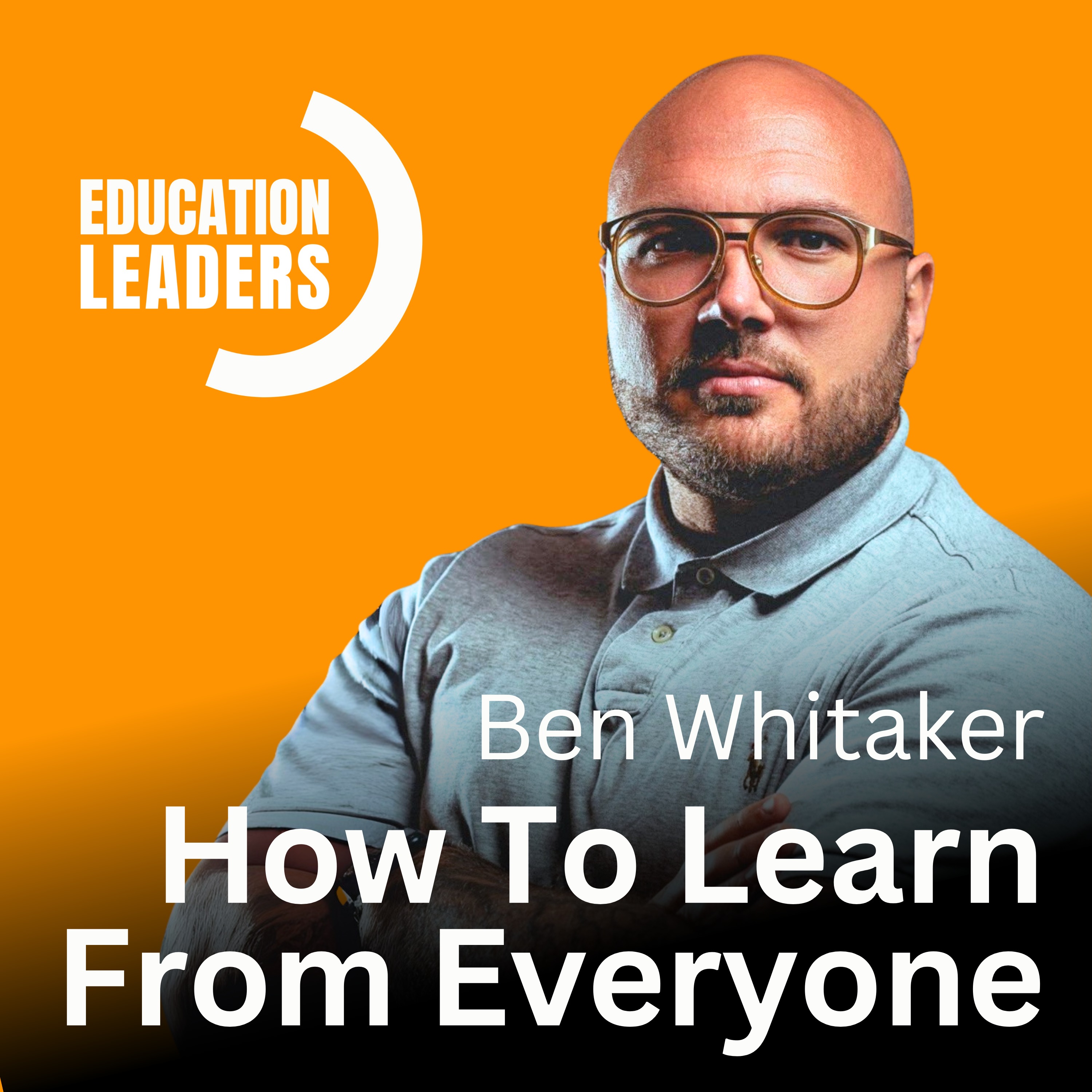
Shane Leaning chats with Ben Whitaker about his new book "The Ideas Guy" and why he thinks we're all capable of being idea generators. Ben's an education consultant who specialises in education leadership training and co-hosts the Edufuturists podcast, and he's got some fascinating takes on school leadership coaching. Rather than hunting for that perfect role model (spoiler alert: they don't exist), Ben's all about picking and mixing ideas from loads of different people - even the ones with questionable ethics.
We explore everything from Sir Ken Robinson's unconventional paths to Brené Brown's thoughts on vulnerability as a leadership strength. Ben challenges the whole notion of trying to cram more stuff into education and makes a compelling case for school improvement strategies that focus on creating more space instead. If you're an international school leadership team looking for fresh school leadership tips, or just want to think differently about organisational change in schools, this conversation's going to get you thinking. Plus, Ben drops some wisdom about why curiosity gets trained out of us and how we can get it back.
International Curriculum Association
Join Shane's Intensive Leadership Programme at educationleaders.co/intensive
Shane Leaning, an organisational coach based in Shanghai, supports school leaders globally. He is the author of the best-selling 'Change Starts Here.' Shane is a leading educational voice in the UK, Asia and around the world.
You can find Shane on LinkedIn.
We are a proud member of the Education Leaders podcast network. For more great education shows, visit educationleaders.co/network/
Hosted on Acast. See acast.com/privacy for more information.
Auto-generated transcript. It may contain small errors.
I actually think everything that we do as leaders and as individuals is about curating rather than creating and also not putting people on a pedestal. Hey everyone, I'm Shane Leaning. Welcome to Education Leaders, the chart-topping leadership podcast for school leaders just like you. As an organizational coach, I've helped thousands of leaders worldwide lead with greater confidence, make better decisions and create winning teams.
And on this show, we explore some of the strategies that are going to help you achieve your goals and transform your leadership. This episode is supported by the International Curriculum Association and the Teacher Development Trust. Stay tuned to learn more. So my guest today is Ben Whittaker. He's worked in education for over 14 years and he's now
leading a consultancy that helps educators with digital tools and staff development. You may have heard of him. He co-hosts the Edge of Futurists podcast and he has a great book called The Ideas Guy. But as you'll hear, Ben's not claiming to be the only person in the room.
His philosophy is quite the opposite and it's what really drew him to him. Let's get straight into the conversation. A few years ago, I had a coach and the coach said to me, what is it that you do and what are you struggling with? And one of the things was I struggled to tell people who I am, articulate that elevator pitch or explain what I do, because I had the hats spinning in loads and loads of different directions.
So he said to me, he said, what I've got from you in the time that we've been together is that you help people with ideas. You're like an ideas guy. And I was like, okay. And he said, but what I've realized is that you aren't just like, you're the ideas guy.
It's that you're wanting to help other people with their ideas. So it's the principle. The ideas guy is a principle really. Yes, I can help people form and frame ideas, but the principle always is that everybody's got ideas and they've got an inner genius of potential that they can get out. They just need somebody
sometimes to help them form and frame that. So the ideas guy is the name of a book that I've just released. And it's a brand that we work in, but it's based on this concept that we are all the ideas guy and we've got to find that out. So it's not a gendered term.
It's a concept that we've all got a potential for ideas and ideas breaks down into five things. And I'll just really briefly tell you that, and I actually turned it into an acronym. So I is innovation. D is digital. E is education. A is authenticity. And S is strategy. So all of
those things have got components in what I do. So I talk about mental health and shame and an understanding of all that kind of stuff in authenticity, as well as strategic thinking when it comes to business or education and other things like that. So that's the premise of it. I would say that's an elevator pitch, but that's if you're going up to the top of a Burj Al Khalifa, right? So it's got to be a big elevator, a long elevator.
I love it. I love it. It's not just that you're the ideas guy, although you are an ideas guy. It's we're all the ideas guy. Actually, Ben, I've been recently, I'm very behind on this,
but I've recently watched in the walking dead. I don't know if you ever watched it. I haven't, but I have got friends who are into it. Yeah.
There's this character called Negan and apparently we are all Negan. This is kind of this, this character, but I prefer being an ideas guy. He's a bit of a baddie. So tell me like, what's the premise then in the box? So are you pulling on other people's ideas?
Like where are the ideas come from? And are you just looking at like the best ideas? A great question. I think ideas are everywhere. And Linus Paul in one of the longer two people
to have won two Nobel prizes in different arenas talks about the best way to have good ideas is to have lots of ideas. So I veraciously look at stuff and I'm into all sorts philosophy, sport, health and fitness, religion, spirituality, business. And so I'm curious everywhere. So the ideas that are in the book are not my ideas. Basically, I've taken 25 people from
across different disciplines. I split it across those five areas of ideas and then ask them in my own way. Obviously, I've not gone and had a meeting with them. Some of them aren't with us anymore. But I've learned lessons from them and done a little bit of story about their ideas and
then applied that towards in practice. So I'll take something that they've said, or they've believed and lived and then apply that as a practice that we can learn from. So the good thing there is that a lot of these people are not perfect people. And I like that a lot.
So there's some people in there that have got questionable ethics in lots of ways. And we'll probably pick up some of them, but there's some people that we wouldn't necessarily champion as the paragons of perfection or something similar. But we can learn from everybody. And that's really important for me that all of us, we've got ideas, but that doesn't necessarily mean that everything we do is perfect and everything we do is on point. I really like that. And it speaks
to something that I think is so needed in the world today, right? Like there's such an obsession with black and white or this person is this, this is this, or even feeling like ourselves that we have to be X. And actually like there's a complexity to us. And last time we spoke, Ben, you were talking about curiosity. And I think that's something that threads through a lot of
your work, right? Yeah, absolutely. I've always been the kid. I still am the kid, the kid that asks why and wants to know how this thing works. And there's lots of us like
that. And interestingly, I think there's been multiple studies, I don't know about how children at four and five years old, 95% of them would be classed as geniuses. And then by the time they leave education, that number is in the teens or below, because the school, like remove the creativity. And obviously Sir Ken Robinson talks about skills, killing creativity in his famous TED talk. And I'm not saying they do what they don't. The conversation about curiosity and
creativity, I think intertwine. And because if we've got a prescription of this is what you need to learn, and this is what has to be in your syllabus, in your curriculum, then by definition, you removing the need for curiosity, because you are telling people what they need to know, rather than helping them find what they need to know. CJ Cherry said, gave a really great quote, I don't use it in a book, but I love it is that ignorance killed the cap curiosity was framed. And I like that a lot, because the idea that somehow we've been trained to be just that's the answer, because I said so, as opposed to, okay, where do we want to go with this? One of my favorite personal failures, probably not a phrase that we use very often,
was one of my first ever teaching observations. So obviously, I used to be a high school teacher in the UK. And I was being observed and a lad asked me a question. And my response to his question was, that's not in today's lesson plan. But we can talk about it another time. Essentially,
was the summary of that. And my observer who happened to be one of the people that really supported me and my career going forward, said that was a great opportunity for you to engage that young person and bring that young person with you on the journey beyond today, if you'd have explored that with them. And actually, would it have taken away from the lesson plan, if you'd have gone down that route, even just for five minutes to allow that curiosity to be developed? So yeah, curiosity is something I encourage in my own kids, because I've got two girls, 14 and 10. I always want people just to ask questions and to think and can we do
things differently? Well, on that note, I'm curious about your book, then. So let's maybe talk a little bit about some of those stories that stand out to you maybe in the book of some of those thought leaders and how their approaches might be applied by school leaders listening to this podcast. And maybe then we can thread some of it together and see where it takes us.
Yeah, no, that sounds cool. So obviously, I mentioned Sir Ken Robinson earlier, and it would be really remiss if we're talking on an education leaders podcast to not talk about the person who's probably had, theoretically, in education, the biggest influence on my life, and my career, the way that I see things. And I had the privilege, I never actually met second, but I did meet his daughter very recently. And she's maintaining the second Robinson Foundation. And she finished his last book, actually, which was lovely. And in the
chapter from Sir Ken Robinson, I called that chapter champion creativity. And my whole principle of him is that if I was to summarize what he wanted to do in a practice that we could apply, it would be to promote unconventional paths. That's the takeaway thought. So in our lives, we need to promote unconventional paths. And that ties into lots of things when it comes
to innovation. If you want to find solutions to marital challenges, or educational challenges, or personal fitness challenges, I think sometimes you don't have to do the path well trodden. And I understand the principles of that. But I do also think unconventional paths are ways that we can see things differently. I talk about this as alternative generation in
a lot of the coaching that I do. So design thinking, as many of us will be aware is you spend a lot of time defining your problem. And then you spend a lot of time beyond that, looking at alternatives and what could we do? And then we can maybe prototype one or two of those. But the idea that you're throwing out lots of ideas, and that gets the brain going curiously
and creatively. And actually, you then might fall on something. I was part of the Google Innovator Academy in 2018. And quite privileged to be part of that in Copenhagen. And we spent
three days. And of two and a half of those days, we didn't even come up with one solution. You were able to come up with a solution before you went to that of what you wanted to solve. It was just, this is a problem I'm seeing. And they spent lots of times defining that. And so
the creativity piece that I talk about for Sir Ken there, really resonates with me. So I do love that in that story about Sir Ken. I love the concept of unconventional paths. And as you're talking, it's bringing to mind some work that I'm doing, we work collaborative at the minute, where we look at organisational change, but through that design thinking lens, because you're right. So often we're in like a rush towards implementation, that we actually forget about
ideas and going wide with what could we do? What could we do in this situation? How often do we actually ask ourselves that as leaders? And maybe how often do we ask our students as well, what could you do in this situation? I love that. So Ken is one of your all time heroes then.
Yeah, he is. And I think he really explained, I think my own experience in schooling, that I have always wanted to know stuff, than wanting to have conversations with adults, and really try and push myself. I heard somebody say to me, might even remember my dad, so sorry if it wasn't you, dad, but the conversation was, he said, if you're the smartest person in the room, you're in the wrong room. So I thought to myself, I always want to be the guy that isn't the smartest person in the room. I want to be around the smart people in rooms, and learn from them,
and be on that curious lifelong learning journey, which without it being a buzzword and buzzphrase, one of the other people that's in the book is, and you mentioned curiosity there, is, it'd be crazy to write a book and talk about education paragons if we don't think about Maria Montessori, and the Montessori approach to education, which I know that many of you listeners will be familiar with. And although it's tied that to that unconventional path, let's let young people explore, and go down different ways to find ways. Now that's not saying chaos in a classroom, and if anybody hasn't seen Montessori principles, and always seen a Montessori school, you'll realize you absolutely should learn about it. But the exciting bit that sits in there is that Montessori principles is very much like a planned environment. So the teacher
does spend time thinking about the children that are going to be in the room with them. The facilitators in that room are absolutely facilitators, but it isn't just about head knowledge from an incredibly clever and intelligent adult somehow funneling that information into a child's brain. It's about how the child helps to explore that. And they have a little bit of urgency around that, but it's a planned environment with lots of opportunity for learning that students can go in different directions from. So yeah, talk about her and the takeaway from
her. Simply stay curious. This episode is supported by the International Curriculum Association. Now I've been working with the ICA for quite a few years, but they've been around for 30 years and they've been around championing quality, unlocking potential and improving learning in international schools right around the world. I really, really love that at their core is a model for improving
learning. And this model is focused on the learning experience and they have tons of great curriculum materials, PD resources, and even an accreditation pathway for schools just like yours. So if you're interested, and I really do recommend you check them out, head over to internationalcurriculum.com. Today's episode is supported by the Teacher Development Trust.
TDT's associate qualification in CPD leadership is so perfect for international school leaders. It's fully accredited and it's delivered online over 10 months. In it, you'll create an actual CPD, that's Continuing Professional Development Strategy, for your school based on research that shows well-planned PD, improves pupil outcomes and teacher attention. And I actually did this program myself and hands down, it's some of the best professional development I've ever done.
So much so that I am delighted to be co-delivering this special Asia cohort, which starts in November. If you want to learn more, go to tdtrust.org or click the link in the show notes. There's a theme emerging between Ken Robertson and Maria Montessori. Is there anyone who
stands out from the crowd in the book who's a little bit different from what you might expect? Yeah. So somebody like, somebody like Brene Brown, perhaps. So the curiosity piece is, there's a caveat that sits in there around shame and vulnerability. Because if you are curious,
then automatically you're putting yourself in a vulnerable space, right? So you're in a space where people may well just take advantage of that because you can go in one way and you can go in another way and you can go in another way. But Brene Brown's chapter is about vulnerability and about how vulnerability is key to being a strong leader and the key to being somebody who is authentic because this is in the authenticity section. And her takeaway is to practice vulnerability as strength. Now getting and turning vulnerability and using it for good
is a job in and of itself because none of us like to be vulnerable by default. I think most of us try and hide our vulnerabilities and weaknesses because we want to appear to be strong and we want to appear to have things together. But actually being vulnerable and asking for help, but also being interdependent and working with others is actually strength because that whole concept of if you want to go fast, go alone. If you want to go far, go together is based around this idea that you can do things on your own, but realistically, if we want to go far and if we want to do things that have impact and lasting impact and education is one of those areas where we want beyond your class, that's the thing, right?
If all you've got to do is pass your class and get to the next stage, then it's transactional. So why would you be vulnerable? Why would you look long term? But if we're thinking we're preparing young people for life and we're preparing learners for something beyond the schooling and not just work as well, by the way, I don't believe in preparing people for that for their work because work's just part of life, but embracing vulnerability then as a strength. And I think Bernie Brown's really good at that because we will fail.
Another podcaster that I really love listening to is other than your Shane, obviously, he's Stephen Bartlett. Oh, yes. I was listening yesterday. And he gets lots of things wrong and that's also cool, but he uses this thing that he's probably stolen from somewhere. And if he hasn't stolen it from somewhere, I apologise.
He said that failure equals feedback. Feedback equals knowledge and knowledge equals power. So if we want to be strong, then we have to fail a lot, but we have to learn from that failure. And I think Bernie Brown talking about vulnerability as a strength, if you want to be strong and powerful, then you need to be vulnerable and be willing to get things wrong and get help for that in order to be able to be as strong as you could be. I couldn't agree more. I love Bernie Brown's work. And I love how you've given
yourself the opportunity to get down in writing and really have a think about who those people are that influence you and have influenced your journey and those people together craft who Ben Whittaker is going forward, right? They're crafting you. So I'm taking from what you're saying that this is also a message to other people about figuring out who they are through other people, right? Yep. I've started something on LinkedIn. I got a bit rouncy the other day.
Yeah. Because I'm sick and tired, if I'm really honest, I'm sick and tired of people talking about being self-made and they don't use the phrase self-made. They just talk about how good they are and forget to ever talk about the people that have helped them get there. I'm very grateful to wonderful people like David Price and Bob Harrison and Bob Graves and Kath Wilson that have helped me get to where I am in my own life. And all these people are
the giants on whose shoulders I'm standing. So the principle really is that we are not an island and we are not self-made. The conversation is that we are a product of every experience and every interaction. And the people, we are some sort of the people that we've met along the way.
And so I may have never met some of these people that are in the book, but somehow their lives have influenced my life. Now, I don't expect to be taller or stronger or bigger than Steve Jobs or Sam Altman or Maya Angelou, other people that I talk about in the book, but I can certainly take things from their life and apply that into my own. And the conversation of the book is that I think everybody can learn something from these people, but there are also a whole host of other people that we can learn from. It's the idea that in every conversation, in every interaction with people, there is an opportunity for you to learn something and grab ideas. I love that. So where would you recommend people start? If
listeners are going, do you know what? I'd like to curate a set of people and ideas. Do you have a framework or a way that they can pick and mix their ideas to form their style? I think if I'm being fully honest in this space, a framework for me is basically just to keep your eyes and your ears open because we can learn from everybody. There's something we can learn
from everybody. So the framework for how to pick and mix is that, yes, they might be famous. Yes, they might have an innovation or they might have done some wonderful technology, but realistically, these people are everywhere. And so what do you see? What do you hear? The other bit that sits
in there is that there's a gut that we have and often we can feel whether what we're learning from that person is something that we want to learn. Actually, even if somebody is so not you and not the person you want to become, that's learning. In my experience, I regularly sit in networking meetings or in leadership meetings and think to myself, I do not want to be like that. And that's learning because I'm going away and thinking that's an idea that I want to take from it. I always try to find good that I can take from
somebody, but I would suggest that what you see and what you hear, but also what you feel in that space from them. And I suppose tied to that is not throwing the baby out with the bath water. Hopefully that translates everywhere. But I mentioned Elon Musk in the book. I talk about
Steve Jobs in the book. I talk about Phil Knight in the book. I talk about others, Sam Altman, others that you might just go, Oh, and go, I'm not sure what I think about that. In fact, in the introduction, I talk about Winston Churchill. He's not one of the 25,
but I talk about Winston Churchill and his idea about psychic dynamite. Well, all of those people I've mentioned have got dark sides and actually might be more than just a side might be more than one side. So my argument is always rather than trying to find the perfect person or trying to find somebody that's got everything right is that what do we pick up from them? What do we pick from their lives? So if you are looking for somebody who gets
relationships, right, you're probably not looking at a Boris Johnson or Elon Musk or Donald Trump. I get that. But when it comes to communication, or when it comes to innovation or technology, are there things we can learn in those spaces? I don't like everything about them. And I'm not
endorsing them. So I really careful that I say that. But we can get something I'm learning in every space. And so I am loved to suggest that there's nothing that these people we should write them off. I hate cancel culture, I hate these people that say these people should be shut
down. Interestingly, Yuval Noah Harari talks about in Nexus, he actually talks about information. And I still am believing, I'm not quite convinced yet against this that the way to combat misinformation and disinformation is better information, not censorship of information. So I'm still of that idea that let's just get better information out into the world.
And that will help. And of course, if you're censoring people, then the parts of them that are useful, you also miss. So you're literally reducing the dimensions. Do you know what I'm really liking, Ben, about this is I definitely grew up and was told a lot to find a role model.
But who's your role model? In fact, it's a question you're often asked, isn't it? Like, who's your role model? I certainly got asked it a lot when you're young. And then
you're putting a lot of hopes and ideas into one person. Like there is one person you should aim to be in the world. What strikes me about your approach and the ideas guy and what sounds like just your approach to life is you've got this strong belief that actually it's about crafting a combination and everyone's combination is going to be slightly different. That's lovely that you see it like that, because that is exactly what I try to do.
And that's possibly because I've been let down by role models or I've been behind the curtain with some people and gone, Oh, that's not exactly the same as what I thought. And I'm the same. So that's not me pointing a finger at anybody else. I'm also the same.
I sit in a space where I might be able to talk on a podcast like this. I might be able to write books. I might be able to do these things and do keynotes. And it's wonderful. And then sometimes
I just like, yeah, I've just spent two hours scrolling on Instagram. People look at my calendar and go, how do you spin all these things? Look at how many things you've got going on. And then I think about the time that I've wasted doing absolutely nothing. So
there is something in it where we can just give ourselves a little bit of grace in the space to be able to go, I don't have to have everything together. And those people don't have to have everything together. And so if we live with that like disposition of, I'm going to learn wherever I am, but also I'm not going to put these people on a pedestal, the problem with putting people on a pedestal is once they fall off that pedestal, it's really, really hard for us to see them in the same light again. But if we just see them as everybody we can learn from, and there are some people I love, as soon as some people's books come out, I'm like, I'm buying that. As soon as some people's
videos or films come out, I'm going to watch that. And that's good, but that doesn't necessarily mean they have to be perfect. And so yeah, it absolutely is a pick and mix. I think the future of education is pick and mix. And that's probably a different conversation,
but I actually think everything that we do as leaders and as individuals is about curating rather than creating and also not putting people on a pedestal. Well, that could be the perfect place to finish Ben, but I'd be remiss if I didn't ask you, is there something that we may have missed in a conversation? And it's got to be more poignant than that last statement you gave now. Oh, wow. Okay. There is something that I wanted to maybe mention,
especially to the people that have been listening to this, that are in education, that are leading education. I started working in education 2004 and feel like I'm quite long in the tooth. I know I'm not as long in the tooth as some people, but I feel like I'm quite long in the tooth and have lots of experiences at different levels. But what I seem to see across the world and across sectors is that education is full of stuff and the curriculum is packed full of stuff. The assessment criteria is full of stuff,
but I don't know if there's enough space. And if we want to learn, authentically learn, beyond just being able to learn to memorize for a test, then I think education needs more space and less stuff. And that's going to be a brave person that's willing to go. Do you know what? I'm going to take that out. In fact, I'm going to change what happens in year
nine. Or I'm going to say we don't need that bit because they can probably pick that up from YouTube or TikTok or they might already have an experience of that. And they'll probably pick that up along the way. But I want to create some space for reflection. And I would love
to see brave leaders who would be willing to create more space by removing some stuff. I love this conversation with Ben, his concept that where all the ideas guy feel so much more healthier than the traditional hunt for that perfect role model. I really liked his honesty about learning from imperfect people without putting them on pedestals and picking and mixing rather than wholesale copying. Well, that really resonates. But I think what really hit me
most in this conversation was his final point about education needing a bit more space and a bit less stuff. It really takes courage as a leader to remove things from an already packed curriculum. But maybe sometimes that's exactly what our students need. And funnily enough, leads on really well from last week's episode with Catherine Burble Singh. Sometimes that
bravest leadership decision is not what you have, but what you're willing to take away. You can find Ben, his work, his book, and a podcast using the links in the show notes. Education Leaders is hosted by me, Shane Leaning. Big thanks to the show editor, Pete McGill, and for the original music by Guillaume Silva. And thank you so, so much for tuning in today.
If we don't speak before, I'll see you here next week.
Katharine Birbalsingh, founder of Britain's most talked-about school, reveals the leadership principles that transformed her vision into…
Listen & show notes
Shane Leaning speaks with Paul Halford about his new book "My Educated Life: Lessons from Leading Schools." Paul explores why change in…
Listen & show notes
Shane challenges the common assumption that all teachers must be primarily motivated by their love of children. Drawing from research and…
Listen & show notes