

The Danger of Getting Comfortable | A Conversation with Richard Wheadon
There's a particular kind of leadership trap that nobody warns you about: the one where everything is going so well that you stop noticing…
Listen & show notes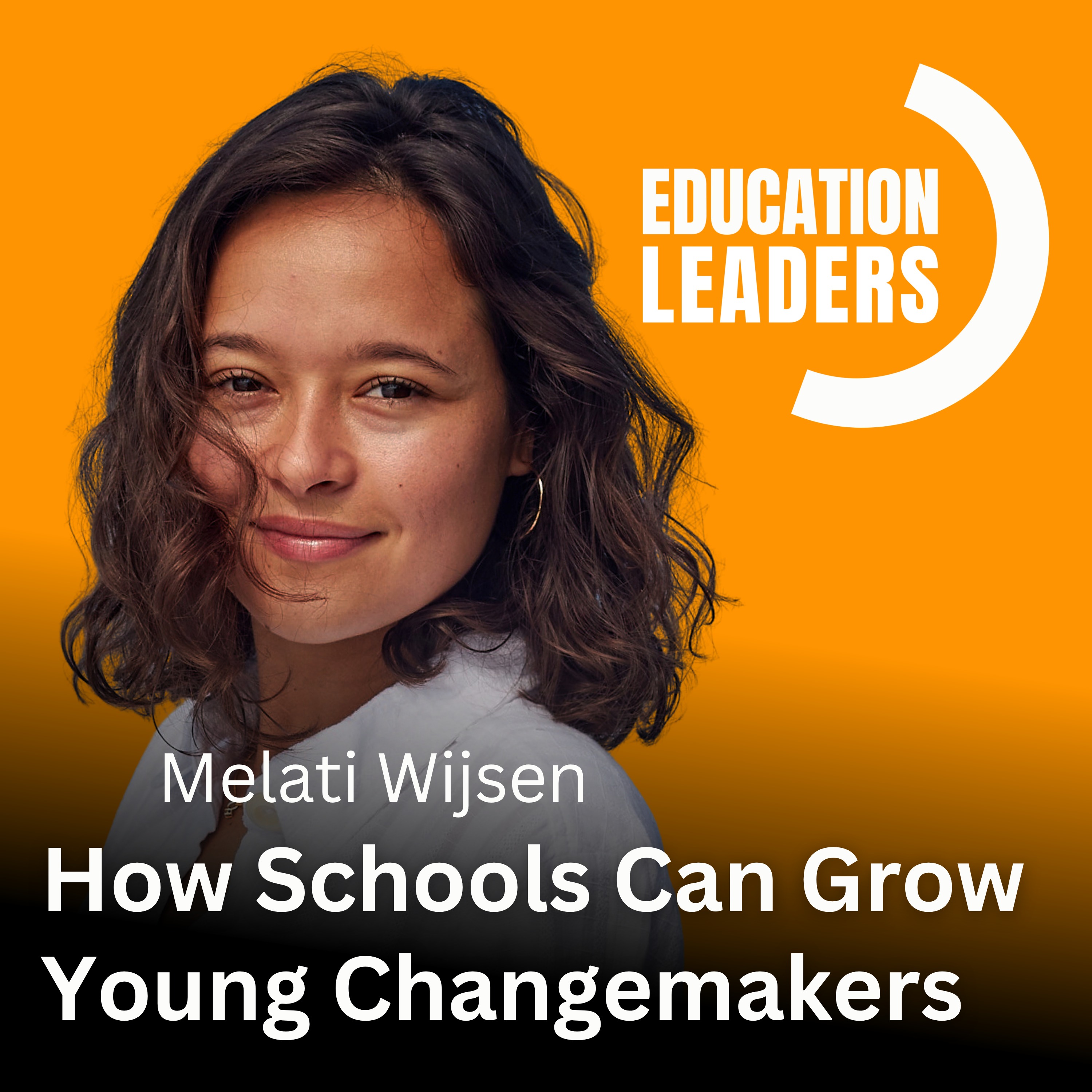
Melati Wijsen started Bye Bye Plastic Bags at age 12, spoke at the UN as a teenager, and never went to university, yet she is now teaching at three universities and shaping how a generation thinks about leadership and change. This episode is a conversation about what happens when a school genuinely creates space for a student's passion, and what school leaders can learn from one of the most compelling young voices in global education. Melati's journey through the Green School Bali, international advocacy, and her new book Change Starts Now offers a rare window into what education looks like when curiosity is treated as a core subject.
You'll hear why Melati believes clarity beats inspiration when building a movement ("Bye bye plastic bags" mobilised an island; "let's change the world" mobilises confusion), and why she burnt out at 16 after saying yes to too many causes. She and Shane discuss the real tension between academic accountability and changemaking and why she argues it doesn't have to be binary. Her practical answer for any leader with a passionate 14-year-old in their school is specific, actionable, and completely free. If you've ever wondered whether your school's systems are growing future leaders or quietly flattening them, this conversation will leave you with a lot to sit with and a few things to act on.
Resources & Links Mentioned:
Join Shane's Intensive Leadership Programme at educationleaders.co/intensive
Shane Leaning, an organisational coach based in Shanghai, supports school leaders globally. He is the author of the best-selling 'Change Starts Here.' Shane is a leading educational voice in the UK, Asia and around the world.
You can find Shane on LinkedIn.
We are a proud member of the Education Leaders podcast network. For more great education shows, visit educationleaders.co/network/
Hosted on Acast. See acast.com/privacy for more information.
Auto-generated transcript. It may contain small errors.
She started a global movement at age twelve spoke at the united nations never went to university and now teaches in universities around the world. Today melati wyson is gonna challenge everything you think you know about what education is actually for. Hey i'm shane leaning welcome to education leaders the chat topping international podcast for leaders in schools around the world i'm an author and organizational coach and in this show i bring you practical ideas, and honest conversations to help you lead with confidence and clarity this episode is supported by the international curriculum association and teaching walkthroughs stay tuned to learn more. My guest today is melati wyson now at just 12 years old melati co-founded by by plastic bags in bali and since then she's spoken at the u.m she co-chaired a world economic forum committee.
Sat on the inaugural expert advisory panel of the earth shop prize and had her film premiere at cans she's also just published her first book change starts now. And through her company youth topia she is bringing everything she's learned since the age of 12 into classrooms and boardrooms around the world this is one of those conversations i know is going to make you rethink what is possible for young people in your school so let's jump right. I didn't go to university, but I feel that after I threw off my graduation hat in high school I just kept on learning just in a different way and that's kind of my philosophy and a very big north star in everything that I do is like learning is lifelong. And I think I started that with my activism journey at 12 because that curiosity really opened up a path for me to keep on learning, no matter where I was in which room I was in, whether it was the United Nations or my grade six classroom.
Well I'm really curious because I know there's a lot of leaders who are listening in now and they will mostly be familiar I reckon with the more well trodden path especially from international schools. Student finishes international school in the next step is university that is the next step but you've had a slightly different education so really curious to hear a little bit about what was your path up until leaving school what did your education actually look like. Yeah well I was very privileged to be able to be a scholarship student at the green school Bali and already that as an educational platform was a school that shared the philosophy of learning is integrated into the natural world nature was our teacher. So every day from middle school to high school when I graduated it was I would say almost like every other school except that it was entirely different at the same time.
Because it also you know it did foster this space for me and my sister at the time and our team members at the time you know a bunch of 10 and 12 year olds who were wanting to get involved in activism. And so we had that space we had that supportive ecosystem within our teachers within the school to be able to actually go and turn it into something. And when I graduated high school I mean that was also a little bit untraditional and where I really feel that support in my education is I think the last year of high school I might have been less than 50 days on campus physically and that was simply because at that point my activism had already taken off so drastically that I was traveling around the world I was spending more time in other students classrooms or in other government meetings than actually attending my science class. But again this really showed and shaped the person I am today because I got the opportunity to shape my education in a way that supported my activism it didn't feel like a sacrifice.
I was able to go to the United Nations and listen to scientists on a panel talk about the latest IPCC report and that reflection I turned into an essay and submitted back to that science class that I missed and that was translated into credits. I went to the most incredible events with really incredible entrepreneurs and I turned their lessons their stories into an essay I submitted for English class. You know this wasn't at the time and I don't even think today anymore it's been continued but it was a way where as an individual student I challenged the teachers and the systems around me to say look just because I'm not in class doesn't mean I'm not learning and that is the type of radical revolution we need in education. And I see it happening all around me and students and the way that we as a generation simply refuse to sit back relax and do business as usual we're living in a world that demands change and so we're doing it weird living and breathing this new way of learning and leading.
Well what an incredible honor to be speaking to you about this and to hear that journey. Thank you for sharing and I'm imagining right now that the listener is tuning in feeling like me incredibly inspired and thinking wow that's great but also feeling well I've got a school and wherever I am in Singapore in the UK US wherever it is. But we can't all be green school barley so a lot of schools might be thinking well what can I actually do what could I actually replicate to give this opportunity like you've been given. I think it's a great question and the fact that that question is already being asked shows that that first step is ready to be taken which is really important right it starts with that again curiosity just like when I was 12 years old how do we insert that back into classrooms around the world.
So the question is great and it's the beginning of opening the door the next step I think is to really implement creating space within the school day. And really looking at how we view change making or the lessons on curiosity creative thinking critical thinking how do we implement that and actually create space hours in the day that the students are in school. To just let them create something let them find what they're passionate about far too often students don't have this space or this time during their school day. And I know this through the work with youth topia and working with schools working with really passionate individual teachers or students.
The momentum at the beginning is so high but in order to sustain this and i've been doing change makings from 12 i'm not 25 so for more than half of my life, I know what sustaining that change making energy is about. It needs to be supported with the right systems and that starts with creating space and time so don't make this change making an extra curricular or an extra addition outside of class time but really create a framework an hour a week. It can be as easy as that an hour a week where students have dedicated time or teachers have dedicated time to explore what this looks like for your school as a community and for the students who are interested in this topic. So through youth topia your organization obviously i imagine other young people who you work with they haven't just come from the path you have come from right they haven't just come from green school barley where they had this time.
I assume some things had to change for them later and do you end up having to give them the space later or were they all afforded that opportunity at school those young people you work with. I mean everybody's change making story is so different and that's also what makes it really beautiful right it's also one of our biggest beliefs to have a wide range of role models available for students in the first place. Because I had that support I had that ecosystem that's beautiful story of two sisters that grew into an island wide movement at 10 and 12 years old. But there are other change makers that we work with who after years of campaigning still remain active in their fight towards reaching their goal and still haven't achieved it or who have still a very, very small team but are doing incredible work so providing this wide range of different ways of change making.
Has really been helpful for students to see who they relate to which again then helps after you have the time the space you can start to see the next steps in reflection of other people's examples. I love that and now i'm wondering of those people you're talking about what do the ones who are actually making that change happening the way you describe like what do they have in common what makes a change maker. You know my definition of a change maker someone who wakes up in the morning and thinks how can I make the world around me a little bit better today. And I think this is a nice way to break it down because sometimes when we think about change can feel really overwhelming and difficult you don't know where to start you have so many things you can be passionate about things you hear about on the news far away in different countries or in political systems far away from you but.
I think where it starts and where i see the common thread and all the change makers i work with is this. Belief that when they wake up in the morning they have the power and the confidence to do something and no matter how small or how big to impact the community around them positively and the second thing i would say is. Maybe a little bit cringy but i really feel we have to bring this back into the narrative because there is a frustration amongst Gen Z and the generation i'm a part of that change is not happening fast enough. And I know that that's a very big narrative, but the other side and other commonality I see throughout all the change makers I work with is that the love overpowers the frustration.
We keep doing this work for the first year the second year more than half of our lives plus plus because we have a deep love for the community we're a part of and the world we're a part of. And I think that that's something that you know talking about creating space and time in the schools and then what do you do with that time i think it's about building connection back for the students to connect with each other. And with the world because when you love something you are more drawn to protect it to stand up for it to do something when things go wrong. Well melati i'm all for cringy kind of like cheesy stuff like and actually really like the way you frame that and you say like love overpowers that frustration I wonder if.
People who are listening might also resonate with that we might have not called it love but that deep sense of purpose and that deep sense of what you said as well connection. To what we do and I think a lot of people who are listening are educators who naturally have a love for a purpose or a connection to what they do and that sometimes is what you lean on. In those times of challenge but I also like how accessible you've made your statement as well because you said it's about doing something to make it a little bit better today not like you know let's do everything right now and feel frustrated by that but what can I do to make it a little bit better is that drawn from your. Journey melati like a lot of people would look at you and go well easy for you to say melati you're in your twenties and you've like conquered the world with some of the things you're doing you've done huge things that we couldn't even dream of but did you find it was step by step.
Definitely it was step by step lesson by lesson and only through wins but also a lot of failures and i think that's another really big lesson you know that narrative that you're just sharing of like let's do it all oh trust me twelve year old melati was right there with you. Our to-do list and our wish list for change as I say was very long and very big and included a lot of things that we wanted to see happen but very quickly we also learned that in order to build the momentum that we wanted to really get this island wide potentially nationwide worldwide change. Started with being specific and being super clear with the type of change we want to create put this into your everyday practice imagine someone tells you and you know you say good morning, how are you and you start a conversation with someone who's an advocacy or change making world and they tell you their vision for change and they say let's change the world. Great where do we start right you must be thinking that when you hear that statement just like I am but if you hear let's say bye bye to plastic bags and give up one single use plastic item.
Is it clear do you understand what type of change you have to do and then it's up to you to decide yes or no i'm joining i'm not joining right, but if you are not clear you build confusion if you are clear you build a movement. This is really powerful is speaking very personally to me as well I think is part of that overwhelm that you talked about about change not moving fast as well sometimes because. We're looking at too much like you focused in on something and and I feel like the modern world sometimes wants us to be a part of every movement and to solve every challenge and if you're not then that's some kind of a problem I don't know if you felt that tension or spoken to people on that. Definitely I think that's one of the first drivers to how I became burnt out at like 16 years old.
I was 12 I started with a very specific clear vision and throughout that journey so many people said amazing inspirational but have you thought about focusing on this or that or this or that and I thought okay okay okay. Yes, yes, yes, and there you go, you know you start drifting from that main purpose that you set out for and sometimes that's good community feedback is so important but also staying strong with your vision of changes equally as important. So how to navigate all the different sounds especially when you're also growing up and in a space of real influence it can be really difficult and takes a lot of lessons and a lot of fine tuning to finding what your voice sounds like in an authentic way to you and to the movement you're a part of. So a lot of lessons a lot of lessons there but I have a deep calling this morning, especially to curiosity because I do think that schools, one of the biggest elements that they need to appreciate but also foster and ensure it doesn't die by the time we graduate is our curiosity because that's how I was able to get out of a burnout, for example, it's how I was able to keep going and find that voice it's.
The unbelievable passion for being curious for asking as many questions, no matter how silly they may be or what answer would come, it is this almost this like I'm not giving up on ever asking questions because that will lead me to who I am and who I want to be. Leaders tell me all the time that they struggle to find a practical way to get evidence informed practice into every classroom and that's where teaching walkthroughs come in they transformed the most effective teaching techniques into five step visual guides that are actually easy to follow. And what happens when your team use them well enthusiasm spreads teachers improve their craft and they genuinely love using them and I do too that's why I'm proud to be a consultant for teaching walkthroughs. You can find out more at walkthroughs.co.uk or using the links in the show notes.
Quick one before we continue I am really excited to be partnering with the international curriculum association on the international leaders conference 2026. If you're serious about growing as a leader, this is the one event you need in your calendar this year we have got some of the biggest speakers in education coming together for this and because we know our audience is literally all over the world. We're running it twice across different time zones so wherever you are you can be there live it's the seventh and eighth of may head to international leaders conference.com I'll grab the link in the show notes.
I'm wondering Malati there's a tension in schools that I like to explore a little bit with you to see what your thoughts are on in that I think many leaders will listen to what you're saying and say yeah well I do want my students to be curious I do want them to. Change the world in their ways, but also I really need them to pass their exams so do you have any thoughts on how a leader is supposed to hold both or do you think they even should be. I mean this is a really tough one to balance but a good conversation to have because, on one hand, I understand that there are certain academic criteria is that we need to pass and a certain bar that we try to reach in all aspects, but at the same time. The exams in school need to reflect the world we live in and are we preparing our students for once they do ace that exam.
Are they going to ace the exams that they will undoubtedly get outside of school every single day it gets worse and worse with the climate crisis and the realities we're living in the social injustices. Do our students do our young people in the world today know how to navigate the anxiety they experience from an exam that we're teaching them in school will those answers that they are supposed to memorize help them. Buster an incredible conversation that lands them their dream job or will it get them a job that they stay in a doom loop. Right so these are all questions that you know I don't have an answer I don't I don't say kill all the exams and only have space for students to grow in their curiosity I think there is a much needed evolution that balances both.
And at the moment I see its wing one or the other it's a green school type vision or a IB type school I think that's not fair one to the students. But also to all the possibilities that exist in the world and I have this incredible privilege of having been able to mold my own education whether I was you know going through my own high school experience but also now with utopia and learning how to work with schools to craft that opportunity for other students as well. It speaks to something that comes up time and time again on this podcast which is the problem of binary thinking thinking I have to do this or I have to do that and there's no other way. To be thinking about that how you described it's very powerful for me i'd love to pick up on what you said you work with schools, which is awesome like it was one of the young people you're working with schools.
So I'm sure you're experiencing schools who want to support student activism in a way but maybe they've also got other pressures so what kind of things do you discuss with schools what kind of solutions do you look at together. Well there's a wide range of solutions to look at this and that's the exciting part as well we try to meet the schools where they are at some schools are really really ready and want to go full steam ahead because their leadership is wanting to do it as well. And that's the big game changer that we see oftentimes whether it's teachers or students on their own who want to achieve change will get a successful one or two workshops with a class that's really passionate but after that we see a slow possibility to integrate it into the system. When leadership of schools are involved and say okay let's work towards getting this on a regular consistent basis with a few teachers involved, then we see a long term successful system set up.
And so that's been one of our biggest learnings and key takeaways yes we'll want to do that one or two workshops to get our foot in the door. But essentially to get that long term systems change that leadership really does have to be on board to support educators who are actually having access to these students on a day to day basis. You're singing to the choir here melodic I have to say for people who are tuning in melodic's got a brilliant book which I've introduced I'm going to take off the shelf and you'll see the resemblance there's a reason we connect because not only not only do we seem to like the same color scheme, but we've chosen very similar titles to our book and there's no accident that we're chatted today change that's now it is your book melodic now it's been out for a little while how are you feeling about it right now like is it settled or is it just like. Yeah well it's been a year I passed the year of being a published author just recently the other week thank you and I was reflecting back on this and of course the book I wrote in a way of sharing 100 lessons over the last decade of everything that I learned from 12 to 24 years old.
And the book has brought me on a journey to my next phase which really focuses in on the power of education because I shared these lessons of my decade long journey of activism with bi bi plastic bags then with utopia looking at how we really focused on widening the narrative of what it means to be a change maker through the learning platform. But then I noticed something else happening as I was doing the book tour speaking to schools teachers were asking me can you turn your book into a class can you turn your book into a minor program. And so that's actually the most exciting update and news from my side is that over the last few months I have been actually teaching at three universities. The book as a minor program is an official minor program and that's been one of the most exciting parts because for me it's really about how we can change the way we learn.
In turn to change the way we lead because the world is demanding a different type of leadership, we need to see more empowered leaders more connected leaders more emotional. Leaders who are connected to their communities and the world we live in so the program really centered around 15 weeks of deep learning with each other and the three universities were connected so students across different parts of the world connecting with each other. Learning with each other and essentially being in charge of their own education because with my own experience or therefore lack of experience going to university myself. I thought how best to give back this opportunity that I had of taking education into my own hands to students who are in the system.
And I thought, okay, I'm going to create a framework of these 15 weeks but within those 15 weeks there were moments of, you know, a full week of boredom. I wanted them to get as bored as they could be, go out for walks and, you know, just really in that moment of boredom, I thought that they could find their inner voice or something that sparked their interest because they had already gone, for example, the week before with an insane amount of guest lectures and really inspirational people but that quietness were so often not taught how to find because the world is so distracted, it's designed to be constantly distracting. So sit with that boredom, for example. So, you know, I had students that were going into the program being like, are you serious? You want us to do nothing? And I was like, yeah, go enjoy.
So lots of different skills, you know, we had the guest lecturers, we had these really different opportunities for the students to do, but at the end of these 15 weeks, they had to design in groups a one and a half hour master class that they would teach back to the board of directors on how they would envision learning about topics like change making, like climate education, and in a way, teaching the teacher, but from a student perspective, on how they design a future classroom. Well, actually, two things. Firstly, this is awesome. I mean, you didn't study at university and you're teaching at university. That is just the most awesome thing. And two, like, can I do the course?
Like, or is it not just publicly out there? It's just at the universities at the minute, is it? It sounds great. Yeah, you know, thank you. And I'm happy to report as well that these three universities are signed up to do another batch with even more universities now joining. So that's really exciting. And our big focus of 2026 will be to scale this across universities globally, but also creating a more high school or middle school version.
And this is just going to be available on the utopia learning platform. So stay tuned, but that's going to be a very big focus for us. Lots to come. That's awesome. So I wonder now you've done so much and you've achieved so much already. And a lot of leaders are going to be listening, thinking, wow, what were my lattice teachers doing right to get you to this part? I wonder if you could speak to like what was done right in your education. And I wonder if I could be so cheeky, was there anything that was done wrong that you look back on and go, oh, if only.
I mean, there's so much love that I have for my teachers. And I think maybe the expected answer is that they did provide that space. They did provide that time for me at school to be able to foster my curiosity, like I shared in the beginning. But I think to be a devil's advocate, I would say I think one of the best things my teachers did was challenge me.
You know, it wasn't easy for me to convince them that just because I was at the IPCC report with the United Nations, that I could skip science class. And I think that level of being taken serious and not getting any brownie points just because I was doing this change making and this activism and really holding me accountable, I think really helped with building a sense of holding myself as well accountable, which is also what we learn in school. Right. If you don't do your homework, there are consequences.
And I think this type of strictness, accountability, but of course, with that backbone of support that I knew was always going to be there as long as I could prove my point. And that offering was always there. I felt like their door was always open for me to have that conversation. The challenge that they gave me was that they didn't always accept what I would give.
And I think that that has been one of the greatest gifts because I do think that in more alternative schools like Green School, sometimes the idea or what it may look like from the outside is that we give freedom. It's free for all. Kids can come up with their own creativity. While that may work for some students, I do think that a certain level of accountability and holding on to that is important.
I mean, I was 15 going to the U.N. thinking I'm skipping school. I'm doing a two weeks out of school journey.
Of course, I can turn it into a science class, but when an essay wasn't going to cut it, I had to do XYZ on top of that. OK, I understood then the depth of me missing school, of me doing this extra change making. So I think they did that really well, although my 12 year old self would have said they didn't do that very well. Well, I was going to ask, in that setting, you're a teenager, like full of ego.
Like, did you feel like go away like I'm doing absolutely fine? I mean, of course, there are definitely those moments. And I think there are also those then humbling moments where it's like, no, you didn't pass your science class. You know, that wasn't not the case.
And that was really tough because I could also see so many other parts of my life were excelling and then other parts. And I'm not a numbers person. So math class was, for example, one of the hardest for me to keep up with, especially if I missed in class explanations and all of that. So it was really a humbling experience because while I was good on stage with my words and while I was good in writing, for example, other parts really weren't the best.
But again, for me, what was really helpful was having that support that didn't create this narrative that I was a bad student, but I just excelled and had strengths in other parts. And that's also an interesting narrative I feel more schools have to do, especially from a leadership to students role, recognizing what those strengths are. And instead of pointing out the flaws, because it's so easy to focus on what is wrong, instead shift the energy onto saying, wow, you've really got this good. Like, what can we do to support and grow that?
Yeah, I think the education system sadly can sometimes breed this deficit mindset, if you like, where because it's like you study math, science, English. And if you're good at one, not so good at the other. And there's this kind of mindset all the time that it's just not good enough or must do better. Whereas there's a difference to saying, where is this child strengths?
Where are they and where should we celebrate? It's a wonderful surprise almost to speak with you, Milatian, for you to say one of the things you valued the most was strictness and accountability balanced with that openness to you and to who you are. Yeah, that's really wonderful to hear. So maybe it's this, but I wonder just to close, like if a leader is listening and they've got a like a 14 year old or a 12 year old, let's say in their school, this person is reminding them of a young Milati.
Like what's one thing you think they should definitely do to support that young person? If I think back to thing 14, and one of the things I valued the most was this feeling of not being alone. So I think one of the first things that if you have a passionate 14 year old is try to find and pair them up with other like minded peers. And you'll be surprised what a bunch of 14 year olds who are passionate can achieve.
But to find that is one of the most important first steps to find your peers, to find your community, your team. You have this one curious, passionate 14 year old. Where are the rest? Who are the rest?
Are they in the class? Are they in the grade above? Link them together, start connecting the dots. And that is the first step to building a school club or a class or, you know, a school project.
But connecting the students who care about the same things together is one of the first ways that teachers can really foster and grow that passion into something much bigger. Oh, gosh, what a conversation. I think the thing that's going to stay with me the most is this idea that curiosity is something schools can either protect or slowly kill. And the choice really does sit with us as leaders.
A few things you could take away from today. Well, first, consider where in your school day there is dedicated, protected time for students to explore what they care about, even if it's an hour a week. Malati says even an hour a week can be the start of something. Second, think about the passionate young person in your school right now and ask yourself who else they could be connected to, because community might be the single most important thing you can give them.
And third, reflect on whether the balance between accountability and freedom in your school is truly a balance or whether it is tipping too far in one direction. You can find Malati her amazing work and her book using the links in the show notes. Education Leaders is hosted by me, Shane Leaning, thanks to the show editor, Pete McGill, production assistant Skyler Osterman and for the original music by Guillermo Silva. And thank you so, so much for tuning in today.
If we don't speak before, I'll see you here next week. If you're interested in learning more about teaching walkthroughs or the International Curriculum Association, check out the links in the show notes.
There's a particular kind of leadership trap that nobody warns you about: the one where everything is going so well that you stop noticing…
Listen & show notes
What if the principles that help students learn could also transform how you lead? This episode explores the powerful concept of the…
Listen & show notes
Shane and Chris are back for this month's Education Leaders Live, recording from Shanghai and Newcastle respectively, to unpack some of…
Listen & show notes