

The Science Behind Post-Decision Doubt
That sickly feeling after a tough leadership call isn't your intuition warning you that you got it wrong and this episode explains exactly…
Listen & show notes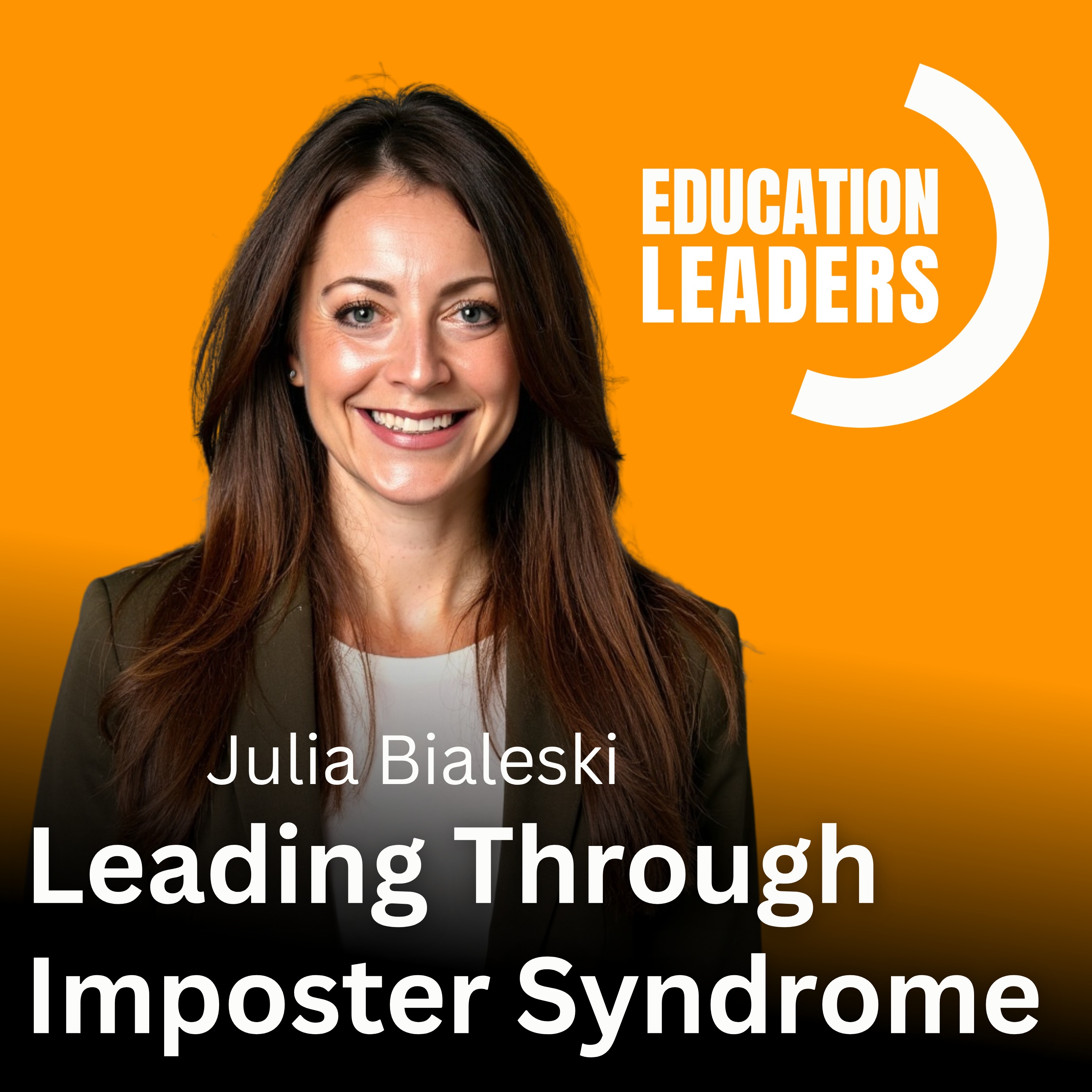
Most school leaders have felt it at some point: that quiet, nagging suspicion that everyone else is more capable, better prepared, and more deserving of the role. Julia Bialeski knows it well. In the spring of 2019, she walked into her first principal job with a smile on her face and panic in her chest, presenting excitement to the world while privately wondering when everyone around her would figure out she wasn't good enough. In this conversation, Julia, educator, district leader, career coach, and author of Leading with Grace, talks honestly about why imposter syndrome hits school leaders so hard, why the loneliness of the job makes it worse, and why the profession's retention crisis has everything to do with the leadership models we put in front of the people coming up behind us.
Julia shares two practical strategies that have worked for her over years in leadership: a daily learning log that helps you end the day focused on what you gained rather than what you still don't know, and the "smile file", a simple physical collection of notes, cards, and messages that she has carried with her for over a decade and reached for on her hardest days. She also shares the question that changed how she thinks about new roles and challenges: not "am I good enough for this?" but "why not me?" If you've ever sat in a leadership role quietly wondering whether you really belong there, this conversation is worth your time.
Resources & Links Mentioned:
Leading with Grace by Julia Bialeski
Episode Partners
International Leaders Conference
Join Shane's Intensive Leadership Programme at educationleaders.co/intensive
Shane Leaning, an organisational coach based in Shanghai, supports school leaders globally. He is the author of the best-selling 'Change Starts Here.' Shane is a leading educational voice in the UK, Asia and around the world.
You can find Shane on LinkedIn.
We are a proud member of the Education Leaders podcast network. For more great education shows, visit educationleaders.co/network/
Hosted on Acast. See acast.com/privacy for more information.
Auto-generated transcript. It may contain small errors.
What if the panic you felt when you got that promotion, that voice telling you you're not good enough and it's all about a come crashing down? What if that's not a weakness? What if it's actually the most human thing about you? Yes, today we're talking about imposter syndrome and what school leaders can actually do about it.
Hey, I'm Shane Leaning. Welcome to Education Leaders, the chat-topping international podcast for leaders in schools around the world. I'm an author and organizational coach and in this show I bring you practical ideas and honest conversations to help you lead with confidence and clarity. This episode is supported by the International Curriculum Association and CC.
Stay tuned to learn more. Now, my guest today is Juliet Bialeski. With over 20 years in public education spanning classroom, school leadership and district level roles, Juliet is the author of the brilliant book Leading with Grace. She's also a career coach for educators and her mantra, be brave and care about people is going to come through in every single minute of this conversation.
So let's jump right in. It really was panic. That is the best word to describe it and I still can feel it almost seven years later to this day, what that felt like. I knew cerebrally that I should have been nothing but excited and proud of the accomplishment to be promoted to principal that I had worked for for so long.
And so it was important to me to present that on the outside. And I can still recall walking through all facets of my life at work, on the weekends with my family, everywhere that I was, I felt that I needed to present as nothing but happy and excited. And I was those things. I had those feelings, but inside the primary feeling that I was experiencing was panic because I was so terrified of the weight of the responsibility that was now on me and that I wasn't up for it, that I wasn't really going to be good enough.
And that at some point it was going to come crashing down because everyone around me was going to realize that I wasn't going to be good enough. And of course I regret that now at the time, I wasn't able to think of it that way, I truly regret it now because it was such a special time in my life and an important time in my life. And so I've tried to learn from that experience and take it into every other new challenge that I've encountered since then so that I can be prepared for that feeling when it will inevitably rise up. And that's why imposter syndrome is one of my favorite topics to talk about because it was so impactful for me in an unfortunate way.
And that is just one story I can think of in my life and career where I've experienced imposter syndrome. So I'm really passionate about talking about it because I hope that others will hear it and will recognize something of themselves in that story because I think it is such a common human experience that we have that we don't talk about, which is why I'm passionate about speaking about it now. Julia, thank you for opening with such a personal story to share of yours. I guess I'm curious, before we kind of go in to unpack the idea of imposter syndrome, is it something you went through then and you've managed to reduce in your life or is it something that is ever present?
I do think I've been able to reduce it a bit, but it will never be completely eliminated. So I think both of those things that you spoke about are true. It's something I've been able to reduce and it will be ever present. And so what I know now is that any time I have a transition in my life, whether it's in my professional life or my personal life, it's very likely going to creep up and it's something that's going to arise.
And now I feel more prepared for it. I have some strategies that I've found that were successful to me in the past, but the most important thing is I can name it. So I can anticipate that when I have these feelings, it's not really reality, it's imposter syndrome. And I can say it out loud.
And when I say it out loud, it can be as though I'm releasing it out a little bit and then I'm letting it go so that I can move on and move beyond it. But I do think it will be ever present because as I said, I believe it is just a part of the human condition. Psychologists have now studied and are really elevating the fact that it is completely normal. It is something that impacts almost everyone.
Certain groups, women, people of color, disproportionately experience imposter syndrome, but it is true for everyone. And it is something that really can unite us if we talk about it. I like that. It's almost bringing back, for me, feelings of it's that mindfulness approach, isn't it, like these things that are present are, you know, these old Buddhist philosophies, really, you know, to not necessarily to go, OK, imposter syndrome is something that will happen and you expect it to happen again.
But what tools and strategies can you have to be mindful with it when it does come and that's what you feel a little bit more prepared for, having explored it a bit? Yes, absolutely. I mean, I think when you go into a situation and you have some tools in your tool belt, we use that analogy a lot in education, right? We have some tools at our tool belt.
We have different things we can try. And again, just putting words to it and knowing that it's going to come up and that it's perfectly normal. In periods of professional transition, especially when we are in an exciting new role, maybe we change campuses, maybe we move and work in an entirely new place, there are always going to be things that are new for us. And as humans, it's very uncomfortable for things to be new and different.
And for those of us who may be in our last role, we're very accustomed to feeling extremely competent. We're high performers, we're high achievers. When we are starting anew, it's perfectly natural that there's going to be a lot that we're learning, but that brings up a lot of really uncomfortable feelings for us. And it can trigger like a bit of a fight or flight response where I feel like the imposter syndrome comes in.
And for me, that can often manifest like, flight, I want to flee, I made the wrong choice, or they made the wrong choice in me. And how can I get out of this situation? But in fact, we have to get through the situation rather than get out of the situation. So those tools are really useful to help us get through.
That's awesome. I wonder if we can focus in a little bit on what makes imposter syndrome quite interesting in schools. And, you know, in your brilliant book, you're leading with grace as well, you kind of set the context a little of some of your work with kind of the teacher attention crisis, which a lot of people talk about, but also like principals, you know, leaders leaving the profession as well. And I've certainly, as I was reading through your book, you know, just nodding along, already nodding along to your story at the beginning of there, because I felt imposter syndrome many times through my career, and I think many leaders do.
But I wonder, I think there's something about school leadership that sometimes seems to make it a bit worse. What do you think that is? I have a few thoughts about that. I think leadership in general, but especially school leadership, we are surrounded by people, sometimes hundreds or over a thousand people every single day where we're working, but it can be very lonely work.
Leadership, for those of us, maybe in a principalship, or even when I was an assistant principal here where I live, I was the only one in my building who had that title. And so while I was surrounded by other people, perhaps the dynamics at play, perhaps I was supervising those people, or when I was an assistant principal, I had my principal, but they were supervising me. And so I didn't have a peer or someone who I could lean on and who I could see struggle with the same things that I was struggling with. So the loneliness really comes in, I think, in amplifying those feelings of imposter syndrome that can creep up.
And the other piece that I alluded to before is education is challenging work, it's mission-driven work, but the weight of the responsibility that we have in school leadership and in education in general, because I experienced imposter syndrome as a teacher when I went from teaching middle grade children to teaching primary grade children and realized that I really had to learn a lot of new techniques and I had a moment of panic at that time too. The weight, the responsibility that we carry to care for children, to care for our communities is tremendous. And so I think it really does amplify those feelings of imposter syndrome because the stakes are high. If we are not able to effectively lead our schools, if we are not able to effectively take care of people, that has serious consequences.
And I'm sure there are connections in other industries as well, but of course what we know is education and that weight is very real in leadership. Yeah, it's the gift and the curse of being in a social profession, if you like, or where we're contributing to a social good. And that is a wonderful gift and purpose in our lives as educators. But equally, I can see what you're saying.
When you become a leader, that responsibility can maybe feel too much at times. And that, I guess, would then lead to you sometimes feeling, I'm probably not good enough to do this. I shouldn't be doing this. There are better people who could serve better than me.
That was certainly my experience. Those almost would be the exact words I would have used to describe particularly how I was feeling at that time when I was a new principal. And a big reason why I wrote the book was because in reflecting on my experience in the principalship, I thought, what words did I need to read or hear at the time that I had those feelings of panic and that I was questioning whether I was good enough because I was able to look back and say, I was in fact quite competent and able to do the job. What did I need to hear though in those moments where I was feeling discouraged and I didn't have a lot of hope that I could rise to the challenge and to the weight of that responsibility, which is really what set me to write the book in the first place.
Are there in those moments, like as I assume a leader's listening now and going, okay, what did you need to hear? What do I need to tell those people who are experiencing that? Yeah, well, I mean, first and foremost, I think what we all need to hear is that you can do it. I can do it.
When you're having those moments of doubt, it's really just flipping it on its head and realizing I can do this. I have a friend who uses the phrase, why not me? And I have sort of adopted that and I love it. When I'm looking around and I'm thinking about how well other people seem to be doing their job or perhaps the person who was in my role before me, I might find myself in a comparison trap of wondering, am I doing this as effectively as the person who had this role before I did?
What about my colleague across the way? Am I doing as good of a job as they do or as I could? And when I started thinking about it through the lens of why not me? Other people can do it, why can't I?
It freed me to allow myself to be more authentic to who I was and to think I must have been chosen for a reason and so I need to lean into who I am. They chose me to be Julia. They didn't choose me to be the person who was here before me or the person who will be here after me. So for the time that I'm here, I need to be Julia and bring who I am to work each and every day and to the students and staff and community with whom I'm working and that is really what I needed to hear and what I hope others need to hear too.
Why not you? You can do it. I love that, why not you? Although I would worry that sometimes in my situation I might go why not me and then start listing all the reasons why it shouldn't be me to do that.
Well, you know, those days happen too and we can have tools and strategies for combating those days too. I think that's perfectly normal because we are human. And so when we put the role or a title up on a pedestal, that is always going to feel unattainable or unachievable to us. But when we realize that we are humans who come in, just like our students are humans who come into school every day, the staff and faculty with whom we work are humans who come and they want to be there but they bring all that being human is.
When we show that as leaders, I think the power of modeling that for other people, it really does help break the cycle that I think has caused a lot of us to experience this imposter syndrome in our careers. If we didn't have a leader who was really speaking about it, articulating the challenges that they were having, if they always just presented as always having everything under control, we didn't have any other model to look to. But I feel that we have a responsibility and leadership in a way that is responsible and that is still showing that we are coming in on an even keel, that we are steady in a crisis. But when we are showing that human side, it allows other people around us, whether it's other adults we work with or the children for whom we are modeling, that it's okay to be a little vulnerable sometimes.
It's okay to say, I'm not really sure what to do in this moment, but I'm gonna think on it for a bit and I'm going to get back to you. It's okay to present. This is a really challenging situation for me. I'm feeling a little bit emotional right now.
I need to just step away for a moment and then we're gonna have this conversation again later. That power of modeling for others is how I believe we can over the longterm break the cycle to at least normalize imposter syndrome and show others that it is very normal and everyone experiences it. How you've just described that I think is so powerful. There's so much learning in that because many leaders would think just saying, I'm feeling emotional or I'm not sure on that and see that as admitting that you're not a good leader.
But the words you used after that, I think was so important. You're not just saying, I'm not sure on that. But as a leader, you're saying, I'm not sure on that. So can you leave that with me?
I'm gonna go away and think of that. I'm gonna do something. That's still leadership. That's great leadership.
I'm not in the best place to think about this now. So can you give me that? And I'm gonna do something about it. You don't have to say, I'm not in a good place.
So just let me melt away and let's never talk about this again. Of course, that's not good leadership. But I love how you framed that, those two scenarios. I felt a power and a leadership just in those statements.
Yeah, I think there's definitely nuance there. It's very important when we have the gift of being responsible for taking care of so many people around us that we are thoughtful and that we are mindful that people are constantly watching and learning from how we present. And so we do have to be careful about it. But I have found that the power of a pause when I don't know the answer or I think I know the answer but I believe I need a little bit more information maybe before I share that information with whoever I'm speaking with.
That was something I was afraid of for a very long time because I felt that if I didn't immediately know the answer that that was a character flaw that I was communicating a lack of competence or that people were going to judge me for that. But again, we're humans. It's not realistic that we're always going to know the answer particularly when we're new to a role or we're new to a place or we're navigating something new for the first time. And again, I think there is great power in modeling for others.
I hear you. Let me make sure I have all the information perhaps restating and ensuring that I'm understanding what you're asking me about correctly so that I can take some next steps to find out. Just the other day I was in a situation it was in a very public space, a meeting and someone asked a question and just in that moment I doubted myself. I thought I knew the answer but I didn't want to misspeak and lead this person in the wrong direction.
So I took a breath and paused and I said, I believe I know the answer but I would really like to connect with a colleague. Made sure that I had the email address of this person so that I could follow up with them afterwards. And then the next day I was able to connect with my colleague and follow up. It turns out I didn't know the answer.
But in that moment, something was telling me that I might be about to misspeak and say something incorrect and I certainly didn't want to present like I didn't know the answer but I also didn't want this person to have incorrect information. So that's just an example of taking a pause acknowledging that you want to help someone and that you maybe need to get some other information. I could have said, gosh, I have no idea. And then maybe I would have looked a little bit incompetent but I was thoughtful about the way I worded it that I wanted to connect with a colleague and get back in touch with them and made sure that I had the correct way to do that.
And then of course that follow up is extremely important so that you close the loop and they hear back from you. But over time you are making deposits when you do things like that. People talk in a good way. Word gets around that you really follow through that you make thoughtful decisions that you do maintain and even keel that you really listen and you make sure you have the right information, you do your homework and you kind of start to notice people start coming to you more with questions and they're already prepared for that type of a response.
I think we can have such a tendency in leadership in education especially because there is a great sense of urgency to everything that we do. But some of that sense of urgency sometimes can be a little bit of an artificial sense of urgency where things are very fast paced and people want to answer right away. And as leaders we have to get good at discerning is this really a situation that requires me to make a decision or to give an answer right now or is this something that could wait till tomorrow or that I could get a little bit more information about and that everything will be okay. And that takes practice.
I think you learn over time and certainly the longer you're in a role or the longer you're in a place then you get to know the people and the personalities. At the beginning it can be a bit of a trap I think because you can feel this pressure. For me it's often internal pressure. No one else is putting it on me.
I'm manifesting it. But in some situations it could be that other people are legitimately putting pressure on you and we have to be confident enough to know when we can speak to something, when we have the answer and when we do need to just take a pause. It speaks to this idea of almost, I'm thinking of Stephen Covey's work on trusting character and trusting competence and how we can just jump to that competence thing. But that character built over time, people will start to lean into it and this is a great muscle to build but quite a vulnerable muscle to build as well I guess.
Yeah, it really is. It really does feel vulnerable to do that but I completely agree. I think it does build slowly over time and then it grows your competence over time because as you're doing that and you're in a more calm state of decision making and of learning, you're kind of accomplishing both goals in the same time and I have experienced that personally where people do then have a high degree of trust in you because they know that you are not just giving them an answer to just move on with your day or to get to the next thing that's on your to-do list that you're listening and that you wanna make a thoughtful decision that's in their best interest. Quick one before we continue, I am really excited to be partnering with the International QuickLIM Association on the International Leaders Conference 2026.
If you're serious about growing as a leader, this is the one event you need in your calendar this year. We have got some of the biggest speakers in education coming together for this and because we know our audience is literally all over the world, we're running it twice across different time zones. So wherever you are, you can be there live. It's the 7th and 8th of May.
Head to internationalleadersconference.com or grab the link in the show notes. Leaders, we've all heard this feedback from our parent community. There's too many school apps and emails.
And then there are the parents with children in primary and secondary school. Yes, the ones who had to remember which of the 10 to 15 applications are used for each child, for each teacher and for each type of update. One app for attendance, another for grades, another for communications and we wonder why important information still gets missed but it doesn't have to be this way. CC brings communication, learning, student information and school life into one simple platform.
One place for parents, one system for your school. If this is something your school is dealing with, it's worth taking a look at cc.org. That's s-i-s-i.org.
So Julia, I'm wondering if I could share with you attention that I feel like I noticed and I wonder if you share the same because imposter syndrome, it's being talked about a little bit more but I think in certain circles. So sometimes on social media, I'm glad to see sometimes some people sharing a bit more vulnerability and that's kind of a wonderful thing. It always helps me. And I feel like most people are starting to get familiar like I've heard of the term imposter syndrome, right?
Like it sometimes gets kind of almost banded out quite casually in conversation. But in schools and in leadership, I don't know like how much it's actually being talked about actually when you get down to the nitty gritty, like not just kind of friends chatting but actually in that leadership room. It's just not being talked about in the same way. And I wonder like, do you feel there's a reason we're afraid to talk about it when we actually get into schools and into our leadership positions?
Well, I think when we're on the journey to get to the leadership positions, at least in my experience earlier in my career, there was a bit of a scarcity mindset, right? There were only going to be so many promotional opportunities. And so while you may have been in a cohort of people who were all currently at the same place in their career as you are, I experienced a time where there was an undercurrent of that scarcity mindset and there is a little bit of built-in competition there. There may not be opportunities for all of us.
And I think that can just naturally make people a little reluctant to be vulnerable or to show where their Achilles heel might be or where they might be lacking in a certain area. And then when you get into the role, I really do think that the weight of the job is a big part of it. We have the responsibility of taking care of the absolute most precious resource that anyone could possibly have, which is their child. And we also have the responsibility of taking care of all of the adults that are around us because they are looking to us for direction, dozens or hundreds of different times in the same day often.
And that is a tremendous responsibility. So I think in leadership, we feel that weight and we feel that responsibility and it can make it really challenging to talk about. So we have to find cohorts of people, whoever that might be, who we can talk with, even if they're not in our immediate vicinity in our building, on our campus, if they are colleagues within the district. I was really fortunate as a first year principal in my district to have a cohort of other new principals.
And that was an incredibly formative experience, a bonding experience for us to be going through this very unique time of our lives together at the same time. For some people, they find that outside of work. They find it with friends or family members and loved ones or in their place of worship or in their community. But we all have to have some type of trusted group.
It could be through a therapist. I mean, we have to have someone with whom we can talk about these things. And again, to just affirm that they are very real. But I do have that belief.
We have to talk about them in our workplaces as well, because that is the only way that people will continue talking about them more in education than in schools, is if we are modeling. I am just such a firm believer in modeling. And it does go back to that covey work with competence versus trust. It's like the first time you model something, you're maybe not going to see the payoff of it.
But when you are modeling something consistently over a long period of time, that becomes your legacy. That becomes what people remember about you. And then when it's their turn and they are promoted or they are in a new situation, they are going to kind of think in their mind, what would Shane do in this situation? Or what would Julia do in this situation?
I know that's how I learned there are so many wonderful people I've worked with who I've just sort of gleaned little things from over time. And when I'm feeling maybe a lack of confidence, it's almost like I can pretend that I'm this other person for just a moment, and how would they show up? And it really works. I have to tell you, it really works to think, fill in the blank with whoever the leader is that you want to embody in that moment, the trait in them that you admired.
So that modeling is just so important. On a systemic level, I feel like that modeling is vital for our profession and just for general work because if we were to look at models of leadership over time, we are in a place where sadly there are some old fashioned kind of, I'm gonna use masculine in inverted commas, which are not accurate versions of masculinity. These versions of leadership, which is all about being authoritative, about not sharing about these different things that people are picking up on those models because they've seen that and then that perpetuates itself, doesn't it? Because everyone goes, well, that's what a leader should be.
And what you're suggesting is if we can model some of that vulnerability or model some of that humanity and it works and people see that it works because over time you build that character, that trust and that develops your competence and for all those good reasons, then other people will see those leaders and go, I wanna be like that and I'm gonna emulate that. And we can build a much kinder, a much more generous, and hopefully I would argue a more efficient because of that sector. Yeah, and I think what you're saying makes me think about what you raised at the beginning of our conversation, which was how do we retain the leaders we have and how do we build a pipeline of leaders for the future to ensure the sustainability and longevity of our profession as educators? And that's how I think we do it.
We have to be very thoughtful about what story are we telling when we're in the leadership roles through all of our types of communication. What story are we telling about what leadership is? If we are presenting it as something that nobody is ever going to want, we're going to have a real problem when nobody aspires to come up behind us. If we are presenting it as something that is challenging but also affirming and extremely rewarding and valuable, meaningful work that you can bring your human authentic self into, other people are going to think, okay, this feels intimidating to me, but she did it.
I think I can do it too. And I can find my way just by bringing who I am into that role. And so that really speaks to me, that idea of, I think when we were talking, I was thinking of it as what I would call old school leadership. It's very compliance driven and that can be effective.
You can gain compliance and you can get people to do what you need them to do. And sometimes there are challenges when we bring our human selves and then we do have to have a difficult conversation with someone, we have to figure out how to navigate that space. But I found it's possible to do that and to show up as a human. And sometimes we might err and we might not handle a challenging conversation in the way that we wish we had, right?
We might not be able to be as authoritative as maybe we should be in that moment. But I think when we look at the totality of our time in a role, when I reflect back on my five years as a principal and I think nobody is gonna remember every single thing that I did, every single wonderful decision that I made, every single misstep that I made, no one's gonna remember all of those things. I don't even remember all of those things. And no one else is certainly thinking about me as much as I think they are.
But what they're going to remember is just overall, hopefully my authenticity and who I brought to the role and what they appreciated about me and learned from me, both positive and negative, the things they learned from me that they don't wanna do and that they don't wanna bring into their next role and hopefully the things that they would wanna model or embody when it's their turn. Julia, this conversation has been truly awesome and I love how we've kind of looked at that kind of macro level as well, which is really useful. But I wonder if we can finish something like if I could ask you, cause I know leaders are gonna have clicked onto this podcast because they are gonna have been feeling it, they're gonna have seen the title and going, that's me, I need to listen. So I cannot ask you for a practical strategy or something that you might be able to give that might help people work through imposter syndrome.
Okay, so I'm gonna cheat and give you two. I'm gonna give you a little bit of a shorter term practical strategy and then one that is not difficult but it's maybe a longer term payoff. So my favorite short term strategy that has worked very well for me and this is particularly relevant when I'm either new in a role, I'm given a new project or it could be a new curriculum program. It could be a new administrative team that you're trying to pull together, really any challenge.
I mean, it's education, so pick a day and I'm sure there's something that you're facing. But I found it especially effective when I'm new in a role and I'm feeling very overwhelmed by everything I don't know yet. And I find myself getting into a pattern where every day I'm getting in my car at the end of the day and I'm just feeling so bogged down and overwhelmed by all I don't know. So a strategy that I find really effective is at the end of the day, I write down three things that I did learn that day.
It could be the most simple, basic things. It doesn't matter, anything counts. It could be if it's your first day in the new job and you learned where the refrigerator is to put your lunch, you're gonna write it down. And I really do find the value in writing it down.
Some people like an electronic calendar. I actually will just print a blank calendar off the internet just for this purpose to capture over time the three things that I learned. Those 1,000 things I don't know yet are still there, but I can end my day reflecting on the three things that I learned that day and it lets me see that I am making progress. It doesn't feel like it's very fast, but if I look back over a month, now I have 90 things.
If I look back over two months, now I have almost 200 things and that compounds over time. So I think that strategy is simple, but really helpful. It doesn't have to be a calendar. It could be a posted note.
It could be in your phone or on your electronic calendar that you use for work, but that's a great one. A longer term strategy that I borrowed from a school counselor who I worked with once is the idea of the smile file. And I wrote about that in the book. And the smile file is just a cute name.
I came from the elementary level, so we like cute names for things, but it's a plastic envelope, like a legal size envelope with a little Velcro tab. And it is really just a place to collect positive notes, whether it's a handwritten card, a post-it, a drawing from a student, an email from a community member that you print. When you get those compliments, because we all do, enjoy it in the moment, but then tuck it into your smile file. And I have carried my same plastic envelope with me for the last decade through every job and every role that I have.
It's sitting on my bookshelf in my office at work right now, and it's overflowing, but something sentimental makes me not want to replace it or take anything out of it. And I would just tuck notes in there. So in the moment, you get that one note, you appreciate it, you stick in the file and you get that little boost of happiness. But when it's really critical is maybe several months down the line when you're having a really hard day.
When you're having a challenging day, when you aren't feeling effective, when you are starting to question whether you're the right person for your job, you take out that smile file and you pull out a few of the notes and you read them and you just get a reminder of the impact that you've had on people. It can also be really useful when you're having a perfectly fine day to take it out and read and think, what is it that people value about me? Because oftentimes you're doing fine, but you might be reminded of something that you need to do more or you want to do more. And having those positive pieces of encouragement, even if it's from an old job where I felt really competent, reading it on a day when I'm having a hard time reminds me that there will be a day in this job that I feel like that too.
It might not be this moment, but there will be a day like that too. So everyone should have a smile file. And I think it's a great leadership move. It's inexpensive to make sure everyone in your staff and faculty has their own smile file where they can collect those things too.
It really helps with morale across the board. There is a stationary shop just across the road from me. I'm so going out to get myself a little plastic wallet. Yeah, it really doesn't have to be fancy.
I mean, you could do whatever you want with it, but we had a hundred people on staff, so we needed to order something inexpensive for everyone. And we printed a little sticker with like a little saying on it and put it on there. I also love to give it to everyone. I love handwritten notes.
So it was important to me when we first gave it to everyone on staff that they already had one note in it from me sharing something that I appreciated about them. So it's definitely something that, you know, leaders can implement immediately, but it can be really helpful for you as a leader too. Didn't I tell you this one was going to hit home? I think what Julia said that will stay with me longest is this.
Nobody chose you to be the person who was there before you. They chose you to be you. So be you. A couple of things you can do right now.
First, when imposter syndrome creeps in, name it out loud. Just saying the words takes some of its power away. Second, start that smile file today, I am. Genuinely, it costs almost nothing and the payoff on a hard day is enormous.
And third, think about what story your leadership is telling the people around you because they are learning what leadership looks and feels like from watching you. You can find Julia and her amazing work using all the links in the show notes. Education Leaders is hosted by me, Shane Leaning. Thanks to the show editor, Pete McGill, production assistant, Gallaro Sterman, and for the original music by BMA Silver.
And thank you so, so much for tuning in today. If we don't speak before, I'll see you here next week. If you want to learn more about CC or the International Curriculum Association, check out the links in the show notes.
That sickly feeling after a tough leadership call isn't your intuition warning you that you got it wrong and this episode explains exactly…
Listen & show notes
Melati Wijsen started Bye Bye Plastic Bags at age 12, spoke at the UN as a teenager, and never went to university, yet she is now teaching…
Listen & show notes
There's a particular kind of leadership trap that nobody warns you about: the one where everything is going so well that you stop noticing…
Listen & show notes