
What the Pandemic Did to Student Brains | A Conversation with Nancy Weinstein
If you've noticed that students seem different since the pandemic and you're not sure what to do about it, this episode gives you real…
Listen & show notes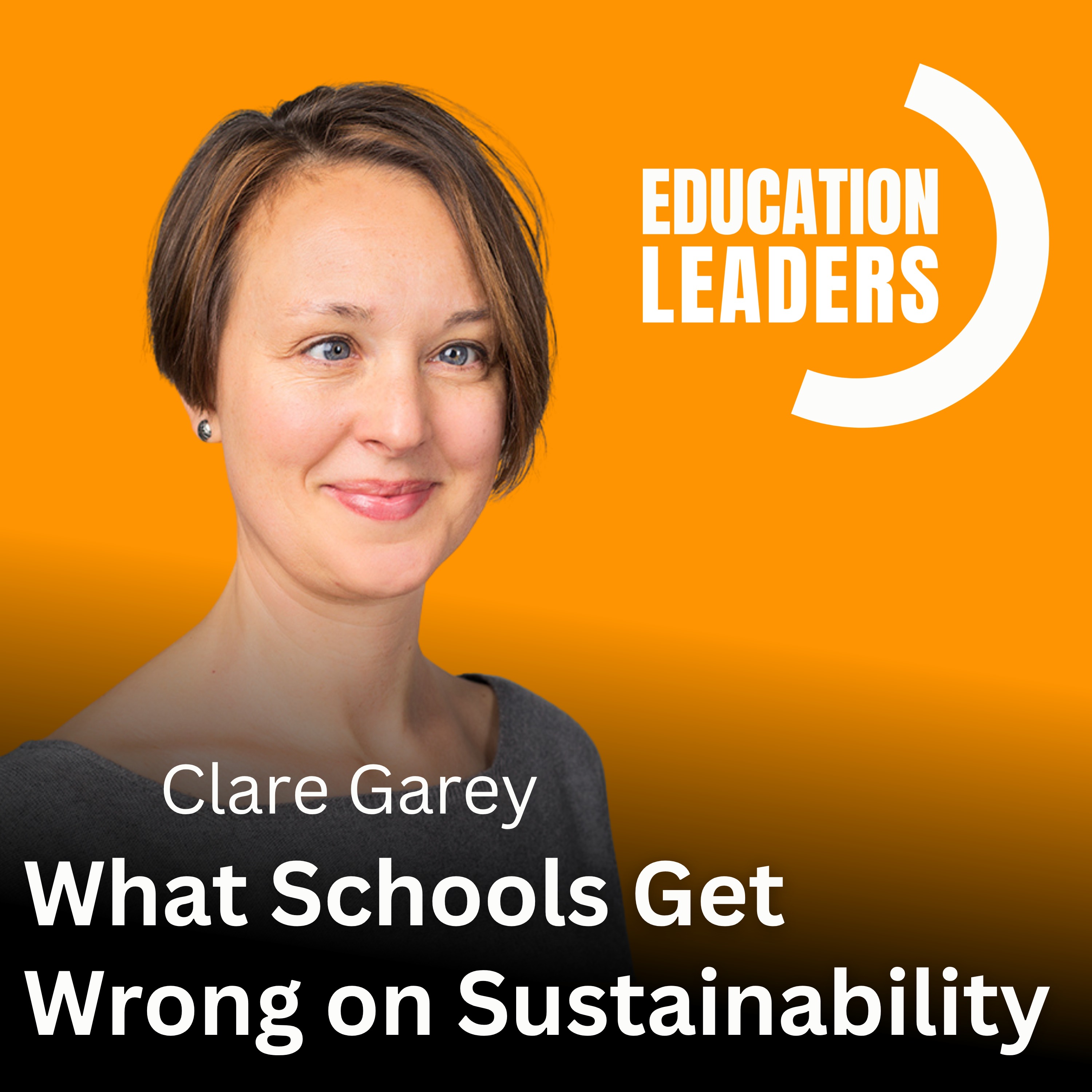
Three-quarters of children are worried about the state of the planet and Clare Garey argues that makes sustainability not just an environmental issue, but a wellbeing one. In this conversation, Clare, founder of Sustainability at School, challenges the idea that hanging up an eco poster or marking Earth Day is enough. Drawing on her work with international schools across Spain, India, Singapore and beyond, she makes the case that young people who learn about climate change but have no opportunity to take real action become disempowered and that school leaders have the ability to change that.
You'll learn why trying to tackle every sustainability issue at once leads to overwhelm and why choosing one focused theme in year one is the most powerful thing a school can do. Clare walks through the four pillars that stop sustainability becoming just another initiative; a clear "why", a representative team, a simple action plan, and treating it with the same strategic weight as any curriculum change. You'll also hear why language matters more than leaders realise (calling it a "project" is, in Clare's words, "curtains"), how students in Hyderabad reduced their school's energy consumption by 11% by asking the operations team for monthly data, and how a school in Barcelona is on track to eliminate 250,000 single-use yogurt pots in a single year. If sustainability has felt overwhelming or abstract for your school, this conversation will make it feel both urgent and entirely achievable.
Resources & Links Mentioned:
Episode Partners
International Curriculum Association
Join Shane's Intensive Leadership Programme at educationleaders.co/intensive
Shane Leaning, an organisational coach based in Shanghai, supports school leaders globally. He is the author of the best-selling 'Change Starts Here.' Shane is a leading educational voice in the UK, Asia and around the world.
You can find Shane on LinkedIn.
We are a proud member of the Education Leaders podcast network. For more great education shows, visit educationleaders.co/network/
Hosted on Acast. See acast.com/privacy for more information.
Auto-generated transcript. It may contain small errors.
What if getting serious about sustainability in your school had nothing to do with another action plan or another initiative, not even another thing on your plate? Well, my guest today reckons it starts with one decision and a really simple audit. And by the end of this episode, you will know exactly what that first step looks like. Hey, I'm Shane Leeling. Welcome to Education Leaders, the chat-topping international podcast
for leaders in schools around the world. I'm an author and an organizational coach and in this show, I bring you the practical ideas and honest conversations to help you lead with confidence and clarity. This episode is supported by the International Curriculum Association and CC. Stay tuned to learn more. Now, this episode is a bit
different. I actually recorded this live at the International Leaders Conference in front of an audience of school leaders from all over the world, which means it's got, well, a slightly different energy to our usual chats. And honestly, the audience even shaped that conversation in a really good way. My guest is Claire Gary. She's
the founder and director of Sustainability at School. She set up the organization back in 2020 because she kept hearing the same things from leaders. They cared. They felt urgency. They just didn't know where to start. I think you're going to love her.
Her approach is refreshingly clear based on what is measured matters. You're going to love this. Let's get into it. I think it's fair to say that pretty much every school has some kind of focus on sustainability. You know, it's been key part of the curriculum
in most schools for a long time now and lots of people are celebrating kind of eco days. There was Earth Day just recently a couple of weeks ago. We've got World Environment Day coming up. And I don't in any way want to detract from those celebration days. They are important
days to mark. But I think what we mean about getting serious about sustainability is, for young people growing up in the world today, they're living climate change now. This is not a future issue. We're not talking about something that is happening multiple years in the future. This is happening now. And so I think the reality is that for young people
who are learning about climate change in the classroom, experiencing it on a day to day basis, but don't have the opportunity to actually take action to contribute in a positive way to slowing climate change down, that can actually be really disempowering for young people. And in fact, there's lots of research coming up now, for example, a survey that was done in 2021 found that three quarters of children are worried about the state of the planet and 22% are very worried. So we're actually talking here about the wellbeing issue, as well as the environmental issue. And I think it requires a serious response. It requires
schools to actually respond and equip young people with the skills that they need to actually understand how to take action, not just learn about what this issue is, but what they can do about it. And so when I think about the difference between a school that is undertaking some wonderful, but one off ad hoc activity, like, I don't know, maybe there's like a beach cleaner, I think about examples of schools that we've worked with in the past, one school that we worked with in the south of Spain in Mortia, they went through a whole three year journey with us. And at the start, they were very lucky because they had this incredible building that's got all the bells and whistles, it's, you know, got panels on the roof, it's got rainwater harvesting, all of this. But the students didn't know about it. And the comments
that the staff were making to us at the outset of their journey was, this students don't even know how to recycle properly. And we walk into the classrooms and the air conditioning is on 16 degrees. And so that's what they were dealing with. And there were lots of interesting activities. But then three years on, I could honestly say that the system, the action is
embedded. What I mean by that is that they have, just in the secondary school, 40 student leaders who are empowered to actually drive action through that school. They have a solid sustainability action team made up of representation from across the school, leadership, academic staff, operations staff, they have this kind of culture shift where it's just what they do. It's not like, oh, remind people to do whatever, it's just part of their habit.
And I would say that the other things that come up are things like sustainability becomes a consideration when the school is actually making strategic decisions about how they're actually going about what they're doing. So that's what we call whole school sustainability. And that's what the work that we need is all about, really. Thank you, Claire. I know that people listening
now are going to be thinking, I want my students to be like that. And it'd be great to unpack a little bit and how they might move on a journey towards that. I'm really curious though, like something that you said, which is just like, blow my mind. So that three quarters of students are worried about the state of the planet. And I've never heard of the sustainability
challenge framed as a wellbeing challenge as well. Do you think that there's something about that generation that are going through schools that are more concerned on this? Or is it that there's seen the impact of living the impact of this more? I think it's both actually. For sure,
the actual impact is more immediate. And that's getting more the case each year. It reminds me of a situation where we work with a school in Hyderabad in India. And the first time we visited then, it became apparent that the school was only open for half of the school day. And that's
because of the extreme heat that you're experiencing in Hyderabad. So in fact, the actual school operation for a start, and then you've got what I call the air conditioning paradox, right? So in many of the schools, and I've seen a lot of people joining from Asia, so air conditioning is just part of how you have to operate in a school in Asia. And I know you're based in Singapore, certainly the case in Singapore, right? So you love to use your air conditioning,
but the paradox of air conditioning is that actually the more you use, the more it creates like heat and heat pocket, what are called heat pockets are actually an issue in Hyderabad. So there's this exponential growth in the use of air conditioning, it actually exacerbates the problem, right? So what that means is that you sort of experience the young people experiencing the issue, it's getting worse. And so that's why we need to ensure that they're given the tools to understand, well, okay, we can use air conditioning, but we can actually use it in a sustainable way, in a kind of conscious consumption type way. Okay. And there was a sort of second question in
your original question, which was about, are we seeing more students concerned? I don't have data on that. I think that actually measuring these things and doing the surveys is something relatively new, but I wouldn't be at all surprised if it is more of an issue, because young people are much more aware than they used to be. Yeah, thank you for sharing that. And fascinated to hear of how some students can see it in their
daily lives and therefore need it. And now, like also super curious, I was listening to a great talk by someone called Kobi on the idea of Gen Zs and Gen Alphas and how they're thinking differently about life as well to some sort of our generations and how there can be some challenges in terms of maybe like, you know, the use of social media or the need to be an influencer and these kinds of things. But how there are also these positives in that they're more aware, they're more conscious of being sustainable earlier. And they are more aware of some of the needs in our planet and wanting to have an impact on that, which I think is exciting and maybe gives me a bit of hope as well. 100%. That sense of needing purpose is something
that I see definitely with very young people, but also with a generation that I see as a different generation from me, chosen by age, you know, people who are now in their 20s and 30s. So, I think it is exciting and it does give hope for sure. Well, let's build on that hope then because people are tuning in, they're thinking, okay, I'm sold, you know, we want to start working on this. So, what's the temptation? We go get our
big 10 step action plan and we implement all this, we're going to turn off our air conditioners, we're going to do this, we're going to do that. We're just going to go for it, right? Like, that's a lot. Where do we even start with that? This is the work that you do every day.
Yeah, absolutely. And I think one thing that I would like to frame, first of all, is that sustainability action is a journey, right? You know, even the example that I gave of the school in Mortia, they're very much still on their journey and they will remain on that journey forever, right? It's not a destination. We are just trying to do something that is more
purposeful than currently, right? So, that's the first thing to sort of slightly take the pressure off because perfection is just not an option in this space, is the first thing. And the second thing is, you know, Green School Bali, and there are many other green schools around the world or, you know, Arbour School in Dubai, these schools are pioneering, they are absolutely incredible models for education. But I think my experience certainly is working with what I would describe as international schools that are much more, I guess, mainstream. And so, there are many priorities for those schools,
and many priorities for any school, right? But Green School Bali is a school that has made sustainability, regeneration, and all of those kind of amazing issues absolutely central to their vision and the way in which they deliver their educational model. But there are thousands of schools around the world where this is a priority, but so are many other things. And I think I would just like to equally acknowledge that because that is really probably the space that we most work in, is with those schools that want to make this more of a priority. They want to be much more intentional about it,
but they're never going to make it like the driving force behind their strategy, okay? So, that's the first thing. And where do they start? I mean, essentially one of the first things that we normally do with schools, and schools can do it themselves as well, is kind of a review to just understand kind of where they are.
Because as I mentioned before, all schools are doing something already, okay? And what you tend to find when you lift the lid is actually that you're doing quite a lot. So, it's important to get an understanding of that, and that can be done through surveys, interviews, etc. And one of the things that we encourage schools to do at the outset is with a survey to try to understand what are the issues that are really bubbling up for people, you know? And that's
students across the school, staff, and also parents. Let's try to understand which of the sustainability issues that are most important for that school community. So, it can be energy, like we touched on, it could be water, it could be waste, it could be transport, it could be air quality, biodiversity, etc. But I think, and on what we try to do is when we've done those surveys, there'll be a few issues that are bubbled to the surface, and we get the team to actually decide on one core topic to focus on in that first year that they're working with us.
And the reason for that is we experience the busyness that schools live with every single day that we're doing our work, right? So, we're very aware that people are stretched, that schools are extremely busy places, right? And as I just alluded to, sustainability is a transversal topic, right? I've just mentioned, like, five or six different areas, and that's not even touching on the social side of sustainability, it's just the environmental side, okay? So, if you try to do everything, it just leads to overwhelm. And so, what we find is
that core focus can be really helpful. Choose one topic that is important to that community. In Bangkok, for example, I'm thinking that air quality is an issue that comes up very strongly for parents. You know, water, if you're in Spain, really key topic. Whatever is
most relevant, okay? And then that gives the team the opportunity to actually really focus in on that specific issue, set some key goals, and actually start measuring impact as well. And we'll talk about that, I think, probably a little bit more later. This episode is supported by the International Curriculum Association. The ICA have been around
for 30 years now championing quality, unlocking potential, and improving learning in international schools. And what I really love is that right at their core is the model for improving learning. This is a model focused on the learning experience, and they have got tons of great curriculum materials, PD resources, and even an accreditation pathway for schools just like yours. If you're interested, head to internationalcurriculum.com.
Tell me if this sounds familiar. Your board asks for a school-wide report on academic achievement, and you've got 24 hours to deliver it, so you start digging. But elementary data, well, that is on one system. Middle school is on another. High school data is somewhere else,
and then there's exam boards on top of that. Well, by the time you've tracked down the 10 to 15 places your data lives, there is no time left for actual analysis. But the thing is, that status quo is not normal. It is just what we've gotten used to. And the good news is CC
changes that. CC brings every part of your school into one simple platform, so you can spend less time compiling reports and more time leading. If that sounds familiar, you can check out cc.org or s-i-s-i.org. There's a pressure, though, with sustainability,
isn't there, to go, well, if I just choose a one thing, I'm going to get shouted out for not choosing the other thing. Do you ever come across like that kind of challenge, or people like reluctant to take on that one thing because they're like, well, it's all important? Yes and no, right? I think alluding to the point I made before around schools are already doing something, what we wouldn't want is for them to stop doing the activity. So let's say, for example,
they've got an amazing garden, we want them to stop doing that gardening activity just because they've decided to focus on energy. And that is feasible, right? And we have a lot of schools that are doing that. And I think the answer is to have a robust debate at the outset. And we
definitely have that. I'm thinking of the school in India, actually. I remember there were three topics, biodiversity, waste, and energy. And we had a big team of people all around the table, and they had to look at the pros and cons of working on each topic. And in the end,
that was a vote, right? So it's about bringing people together on the journey and deciding together and making it really consultative, I would say. Thank you for that. So I guess it leads very naturally to another question then, which is, leaders who are tuning in now are going to be thinking, well, this is good, but I've got lots of different things that I go through. And I often talk about that teachers
almost have the rolliest eyes of any profession. Do you agree, Claire? Because we've seen that change happen time and time again, right? And we're really good at, here we go again, and not another initiative, right? So I guess the question would be is how do we make sure
that one thing that was chosen doesn't just become another initiative, especially from that leader's perspective? Yeah, a hundred percent. Rollie Eisendrome, absolutely a hundred percent, I think, right? So it comes down to four key aspects and there are probably more, right?
But let's try and keep things simple. I would actually like to challenge those listening to think about what we've talked about before or other issues that you have on your plate. What's the why behind, right? So as a leader, or as a staff member, what we always try to do is really challenge people, well, why are you bothering with this? Why is it important for
your school? Okay. And I know why it's important for me as a practitioner and for my team, but that's very different. It's different in every school, right? So it might be that
you're part of a school's group where this is, you know, a priority for that school's group from a strategic perspective. Or it might be, right, we just know this is the right thing to do, or we want to develop leadership among our staff and students, or we want to save money. Yeah, there are lots of different drivers. So I would love for people to actually have a think about that. That's the first thing. The second thing is having a really great team
behind it. So what I mean by that is we help schools to set up a sustainability action team. And I mentioned before, it has to be representative across the school. So you're looking at, you know, individuals representing each area of teaching, operations team absolutely key, very rarely in schools, you have the operations team and the teaching team in the same room together, member of the leadership, and then somebody who is actually the link between student teams and the sustainability action team, or you have the students sit directly in that team, okay?
It's a mixture, I would say, of top down and bottom up, right? So you need both. And that is something that we help to build the capacity of schools to do. So you need that distributed leadership, where that team and the students are actually driving the initiatives across the school, but you also need that figurehead, that person in the leadership who is vocal and clear about why this is something that's important for the school. The third thing is a clear plan. So when
we've got a theme, no one's short of ideas, right? Ideas are the easy bit, but having really clear, like, what are we actually going to do? And it doesn't have to be complicated, you know, we've developed a super simple template for people to do this, having that clear plan. And the fourth thing I would say is treat it like any other strategic area in your school, okay? So to be successful in any area of your school, you need to apply resources,
thought, time, planning, meetings, et cetera. And this should be no different, okay? So it needs to be something that becomes embedded in your school improvement plan if you have one, it needs to be on the agenda in key strategic meetings, you know, it becomes part of the fabric of how you do it. And that takes time, right? But that is key. And the final thing,
which I've noticed a lot is language is actually really important. So as soon as a leader calls this a project, it's curtains. It can't be seen as a project because otherwise you do get roly eyes, of course you do. It's not a project. This is part of the direction that the school wants to take very
intentionally, okay? So just to give you an example of that, we've worked with the British School of Barcelona, and we're very lucky that the executive head of that school is somebody who is extremely motivated around this issue, but for all sorts of reasons, not just his altruistic reasons. So he's definitely the figurehead, but for sure, what we've put in place is a sustainable action plan, which has that distributed leadership across three different campuses, student representation across the school. So yeah, just to give you a flavor of what that means.
Thank you so much, Claire, for making that so practical, actually. I've been scribbling my notes down. So thinking about what are the drivers, I really like that. I'm meeting that great team up and down, almost top down, bottom up together, like really powerful to me, clear plan. And I think that fourth one really, really resonates for me. Treating this like any
other change or thing that you do in the school, not project, but it got me thinking, yeah, I reckon sometimes a sustainability initiative and it'll just be seen as like not the core business of what we do. So we do it slightly differently. And then we wonder why it doesn't work because if it was a curriculum change or an assessment initiative or something that we felt like is the core business of our school, we might have an established process. We might follow a clear implementation cycle or whatever it is. But yeah, treating this as
a project or as a nice to have, well, it will probably stay as a nice to have, won't it? 100%. That's great. And language, totally here. Oh, brilliant. I'm absolutely loving this. So I wonder
if we can flip that or kind of go to that bottom up approach, but kind of think now a little bit about the students. So from your perspective, you know, what role do students have in driving this change in schools? Yeah. So students are absolutely fundamental, right? What we're looking
to achieve in the school setting is habit shift ultimately. So going back to the example in Hyderabad, they chose to focus on energy in the first year and those young people become the champions of the campaign to actually manage air conditioning in a sustainable way. So they're the ones who identify the problems at the outset or the habits that we need to shift. When there's a theme clearly defined, it's like, right, then the students actually go about doing an audit. So in this case, an energy audit, it could be a biodiversity audit or a transport
audit, whatever. They are the ones that identify, okay, so what are the problems that we're seeing? And it will be things like I'm thinking about a school in Singapore that just has been through this process actually. And one of the things I identified was that the air conditioning is on, but staff are dropping the doors open with door stops. So, you know, if you want an efficient use
of air conditioning, you have to have the door shut and the windows shut, and then you can maintain a constant temperature. So the students are the ones that identify the habits that need to shift. And then they're the ones who actually develop the ideas, the kind of campaign that they want to implement, obviously supported by staff. And then they're the ones that are the champions that drive that through. And so what that actually looks like in practice, I remember this particular
school in India, it was actually the students that each month when they were looking to understand what's the impact of their actions, you know, they were the ones asking the operations team for the data on, okay, have we actually managed to reduce our energy consumption? Because they were so focused on, right, well, we're trying to make sure that the air conditioning is being used between this temperature range, and that people are being mindful and turning it off when they're not in the room, etc. And so yeah, when the students are the ones that are coming up with the ideas and driving it, it takes on a life of its own, which is what we really need to see. Plus, they take their learning thing with them.
So, you know, at the end of that particular campaign, we survey parents to identify to what extent young people were actually taking those learning things with them. And I think it was a quarter of the young people were tinkering with air conditioning at home as well and teaching their parents about how it should be used. I love that. That's how you know you've won when the students start coming in saying, we need this data to measure the impact.
I mean, that's pretty special. And I guess picking up on that word, then, like, if we're thinking about impact, could you kind of talk us through how do we think about measuring impact? And why is that an important part of the process? Yeah, so right at the beginning, where we're talking about surveying the community, one of the questions that we ask is, what would motivate you to take action to protect the environment, right? And, you know, it's a multi choice one, and people can choose all sorts
of different things. But one of the things that comes up again and again, really strongly, is knowing the impact of my action. Like, why would you change your habit if you didn't think it would make a difference, right? It's fundamental human behavior, and habit change takes a long time to take effect. So yeah, knowing the impact of your actions is really important, and measuring,
using data is a really powerful tool for that. What we often find is that some of the schools that we work with are a little bit kind of scared of data. But, you know, I'm not a numbers person at all. And what I've discovered is that actually sharing the data can be super powerful, right? It can help the teens set a target for reducing something. So, you know, we think about
the energy example, and then I've got another example, I think will be quite interesting for people as well, but set that target, and then you can actually track your progress against it. So in the example of this school in India, very large school, they essentially start the process, this wasn't last I've done, it was the year before, right? So they looked at the previous year's electricity consumption bills, just kilowatt hours each month, and set a baseline. And then they set a target to reduce it by 5%, and then they track that on a monthly basis.
And by the end of the subsequent academic year, they managed to actually reduce their energy consumption by 11%. So a whopping achievement for them. But what we were saved before is the meaningful piece is sharing that information with the school community in a really transparent way, because it doesn't always go down, right? It can go up, but it's that transparency and that saying, we're on a journey here, we're actually going to track this is really powerful. It's really
powerful for parents as well. The other example we just uncovered at the school in Barcelona was they're trying to reduce waste through conscious consumption, conscious procurement, and actually looking at ways to reduce single-use items. And they kind of toned in on yogurt pots in Canteen. So the students are getting a single portion of yogurt, and they're phasing that out. So it'll
just be a serving of yogurt in a bottle instead. Well, we've worked out that that's going to save them 250,000 yogurt pots in a year. So you throw those numbers out, people start to realize, okay, well, it's just one yogurt pot. No, it's not just one yogurt pot. It's 40 million yogurt
pots. So yeah, that's why we focus quite heavily on impact. That makes so much sense and actually stops it from just being feeling like this thing that we all think we should do. But to actually getting really serious about, well, what measurable difference does this make? Can we
actually just talk about that and look at that? Actually, just like yogurt pots, when you talk about it in that scale of a school, you go, oh, right, I get it now. Now this is much more meaningful than us just kind of thinking it on the individual level. We're looking at some bigger things here, and then we can go, okay, we can start tracking this. We can start communicating
this. That's really, really exciting. One of the things you've asked people to do in the workbook is to think of an action that they can take in the next 30 days. Is there a common burst-like action or first step you would ask people to do? Maybe they've just listened to this
just right now and they're going, well, what could my first step be? What could my first conversation be? What would you say? I think it's to uncover what you're already doing, right? So just do a simple audit. What are we already doing in our school around this issue?
And then building on that, so that's going to involve talking to some of the kind of key staff who might be involved. It may be that you already have a sustainlessly leading your school. It's fabulous. Talk to them. Talk to the usual suspects in this area, right? There
will be people doing great work, I'm sure. Just get an understanding of that first, and then, as I was referring to, very simple surveys. So, understanding how well does the students feel the school is looking after the environment at the moment? What key issues are most important to us? Keep it super simple, but something that students complete, something staff complete,
something that parents complete as well. Then you have like a really good understanding of, okay, where are we now? So that would be the first step. And then from that, if you have some data and you already have some champions, it's then identifying, okay, who do I need to involve in this process? What we mentioned before, it needs to involve key representation from across
the school. So even if you do have a sustainability lead, normally what we find is it's not going to cut it. You need more people back up to that individual and representation from across the school. So I think those are the first two steps, I would say. Right, so a few things from that
conversation I really want to thank for you. First, the line about not calling it a project. That's really interesting. As soon as you call sustainability the sustainability project, you have lost the room. I liked Claire's point that language tells your staff whether this is
core business or just and nice to have. It's one of those small things that does an enormous amount of work actually. Have a listen to yourself. How are you talking about this in your school?
Second is the choosing one thing idea. If you were at the conference, you'll know when I opened that international leaders conference, I talked about that exact thing. So to hear Claire apply that same principle to whole school sustainability, that really landed for me. And third, the data.
That 250,000 yogurt pots figure from Barcelona. Wow, that really is going to stay with me. But also in India, where a quarter of students went home and started adjusting how their parents used air conditioning. I love Claire's point that the number one motivator for behavior change is knowing your action makes a difference. And that is clear in both of these examples.
Measure it, share it transparently and the habits shift, including at home. If you were with us at the conference, your workbook has a few questions to guide you through this. If you were tuning in on the part, well, I've put together a two page version of the workbook in the show notes. So you can grab that sit down for 10 minutes this week and have a go.
That's your first step. Education Leaders is hosted by me, Shane Leaning. Thanks to the show editor, Pete McGill. Production assistance by Skyler O'Sturman and the original music by Guillermo Silva. Thank you so, so much for tuning in today. And if we don't speak before,
I'll see you here next week. If you want to learn more about CC or the International Curriculum Association, check out the links in the show notes.
If you've noticed that students seem different since the pandemic and you're not sure what to do about it, this episode gives you real…
Listen & show notes
Saying yes is one of the most common habits among school leaders, and most of the time it happens automatically, without conscious…
Listen & show notes
What does it really take to step into public thought leadership as a headteacher and what do consultants and trust leaders get wrong when…
Listen & show notes