
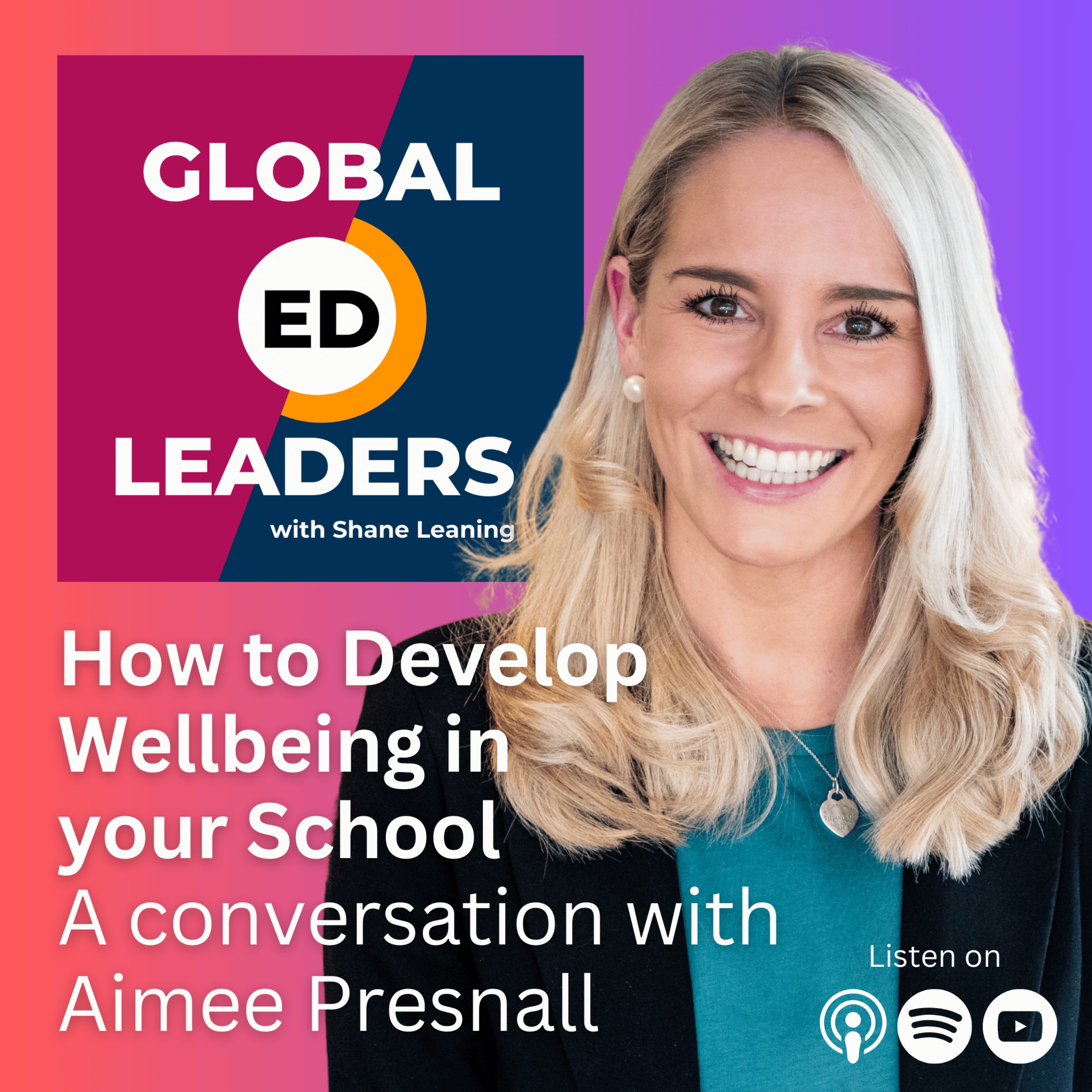
How to Develop Wellbeing in your School | A Conversation with Aimee Presnall
Shane and Aimee explore well-being in schools. Aimee shares her passion for well-being and how it started during her early years in school…
Listen & show notes
Teacher capability procedures—words that send shivers down the spine of even the most seasoned school leaders. In this episode, I share practical guidance to make this daunting task more manageable.
We explore the recently released non-statutory guidance from the UK’s Department for Education for managing underperformance, with insights that can be applied universally.
Whether you're dealing with minor underperformance or more serious cases, this episode provides you with tools and frameworks to handle these challenges with fairness, support, and a structured approach.
This episode is supported by the International Curriculum Association. Click here to Register For The International Curriculum Conference 2024
Thank you for tuning in, and as always, if you found this episode useful, please share your experience. You can find me online on X (@leaningshane), and LinkedIn. My website is shaneleaning.com and email address is [email protected].
About the host
Shane Leaning is an independent organisational coach based in Shanghai, collaborating with international schools and agencies globally. He co-founded Work Collaborative, a community dedicated to inside-out change in education, and hosts the chart-topping podcast, Global Ed Leaders. Previously, Shane was the Regional Head of Teacher Development for Nord Anglia Education’s China bilingual schools, overseeing professional development across 11 schools. He holds an Executive Master’s in International Education from King’s College London and is a certified organisational development coach.
Passionate about creating agency in schools and empowering leaders, Shane is co-authoring 'Change Starts Here,' due for release in Summer 2024. He is a CollectiveEd Fellow, an Associate of the Teacher Development Trust in the UK, and a TEDx speaker. Living internationally since 2012, with extensive experience in China and Asia, Shane is a recognised voice in international education leadership.
Join Shane's Intensive Leadership Programme at educationleaders.co/intensive
Shane Leaning, an organisational coach based in Shanghai, supports school leaders globally. He is the author of the best-selling 'Change Starts Here.' Shane is a leading educational voice in the UK, Asia and around the world.
You can find Shane on LinkedIn.
We are a proud member of the Education Leaders podcast network. For more great education shows, visit educationleaders.co/network/
Hosted on Acast. See acast.com/privacy for more information.
Auto-generated transcript. It may contain small errors.
teacher capability procedures, three words that can strike fear into the hearts of even the most experienced school leaders, but fear not because today we're going to explore a few bits of practical guidance that make this process that little bit more manageable. Hey everyone, I'm Shane Leeney. Welcome to Global of Leaders, the international chat topping podcast for international school leaders just like you. I'm an organizational coach and in this show I get to know the ideas and educators making a difference in schools around the world. Before we kick off, I'm delighted that today's episode is supported by the International
Curriculum Association. Stay tuned to learn more about their upcoming conference. So the Department for Education in the United Kingdom has just recently released a bit of non-statutory guidance to help schools manage serious underperformance of teachers and school leaders. And this guidance outlines a bit of a framework for capability procedures and the aim is trying to get that balance right between support for the teacher and accountability for their performance. Now I know that many international school leaders
also have to go through this. Unfortunately, more regularly than we'd like, we're not talking about minor things in schools. We're talking about when serious underperformance is an issue for you. How do you deal with it? It terrifies the hell out of leaders. It
used to terrify the hell out of me, but there are ways to get through it. And in this episode, I kind of wanted to use this new guidance that was only released in July, 2024 to help frame some ways that you can get through it because even though you're not going to be necessarily in the UK, I think this guidance is going to be useful for you. So let me go through a few points and then I'd love to know what you think. So in this guidance, the first thing that really stands out to me is that we should be offering informal support first. Only in the most serious
cases should we go further than that. Most of the time, teachers, if they're underperforming in some way, should be provided with some sort of informal support to improve their performance before moving to formal capability procedures. Formal capability procedures are not the first step. There are other things you should be doing. And that support that comes before that
should have some clear objectives, some clear timelines and clear goals. I think instructional coaching, obviously anyone who knows me knows I love instructional coaching because that really integrates those three things. So before you jump to something formal, try something informal and you never know often that informal help can be just what's needed to unlock that challenge. But if you have to go into such a process, a formal process for capability, then there are a few things to consider. One, and this guidance spends a bit of time exploring this,
your process has to be fair and robust. You need to follow a clear and fair capability process. There's a code of practice as part of this documentation you can follow. And by the way, I'll link to it in the show notes, or you maybe have your own code of practice for disciplinary and grievance procedures. You must follow those really well. And that will help you to combine
good support with very careful management. Secondly, don't just do it alone. Don't just start alone and create your process from scratch. Use a model policy to help you.
What I love is in this capability document, there is a model capability policy that schools can adopt or even adapt it. Having that clear written policy is important for consistency and transparency and going off a model ensures you don't miss some of those important things. I want to take a moment to tell you about the International Curriculum Conference that is coming up from the International Curriculum Association. This will be held from the 11th to the 13th of November in 2024 in Kuala Lumpur in Malaysia.
It is so exciting. The theme of this is global perspectives, local impact. And I was at their conference last year. I can't recommend it highly enough. This is a focal point for the
global community of schools, part of the International Curriculum Association. There is going to be amazing keynote speakers and a wide range of school-led workshops delivered by classroom teachers sharing their practice and experience. Seriously, with the incredible insights and showcasing of learning, I really do recommend the International Curriculum Conference because it offers a unique level of enrichment connection and learning for all. If you're interested, check out the link in the show notes to register. Please go there. It's going to be great.
The next thing that's important is to take the capability procedures in structured stages. There are defined stages of a procedure that I'll include things like formal meetings, monitoring and review periods, and a decision meeting. You need to really understand these stages and go through it methodically. Don't take shortcuts. And on a similar level,
you also really need to be thinking about as you're going through that, making sure you've got timelines and clear record keeping. The guidance really discusses the timelines for improvements and the importance of thorough documentation throughout the whole capability process, which I find pretty useful. While you're in the process, make sure you're consistently setting expectations and providing a support. It's your job as a school to clearly communicate the standards that the teacher or that leader is failing to meet. It's your job
to help them set targets for improvement, and it's your job to explain the support available that is going to help them improve. So that's three things there. I think these are really vital. Clearly communicate the standards that they're not meeting, set clear targets with them, and the third one is the one that's often missed. Explain the support that's available
to help them meet those targets. Now, while I'm saying follow a policy and follow this guidance, you've also got to consider the individual circumstance, and I think there's some good advice on this within the guidance. The process should take into account their individual circumstance. It's not going to be the same for everyone, right? There might be medical conditions
or disabilities that are affecting performance, and these need to be explored with care, with compassion, and with real understanding. And remember, as we're coming towards the end of this process, dismissal, actually letting a teacher go, is the very last resort. It is ending their employment is the final step only if performance doesn't improve after extensive support and procedural fairness, and those two are really important. If you're going to be letting someone go, you need to make sure you have given them all the support they need, and you have gone through a very fair procedure. And remember, as you go through this process, teachers have a right
to appeal. They have a right to appeal the decisions you're making as you go through the process. And if you actually go into the guidance that I've shared, you will see the different points where teachers have right to appeal. This can be very useful to share.
I think the final thing I'll share as a summary from the document is that you need to handle these capability procedures with confidentiality, while also ensuring consistency of treatment and fairness. It's really important to hold those values true as you go through this. So they're just a few ideas to get you going, to get thinking around this. I would recommend you go and check out this guidance. It's quite accessible to read and really could help ease
anxiety when going through these procedures. None of us ever want to do it, but as a leader, unfortunately, these are things we have to do. I remember the first time I was doing it in a school and I was terrified, but I followed a script, I followed a process, and I would advise you to do the same. If you've got something like this coming up, all the best to you, and I wish you a real safe, methodical, and hopefully helpful process as you go through that capability procedure. Global Lead Leaders is hosted by me, Shane Leaning, thanks to the
show editor, Pete McGill, and for original music by Guilleme Silver. Thanks so much for tuning in today, it means the world, and if we don't speak before, I'll see you here next week.
Shane and Aimee explore well-being in schools. Aimee shares her passion for well-being and how it started during her early years in school…
Listen & show notes
GUEST EPISODE Shane Leaning is interviewed by Chris Jordan on The Leading, Language and Literature Podcast. We discuss: 1. What made Shane…
Listen & show notes
Is your school's literacy strategy doing more harm than good? In today's episode, educational consultant Chris Scorer joins me at a local…
Listen & show notes