

Organisational Change 101 | Change Series 1.1
Shane introduces a mini-series focused on leading effective community-led change in schools. He presents an open-source change model…
Listen & show notes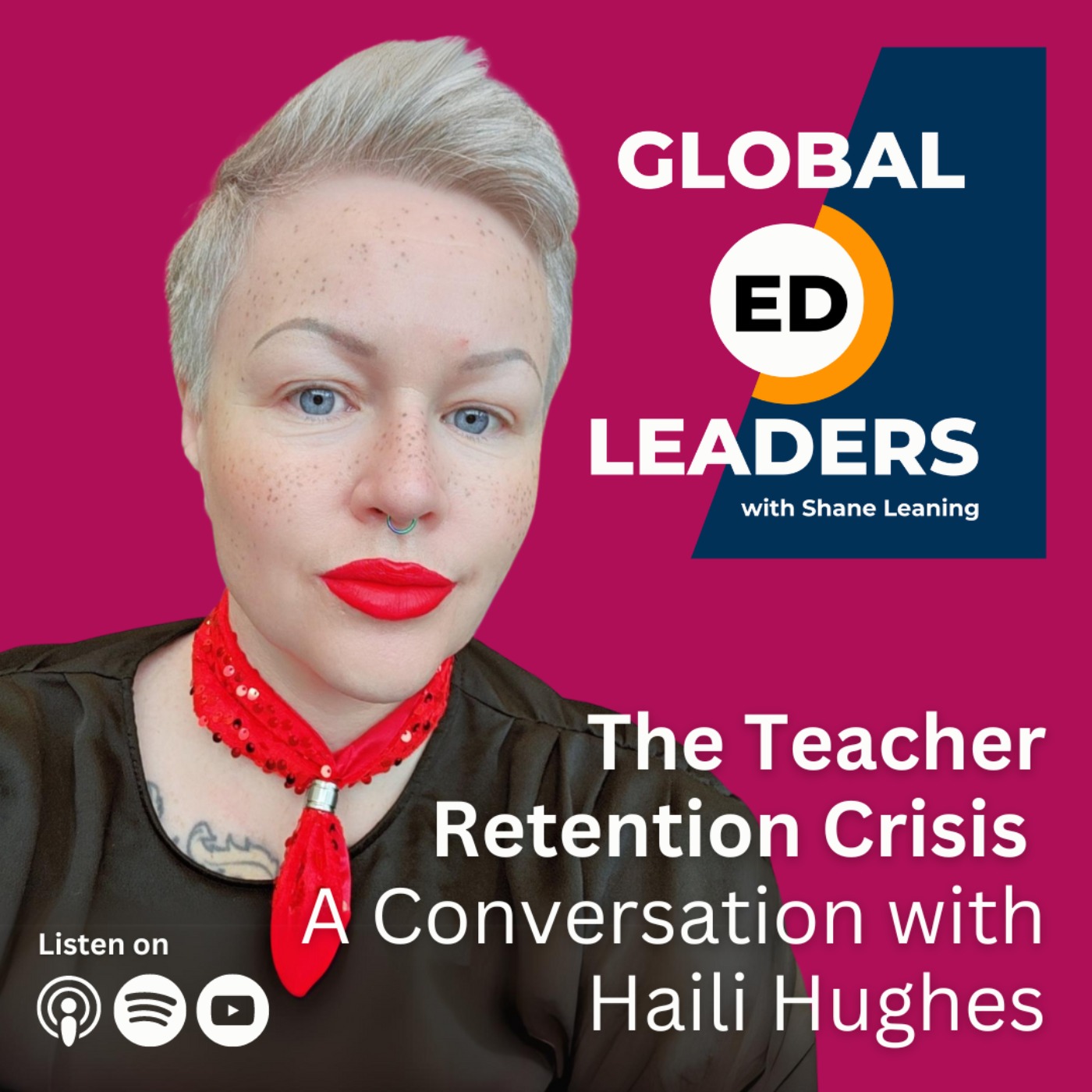
Haili Hughes and Shane Leaning discuss the ongoing crisis in the teaching profession, focusing on the challenges of teacher retention, the impact of toxic leadership, and the need for a supportive culture within schools. They explore the internal and external factors contributing to the crisis, including public perception, accountability, and the importance of psychological safety for teachers. The discussion emphasises the need for educational leaders to create environments that nurture growth and well-being for educators, ultimately benefiting students as well.
Takeaways
· Teacher retention is a crisis in many countries, including the UK, and is influenced by factors such as erosion of respect for teachers and negative media portrayal.
· Toxic leadership is a significant problem in schools and can lead to high levels of stress and burnout among teachers.
· Creating a supportive and empowering culture in schools is crucial for retaining teachers and promoting their well-being.
· Leaders should prioritise teacher agency and provide opportunities for professional growth and development.
· Accountability is important, but high-stakes and performative accountability measures can be counterproductive and erode teacher creativity and self-efficacy.
· Building a sense of belonging and community among teachers is essential for creating a positive work environment.
Links
Preserving Positivity (Book): amzn.eu/d/cwvo6ek
Haili on X/Twitter: x.com/HughesHaili
Haili on LinkedIn: linkedin.com/in/dr-haili-hughes-178479186/
This episode is supported by the International Curriculum Association. Click here to Register for The International Curriculum Conference 2024
Thank you for tuning in, and as always, if you found this episode useful, please share your experience. You can find me online on X (@leaningshane), and LinkedIn. My website is shaneleaning.com and email address is [email protected].
About the host
Shane Leaning is an independent organisational coach based in Shanghai, collaborating with international schools and agencies globally. He co-founded Work Collaborative, a community dedicated to inside-out change in education, and hosts the chart-topping podcast, Global Ed Leaders. Previously, Shane was the Regional Head of Teacher Development for Nord Anglia Education’s China bilingual schools, overseeing professional development across 11 schools. He holds an Executive Master’s in International Education from King’s College London and is a certified organisational development coach.
Join Shane's Intensive Leadership Programme at educationleaders.co/intensive
Shane Leaning, an organisational coach based in Shanghai, supports school leaders globally. He is the author of the best-selling 'Change Starts Here.' Shane is a leading educational voice in the UK, Asia and around the world.
You can find Shane on LinkedIn.
We are a proud member of the Education Leaders podcast network. For more great education shows, visit educationleaders.co/network/
Hosted on Acast. See acast.com/privacy for more information.
Auto-generated transcript. It may contain small errors.
We are in the middle of a global teacher recruitment crisis. But what can we do about that? My guest today has a few ideas that I think you're going to find super helpful. Hey, everyone. I'm Shane Leaning. Welcome to Global Lead Leaders,
the chat-topping leadership podcast for international schools. I'm an organizational coach, and in this show, I get to know the teachers, leaders, and innovators, making a difference in schools around the world. Before we jump into today's conversation, I'm delighted that today's episode is supported by the International Curriculum Association. Stay tuned to learn more.
My guest today is Hylie Hughes. Hylie is a colleague and good friend of mine and the director of education for Iris Connect and a principal lecturer at the University of Sunderland, where she hands and implements teacher mentoring across schools. Hylie has got huge experience and has known very well for her teaching of English, and she's also got a doctorate in education. Hylie is also one of these people who just manages to keep writing books.
I am just amazed, and she has some brilliant books out. I will provide some links in the show notes. But she's particularly passionate about teacher retention, and that's what we decided to speak about today. So let's jump straight in.
We're in a crisis. I do speak around the world and see really similar problems about attrition everywhere. The US, places in Europe, et cetera. I don't know whether it's the same in your context, Shane.
It is. But we're in a crisis. We're in an absolute crisis. And there are lots of reasons for that, I think.
And there are lots of reasons why we're talking more about it now than we have been in the last few years. I think, not least, that we have a new government in power and our Education Secretary, Bridget Phillipsson, who is brilliant, is talking a lot about the fact that actually we need to retain our most experienced teachers. This is something that I've been banging on about for years. I wrote a book about it in 2021 called Preserving Positivity.
And we're in crisis, essentially, because over the last 10, 15 years, the status and the respect for teachers in England has been perniciously eroded. You know, we've got politicians who have called teachers enemies of promise. We've all lived through a pandemic where the newspapers essentially slandered teachers for the whole of schools being closed when they were never closed. And I think that is eroded teachers' self-efficacy.
And teaching has always been a hard job, Shane. It was hard when I did it for 17 years, and it's always been a difficult job. However, when you are well-respected by the public and when you're not facing kind of a backlash in every element of your life over what you choose to do for a job, it almost seems bearable. But teachers haven't had that for the last 10 years, and they've had to make excuses about their job when they give their heart and soul to it.
And they're working so hard, so hard, and having basically abuse from the public. And the Department for Education just have not come out for teachers. And a lot of the people that I interviewed for my PhD thesis will never forgive them for that. Yeah. I mean, there's a real PR problem,
and I've really felt that highly. You know, I'm based out in China, and the status of teachers within society in China is very different. Yes. They may be paid very similar or less in the context, but their status in terms of how important teachers are, how much respect they are given in terms of society is pretty high.
Like, you're an educator. You're really important in society. We really need good educators. And yet it seems that there's such a stark contrast with the narrative, the PR around teachers in the UK, to the point where, you know, I've heard so many times of, oh, you're a teacher.
Oh. Or don't be a teacher. They're a failed ex, that narrative. Or even, you know, we go way back when they were that whole Those Who Can Teach campaign and how it got subverted into Those Who Can't.
Mm-hmm. It is a real problem. I wonder though, do you think it's just an external PR problem that's causing teachers to leave, or is there something else at play? It's an internal one as well.
And I've been out of the classroom for three years. I'm heading back, hopefully, next year. You know, so I still think of myself as a teacher, although officially, I guess, I'm an academic. And it's an internal problem.
And teachers like to moan. And I include myself in that. I think what has grounded my sort of view on the profession and the work-life balance is that actually, every job I've ever done is really hard. And when I was a journalist, I worked harder than I did when I was a teacher because I didn't get any time off because news doesn't wait.
I worked in a really misogynistic, horrible environment that was nothing like the psychological safety and belonging and the community that you find in a school. And I worked in a job with very little moral purpose as a national newspaper journalist, so I didn't get the satisfaction of working in teaching. And I think a lot of people who I speak to have had careers that aren't in teaching or had a period out of the classroom and have gone back and have realised that actually, perhaps the grass isn't greener. And I think sometimes as teachers, we need to realise that, yes, we work really hard and it's a hard job.
But actually, there are lots of hard jobs. For example, my mum is a cleaner. I wouldn't swap with her in a million years. It's backbreaking work.
I think we need to realise that, and there is a PR problem. I remember even 20 years ago when I first went into a school as a teacher and sort of some of the old timers saying, oh, what are you doing? Run, run as fast as you can. What do you want to do this for?
So there is an internal PR problem. And very recently, I was on a depend for education, Westminster Education Forum conference, speaking about the future of ITT. And there was a famous Lord speaking. He said that teaching has a PR problem and he faced a huge amount of backlash for it on Twitter.
And he annoyed me at the time saying it, but he has got a point. And, you know, none of us are going to love our jobs all of the time because that's just completely unrealistic. But what we need to remember is the absolute joy that we get from teaching. There's no other job I can think of that has the benefits of teaching.
Great pension, 12 weeks holiday, you know, and it's intense when you're there. But, you know, the other things that you just cannot bottle and put into another job, that tangible making a difference, that going on a journey with students and staff, and God, I miss it. Hylie, what you just said is really, really interesting to me because I've said something similar in the past that having also worked outside of schools in different environments and having also not necessarily found that teaching was the hardest of all my jobs that I've had and certainly resonating with you when I've said in the past to people reflecting on some of the work in my family. My dad was a steelworker and really reflecting on the toughness of that job as well.
And it did used to irk me when some teachers would go, yeah, but this is harder than any other job. I think it's got aspects that are really tough. There's absolutely a very tiring performative aspect that some jobs don't require. There's certainly that, but I don't like this kind of talk of comparison and I feel it's quite toxic.
But, you know, when I brought that up before, I was quite angrily taken down about it. Like, it's almost a bit taboo, right? Oh, me too. Yeah, I'm not popular in the staff room chain and I say that like 100%, you know, but I've said it all my career.
And I think what it also comes down to as well is what you see teaching as. And there are those people who see teaching as their vocation and that's absolutely great. And I think there's a difference between seeing teaching as their vocation and a vocation, because for me, seeing teaching as a vocation is toxic. It's used as a stick to beat teachers with.
And what it means is that you take your job above all else in your life and teaching has never been that for me. It's been my passion, but you know what? Like when I leave school at five o'clock or half five, I'm not doing work when I get home. And guess what? Nobody's going to die
because I've got a family and you've got to ring fence that time and the most successful teachers, you've got the most longevity in the classroom are those I think who I've seen who are able to actually do that because there are a lot of people in teaching who become martyrs to the job and it's not sustainable. You're so right. And I think sometimes leaders can lose sight of that. The priority of a teacher in a class is first, themselves.
Yes. Second, their family. And third, their job probably like it's going to be in that order and it'd be insane to think that it wouldn't be in that order for most people yet that expectation is there. But I also think for teachers, it does come doubly like people are expecting them to put their job first, but also it's sometimes this student first mentality that I can also think with good intention behind it has a problem and it's why I found Jonny Utley and Jon Tomsett's book that putting staff first is so great for me.
It just really encapsulates how leaders who put staff first, by definition, put their students first. But by putting students first and not prioritizing your teacher's wellbeing, that's a problem. And I guess we're hinting here, you know, we've talked about maybe teaching is not right to be comparing it to other professions and teachers who are considering leaving, it might just be, you know, just hold on a second and consider first. Consider what you're going to is the grass greener.
But I guess we're also saying that teaching is tough and there are some problems at the minute, right? And that's also contributing. Yeah. 100%.
And I am absolutely not belittling or, you know, minimizing people who are really struggling with this job because I've been there too. 12, 13 years ago, I left a school where I was horrendously bullied by a toxic leader to the point where I was giving up. And basically it was a make or break move to another school for me to see whether actually it was just me or just him or that school. And if this was what I had to look forward to for the next 40 years of my career, because if it was, I'd be gone.
And luckily I moved to a school for the last decade of my career where I wasn't bullied. It had its problems, the school, you know, CPD wasn't great, which is ultimately why I ended up leaving in the end for different opportunities because I was bored. So I had somebody delivering kind of CPD who was great, read a lot, et cetera, but I knew everything she'd read and it wasn't challenging me or pushing me. So I think that's important.
But I also think at the moment in England, the behavior is just really, really challenging and it's a post-COVID thing and I think teachers are struggling with that. Teachers are also expected to solve every ill of society. So, you know, if you go onto any social media channel or dare I say it, the Daily Mail comments section, you will find quite a lot of people arguing that teachers should be teaching sex education, finance, business, everything else. And, you know, every time something goes wrong in society, it's like, oh, why didn't school sort this out?
And it just seems like society is a little bit broken really and sometimes the partnership between kind of home and school has really suffered. And I think COVID's had a lot to do with that. But that also feeds into that narrative again, I guess, of kind of teaching being quite a badly respected profession now because parents, lots of parents don't respect teachers. So it's a vicious circle really and some teachers are really struggling and I'm not minimizing that because it is a bloody hard job.
And I've said it many times, it's like comparing apples and pears, isn't it, I guess, to compare it to another profession because I don't think there's anything quite like it. I suppose the thing that comes the nearest probably is nursing or social work. And actually, Sam Gibbs and I are writing a book about retention where we're actually looking at that as a profession and the police as well who have gone through lots of retention problems in the last few years and seem to have put some things in place that have worked that I think we can learn from. So yeah, I'm absolutely not minimizing it 100%, but we do have to be realistic here that actually working in any job in this day and age is really tough because we're working harder than we've ever worked.
We're working longer hours than we've ever worked. We're in a cost of living crisis where we're all struggling to make ends meet and just actually working, I think is tough. And teaching is just one of those jobs. I really like how you put that highly and I'd love to hear more about what we might learn going forward and talk a little bit about that.
But I would love to just sit with a moment because I think something that might have picked some listeners either up is you talking about toxic leadership. And I know you've spoken publicly a little bit. You just alluded to it there about your experience of toxic leadership. Would you be able to talk a little more to that?
What was happening to you? And are there any kind of signs or things that you learned from it that you think people listening could take some value from? Yeah, absolutely. So it was my first school, incredibly charismatic deputy head, male, one of the best teachers I've ever seen in the classroom, which made it worse in a way because I really wanted him to like me.
Very popular in the school. I'd been there from an NQT all the way up to deputy head. He'd been there about 15, 16 years. When I started, kind of life and soul of the staff room, but ruled with an iron fist.
And I wasn't by any means the only person that this leader bullied. And in fact, he ended up losing his job over bullying a few years after I'd left the school. At the time, lots of people had complained about it. And unfortunately, the senior leadership team just swept it under the carpet and said, it's just the way he is.
It's just part of his personality. And that happens far too often in education. And we see people being promoted to really high levels of kind of responsibility and power who've made people's life a living hell. And let's face it, often men highly.
Yes. Yeah, I have to say, you know, I'll probably have a lot of Andrew Tate's friends jumping on me for this, but it is true, I'm afraid. Although I have been bullied by toxic women leaders as well, especially in HE, they abound. But yeah, and this leader, very Machiavellian, I was promoted very, very quickly in my first school because the school went into special measures.
The head of English walked out and never came back. And suddenly I, you know, when I was a very young second in English as well, I kind of volunteered as tribute Hunger Games style because nobody else would do it because it was special measure school, really tough. But I loved the kids. The kids were incredible.
The kids were me. It was my area where I grew up. So I moved very quickly through the school and he just systematically kind of undermined me with my department. Like at lunch, I would kind of walk down the corridor and he'd be in there with the rest of the department.
Having lunch, I wasn't welcome. I was screeching and squealing with laughter, you know, and that was quite difficult and it was horrible. And then he would do things like make me cry or talk to me like I was about five and then come in the next day with a box of chocolates or flowers or yeah, it was horrible. Haile, I'm so sorry to hear that.
That is a horrible, horrible experience. Have you heard others? Could you share about this? I'm wondering what kind of feedback you've had from other people. Is this something?
Honestly, it was like a me too moment, seriously. The amount of people who were like, oh my goodness, this happened to me. And recently I provided the keynote at Research Ed Southwest and interviewed four or five teachers that had left the profession as to their reasons why. And one of them was just heartbreaking.
And she talked about a toxic leader and I showed it at Research Ed and I've kind of blurred the video and shared it as a thread on Twitter. And she shared just a, oh God, it was like heartbreaking story of being this teacher full of passion, enthusiasm. And then, you know, it was just systematically eroded and bullied for 16 years by a toxic leader. So it's so common.
And like every time Sam Gibbs and I post about this, we get hundreds of replies. I get DMs into my inbox all of the time on X about a blog I wrote a few years ago about this. And you know, people come across it and say, oh, thank you so much for writing that blog because I thought it was just me and I came across it and I recognized my experiences straight away. And it's really kind of helped me realize that actually I have to leave the school.
But the worst thing about the whole thing is, and this is a narrative that I see repeated again and again and again, unfortunately in these stories, is that this person was asked to leave the school a few years after I'd left because he bullied hundreds of people and it eventually came to bite him. And he's now a deputy head in a really exclusive school in the Northwest. And the diocese closed around him and we see this so much in education, people promoted to executive leadership positions or shipped out to do another role when in any other career they've begun. I want to take a moment to tell you about the International Curriculum Conference that is coming up from the International Curriculum Association.
This will be held from the 11th to the 13th of November in 2024 in Kuala Lumpur in Malaysia. It is so exciting. The theme of this is global perspectives, local impact, and I was at their conference last year. I can't recommend it highly enough.
This is a focal point for the global community of schools, part of the International Curriculum Association. There is going to be amazing keynote speakers and a wide range of school-led workshops delivered by classroom teachers sharing their practice and experience. Seriously, with the incredible insights and showcasing of learning, I really do recommend the International Curriculum Conference because it offers a unique level of enrichment connection and learning for all. If you're interested, check out the link in the show notes to register.
Please go there. It's going to be great. I remember you sharing about this, you and Sam sharing about this online as well. I saw the feedback and, funnily enough, I was thinking of replying myself and I didn't at the time, but I've also had a horribly toxic leader in my journey as well and I remember it just resonated with me because I had a leader who put me down at every chance, constantly told me that I wasn't very good.
Literally as explicit as that, I mean, it was pretty constant for a year and it's how much you end up putting up with. I mean, while I was in this position, I was signed off with stress and all sorts due to this. Took me too. And yet I still kept going back and it is a problem.
And interestingly, when you just said, often these people stay in the system and promoted, this person absolutely has been celebrated in the system since that's happened. I wonder what that is. Is it because often there's a character trait that comes with it that is appealing to those above them? I think probably because these people are often very charismatic.
And if you're on the right side of them, then life is sweet. But if you're not, well, you know, good luck. And I think that's the problem, isn't it? That people are complex, right?
And toxic leaders are bullies, if you like. They're not going to be bullies all of the time. They're clever about who they bully. I'm a kind of loud, outwardly confident person and nobody would think I'm a sort of natural victim, if you like.
But often their sort of jealousy and insecurity does make them gravitate towards people like me. We mentioned Sam Gibbs before then has also had a similar experience to me. And there's so many people out there who are close to packing it all in. And I'm so glad I didn't.
And I'm so glad that I went to another school and realized actually it's not normal behavior. No. What's sad as well? I don't know if you've noticed its pattern, but often it's the people who suffer are people who maybe do sometimes think in a slightly different way or express in a slightly different way.
Or are happy to voice concerns and are wanting the best, you know. And then often that can be seen as a threat or a challenge to authority. Yeah. It does frustrate me because I work a lot in leadership development and working with brilliant leaders.
And we know that the best leaders in the world have true empathy for their teams and respect diversity in their teams. And therefore, you're used as their main weapon, you know, their ears to listen and to really understand that diversity. And when you do, like, I've had teams that I've been so proud to lead. One particular team I had, they were labeled by some as the Misfits, which I just really didn't like, a team of Misfits.
And they were incredible because listening and tuning in really helped. I maybe have empathy in a little way for some leaders who get it wrong sometimes because it can be easy to get frustrated and then lean into kind of that, oh, it's them. And then lean into kind of distancing and what then can just evolve into a bullying behavior out of almost self-protection. But it's just never okay.
And it does need calling out. Absolutely. 100%. I think that's really important.
And don't get me wrong. I've never sat in the chair. I've never been a head teacher and I hope to one day. And that's got to be so hard, like such a lonely job, such a weight of responsibility on your shoulders.
You know, I spent some of the evening last night with Vic Goddard, amazing Vic, who's the head of Passmores in Essex. And he's been ahead for like, gosh, 15 years or something now, incredible job, you know, in a really disadvantaged community doing great things. It's a hard job. It's a lonely job.
And, you know, who am I to criticise leaders? But I think we have to call it out because these people, they gravitate towards positions of power where they can exert their force. And it's not fair and it's not right because as a leader, you have a great sense of responsibility for the wellbeing of the staff and the kids. I'm doing my MPQH at the moment and one of the quotes that really resonated me with it, which the facilitator said the other day was it's about the shadow that you cast.
And that's it, isn't it? That's what it's all about. And if you're a leader, what you do, what you say, the way you behave, it has huge ricochet effects on the culture of the school and the feelings of your staff. And I think people need to be mindful of that.
And this isn't just heads. This is senior leaders. It's middle leaders as well. I've learned to horrendous middle leaders, my goodness me, and really brilliant ones as well.
And it can make or break a team. It's vital actually. And that's why I think Sam Crohn's work on teams and looking at teams that are outside of education actually is brilliant, absolutely brilliant. Yeah, I would agree.
I love his book. It's been a real joy to read this last year and it's really helped me in my practice. I wonder then, Ali, reflecting on that, so things can be pretty tough. Like if a leader is going, I really want to improve people staying in my school.
Do you have any thoughts on areas or starting points that they might decide to look at to kind of help with that retention? Yeah, absolutely. So I think a lot of it comes back to self-determination theory for me and this idea of kind of agency. So this kind of tight but loose.
And in Mark and Zoe Enz's brilliant book, The CPD Curriculum, a few years ago, they used the analogy. It was a geography analogy, of course, talking about a braided channel. And I had to look this up at the time because I did do geography GCSE, but I'm quite old now, Shane, and it was a long time ago. So I had to look it up.
And they used the analogy of a braided channel in geography where the currents go in the same way. They're all swimming in the same direction. But actually, staff are probably going to have to go different ways down little, you know, tributuaries. I guess that's the right word.
Mark will probably message me after this and say, but, you know, have to go down different kind of side roads or whatever to get to the same destination. And we're all swimming with the tide. But actually, we're going to do it in different ways. And it's that tight but loose, isn't it?
And nobody's saying that teachers shouldn't have accountability because we're public servants. You bet we should have accountability. You know, that's really important. And Sam Gibb talks about a pendulum swing.
And I completely agree with her on this. That years ago, I was largely left to do whatever I liked in my classroom. And a secondary English practitioner, I'd be observed formally once a year. So somebody would come in and see me and I'd get my offset outstanding lesson out in my top drawer and do it.
And then people would leave me alone for the whole of the rest of the year. And that's wrong. It's absolutely wrong. It's high stakes.
It's performative, you know, and who knew what I was doing for the rest of the time in the classroom. And, you know, in fact, I worked with people who were doing horrendous things in the classroom. I worked with a geography teacher who was retiring, you know, when I first started. And a member of SLT walked in and said, where's Mr. X?
And the kid said, he's in there, walked in the stock company. And he's playing in the door while the kids are watching a documentary, you know, and stuff like that went on for years in schools and teachers were untouchable. So we absolutely should have accountability, 10,000%. But like Sam talks about that pendulum, it swung too much the other way now so that people are literally having to deliver pre-bought in centrally made PowerPoints on the same day at the same time.
And if the kids don't get it, well, it doesn't matter because they're moving on anyway. And, you know, when it's eroding teachers' creativity, self-efficacy, if we think about self-determination theory, belonging, relatedness, competence, it's not rocket science, is it? So it's, you know, how do we build that community? How do we go tight but loose?
How do we have a culture that's tangible? But how do we trust our teachers to be able to make those professional judgments that are right for the children that are in front of them in their context? And that's what leaders have got to think really carefully about. And PD and coaching is part of that, obviously.
Yeah. And there's no easy solution to this. You can't just buy yet another product. God knows we've got enough products at the minute.
Like you can't just buy another product off the shelf. That's going to solve this issue as well. Well, the shiny thing doesn't solve it. What we're doing there is focusing on the product, not the persistent problem.
Absolutely. And that big issue that stood out to me is the agency piece in that teachers are professionals. And that means, yes, they need to be held accountable. And I would say mostly would want to be held to account.
Yes, agreed. Because they are a professional and they want to do a good job. I also think that's a myth that teachers are just anti-being held to account. I think you might be anti-being observed once a year in a high-stakes way.
Yeah, of course. But being held to account for your job, it's a desire to expect that there's a whole profession of teachers who don't want anyone to have anything to do. I know. It's like they think that teachers have got like, you know, packets of matches in the pocket and they're just waiting for the opportunity to set fire to the school.
You know, it's like absolutely bonkers. But there are people who genuinely believe that and that teachers want to strike and that teachers are sat around doing nothing and, you know, we're in at eight and home at three. And, you know, all these tropes that exist and it's just ridiculous really if you think about it. But every teacher I've ever met, you know, absolutely accepts that there should be some accountability.
But we know that the high-stakes performative accountability that some schools are still using just doesn't work anyway. So it's a waste of time for everybody. Exactly. I guess for me, I always come back to that book that I mentioned earlier with Don Thompson and Tony Utley when they said it's an exchange.
I like the way they talk about this exchange that you make with your staff. You go, you know, we're going to do an exchange. What I want from you is to provide incredible, incredible teaching and learning experiences that really provide great value for the students who are in the children we serve. Absolutely.
And I'm going to hold you to account on that. We're going to hold you to account on that. But in exchange, I'm going to value you as a professional. I'm going to support you.
I'm going to nurture you to enable you to do your best work and your best thinking in the school, but also just to live a really good life as well. There's an exchange that's happening. And I think if you think about it in that exchange, you're naturally adjust and course correct a little bit along asking the right questions of what you need to do next. Absolutely.
And what I also think is important as well is that leaders remember that at the moment is a teacher's market in schools. And unless they're creating a really compelling supportive culture of belonging in a school where their staff are going to vote with their feet and, you know, Dylan William, love the one you with. That's what it's all about, isn't it? And if leaders aren't creating that environment of growth of psychological safety, of belonging, of agency, I prefer that word to autonomy.
Then actually the teachers are going to go elsewhere and it's absolutely a buyer's market. They could go anywhere. We're at the stage with some subjects in England where we're accepting anybody with a pulse. We're digging them up and hoping we can revive them by Christmas.
So, you know, if you're a geographer or a chemist or a physicist, you can walk into any job for any salary anywhere. So it is an absolute teacher's market. And we just need to remember that. This episode gave me so much to think about.
I'm reminded that teacher attention is a crisis across many countries, including the UK, and it's influenced by things like the erosion of respect for teachers and negative media betrayal. And what I really took as well is that toxic leadership can be a significant problem in schools and lead to high levels of stress and burnout. As leaders, we need to think about creating supportive and empowering school cultures to retain those great teachers and really think about promoting wellbeing. That means prioritising teacher agency and providing great opportunities for professional growth and development.
That's not to say accountability isn't important, but high stakes and performative accountability measures can be really counterproductive and can really erode teacher creativity and their self-efficacy. I think the resonating takeaway, for me, is that we need to build a sense of belonging and a sense of community amongst teachers. That's essential in creating that brilliant, positive work environment. You can learn more about Haile's brilliant work, including her upcoming book, on this same topic by going to the links in the show notes.
Global Lead Leaders is hosted by me, Shane Leaning, thanks to the show editor, Pete McGill, and for your original music by Guillerme Silva. Thank you so much for tuning in today, and if we don't speak before, I'll see you here next for you. Remember to find out more about the International Quikulum Association and that fantastic International Quikulum Conference in November, check out the links in the show notes.
Shane introduces a mini-series focused on leading effective community-led change in schools. He presents an open-source change model…
Listen & show notes
Sharath Jeevan OBE explores the concept of inflection moments for leaders in education, addressing the challenges and opportunities they…
Listen & show notes
Teacher capability procedures—words that send shivers down the spine of even the most seasoned school leaders. In this episode, I share…
Listen & show notes