

How Leaders Make Ripples
My guest today is David Harkin, CEO and Founder of 8billionideas, which has impacted over 500,000 students in 26 countries. David is a…
Listen & show notes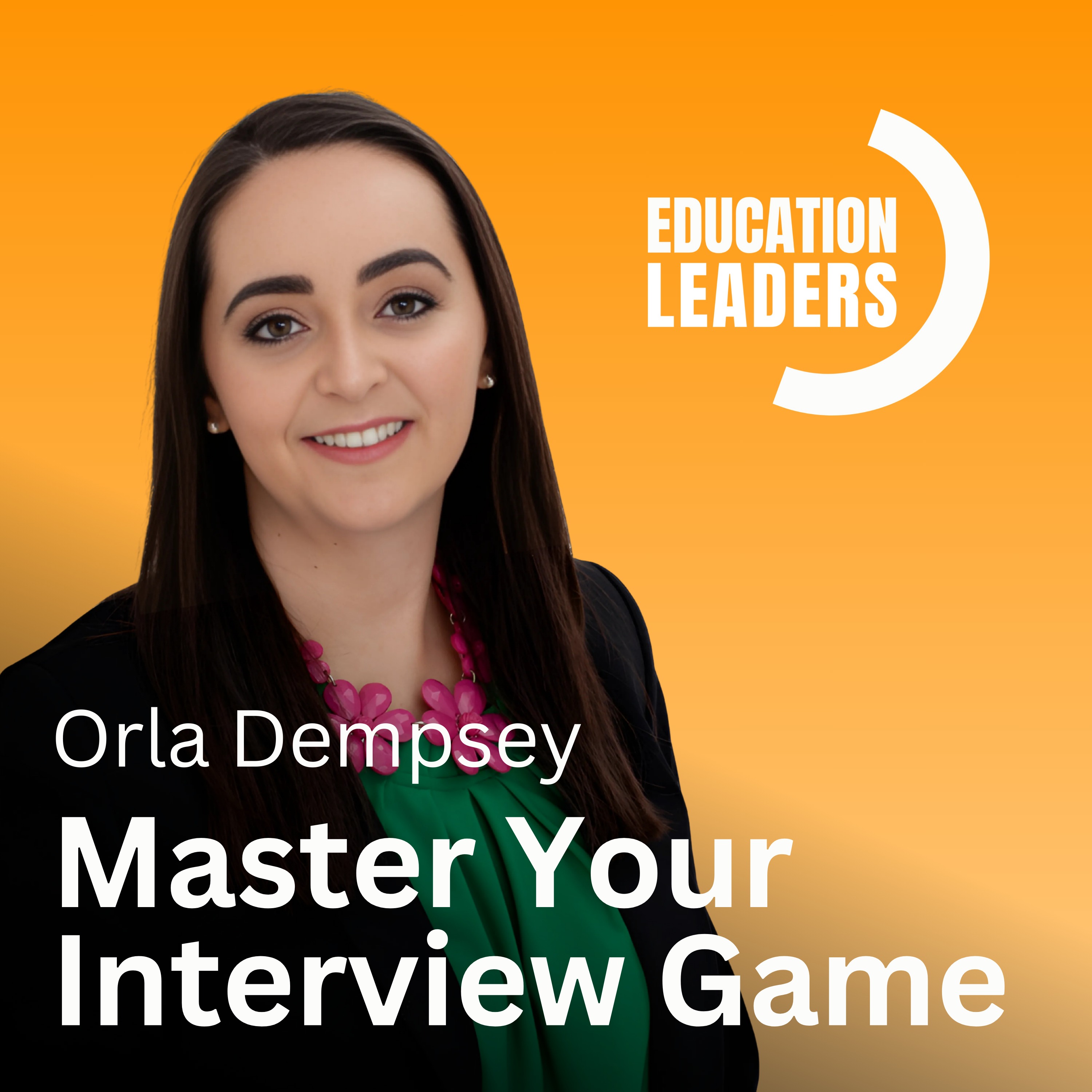
In this episode, Shane gets coached on leadership interview techniques by Orla Dempsey, an expert in helping teachers secure leadership positions. Throughout their conversation, Orla shares practical frameworks and strategies that help transform interview anxiety into confidence.
The International Curriculum Association: Learn more
Join Shane's Intensive Leadership Programme at educationleaders.co/intensive
Shane Leaning, an organisational coach based in Shanghai, supports school leaders globally. He is the author of the best-selling 'Change Starts Here.' Shane is a leading educational voice in the UK, Asia and around the world.
You can find Shane on LinkedIn.
We are a proud member of the Education Leaders podcast network. For more great education shows, visit educationleaders.co/network/
Hosted on Acast. See acast.com/privacy for more information.
Auto-generated transcript. It may contain small errors.
Leadership interviews, they absolutely terrify me and chances are they make you a bit nervous too. In this episode, I actually get coached on beating interview anxiety and we really cut through the fluff and show real impact. Just in this one episode, I've become better at my interview game and I reckon you will too. Hey everyone, I'm Shane Leaning.
Welcome to Education Leaders The Chat, topping leadership podcasts for school leaders just like you. As an organizational coach, I've helped thousands of leaders worldwide lead with greater confidence, make better decisions and create winning teams. And on this show, we explore strategies that will help you achieve your goals and transform your leadership. Now before we jump in, I'm excited that today's episode is supported by the International Curriculum Association.
Stay tuned to learn more. Now my guest today is Ola Dempsey. Ola specializes in helping teachers secure leadership positions in education. She's based in Ireland and she is a cracking coach.
She really helps her clients overcome limiting beliefs and prepare really well for interviews. She's got a really practical approach and that's helped a lot of teachers transition into those middle and senior leaderships. Now, I'll be honest, I'm a bit nervous about interviews myself. It's probably why I work for myself.
But today, Ola actually coaches me through some interview techniques and genuinely, I learned a lot here and I think you're going to find it incredibly valuable. So let's jump straight in. When leaders are going for interviews, it is very important to have a bank of stories which allows the interview panel to be able to create a sense of rapport, to understand the impact that a school leader has had. And it's very important.
So when we talk about tenses, I say to my clients, we want our answers to be in the past tense and that's where our stories come from. So regardless of the question that's asked, whether it's what would you do if we want to try and change the tense so that we're giving them evidence of the fact that you've had a similar experience or that experience already. So that can be quite the challenge for a lot of school leaders because they hook onto the tense of the question being asked and they would say, I would do this and I would do that, which shows that they put some thought into it. But actually, it often leads them down the road without being able to give the example of the fact that you've already done that in a similar setting.
So it's fabulous. And also, I suppose as a coach, I acknowledge that as part we'll talk about the star technique quite shortly. For my clients, the result part is the bit that they kind of shy away from. They can tell the story, but they don't like owning the fact that they were good at doing that.
And just from conditioning that we've had as children and keeping our voice low and it's not good to show your impact, it's not good to be speaking up and saying good things about yourself. For me, there's two angles there where I love to kind of sit back as a mock interviewer and I say, this is brilliant. This is what I want to hear. And I'm supporting and champion my clients all the way along.
So in turn, that builds confidence in the interview. So stories are very important to me. Seriously, Ola, we could just end the interview here because I've just taken something huge that I've never even thought of, that it's such a simple reframing. When you're asked a question, take a moment and think about when you're answering, answering in past tense.
And that will lead you to move into a story, to move into the idea of what your impact. You are so right. When you get asked a question, you instantly match the tense of the person who's questioning you. That's so natural.
Ola, that's brilliant. I need to practice this. So I absolutely love that. And I've also kind of had a real, yeah, that's me moment with the confidence thing, because I think the idea of telling a story or jumping into past tense, talking about your experience for so many of us just feels a bit icky.
And I certainly feel that sometimes. So leaning into that is super important. So I'd love to unpack how we do that. Now you mentioned the star technique and I'd love to talk a little bit through this on how we structure leadership stories.
So the star technique is the framework that we use in education to show your competency. So we have a document in Ireland called the Looking at our School document. And this outlines the leadership qualities that they're expecting at leadership level. And the way I view it is that they have four different domains, they call them.
And underneath those domains, there's four standards, which I would see as the leadership competencies. So each of my clients, when they're going forward for leadership interviews, they could be asked potentially thousands of questions, but they all boil down to simple competencies and belief in themselves and said, I can do this. And the star technique is the framework that we use to structure interesting, short, impactful interview answers that show that you're already competent in that area. It's also a good idea to be mindful of the fact that you won't be fully competent in every single area.
And there's different levels of experience and skills you've built over time, but to have some kind of a story prepared that will help using that star technique. I suppose to explain the framework itself, star stands for situation, task, action and result. So I'm often thinking, and this is a good tip for your listeners, often as leaders and as teachers, we play many different roles. We wear many different hats.
And over the course of your career, there's been different roles, whether true sporting, true voluntary capacity in the classroom, outside in the school community that we are playing. So your situation can often start with, in my role as we would hear in Ireland, we'd say AP one post holder or middle manager. And then you start to structure your story there. What that does in the mind of your interviewer, it almost encapsulates the story for the listener.
So it's very clear in saying this person knows what role they were playing, the situation at hand and whatever, you know. So in my role as middle leader, I did have a tricky situation when X happened. Then you move on to your task and your action. If my client is a little bit of a waffler, so in Ireland, they're very conscious of waffling and saying too much in interviews.
I often put the task and the action together. It's the focus on what did I do? How did I do it? And that is, I suppose, what I would be best known for is the use of verbs.
Because when my clients come to me, they haven't experienced coaching. They're not at that level that in the art education system, they get access to much coaching, we'll say. So the senior leaders would, but a lot of my clients wouldn't have access to that just yet. So by heavily leaning on verbs, it helps them to show the variety of the different actions that they took to build up that competency, to explicitly state each step along the way of what they've done to develop that competency or in that situation.
Then the result comes at the end. And I often think this one won't look very good on a podcast, but I often think of the star technique being like a clam. So each side is a mirror image of one another. One side is your situation and the other side is your result.
And whatever way you set up the sentence structure for your situation, you want to mirror it with your result. So say, for example, I once had a tricky situation with a colleague when we disagreed over art materials. And then you might say, as a result of dealing with the tricky situation with my colleague, I noticed that. So many of the words in that sentence, you're finishing it up and you're closing off that story.
And that helps the listener then to know that she's getting close to the end of her interview answer. She has given me the evidence necessary in the task and the action part. And it greatly helps the person to stop waffling. So I would say that the result could be one, two or three parts.
You don't need to say many words. I'm very strict. I said, you can say 17 words. 17 words or less to show that result.
Because I know if it's a hundred words or I know if they never understate what the result was. I suppose it's to try and bring in their energies and say, do you know what? I'm finished my interview answer. I don't need to prove any more to you.
I know that I've shown my competency in this area. So I have a funny way that I teach the star technique. I think it's probably different to others, but it's very impactful on the ears of the listener. I love this.
I'm going to be a bit bold. Can I have a go? Can we have a go at doing this? Like, I'm just trying to think, I really want to have a practice with this.
So like you're interviewing me all right. And I'm applying for a head of English role, I guess, you know, at a school. What's kind of a classic question? Like, when did you have a difficult conversation?
Well, you know, or when did you last? What kind of things come up? I'm going to show something different because you haven't mentioned it yet. But part of your role as a senior leader in English would be taking others under your wing, fostering their own professional development.
So asking a question like that, this is where I often say, look at your verbs. Like, to my client, I say, have your list, and they're easily able to pick them out of what that competency is. Are you able to foster other leaders coming up behind you? So I might ask you a question like, can you tell us of a time that you developed the leadership capacity of another staff member and what did you do?
Oh, okay. So instantly I need to go into past tense and I'm thinking, so I used to work with a member of my team who had a real feeling of always sending out long emails when he wanted to get something done. And it used to just rub people up the wrong way. So one day when we were having a meeting together, like we talked this through, like we reflected on the way he used email.
We'd built up a decent rapport, but maybe he was going to be a bit defensive. Hang on a sec. Now I'm tripping up, aren't I? I've done the situation. Now it's the task, right?
And that's in terms of what my solution was going to be. How would you describe that again? So the task that I took on board was? So the task that I took on board was to help him reflect on the impact of his emails.
So the action that I took to help him was to have a coaching conversation with him in one of our one-to-one catch-ups where I used a coaching style of questioning to really bring out and get him to bring out the reflections for himself. And we had a bit of a conversation. And as a result, he was able to identify for himself through that coaching scenario that his emails might be a little bit long and difficult to break down and was able to, together with me, come up with a few tasks that would shorten his emails to help it so that those people who were receiving his emails would not feel a bit annoyed and frustrated when his emails came through. I know that's too wordy, but is that how you practice it through?
Yes, absolutely. Well done. The piece I beat back, there was a couple of very good things that you did. So you got straight in. You just owned that story and you said yes.
So usually I was like, the situation is always yes. I have that experience, whether I'm very strong at it or I'm not so strong, but you have some example to use. So my years perked up at that stage. You said, okay, yes, I have something that comes to mind.
And then, yes, we could work on your result just a little bit, but I always think that the first start technique story that you tell is always the one that's clunky because your brain is getting used to that format. And then it gets easier and easier as we go along through the 90 minutes that I meet with my clients. The piece of feed forward, we say, is when you talk about, I used a coaching conversation, okay, is what you said. So if you were to break that down using verbs, and you'll know because there's this coaching skills involved here.
So what coaching skills, if you're to get more granular with this, did you do in that conversation itself? Ah, so that's good. So I could have instead said something like, I used a technique where I asked this person, what would make this email 10% more effective to give him a really small step to think about rather than a big change. And that allowed him to reframe his thinking and think in a small way of how he could make it that little bit better.
And it didn't feel overwhelming for him or intimidating. Is that a bit better? Yes. A list of verbs would be very helpful here for you.
So first of all, you probably acknowledged him. I acknowledged his great efforts and, you know, congratulated him for his dedication in these emails. I listened to whatever it was, his reasoning about it, his passion, et cetera, for being so dedicated with his work. I reframed or I empowered him to reframe the process that he would use to write emails in the future.
I championed him for these new thoughts that he had. So really leaning on those verbs can put out a lot of waffle and really make it very impactful. This is really, really fantastic. I'm writing this down and thank you for practicing that through.
Hopefully it's useful for the listeners listening in, modeling that process a little bit. This episode is supported by the International Curriculum Association. Now, I've been working with the ICA for quite a few years, but they've been around for 30 years and they've been around championing quality, unlocking potential and improving learning in international schools right around the world. I really, really love that at their core is a model for improving learning.
And this model is focused on the learning experience and they have tons of great curriculum materials, PD resources and even an accreditation pathway for schools just like yours. So if you're interested and I really do recommend you check them out, head over to internationalcurriculum.com. I wonder if we could kind of shift the conversation a little bit.
When we're in these interviews, a lot of the time we're trying to think about not just kind of telling our story, but really aligning ourselves with what that school wants, what their particular needs are. Do you have any advice on how we might research and align ourselves with those needs? I think the first recommendation that I would love to see made in the Irish education system is explicitly stating what the needs are because there's a lot of kind of questioning around what makes this school of a particular ethos different to the next school and the next job that's advertised. So I would spend a bit of time with my clients inferring the information about that school.
So we would look at a principal's address. We would look at the photographs. What do they value? What are they telling us without explicitly telling us to try and figure out what those needs are?
It's very hard unless you're an internal candidate and you're on the outside looking in and they're kind of going into the blind a little bit in that you're hoping for the best, you're hoping that you are saying the right things that will attract them. But I suppose knowing, so inferring a lot of information, the last thing I did when I was in the classroom was, I was qualified as a coach at this stage, but I realised that my students were missing inference skills and I heavily rely on them myself as a coach and as a mentor to be able to piece together. What's the talent shortage? What's the skill shortage probably in this school?
Because we know that if you're applying to a disadvantaged school, they're going to need certain things. They're going to need somebody who shows up in a certain way. I remember getting a piece of advice from a school leader one time and they talked about when we're attending these roles to know your audience. So if you were applying to a very poor disadvantaged school, well, they said, we don't come draped in gold jewellery.
Come respectful and understanding of the fact that they know that, you know, it's not a big gold jewellery, but the fact that their special setting is so important to them. They're doing such a good job in the area of disadvantage. And then you'll apply to a private school where, gosh, okay, how am I going to fit in here? So it's about understanding those little nuances before we ever apply and being aware of them.
There's certain things we can put in the job application that will make us more appealing from a strategic perspective based on the needs of the school. And yeah, there's a lot of background thought and planning. And sometimes that can be starting a year out or two years out and saying, right, actually, my ideal school is, and you're in this wonderful world where there's so many international schools and where would I like to be based? What would I like to be doing?
Is the coaching approach going to be, you know, is it something like I'd like to establish or something that's already there? So figuring out what that bigger vision is for yourself and your career, aligning yourself to those opportunities. There's two sides of things. I often think interview experience is great, but also if you go for an interview and you get a bad feeling or you feel it's not the right fit to be okay with saying no, because our happiness is so important too.
So just having that clarity is brilliant in the coaching world now that we're really relying on people-centered approaches to things. And I just remember as an NQT, I would never have turned down a job. Whereas I know another, my brother's girlfriend, she's in the accountancy area. She's a bit similar to me in that she loves a job application form.
She kind of gets the whole system and she would apply for jobs for the fun of it because it's a learning experience each time that she goes for it. Okay. Like, I mean, it's time consuming, of course, to be trying that out. But if you're applying for your first job or you're doing your first interview and it's the job that you really want, then you have a lack of experience and a lack of interview competence going into that.
So just planning in advance. That makes a lot of sense. And it's really making me almost think as well that like, you know, this new generation of teachers that are into the profession now, and I think there's been a bit of a change. Like you said, there's a lot of people who are thinking more early on about alignment and about clarity on the kind of school they want to work for.
And I think that's such a good change that people are starting to think about earlier. And it actually, it gets schools to stand up to attention a little bit as well and then make sure what they're offering is a good place for someone to be. I agree. I think it's really scary, but being able to utilize that classic phrase of the interviews for you, not just for them, and be able to say no is super, super important.
That's really useful. Thank you, Ola. I wonder if we could talk a little bit about showcasing impact. So we talked about the story and kind of a bit of confidence around the role, but a lot of the time you're in a leadership interview, especially with any teacher interview, but especially in leadership interviews, people are looking for measurable impact all the time.
Like what have you done? Do you have any examples that people could use to show that? Numbers are very important here. Okay.
So you used a great word there as measurable. So anytime that you can give a figure to me, my brain loves that because that is showing your impact in a way. So it could be a percentage. It could be the number of students in a class, the number of SNAs here in Ireland that you're working with or teaching assistants.
I think that it's not a judgment on the number. Like so say, for example, I worked in a special education class with six students. That's a very specialist setting. So giving me that number just helps my brain understand the context.
I had a very large class of 34 students and 60% of those secured a 60% or above in their standardized testing. So again, it's just about making impact in this short, as sentence as possible. And you can say, which resulted in whatever it is. I suppose that's the reflection in them being prepared for the following class or the following year.
But numbers are so important there. It's just that strategic decision of saying, right, well, what are my figures? And I think that's the tricky part is actually, we often forget because we're so stuck in the role and you're really concerned for the students who are not achieving to their ability, et cetera, or it's just part of the job. But actually, we have an awful lot of data if we choose to use it and we choose to own it as well as school leaders.
I think that that's the part that the little intergremlin would sit on the shoulder and say, oh, but it was a big team and you had the special education team coming in to help. But as an interview panel, you want to know that information about the candidate in front of you. Yes. So what would you suggest?
Would you like, usually with your clients, would you try to prepare a few different pieces of data? Because you couldn't just pull this out of your head, right? Like, so you have to prepare a few scenarios of some data that might come into the conversation. For me, it's very interesting, the lack of awareness of a few different things that comes up.
So you have your differentiation methods, you have your assessment methods, and you know what? A lot of leaders and classroom teachers miss in interviews. It sounds so simple, but we're doing it and I think that's the problem is the methodologies. Think specific in the methodologies that you use, whether it's using photographs, whether it's using group work, teamwork, ICT, and even getting even more specific around the areas of ICT, labelling the pieces of software.
So for me, I just spend a lot of time encouraging and asking coaching style questions to help them come to an awareness of what they're doing on an everyday basis. So as much of the results and the figures, just helping them come to an awareness around the vocabulary of the things that they do. The figures are great, but also the fact that the student who's coming from a disadvantaged background can come into school without feeling under pressure that the school trip is coming up and that the cost is going to be covered and it's going to be turned a blind eye and there's no big deal going to happen about them being able to afford it with their family background. For that student, that impact makes them so safe and secure and that for me is as important, but it's being able to explicitly say that in the interview answer or the student in the wheelchair who has a fully functioning classroom and there's a lot of thought and preparation put into the accessibility and the inclusion around it all.
This is incredibly useful. Again, it seems to be mirroring what we were talking about with the style technique. Getting granular, coming down to the vocabulary and the specifics of what you do every day, yes, when we get nervous or when we go into these kind of wider, we can potentially end up getting very general and waffly and speaking in nothing really like because we're nervous and that's where we go. Ola, this is very useful.
This is like a coaching session for me. I'm finding this really useful. Thank you. I wonder if we can finish up.
I couldn't not ask this question because this is the thing that gives most people anxiety. When that question inevitably comes up or even if it doesn't, how do you discuss those setbacks that you've had in your journey or those kind of negative things, that classic what's not gone well for you question or these kind of things that catch us out and make us feel a bit nervous. I'd be really keen to get your take on this. If I could just add before I answer that question, something that comes up quite a bit is when my clients are traditionally of a very academic background and they are used to writing academic papers, they think that the same style of communication will work orally and it won't work.
I suppose connected to your question around how do you deal with setbacks, it's the difference between speaking from the heart and speaking from the head. When we try and speak from the head, it's not going to come across as authentic as we'd like it or as genuine as we'd like it. We can try and disassociate and distance ourselves from the setbacks that have happened, but we're human and normal at the end of the day. So reflecting on that and being okay with being human, okay, in an interview because what you're trying to do ultimately is create rapport with the interview panel.
That's something that I'm very passionate about is that academic style approach. We can be very academic and very knowledgeable and have all of the courses and the information gathered that make us a great leader. But ultimately, it's who we show up as in that room that's going to convert them to give us the job or not give us the job. So I think to answer your question around dealing with setbacks, the first thing is to acknowledge that nobody is perfect.
Even if it goes down to, I can't answer an interview question. Oh, like, what's my strategy? What's my approach for that? I often say some of the policies and procedures.
If you've never come across it and it's a knowledge-based question, whoa, that's a scary place to be. Because we either have to acknowledge that you don't know it, you can waffle and then just hope for the best. But it's sometimes our little inner gremlin goes crazy then because they're saying, look at their body language. I'm not hitting the nail on the head here.
So acknowledge that setbacks happen and that their learning experience as well. I often have clients go for roles and they don't get it the first time round or maybe even the second time round. But it doesn't mean that they won't get there, but just showing that human, normal approach to the fact that, I think a similar question here would be around when initiatives are begun and they don't get the result that they thought. And you probably know that from working with organisations, things just go a little skew is.
And being able to acknowledge that, well, what were the learning points here? What would we do differently next time? Why did that happen? What did we hope would happen in the future?
And being okay with setting out that framework of saying, oh, okay, this was worthwhile doing. We learned something from it. What's our next project going to be? Perhaps maybe that's connected to that.
But there's always learning when we try new things. I love that. This is such a wonderful place to really close on the idea of bringing your human into that interview because I guess what I'm thinking is in the end, the people who are interviewing you are not just trying to test their knowledge. They're trying to go, can we work with this person?
Are we going to have a good fit? So you need to show them who you are and try to bring those humanness. And you know, Ola, what I love about the way this conversation's gone is you've really helped teach me a few tools that I think would potentially ease my anxiety a little bit when I'm approaching interviews, which would allow me to be a bit more myself. And that's really exciting for me.
Thank you for that. You're welcome. Thank you. I'm glad to hear that because we're people at the end of the day and you might be the right fit or you might not be the right fit.
But that doesn't mean you're not good enough. It just means that for that particular school or organization on this occasion, they've chosen somebody else. Well, I don't know about you, but I learned so much from this conversation with Ola. That's star technique.
Situation, task, action, result. It's such a great framework for structuring our interview responses. It really helps kind of reduce that cognitive load. I really love her advice about shifting to past tense, regardless of how the question is framed.
That really helps us share those real experiences rather than hypotheticals. I also loved Ola's insights on how you can showcase measurable impact through numbers and data. And her reminder, and it's always worth the reminder, that being authentic and human is super important. You're not just showing off, but you're showing them who you really are.
If you want to connect with Ola, explore her services. You will find links in the show notes so you can visit OlaDempsyCoaching.ie to learn more. Education Leaders is hosted by me, Shane Leaning.
Thanks so much to my show editor, Pete McGill, and for the original music by Guillerme Silva. If you like this show, I know you're going to love these free cheat sheets that I make for every episode, including this one. You can find them exclusively at educationleaders.community.
So head there, check it out. And as ever, if we don't speak before, I'll see you here next week. If you want to learn more about the brilliant work from the International Curriculum Association, head to internationalcurriculum.com.
My guest today is David Harkin, CEO and Founder of 8billionideas, which has impacted over 500,000 students in 26 countries. David is a…
Listen & show notes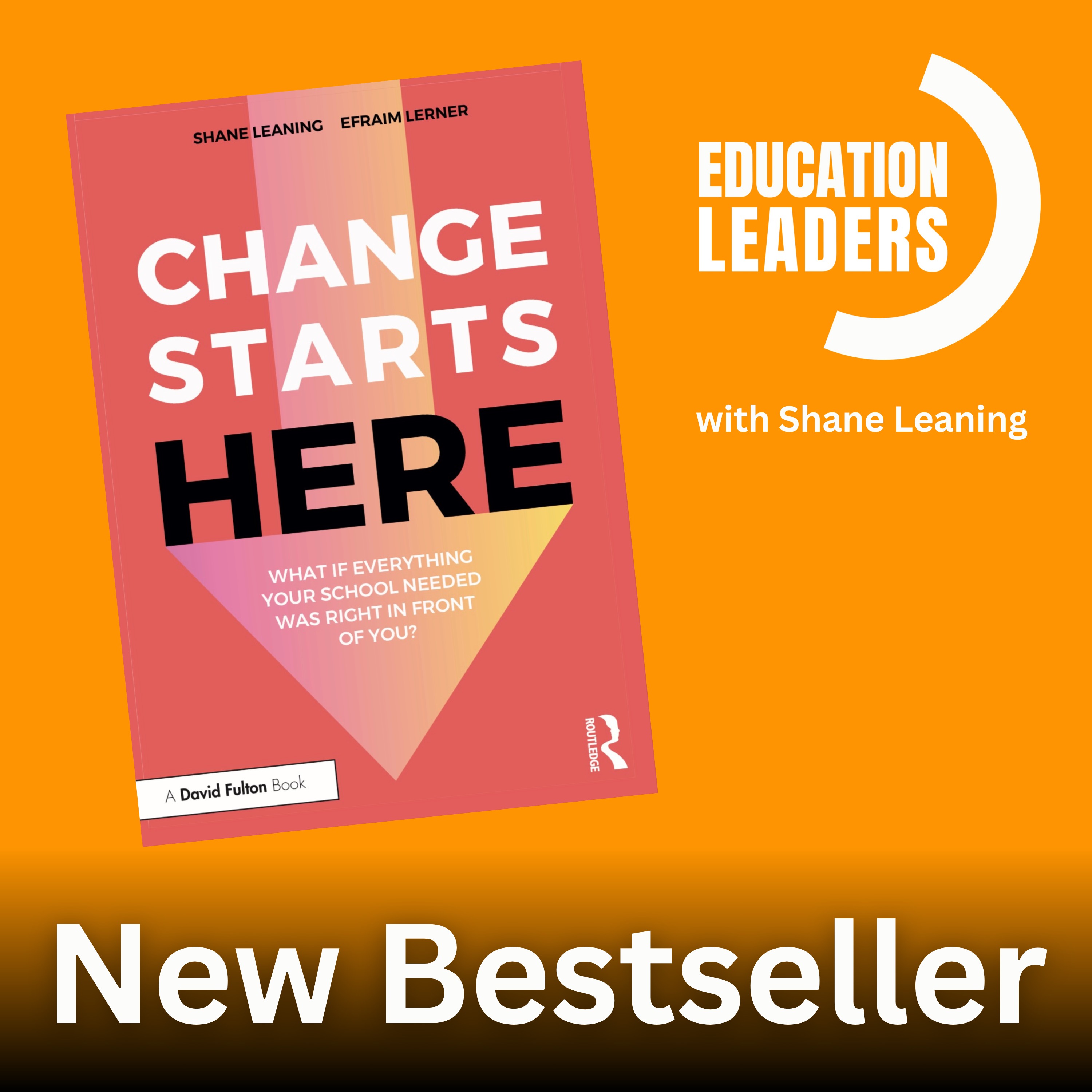
In this special episode, Shane Leaning discusses his new best-selling book "Change Starts Here: What if Everything Your School Needed Was…
Listen & show notes
A Call Across the Pond- Guest Appearance Shane Leaning appears as a guest on another podcast. Time zones don't matter when the…
Listen & show notes