
Master Your Leadership Interview Game
In this episode, Shane gets coached on leadership interview techniques by Orla Dempsey, an expert in helping teachers secure leadership…
Listen & show notes
In this episode, I speak with David Ingram, Founding Head of College at Dulwich College Shanghai Puxi about:
The International Curriculum Association: Learn more
Join Shane's Intensive Leadership Programme at educationleaders.co/intensive
Shane Leaning, an organisational coach based in Shanghai, supports school leaders globally. He is the author of the best-selling 'Change Starts Here.' Shane is a leading educational voice in the UK, Asia and around the world.
You can find Shane on LinkedIn.
We are a proud member of the Education Leaders podcast network. For more great education shows, visit educationleaders.co/network/
Hosted on Acast. See acast.com/privacy for more information.
Auto-generated transcript. It may contain small errors.
What is a trusted adult? What type of things might you share with a trusted adult? But then, of course, working with staff on, what does it mean to be a trusted adult? Hey, everyone, I'm Shane Leaning.
Welcome to Education Leaders, the chat-topping leadership podcast for school leaders, just like you. As an organizational coach, I've helped thousands of leaders worldwide to lead with greater confidence, make better decisions, and create winning teams. And on this show, we explore the strategies that are going to help you achieve your goals and transform your leadership. Now, before we jump in to this conversation, I'm really excited.
This episode is supported by the International Curriculum Association. Stay tuned to learn more. Now, my guest today is David Ingram. David is the founding head of college at Dulwich College, Shanghai Pushi, which is just down the road, so we got to have this interview face-to-face.
Now, I'm not going to tell you much about David. He introduces himself really well in the interview with a fascinating story, but he brings in this conversation great insights on creating environments where children really flourish and building systems that make sure every student feels supported. I know you're going to take so much from this episode. So without further ado, let's jump in straight to where David gives us a little taster of his history.
Well, Shane, I actually started my work in life as a police constable in County Durham. I wasn't a great police officer. I trust everyone. So when I said, did you do that?
No, I didn't. It's kind of an occupational hazard. But one of the things that became apparent to me very quickly is that I were working with young people who had tough lives and were getting into trouble time and time again and whose circumstances were conspiring against them having a successful life. I recall with great clarity a moment and it was on a raid, a dawn raid on the house of someone suspected of harboring kind of drugs and stolen goods and piling in into this house.
And there was chaos as officers were arresting people and looking for evidence. And in this young lady's bedroom, I found a set of school exercise books. And if you can imagine carnage and yet it was a moment for clarity for me because when I read through these exercise books, I saw a young lady who was bright, who had potential on his life for just taking the wrong trajectory. And that really was a turning point in me deciding to become a teacher.
And what really motivated me because of that experience in the police was understanding that young people need a safe space to flourish. They need adults who they can trust, that they can connect with, who feel, make an effort to understand them. And that's very much driven my career as an educator, both as a class teacher and then as a leader later on. So although I wasn't a very good or successful policeman, that experience was really important for me in forming, I suppose, what motivates me as an educator and my philosophy.
I did not know that about you David. And actually it's always been a dream of mine to if I didn't become a teacher, I'd have loved to have become a police constable. So you've kind of lived that dream and made the transition. But it's interesting now that your experience, you have talked about them living in circumstances and needing a safe space and that you've moved into education.
So I'm assuming from that, that you believe schools have some sort of responsibility in that area in the wellbeing of the child. It's not just parental responsibility. Yeah, I've been through ultimately as a partnership, but I do believe schools should be a safe place for children to feel valued as an individual. Often that strong sense of belonging is something that we kind of really strive for as a school here, but I'll go back to the UK and working in quite a challenging school in an area of high socioeconomic deprivation.
And it was a Christmas disco. I don't want you to have ideas of anything fancy. It was someone's tape deck at the time and some hula hoops. But the disco was to start at seven o'clock.
And I can remember going out for fish and chips after school finished. And of course it was December, it was pitch black. And although it was five o'clock, there were children lining up outside the school. And I think what really brought home to me that these kids were lining up and they had another hour or so to wait before the disco started, is that was probably as good as it was gonna get for them in terms of their Christmas experience and how important school was in their lives.
Now, I work in very different environment now. I think most international schools serve affluent and aspirational communities. And yet people lead busy lives. There could be affluent neglects.
There can just be parents working hard to pay the bills and to pay for those expensive school fees, travel a lot, you know, and think social media is something, gosh, we could get lost in as well. So school can be that secure environment. And I'm gonna talk to you about belonging earlier. I think that's just really important.
I think that's the foundation for kind of student wellbeing. And where does this fit with relationships? Is this to do with the building, the safety of the school? Cause when I think back to my childhood, actually, I was lucky that I'm one of those teachers who've gone into the profession because I also had inspiring teachers who I had wonderful relationships.
I felt very safe at home, no doubt about it. I had good wellbeing, but they made me feel safe in a different way, which was intellectual curiosity. And they made me feel excited and safe to explore that part myself. And I don't think that could have happened without one particular teacher.
It stands out in my mind. So I'd love to hear your thoughts on the importance of relationships, I guess, between children and I guess between children and adults. Yeah, well, as you can see the room that we're in, we've got a sense of shared values, which are evident visually around the school. But when we're employing teachers, when we have admissions conversations with families, when we start the year, we'll get together, we're referencing those.
And I think that shared value system, that ethos is fundamental to kind of positive relationships. I think, you know, it's the idea of, if you're gonna come into work here, this is important to us, is it important to you? It's the idea that great learning and teaching kind of starts with positive relationships. You talk to our students about what makes our school special.
The overwhelming responses my teacher knows me really well. And that could be academically. And you talked about an inspiring teacher who had curiosity as a big feature of your learning. It may be just, hey, knowing what works well for me, what doesn't, or hey, I know you're interested in this.
Have you thought about looking into this further? I think that knowledge and celebration of a child as an individual is really important. Not all students are gonna engage fully with their particular class teacher or particular subject teachers. The thing, you know, that's reality, especially in big schools.
You know, you come across lots of different people and that's preparation for life. The shared values are important about your parameters around that. What we've done is a lot of work on trusted adults. So there's been like lots of schools in the world.
We have like an annual survey and one of the questions in the survey is, you know, if you have a problem, if you're concerned about something, is there an adult that you can turn to? And look, ours were really high and I can't remember what the exact figure was. Let's say it was kind of 85%, which by all accounts was supposed to be very good. But then you think, just a minute, did 15% of our children not have an adult that they can turn to?
And that became a real catalyst for us as a key kind of student wellbeing priority was, well, how can we change this? And let's work on the basis, not everyone's gonna get on like a house on fire with their class teacher or their class mentor. So, okay, what can we do about that? So we really, really explicit dialogue at the beginning of the year around identifying students, trusted adults, and maybe having a range of those because busy schools, especially international schools, you know, that may not always be there.
And that has been transformative really because talking through that and talking through, well, if you did have a concern, how are you gonna go and see Mr. Leaning? Or has made a change? I think in the junior school now, we have 100% of students report having a trusted adult and being comfortable.
We're not at 100% yet in the senior school, but what we are finding is higher incidence of self-disclosure, higher incidence of students expressing concern around the peer, which is then leading to positive follow-up on that kind of trusting relationship and the idea we want you to have someone to go to when you're in need has been really, really positive. You have to work at it. So, you know, next August, when we're kind of starting again, it's okay, let's talk through those trusted adults again. Teachers leave peer groups changing and kind of working through that.
This is fascinating to me. So you identified a few things that stand out to me. One, that it's not realistic for every child to just instantly click with a particular teacher or every teacher that they interact with and feel that that's their trusted adult. So there's a sense of realism that you've got.
But two is you've obviously done a lot of work to make sure that these students are able to say that they've got a trusted adult. So what have you done systemically to make that happen? You say you ensure they've got a trusted adult. What does that look like?
Is that you generating lists? Like if a leader was wanting to do the same, what would you do? Great question. And I need to absolutely give credit to Natasha Dennis, our amazing director of student services, Francine Hearn, our deputy head kind of pastoral for the senior school and kind of primary school pastoral leaders as well who have done work on this with students around what is a trusted adult?
What type of things might you share with a trusted adult? But then of course, working with staff on, what does it mean to be a trusted adult around? And this is, I suppose, linked to safeguarding because some of the disclosures may be of a safeguarding nature, but about being available. And then perhaps if there are particular children who are coming on a regular basis, can you then be proactive about checking in with them?
And it leads to some interesting dynamics, you know, because do you have adults who, no one chooses as a trusted adult, or do you have adults where everyone chooses as a trusted adult? They're not all teachers, interestingly enough. They can be admin staff. And I think that's important as well.
So time and training would be the two strategies. Do you have to train the students as well to understand what a trusted adult is, or is it more just that the teachers are? Yeah, time on and training with the students around. These are the type of things you might share.
Or if you're worried about something, but then also talking about, okay, how are you gonna do that? Yeah. Because I think thinking, well, Mr. So-and-so, I really like him.
Okay, right, if you were concerned about something, how would you go and initiate that? I love this. So trusted adult is almost like a good temperature gauge for a school as well, because it's a feedback loop that allows you to understand the wellbeing of the children. But I guess, especially when we get to kind of safeguarding issues and things like that, or if there's a challenge that they're facing.
What about general wellbeing? So a lot of leaders who are listening in who are thinking, yeah, wellbeing's important to me, but where do I start? And it's not just about giving high fives to students in the corridor and putting a box of chocolates in the staff for staff. Like where do I start systemically creating a culture of wellbeing?
So we've got the trusted adult side. Like what else would you say? Your question reminds me of a colleague, Mike Connor. He said, culture eats strategy for breakfast, but you need a strategy to develop a culture that eats strategy for breakfast.
In EIM, we have an amazing leader, Sarah Tillman. She's director at Dulwich High School, Sue Jo, who's kind of led on both staff wellbeing and student wellbeing across the group. And she's worked in partnership with David Bot, positive psychologist in Australia in developing frameworks. So the student wellbeing framework covers academic wellbeing, social wellbeing, emotional wellbeing, mental wellbeing, physical wellbeing, and kind of categories.
And that's around students feeling connected, respected, and empowered. And that kind of comes with an audit tool, which is basically, Shane, an opportunity to look through those different elements and take a temperature check. And that allows a more systemic approach because I think maybe what promotes your wellbeing is gonna be different from mine. I think wellbeing is a very personal thing and can depend at different times and different ages.
And so that's enabled us as a group of schools to engage with both staff and students systematically to conduct those audits. And it's not what we scored in 2024, so we need to improve it. It's more around when we did our audit and that will be with students and staff, kind of evaluating where we are against those five categories and identifying, well, this isn't as strong. Okay, so what can we do about that?
And then leading to some changes. So if I give you some examples of some outcomes of that process. So menstrual health was one. So we've now got kind of menstrual kind of provision in staff and student toilets across the campus.
And that was a kind of a very kind of practical one. Toilets was another one around having gender neutral toilets, for one or two students who kind of felt that that was kind of more comfortable for them. To more on the social side, you're here at our campus, it's on the outskirts of Shanghai and students kind of feeling we would like more social opportunities just to hang out, not organised school activities, but they could have created a social club that has movie nights or kind of skateboard nights, which they've got ownership of, but came through that process. So as part of an audit, where do you gather the information?
What does that include? Yeah, so kind of Sarah, and I also need to give a shout out to Charlotte Ruddy from College of Singapore and Olivia Bugden from our school in Switzerland. I've done a lot of work on collating good practise from different schools. So where great things are happening in initiatives and that's going to be shared centrally from different schools to be able to access, but also where schools are challenged by a particular area, what they're doing.
But the gathering of information will be group of leaders sitting, okay, let's evaluate ourselves, how we think we're doing. Sitting down with the school council and getting the students to give their perspective and where there's dissonance between those two, that's an interesting one and the teachers as well. We will draw on survey data as well. The other element for us as a school, and this is just something kind of unique to us, is we work with an organisation, AS Steer.
And so I think if you've kind of seen Minority Report, yeah, it's a little bit like that, so it's kind of a wellbeing check. Right. And look, we've got some students who, when they're not in a good place, will be going to the trusted adult, will be going to the counsellor. I need to see you.
Or we'll be presenting like, gosh, Shane's clearly having a bad day. We've got other children who present as being perfectly fine. And AS Steer helps us identify perhaps those students who aren't banging on the door of the counsellor, who aren't showing, is struggling, and can say, this student's really not in a good place. And there may be stuff going on in the backgrounds, but they're not sharing that.
And that's also helping us understand and support children, because what it's really enabling to do is be proactive rather than reactive. Hence, the kind of link to Minority Report is we're going to think the student actually has got a lot going on left to their own devices. We could be heading to a crisis situation. So that's been quite powerful, really, a really, really powerful tool.
Takes a lot of time to set that up. Yeah, I've got to say. And a lot of time to kind of train, and it's very sensitive information. Yes.
What we have is then colleagues who've got a really specific set of kind of feedback and strategies about how to support that child, even though they haven't asked for help. But we also use that to kind of look at, okay, if there are particular trends, what's that telling us about and why the student will be? So am I hearing right, this is an application where you put as much data as you've got on the student? It's almost like a 15, 20 minute assessment, and you do it twice a year.
Ah, I see. And it uses averages to kind of make predictions. So present a profile of the student, and then students where perhaps there's potential concern here will kind of suggest strategies. This episode is supported by the International Curriculum Association.
Now I've been working with the ICA for quite a few years, but they've been around for 30 years, and they've been around championing quality, unlocking potential and improving learning in international schools right around the world. I really, really love that at their core is a model for improving learning. And this model is focused on the learning experience, and they have tons of great curriculum materials, PD resources, and even an accreditation pathway for schools just like yours. So if you're interested, and I really do recommend you check them out, head over to internationalcurriculum.com.
I'm lucky enough to work with many schools across the world and speak with many leaders. And often when they talk about a strategy, it's usually a tool is the tool that they use for something. We do assessment through this tool. We do this through this tool.
We do our wellbeing through this tool. What it sounds to me as well, two things. One, I love that you've not really kind of grounded in one particular area. You're getting information from a lot of different places, and you're not relying on one place just to pick up information, which I imagine is a lot to do with the success, because we can sometimes get obsessed with a system or obsessed with something and not look.
But also this episode, there have been more shout outs, I think, than any other episode that I've done, which speaks to a collaborative and importance of collaboration. Well, very much so, and look, that holistic approach. And again, that is total kudos to Sarah Thielman, but David Bart, we invested in that time with David, and he brings an expertise, and it was deliberately holistic, because again, wellbeing works in different ways for different people and to be very intentional about that. I think the other thing that we've come to, wellbeing was a strategic priority for us as an organisation and for us as a school, but then the realisation, actually, now it needs to be a strategic commitment.
You can implement the wellbeing framework and the audit tool, but next year, wellbeing will still be an issue because a human organisation said the idea, this is about a commitment over time to a range of practices. But I think the work that Charlotte and Olivia are doing is really important because it's sharing successes. One of the things I'm very interested in is our kind of colleagues at Knowledge Beijing are, if you like, tagging their kind of pastoral information on ISAMS around the different areas of the wellbeing frameworks, and then when they've got the data board, that's giving them some big data around student wellbeing, and we hadn't even thought of that. We just thought, wow, that's really interesting, because again, that enables us to make better decisions about supporting students and them planning ahead.
Yeah, it's nice to hear that you're thinking long-term about this, because we know schools couldn't be thinking about school development plans, and they have their cycle, and this is a priority now, and this is going to be the priority, but as you rightly say, wellbeing, you can't let the ball drop. If it's your priority this year and it's not next year, then what does that mean? Because you're going to be presented with new challenges all the time. That's really interesting.
So I want to speak to you about smartphones, because I know you've got some thoughts on this, and everyone's talking about it at the minute, so this would be really useful. But before we touch on that, if you were speaking to a leader who was just about to go on a bit of a wellbeing journey, and they just wanted to start to think about that, do you have a place where you'd advise them to start thinking about? Well, I had to spend some time with David Bot, because he was really informative with us, and I think his website and his organisation, that was kind of very powerful. Sarah Tillman and I read a range of books as well, which I can't recall at the moment, but we did a lot of reading around it.
I think what was really, really important is that the process of developing the frameworks and the audit tool was very much bottom-up, so that it was seeking input from staff, from students, from parents, so that it was meaningful, and that would really recommend engaging with a range of stakeholders to get an understanding of what wellbeing means to them. That makes a lot of sense. I think sometimes as leaders, our initial idea is like, if we've got a challenge to solve, is to go out there and look for a product that's gonna make it, because we're so busy, just let's go look for something. But what you're saying is actually, get a bit of understanding through speaking to people, understanding through reading and doing your research, maybe engaging with good organisations like David Bot.
We can link to his stuff in the show notes as well, so that people can find that. Okay, so let's finish talking about smartphones. So debates raging around the world at the minute in the UK already, kind of, are they gonna hand smartphones across the country, are they not? There's people who've got varying opinions, and I've seen schools with different levels of success doing slightly different things, so I'm interested, what's your position?
Well, I've got to be really honest that I can't provide the answers necessarily, and we're a bit of a contradiction in that we're kind of a very innovative score in the use of AI, kind of won awards. Tech has woven through the curriculum from kind of early years up to senior school, where we have kind of AI bots supporting students who may be challenged in terms of their organisation on meeting deadlines. We scrapped my GCSE computer science to replace it with a project about using AI to kind of solve a problem. We took a group of teachers and parents to Alibaba to kind of learn about that working environment.
Next week, we're taking a group to Ding Dong, the kind of food distributor, because their use of AI is phenomenal. So we're very innovative. That is the way of the future. It's really important that our students are engaging with this in a meaningful way and are using AI successfully, engaging with the world around them.
That said, the reason why we're a contradiction is we are quite conservative. If you drop into our senior school restaurant at lunchtime, no one will be on a phone. Students are permitted to bring phones to school, but they're not allowed to use them until the end of the day for getting home. When we go on residential visits, they're not allowed phones.
They may have a 30-minute window to call home, but on the bus during the day, no, they're not. And sometimes we get kicked back from that with the students. So we kind of think both are important. We think it's important to engage.
I think it is important that there are parameters. We have relationships, because we restrict the use of devices and we're kind of buy-in to that. We don't have much challenge enforcing that, but we're conscious it's an ongoing kind of tension. I think education has got to be the way forward because one of the realities, and we've got alumni in visiting this week when they get to university, on their own device bands, they need to be able to get through their course, meet the requirements, socialise, have a healthy life coexisting with their devices.
So I think it's important that we're preparing them for that. And it's about getting the balance right. And the reason I took parents to Alibaba and I'm bringing them to ding-dong, and we get them in to kind of have a look at what's happening in some of our ed tech spaces because I want them to say and be part of that journey. And I think that's kind of really important.
It's not an easy subject. Yeah, I mean, what does that mean? Do they drop their phone in a box on the way in? They just know that's the rule and they keep it in the bag.
Keep it in the bag, keep it in the locker. Okay, like that works? Yeah. Wow.
Now, are you going to tell her mate, we don't get students somewhere sitting in a toilet? Look, I don't know. But it's not a big issue for us. Maybe that's the benefit of being in a smaller school around that, but you can go in at lunchtime or after school, you've got students interacting with each other.
I do think parameters are important. I'm not sure of like total bands, how, and again, that's kind of turning educators into policemen. What I do think is important is to be proactive in a different way is schools must provide students with amazing firsthand experiences so that we haven't got time to get on our phones because we're off to play football or we're going to production and we're really engaged with that. But we're on a residential visit and it's so much fun being together.
I'm creating and it kind of goes back to relationships at the starting. This is a positive vibe. I don't need my phone. Yeah.
And I think that intentionality about curating that is important. Yeah, I think that's super important. I'm almost hearing like three things that are coming through from what you said is one, sometimes when people talk about phone bands or an anti-phone band or anti-phone restrictions, they say, but it's living in a tech world in the future. What I'm hearing one is that actually your school is incredibly invested in providing value in that space.
And you've listed all those different brilliant ways and you've won awards in that area for that reason. So it's too much of a simple argument that saying just allow a student to have their phone on them while in school means that they're going to be really great with technology. You're doing that in different ways, I guess. Yeah, very much so.
Yeah. But what it sounds like the point of your rules here is to link it back to wellbeing. There's a degree you have to protect their experience. And I guess having a phone in school is one way that it makes it potentially less safe for them if they're in a learning experience but there's some other narrative going on that the teacher's not aware of.
Yeah, I think so. And that itself raises the whole issue of where something's happening online, out of school. Yeah. But the impact of that is felt face-to-face in school.
And that's really challenging for schools to deal with. Yeah. And that's something we spend time on in terms of what are the responsibilities. But I think working with parents as well to understand that and support them, we spend a lot of time practical.
This is how to put time limits on your younger child's devices. That's good. Age restrictions so that they're aware and empowered because I think it's a very different world for the parents and supporting their children through it. Yeah, everyone's having to just try the best to keep up with what to do because it's also new.
So it's nice that the school has some level of responsibility or some level of support to the parents to help them to know what's available, how they can make good decisions. It's not about the school telling them how to parent at home, but it's giving tools, right? Yeah. And there are dialogues around this year.
We, as a result of a parental complaint, removed one of the maths apps that we were using in year two. And one of the parents said, it may be great in school, but when they come into a non-educational environment, they're like, in-app purchases, and I feel that I'm being pestered. You know, that led to a dialogue. Is it appropriate for children of this age?
That led to the removal of that app. So I think it's also important when something is deemed to be inappropriate, the acts on that, that we're not kind of dogmatic. No, we believe in technology. Yeah.
We do talk about the dangers of sex extortion, sexting. You know, those are quite uncomfortable conversations, both with students and with kind of parents as well. We've got a student who's just been offered multiple scholarships to kind of art and design schools in the US for an amazing AI animation, which one university said, I'm not sure we've got anyone on our team who can take you much further than this. So celebrating that with the parent community as well is, yes, there are challenges about if your child's in a video game rather than doing the maths homework, but equally, there are real opportunities that come through this.
And we do have to educate children and support them in being able to find that balance. And I think some of the simple approaches to it where we'll just ban it, there's a danger, perhaps, that some of those approach don't allow for that gradual, what I would call kind of scaffolding education around. I'm gonna have to live with both because you're gonna be going off to university and no one's gonna be there to say, you can't use your phone now. That's the reality, isn't it, of the world?
What I feel like I'm picking up from this conversation is would it be right to say that you feel like this decision needs to be made locally at the school? Because some governments are saying, let's legislate and force every school to follow a very specific policy of phone bans. But it sounds like you've got quite a nuanced policy that's evolving here. To me, it sounds like there's a strength in that and you having decision-making power in that regard.
Yeah, I think we've got a set of parameters that works for our community. They may not work in a different setup, let's say in a larger school or a school where lots of children do have devices which are used during the school day as well. People are very emotive about the age of students in terms of one-to-one devices as well. And I do think that's pending on with the school.
So I do think a nuanced approach is important. I think there needs to be clarity around what the expectations are and there needs to be then kind of buy-in and support from parents, staff and students around them. David's journey from police constable to school leader, I think it really highlights how creating those safe spaces for students can really transform their lives. I love how his score has taken this systematic approach to wellbeing.
Well beyond those superficial initiatives we might be used to hearing about, that focus on trusted adults, that's really brought incredible, measurable results on students having someone they can trust and turn to. I love that wellbeing framework. I think it's really compelling and super holistic. And David's point about wellbeing being a strategic commitment rather than just a strategic priority is something every school leader should take note of.
If you're interested in exploring these ideas a little further, I've included some of the links that David mentioned in the show notes and also a link to where you can connect with David online. Education Leaders is hosted by me, Shane Leaning. Thanks so much to the show as Pete McGill and for the original music by Guillermo Silva. Thank you so, so much for tuning in today.
And as ever, if we don't speak before, I'll see you here next week. If you wanna learn more about the brilliant work from the International Curriculum Association, head to internationalcurriculum.com.
In this episode, Shane gets coached on leadership interview techniques by Orla Dempsey, an expert in helping teachers secure leadership…
Listen & show notes
My guest today is David Harkin, CEO and Founder of 8billionideas, which has impacted over 500,000 students in 26 countries. David is a…
Listen & show notes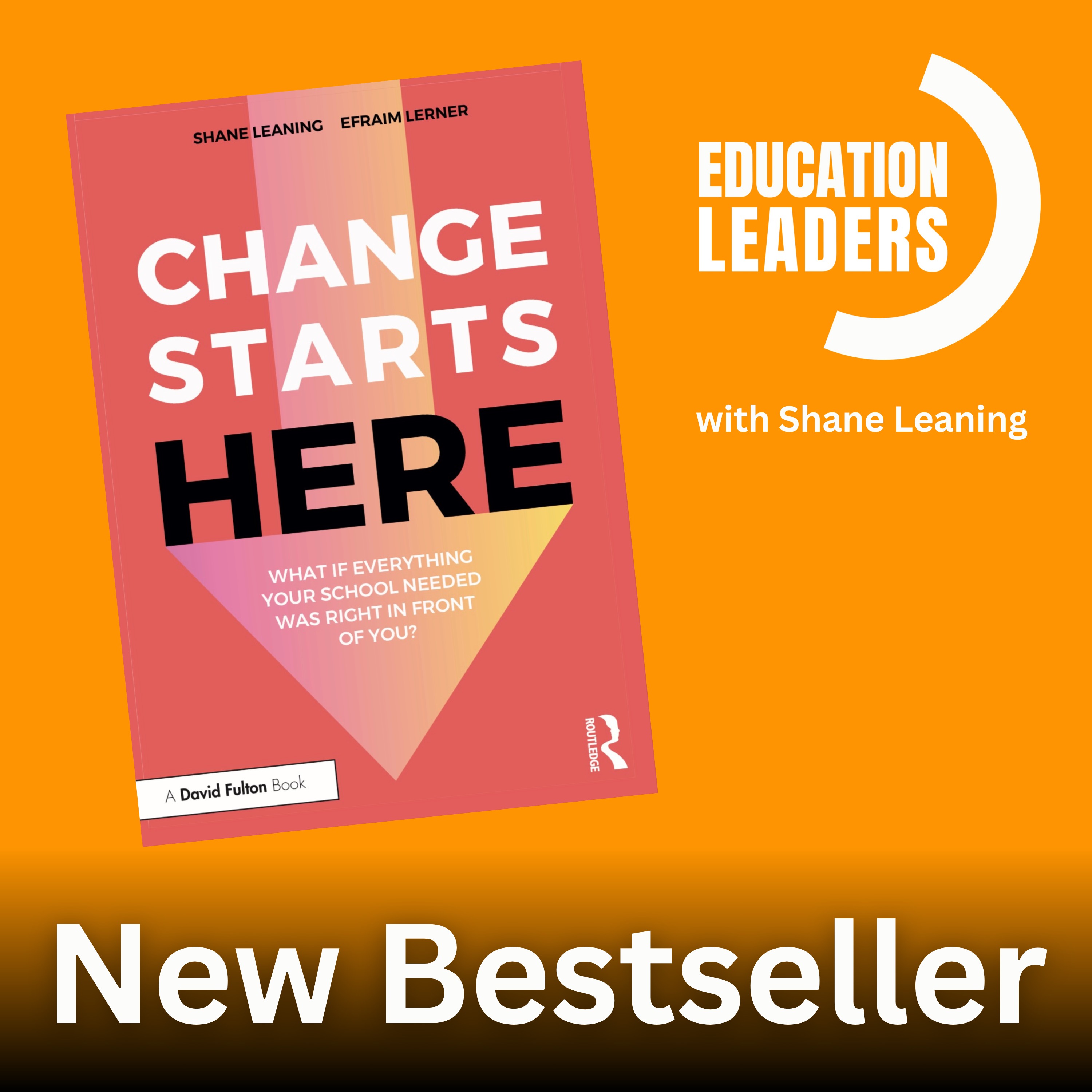
In this special episode, Shane Leaning discusses his new best-selling book "Change Starts Here: What if Everything Your School Needed Was…
Listen & show notes