
How to Lead Without Being Needed | A Conversation with Brett Griffin
What happens when you take a school leader who's used to timetables, structure, and constant visibility, and drop them into the chaos of…
Listen & show notes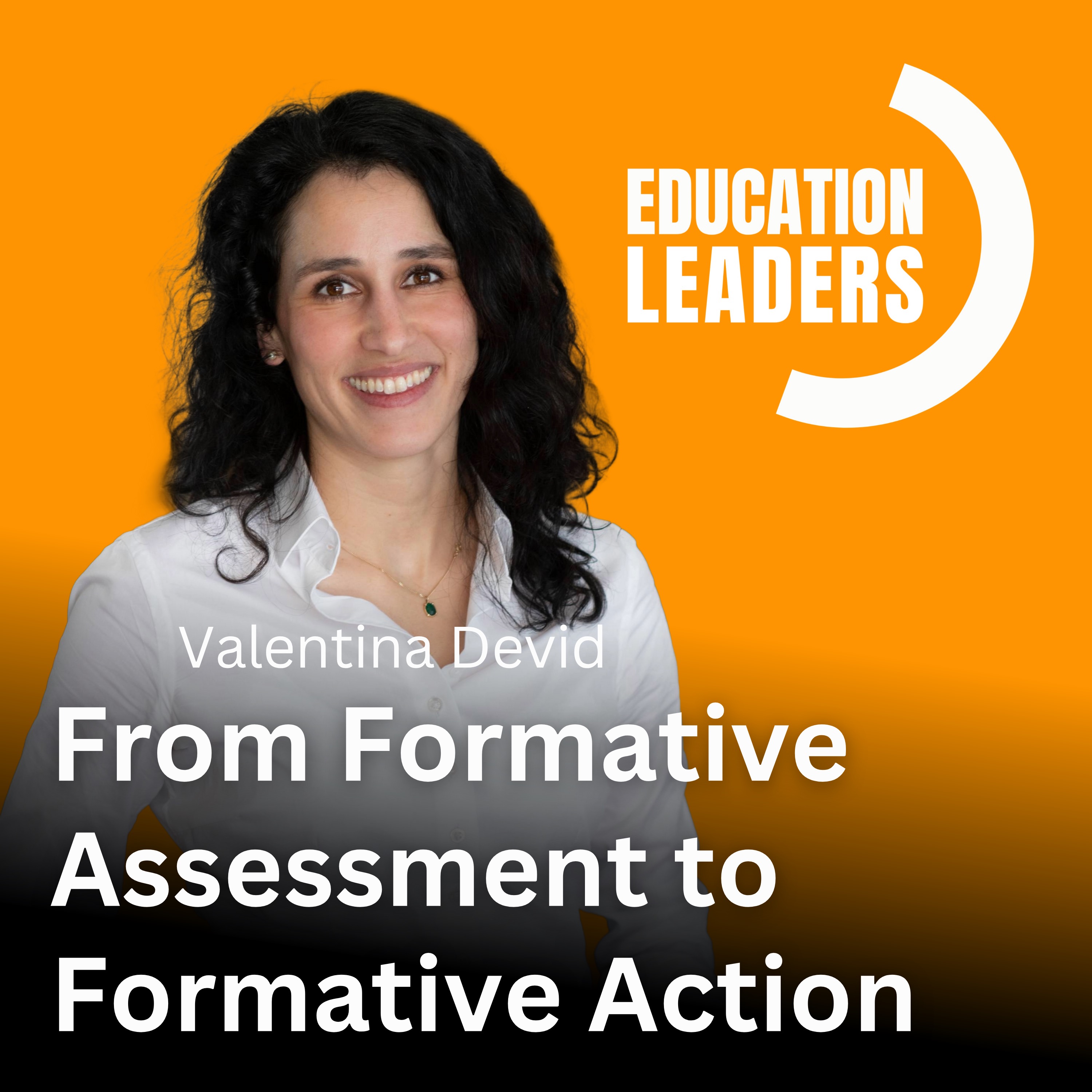
This conversation dives into what formative action is, why Valentina Devid and colleagues reframed formative assessment as an action-oriented practice, and why that reframing matters for school leaders trying to get useful classroom evidence turned into immediate, high-impact teaching moves. Valentina walks through the five-step action-oriented investigation process (orient & predict; think & generate; interpret, communicate & decide; informed follow-up; verify, reflect & predict), gives concrete classroom examples (history teachers checking the five causes of the First World War using mini whiteboards), and warns about common “mutations” — for example, when formative work is dumped into a learning management system as a grade with zero weight and loses purpose.
You’ll learn practical, leader-level actions you can take this term: how to check whether teachers are acting on evidence (not just collecting it), how to coach teams to set a sharp investigative focus so one question gives clear next steps, and how to avoid the three common implementation traps Valentina names (tool-focus, data overload, and handing premature decision-power to beginners). They discuss specific routines you can request in lesson observations (orient & predict statements, mirror questions for verification). Shane and Valentina give examples of immediate follow-ups you can expect to see in a classroom after a formative action check. If you want a straightforward way to tighten assessment practice so it actually improves learning, press play.
Resources & Links Mentioned:
Formative Action: From Instrument to Design — book page (The Formative Action School)
The Formative Action School (Toetsrevolutie) — main site
Hachette Learning — “Formative Action: From Instrument to Design” (publisher / buy)
OliCav — Oliver Caviglioli (visual designer of the model)
Inside the Black Box — Paul Black & Dylan Wiliam (PDF)
LLEARN Podcast (Valentina with René Kneyber & Flemming van de Graaf) — show page
Valentina Devid — LinkedIn profile
Episode Partners
International Curriculum Association
Join Shane's Intensive Leadership Programme at educationleaders.co/intensive
Shane Leaning, an organisational coach based in Shanghai, supports school leaders globally. He is the author of the best-selling 'Change Starts Here.' Shane is a leading educational voice in the UK, Asia and around the world.
You can find Shane on LinkedIn.
We are a proud member of the Education Leaders podcast network. For more great education shows, visit educationleaders.co/network/
Hosted on Acast. See acast.com/privacy for more information.
Auto-generated transcript. It may contain small errors.
Teachers collect loads of information about student learning, but then what? If you're not acting on that information, you are missing the entire point, and today we're exploring why formative assessment might need a complete rebrand. Hey everyone, I'm Shane Leaning. Welcome to Education Leaders The Chat, topping the leadership podcast for school leaders just like you.
As an organisational coach, I've helped thousands of leaders worldwide lead with greater confidence, make better decisions and create winning teams. And on this show, we explore the strategies that are going to help you achieve your goals and transform your leadership. This episode is supported by the Teacher Development Trust and the International Curriculum Association. Stay tuned to learn more.
My guest today is Valentina Devitt. Valentina is a teacher researcher. She's co-author of the book Formative Action, which has taken the Netherlands originally and the world since by storm. Valentina spends her time focusing on helping schools crack the code on something we all think we understand, but often get spectacularly wrong.
Formative assessment, or as Valentina would say, formative action. And these conversations are really challenged by thinking on what we're actually trying to achieve when we check for understanding. So let's jump right in. Formative assessment, as we know it has challenges with implementing it effectively in the classroom and that the goal was really, you know, you really use it as you're supposed to and that it has the effect that you want to.
So we saw in the Netherlands, just like I think you see in a lot of other countries, formative assessment can be misunderstood as tests without grades. And also the word assessment carries a lot of baggage. It led teachers to focus more on tools or on tests and not on the pedagogy. And I think by renaming it or reframing it, actually, by changing the word from assessment to action, you really put a lot of emphasis and focus on that teachers and students have to act upon the information that you collect.
So I think that's one aspect that we changed. And we really saw also that it improved the way that people talk about it and think about it in the Netherlands, and that really helped us. And we also did something new. So we made our own professional development program for teachers around this.
And we really think that it works well. And we see that teachers use formative action very effectively in the classroom. And we also try to clear up the concept because we also saw that teachers were struggling with, you know, what is it precisely? Sometimes teachers find it a bit vague or hard to get a grasp on.
So what we try to do is to talk about it as three core strategies. So one is the action-oriented investigation process. That's the model, the sense for quality and organizing feedback processes. And all the three strategies have their own specific goal that you aim for.
And by explaining that to teachers, we saw that it really helped for teachers to reflect upon their own lesson series or their curriculum upon their education and think, okay, what do I want to achieve here? Do I want to check for understanding? Is that my main goal here, my pedagogical goal? Or is it more about making sure that students know what good quality work looks like?
Or do I want them to create more independence for my students, so make them more independent? So I think what we also did was connecting the pedagogy of formative action more to constructive alignment. And that's also a very important part in our book, is that it's not just pedagogy. Because if you just think of it as pedagogy, what we also saw that teachers do is focus on the tool and on the instrument.
Okay, so if I use Padlet, or if I use the mini-bikeboards, or if I use something, name some tool, and I use that, then I'm doing formative assessment or formative action correctly, you know, check the box. But it's not about that. It's about, you know, you want it to be effective and goal-oriented, interwoven in a right way in your curriculum. And you have to help teachers also think as a designer, of an educational designer, to really reflect upon how your curriculum is built up.
And when in your curriculum, or in your lesson series, or in your module, is it the right moment to use the three different strategies? Two things that I'm thinking at the minute. One, I'm just so thankful that you did this work, you know, in the Netherlands, and then you have translated it, you know, into the book in English, Formative Action, and gifted this, because it sounds like a little bit, the context in the Netherlands, with formative assessment, has had similarities to China, where I'm based, where that word assessment, people have gotten so obsessed with that word and cannot unlink it. So like, they're almost attaching the word formative, which is that important word, to their assessment systems that they already do, and trying to work that out.
And so many schools I work with go into, and we talk about formative assessment, and they show me these things. A common thing is, okay, yeah, we do formative assessment is our homework, for example, where how we assess that. Our formative assessment we have is a 15% of our entire grade, and we add up the formative with the summative, and we make the grades, or all these kind of areas where schools are really trying to utilize it, but have really kind of gotten obsessed with that word. It sounds like something similar was happening in the Netherlands, right?
Is that what you were alluding to? Yes, definitely. And we also saw whole schools immediately overnight saying, okay, we're not going to give grades anymore. We're only going to do a formative assessment, a formative action.
But then at the same time, they did like a lethal mutation. They said, okay, all the tests will have a grade, but with the weight of zero, if you translate it very directly from the Dutch context. So it was graded. It was put in the learning management system, so for teachers to see, for parents to see, for the students to see.
So the students were like, oh, I got these tests for French, or, you know, something, geography, and I got a six. We have like one to 10 system here. So I got a six, but it does not count. Or I got a four, and it does not count, because the weight that is put onto the grade is zero.
So what does it mean? And it was a horrible situation for lots of teachers in schools because teachers were going crazy. They were saying, okay, I have to do all this grading and all this testing, but for what? So the lethal mutation was, you know, was immense.
It got just whole, the whole concept got wrong, because it's not about assessment. It's not about not grading. It's about pedagogy. It's about checking in the moment, checking in the learning process where your students are, really specifically collecting information.
So that's also a reframing or refocusing that we do in the Netherlands. It's not about collecting as much information as you can, because if you collect too much information, you make it very difficult for yourself because you have to interpret all that information. That takes a lot of time. It's also harder to then decide quickly what to do with all that information, because you will see that, like, let's say a third of your students got the concept, the other third of your students didn't got the concept at all, and the other third got it, you know, half, but all in a very different way.
So it's, again, really difficult for you to act upon the information. So what we also say in our book is that you have to create a focus. You have to be very specific to search or investigate, like, a typical misconception or specific aspect of knowledge that you know as a teacher in your curriculum build up or in your curriculum. That is very important that my students grasp and know that concept, because if they don't, then I cannot move along, you know, I cannot move further, or I cannot build upon that.
So we try to make teachers think in a different way, like, what type of information is very necessary now at this moment to collect that I need to check, because if I don't check it, you know, it will make it more difficult for me and for my students to move along in the learning process. And that can be just one question, that it is better if it's just one question and not 10 or 15. I think the way you explain in this to me is just what's really useful about the timing of the work that you are doing with Formative Action and the book is that you are just trying to, let's just bring it back to the why. Let's just help teachers to set goals and understand why are we doing Formative Action?
What am I trying to achieve here? And it's kind of threaded throughout the work you do, like, by almost asking that question and getting clear, you can simplify some of these complex narratives that you might have in your head around what formative assessments is. Any listener, I'm holding up the book if you're just listening to the podcast, because if you get any book this year, get this book, Formative Action, because for one, it's really quite a nice, thin book. And I think this is one of the most problematic parts of education is we all have these wonderful books that are out and there's lots of information out there, but for school teachers, for school leaders, to digest all of this information, it's no wonder we have lethal mutations all over the place, right?
There's just so much to try and understand and learn and then implement in your practice. And what's really quite wonderful about this timing of you bringing this is you start to just add some clarity and you certainly gave me some clarity. So I wonder if we could talk about that framework because it's based on or it starts off with a model that you've got, a five-step framework. Would it be okay if we kind of just went through that?
Yeah, of course, of course. So the model is a visualization and Oliver Kavliogli designed the model for us. And I think it's also beautifully done. And the model is used for the strategy that's about checking for understanding, for checking for prerequisite knowledge or misconceptions.
So that's good to know because we want teachers to really think very thoroughly about it and not just doing it because you have to or you don't want it to be a trick. That's sometimes also the feeling that teachers have in the beginning when they start learning about formative action that it feels like a trick because you're not really sure and clear on what you're doing precisely. But when you go along a bit further and you grasp the concept better, then you get a more better feel of actually what you're doing. And you have to be very goal-minded and check for understanding very precisely.
Can I come in on that, Valentina? Because what you just said is really, really interesting to me. So I think a lot of things happen like that in education. When you learn a good technique, you have to go through a bit of a moment of discomfort, of a bit of unknown and almost like a learner goes through in the classroom really, like where you're a bit uncomfortable and you're a bit like, I'm not quite sure what I'm doing here, but you have to go with it, play with it.
And eventually something starts to click and you go, I get it. What's interesting about you saying that is I think sometimes in education, we try to codify so much at the beginning or whatever to try and make it easy for an understand and forget that actually there's a journey that a teacher has to go to, to learn something. I just really liked how you framed that. Yes, we can do the whole podcast on that specific topic.
We give so much PD. And what I'm really fascinating about is how teachers learn. And you see so many similarities with just how students learn. So I guess it's just how people learn, but I totally agree with what you just said.
It's a phase. And most of the time, it's the first phase where you feel discomfort, where you feel insecure. You don't really know what you're doing. You don't really know how to anticipate on what's going to happen in the classroom.
And for some people, for some teachers, they're more okay with that phase. They can accept that more easily. And for some teachers who like to have control, and they find it very hard to accept that phase. And I also try in my professional development that we do and facilitate is to help teachers go through that phase and also give subtitles to that, to tell them like, this is okay.
It's okay if you feel insecure. It's okay if it feels like a trick in the beginning. It's okay, but it will pass. It's very important that it will pass and that you get a better grasp of what you're doing and that you see more and more that it's goal oriented and that you can use it effectively because it's not supposed to be feeling like a trick or something that you have to do because of your school leader has told you that you have to do it.
So we have the five step model, which we call the action oriented investigation process. We actually renamed it also to help teachers use it better and utilize it the best way. So the first step and the first step, I think immediately is one of the most important steps because the first step is something new. I think you don't find the first step in other models because you could ask us, why another model?
And especially in the Netherlands, there were already a couple of models going around also from other Dutch researchers. So people asked us like, why another one? But I think of course that we made it better but let me try to explain why I think that. So the first step it's called orient and predict.
And this step is a mental step for you as a teacher. And we really saw in practice and again, we try to crack the code about it not being just about the tool, not just being about checking the box. I did the assessment and then it's done. So in the first step, you as a teacher have to really think, where am I now in my lesson series?
Where am I in the learning process of my students? And what am I curious about? So what do I want to check? What do I want to investigate?
I really love the whole concept of investigating the learning process of your students because I really think that helps you creating the right construct in your mind or in your head. Like it's about a research. It's about investigating your detective. You want to know what's happening inside the heads of your students because that's the black box, right?
That is what Dylan William calls also inside the black box. So you have to be curious about that. And then at the same time, you're going to make a prediction. So because you're a teacher and you're an expert in your subjects and hopefully you also know like, okay if I teach this and that subject or this and that concept then I can already predict that lots of students will have this and that misconception or link A to B and that's not very useful if they do that.
Or you know, all those expertise that you build up during the years as a teacher and that expertise is actually immensely helpful to use with trying to make the right prediction. So let's make it more concrete. So I was a history teacher and let's say I'm teaching about the first world war and then I can think about, okay it's very important that my students know the five causes of the first world war and my prediction is that they will forget about, I don't know, let's say one cause because that's a hard one or that's a more abstract one and that's always gives problems. And because you as a teacher have to be thinking before you're doing something in the classroom it really helps you act when you see all the mini whiteboards in front of you or you see all the answers coming in on Padlet or another tool or just fingers in the air or whatever you're doing because it can be a very startling moment.
You know, when you see all the answers and you're like oh my gosh, what am I gonna do now? And then what we also saw a lot that teachers went along with their presentation they didn't act upon the information at all. Just passive, like just kind of going along with it. Yeah, so they saw the information and they were like, ooh, I don't know what to do now.
And then they just went back to their program that they were already having set up. So they just went and going through their PowerPoint and not acting upon the information. And that's of course the whole key concept here is that you have to act upon the information that you collect. So in the first step as a teacher have to think of what do I want to know being very precise with what is then the right question to ask?
What am I curious about? What am I prediction for that question? What do I think that they will answer? And also to make it a little more complicated when do I think it's good enough?
So what is the cutoff score? With what amount of good answers will I decide to move along or go further in or with what type of wrong answers how do I want to act upon that then when I see them? So by being really explicit about this first step we see that it improves how teachers use the formative action model and how they use formative action in the classroom. So that's only the first step.
This episode is supported by the International Curriculum Association. Now I've been working with the ICA for quite a few years but they've been around for 30 years and they've been around championing quality, unlocking potential and improving learning in international schools right around the world. I really, really love that at their core is a model for improving learning. And this model is focused on the learning experience and they have tons of great curriculum materials, PD resources and even an accreditation pathway for schools just like yours.
So if you're interested and I really do recommend you check them out head over to internationalcurriculum.com. Today's episode is supported by the Teacher Development Trust. TDT's associate qualification in CPD leadership is so perfect for international school leaders.
It's fully accredited and it's delivered online over 10 months. In it you'll create an actual CPD that's Continuing Professional Development Strategy for your school based on research that shows well-planned PD improves pupil outcomes and teacher attention. And I actually did this program myself and hands down is some of the best professional development I've ever done. So much so that I am delighted to be co-delivering this special Asia cohort which starts in November.
If you wanna learn more, go to tdtrust.org or click the link in the show notes. I work in the leadership space mainly but it's similar to when I'm working with even just with a leader going, okay, well you need to have an idea of where you are and some kind of theory of action of what may happen in the future which will help you orient with what actually happens when it comes. So you don't kind of get lost.
Exactly, as you don't get lost and you don't know what to do because that's the whole aspect here. So that's the first step and then the second step that's about making sure that all the students have to think and generate. So we have golden rules or you can also call them like success criteria and you can put them beneath or connect them to every step of the action oriented investigation process. And the second step is about then asking your question, doing the mini whiteboards or collecting the information of the learning process of your students.
And we also put an emphasis is that you use the testing effect or the test effect or you make it a good quality retrieval practice. So all the students have to think for themselves not with their books or not with their notes and they cannot talk yet because we want to make sure that they remember the information from their long-term memory to their short-term memory and that's a desirable difficulty in itself. So that's really important here and then you have to make sure because you want to know what's happening inside their head. You want to know what's happening inside the black box.
So everybody has to generate also an answer that's observable for themselves, for students themselves and for the teacher. And you can do that in so many different ways, right? I think this is the idea and something that you keep saying throughout the book as well even when you're talking through ideas is there's so many different ways to do this. Yeah, and what we try to do also in our professional development is not immediately put it too much emphasis on the working methods or how you do it because teachers can be, and I don't blame them, but they can be very practical oriented.
They really want to know how am I going to do this? But at the same time, there's a risk that it becomes too tool oriented and you don't know what you're doing anymore. You don't know why you're doing it. So we try to always balance that out to keep enough emphasis on the why and at the same time also have enough time to look at the practical stuff.
Okay, how do you use the mini whiteboards then effectively in the classroom? How do you create good routines so that all students participate in the right way, you know? That's great. It's so, so important, isn't it?
That balance to get that right. And I know myself just leading workshops, sometimes teachers say, no, just give me a strategy. Just give me a check. And you go, well, I could, but we need to set this within a context.
Otherwise you're just going to use a strategy. Exactly. Yeah, that's always a challenge. Okay, so what's next?
We're getting to a really meaty important part, right? Yes, so the third step is about then you collected the information and then what? So that's the interpret, communicate and decide step. So you interpret the information that you have collected.
You communicate also on the information and you can say, this is the place also where you can organize feedback. So you can also ask deepening questions of your students like, okay, you chose answer option A, can you explain why you chose A and not B? And so there's the place when you talk as a group or talk as a whole class about the information. It's also a bit of a reflection, like, okay, what's happened now?
You know, where are we? And it's a place where you do some sense-making as well. And then somebody has to decide how to move further, how, what to do. And this can be a co-creation, so you can talk with your students and say like, what do we think is the best next step for us?
But also in the beginning, and I try to advise that when teachers are learning formative action, that it's very key that the teacher decides how to move forward. Because if you already let students decide for themselves in the uncomfortable phase, we talked about earlier, there's also a risk that you make it too difficult too soon and that you as teacher also don't have a success experience. Because if you let students decide what to do next, there's always a risk that they decide wrong because they're students and they don't oversee the whole learning process and their self-regulation also comes into play. So I advise teachers then when you're just starting up with formative action that you decide what to do next, that you say, okay, I think it's best now if I do some re-teaching or let's put the class into groups, let's say, okay, you're group A and you all had the right answer, you can move along, I have more difficult assignments here, group B had a more difficult time, I will do some re-teaching.
So you can do anything again here. As long as it's logical what you do, what you decide to do next, and it's an informed follow-up action. That's the next step of course. But step three and four are very tightly knit, they're really interwoven.
So you look upon the information, you interpret it, you could talk about it and then you decide what to do next and you do it. And preferably you do it immediately. I like how you just talked through the teacher having the confidence to direct and decide the next steps because I wonder like in your experience, have you seen interpretations of formative assessments? Sometimes a lot is given to students in terms of decision-making power within it and that might be one of those mutations if you like, that sometimes then all of a sudden when the teacher's not actually able to direct it.
Yes, exactly. So what the risk I think here is that of course we want students autonomy and student choice and student voice, all those things, we want that to improve. And when teachers have that in the back of their heads and they look at formative assessment, they then will go on that road and will say, okay, I did the assessment and now you decide what to do next. But the difficulty here is that students in most cases are still a beginner and beginners have a very hard time deciding what a good follow-up step is for themselves because they don't oversee the whole lesson series.
They don't oversee the whole concept or the whole construct. So for them to make a very high quality decision of what to do next is pretty difficult. So if we actually over-ask them a bit and then the risk is that teachers get disappointed and say, see, it doesn't work. That's what they will say then.
And then they will say, because I see that my student did not make the right decision of what to do with a formative assessment. Now I am disappointed with that result and I blame the concept of formative assessment or formative action. I will say, you see, that's why it's not working. And then you have actually a false causality effect.
It's not the right causal effect. It's something else. It's that students who have always a hard time deciding what to do next. And they'll say, yeah, that's what I meant.
You know, when they look upon their own answer and say, yeah, it's almost good. The right words are in it. That's what I meant. And they will say, yeah, I got it right.
But that's not what you want as a teacher. Yeah, I so recognize that. And that difficulty I feel in that process is normal. I like how you put that.
That students maybe are not ready by nature that you're teaching them something new. And for me, it's just bringing up this idea, I imagine. The more you engage in directing these steps, the more metacognitive skills that the students are developing and starting to kind of develop an understanding and a schema of what these next steps start to look like. I can eventually go, I think I could start to figure this out.
But you've got to scaffold that. Exactly. And that's also what we do in our professional development is first just getting a grasp of the three strategies and just experiment with that. And when they get that a bit, then we go and zoom out and look at like a whole lesson series or a lesson plan.
And we try to think of all the scaffolds and say, okay, maybe you do a very teacher-directed affirmative action process or five-step model in the beginning of your lesson series, but that's okay, because then students are still a beginner, but you want to make sure that you scaffold it and that you don't keep the teacher-led process too much, because then you will not make them more independent learners. So we let teachers make mind maps to visualize for themselves their lesson series and how they will build in that scaffolding process with formative action. Yes, I love that. Okay, so we're going through the process when orient and predict, then can generate, interpret, communicate, decide, stage four, informed follower, and then how does it close out?
And by the way, I love that your model is not a cycle. Me and my co-author, we talk about how many cycles there are in education, and I think sometimes everyone feels the need to put everything into a cycle every time. I love that you recognize that because we talked about it, my colleague and I, and we decided not to make it a circle because cycle implies that you come back to the same point as where you started. And that's not the case here.
You have to be further along in the learning process. You don't have to be at the same point you started. Yeah, you hope so. Maybe that's the problem in education where people talk about the cycle of things happening.
We're just obsessed with cycles. Anyway, I like it. It's a nearly straight line with a little bump in the middle because stage three is so important. Yes.
So the fifth step is called verify, reflect and predict. And it's about actually verifying if your informed follow-up action actually worked. So let's say you did some re-teaching or you let your students practice more with a certain aspect. You still not know for sure if now your students really grasp it and really grasp the concept, or if they can really do it themselves.
So the fifth step is actually what we also sometimes call mirror question. So it's a similar question as the question that you did in step two with thinking and generate. So the question should be almost as similar, but now you want to verify to really make sure if your students can do it themselves and if they can all do it correctly. And this fifth step is then also a chance for students to have a success experience.
And success experiences are very important for motivation. And by seeing that, okay, we got an assignment or I answered a question, I was struggling, it was quite difficult. We talked about it. We did something.
We practiced more or something else. I got a new question. Oh yes, I got it now. I can do this.
Alan, I see that also my classmates can do it. And that's a very important aspect also to really put an emphasis on and really make sure that everybody experiences that because we want them to be more motivated. We want them to have success experience. So they get motivated and enjoy also the learning process.
And also for you as a teacher, it's very important to verify if what you thought was so genius and I talk of experience because this was my hardest and most humbling learning experience myself because I was doing like step one to four and then giving myself a shoulder pad, like, ah, I did this so well and I re-taught it so good. Now everybody should get it, right? And then the next lesson because you can do this very, very well the next lesson because then students will have a little bit of forgetting time and then they will have with them your question have to remember again from their long-term memory to their short-term memory or working memory as you like to call it. And I was startled when I still saw that some of my students were not grasping it.
They were not getting it right. And that was also a very humbling experience for me that I could think that my re-teaching was such high quality and so perfect that everybody should get it now, but still you always have to make sure that you see what's happening inside their head and that it's very confronting but very humbling at the same time that, okay, maybe it's not good enough for everybody and have to do something else. I think this is so important. We used to talk about when I started teaching that teaching is not the same as learning.
And I know people don't like using that term sometimes anymore. People have gone back to teaching, but it's worth remembering. It's a very humbling experience as a teacher that you might go through a process and still find that students have forgotten. But if you don't have a place to verify or to reflect, then you're gonna miss it and it's gonna be gone.
Yeah, I totally agree. So that's why it's really important to also reflect with your students, like, okay, what did we do now? How does this process help you to do it better or better grasp an understanding and what are you going to do in the next step? So how will you also use what you learned in this process in the next steps of your learning process?
So that's why I think the fifth step is also very important. So you can delay the fifth step so you can easily or perfectly do it like in the next lesson, but you should not forget it. Yes. Thank you for explaining that process so clearly.
And we can put some links where people can see some information about this in the show notes. Listening to this podcast, there are majority school leaders on there in leadership positions, and some of them I know are gonna be thinking, yeah, I wanna tighten this up at my school this year. Do you have any places where you would recommend them just getting started on the journey of reassessing formative action? Yeah, so I think a couple of things, actually.
So it's really important to keep that action bit very clear. I think that already helps a lot. That's also why I think it already helps by reframing the name, formative assessment, formative action, that keep always in mind that people should act upon the information. If you don't see that happening, then you immediately know where you can start by improving the pedagogy of your school.
And also by asking that to your teachers, like, how do you act upon the information? How do you do that? What did you do with the information that you collected? And see if they have a good answer also to that question.
I think that really helps. And what we also see in the Netherlands is that sometimes people say, yeah, formative action, yeah, we all do that. We already do this. And sometimes it's true, but most of the times not because people don't oversee or have a very good overview of what the concept all entails.
And that would also definitely be my advice or tip to school leaders. I was a school leader for a couple of years, is that you make sure as a school leader that you also understand the concept deeply. It's not just about implementing it or saying to your colleagues, saying to your teachers, oh, we should do this. But you have to dive in the concept and really grasp the purpose behind each strategy because then you can lead with clarity and navigate all the different challenges that you will face.
And you need to really grasp the concept because then you can support your teachers also with well-informed decisions. And without that foundation, there's always a risk that the whole concept becomes fragmented. And it's supposed to be a powerful aspect and part of your curriculum and of your curriculum design. This was an absolutely fascinating conversation with Valentina.
A few things struck out for me. First, that reframing from assessment to action is really powerful, not just semantics. When we obsess over the assessment part, we end up with these lethal mutations where schools are grading everything, but calling it formative or maybe even collecting mountains of data without ever doing anything with it. The action is the point.
Second, I really like that first step in the model, orient, predict. Before you ask questions or use any tools, you need to know what you're curious about and what you expect to find. And that mental preparation is actually what stops teachers from just going through the motions or getting completely overwhelmed when they see the results. And third, I think Valentina's advice to school leaders really resonated.
You can't just tell your team to do formative action without understanding it deeply yourself. Otherwise, you're gonna end up leading them into confusion. So take the time to grasp the concept properly. Then you can support your teachers through that uncomfortable learning phase which we all have to go through.
I'm actually really excited to be working with Valentina for a one-day special masterclass on formative action and implementing it effectively in Bangkok early November. If you happen to be in the region, we would love to see you there and I will make sure to link that event in the show note. But if you wanna learn more about any of Valentina's work, I will put links to all of our stuff, including her book and how you can connect with her. Seriously, get the book.
It is refreshingly short and really packed with clarity. Education Leaders is hosted by me, Shane Leaning. Thanks to the show editor, Pete McGill, production assistant, Skyler O. Sturman and for the original music by Guillerme Silva.
And thank you so much for tuning in today. If we don't speak before, as ever, I'll see you here next week. If you want to learn more about the brilliant work of the Teacher Development Trust and the International Curriculum Association, you can find them using the links in the show notes.
What happens when you take a school leader who's used to timetables, structure, and constant visibility, and drop them into the chaos of…
Listen & show notes
Struggling with staff meetings that spiral into problem talk? This episode explores solution-focused communication and how school leaders…
Listen & show notes
This conversation with George Peterkin challenges how we think about mental health in schools. George introduces the three pillars…
Listen & show notes