
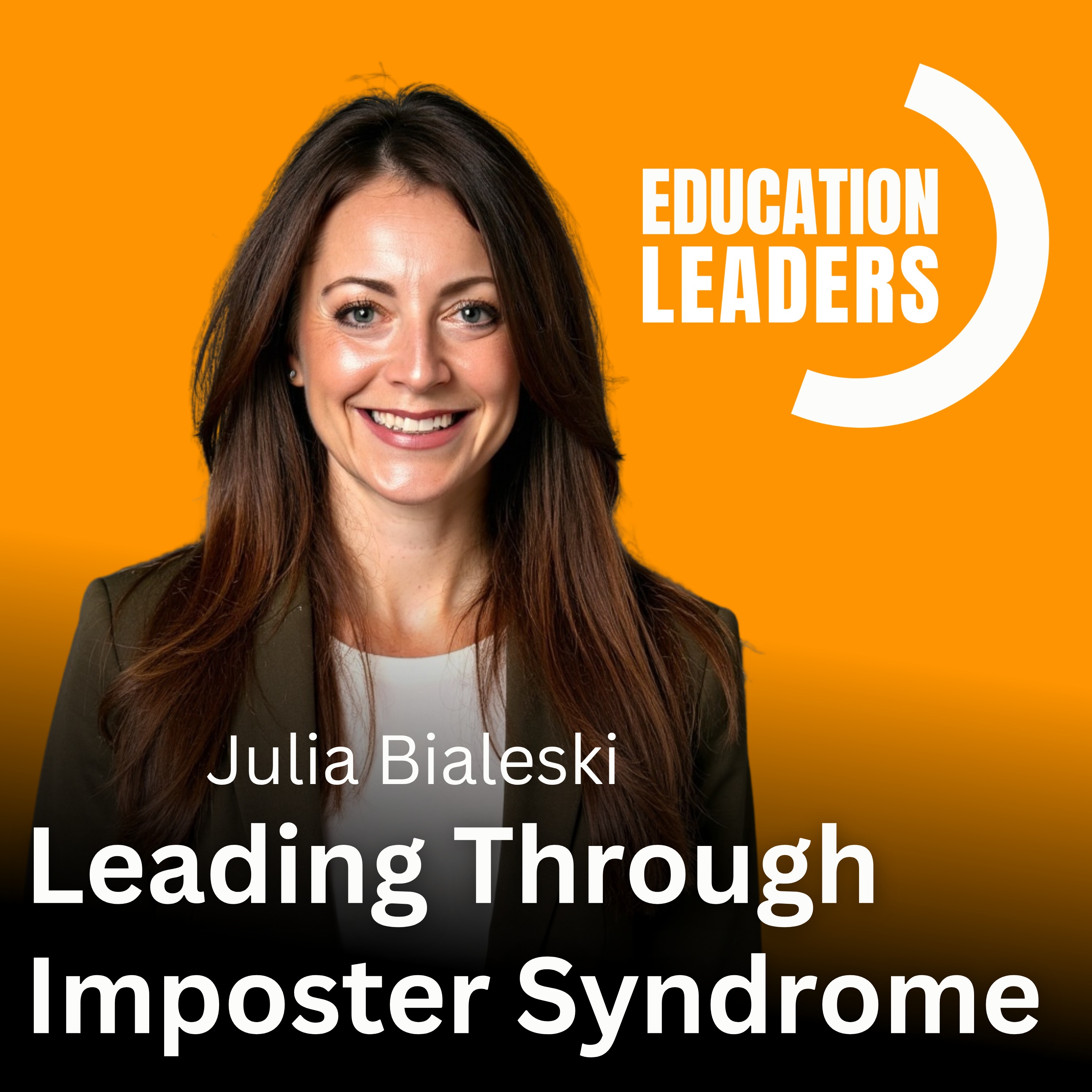
Leading Through Imposter Syndrome | A Conversation with Julia Bialeski
Most school leaders have felt it at some point: that quiet, nagging suspicion that everyone else is more capable, better prepared, and…
Listen & show notes
April was a packed month on the Education Leaders podcast. Five episodes, four guests, and a thread that quietly ran through all of them: the value of small, listened-to, incremental change.
Chris Scorer joined me for our monthly live show to make sense of it all. Here's what landed.
Listening before leading. Richard Wheadon's episode on his leadership journey hit hardest here. Richard's been honest about arriving at a new school full of confidence in approaches that had worked before, only to find the school wasn't ready to hear them. Chris reflected on his own version of that story from his deputy head days. The lesson Richard pulls out, that the relationship has to flip and you're the one who needs to understand them first, is something most leaders quote at interview but find genuinely hard once the pressure to deliver kicks in.
Cognitive load isn't only a classroom concept. Meg Lee's episode on the science of leading drew the parallel cleanly. We'd never overload our students the way we routinely overload our teachers. Chris had sharper questions about where standardisation tips over into removing teacher agency. There's a real risk that well-intentioned alignment becomes content delivery dressed up as consistency.
The story I shared that fell apart in real time. I told one from a large primary school I worked in years ago, where they standardised planning to save teacher time. Some teachers delivered the lessons rigidly. Some scrapped them and rebuilt from scratch. Only a handful actually did what the school intended. Good intention, awful side effect. Wise leadership might have started with a consultation rather than an assumption.
Curiosity as a North Star. Melati Wijsen, founder of Bye Bye Plastic Bags and Youthtopia, took us across to the Netherlands and Bali. Chris flagged the bit that surprised both of us: Melati's gratitude to teachers who didn't let her off the hook, even when she was already running a charity in her teens. There's a real lesson in how Green School Bali holds structure and freedom together. Her book, Change Starts Now, came out a month before mine and happens to be the same colour, which I'm still slightly bitter about.
Vulnerability isn't optional. Julia Bialeski's episode on leading through imposter syndrome went live on Tuesday and is already the most downloaded of the month. Chris and I both copped to feeling it ourselves. Julia's framing of the panic, the public face, and the modelling cost we pay when we hide it from staff and students ties straight back to Richard's journey and to my solo episode on post-decision doubt. The thread underneath all of it: if we can't sit with not knowing, we end up performing certainty instead of building it.
We do this on the last Thursday of every month at educationleaders.live. Come and bring your questions. The live chat is genuinely the best part of the show.
Join Shane's Intensive Leadership Programme at educationleaders.co/intensive
Shane Leaning, an organisational coach based in Shanghai, supports school leaders globally. He is the author of the best-selling 'Change Starts Here.' Shane is a leading educational voice in the UK, Asia and around the world.
You can find Shane on LinkedIn.
We are a proud member of the Education Leaders podcast network. For more great education shows, visit educationleaders.co/network/
Hosted on Acast. See acast.com/privacy for more information.
Auto-generated transcript. It may contain small errors.
Good morning. Good afternoon. Good evening, everyone. Wherever you are in the world. Welcome to Education Leaders Live. It is
April and it is April. We're still in April. Is that right, Chris? We are just still in April, yes.
We're just still in April and this is Education Leaders Live. So it is the partner show to the Education Leaders podcast where myself and Chris Scorer and you discuss some of the topics that have come up on the podcast this month and take lots of interesting tangents together, which I'm sure we will have another one, including just before the show, I was just learning that Chris used to be a falconer. Is that right, Chris? It is indeed, yes. How are you doing?
Yeah, I'm good, thanks. Yeah, I'm good. It's really hot here in Newcastle, which are words that you rarely hear. So it's great to be here and no jumper or thermals required today, which is great.
That's awesome. Get out in the garden. You need to open that shed door and enjoy some of that. Yeah, I've got a child at home as well. We're not opening the shed door today.
Fair enough. It's good to see you, Chris. Wow, what a month it's been. Welcome. I can
see we've got viewers already kind of joining us on YouTube. I can see you there. I can see you on LinkedIn joining us and on Riverside. Welcome to the live show. This is your show.
So the reason we do this live is for a very reason because you don't want to just listen to me and Chris, but you want to be involved as well, involved in discussions about what's happened on Education Leaders and what's happening more widely. So please bring in your comments, bring in your discussions. I'm looking there now. So where have we been on the podcast this month? Well, let me give you a quick summary. We started the month with
an episode on the science of leading with Meg Lee. She's based in the US on looking at some of those science of learning principles and maybe how they apply in the leadership space and whether that can be useful. That was an awesome episode. Then came to the UK for an episode with Richard Weeden on his leadership journey, which is super interested in the danger of getting comfortable in your leadership, which is super interesting. Then
we headed across the water to the Netherlands to speak with Malati. She was in the Netherlands at the time, but she lives between there and Bali. So we've had quite an interesting trip around the world. Malati Weissen, amazing story on growing young change makers, had a little solo episode on post-decision doubt and some of the science behind that. Then
this week, an incredible episode, which has already been listened to hundreds and hundreds of times with Julia Bilesky on leading through and with imposter syndrome, which has triggered a lot of people in the right way. So Chris, how have you found this month? It's been a packed month. It has been a packed month. There were some great themes that ran through all of those
episodes. It's interesting because it takes you on a little bit of a journey in terms of how you feel, particularly about the people that you're listening to. I'd like to start with a small apology to Julia. I send her a message in full confidence that I've finished going through the podcast before we got to today. I started listening to it. Normally,
I pause it and take notes, and it takes me about 45 minutes to do an episode. I think I was 30 seconds in before I'd paused her episode and started taking notes. So it took me a lot longer than normal. We might not have all of the material from the whole podcast.
I'm really sorry, Julia. It was great, though. Luckily, I was present for the whole thing because I was in the conversation. So between us, Chris, we're all right. Well, based on that, Chris, where do you want to start
today? As we're going through a reminder, please comment on what we're talking about. Ask questions. Share your thoughts in the live chat. Where do you want to start, Chris?
I thought we'd start with Meg and have a little bit of a look at that. There were some really interesting reflections here, but actually really simple stuff as well. It's interesting how leaders, and I include myself in this, lose sight of some of that simple stuff when they're under pressure, time, urgency, all of that kind of stuff. I think the first thing was that Meg started to look at how children learn and apply that concept to leadership, because ultimately leadership is about facilitating the learning of others within your organization, usually towards organizational objectives and things like that. But teachers are great at
managing classes. Most teachers are great at managing classes towards particular objectives. They learn what their hook for those particular students are. They learn how to humor them, how to develop them, how to ask questions. And we also learn very quickly that if we tell kids
what to do, it's not really a very effective strategy. Yet we end up in leadership and we fall into that trap, because perhaps as leaders that have been promoted, we recognize that our systems have been successful, so we're going to transfer them into others. And we're maybe a little bit too busy and under a little bit too much performance pressure to take the time to understand the journey that others have got to go on. And I think that was the thing that I pulled out of this. We're not taking those lessons that we have from the classroom as teachers and imposing
them on a leadership journey, if you like. And I love this idea of bringing the signs of learning to leadership. It's mad, isn't it? When you put it that way, it seems so obvious, and it's a great irony that so many things that we would never do for our students. For example, just a simple
thing, like we talked about, cognitive overload. Let's make sure we don't overload our students with too much, because they need time to process and that kind of thing. And yet how often as leaders do we put on our teachers and ask them for this, that, and this, and not look at our calendars very well, and things start bumping into each other, and teachers start getting overwhelmed, and then we expect them to be doing a brilliant job, even if they're overloaded. And yeah, that irony is difficult. I was really intrigued by the idea of
organisational cognitive load, and that's not something that I'd really sort of considered before. But perhaps before I get to that, it's worth mentioning that I think the work that Meg does is pretty noble stuff, helping sort of bridge the gap between research and practice, if you like. I remember when I started my MA in educational research, a colleague of mine, someone that I trusted and respect and so forth, said to me, oh great, you'll be able to write a load of research that nobody reads. I guess the point is that a lot of people don't read it. A lot of people don't have the time, they don't necessarily have the desire. They may
be a little bit cynical about some of it too, you know, reinventing the wheel and things like that is something you hear a lot. And I think that bridging that gap, which is the work that Meg does, is really important because it's really valuable stuff. So good on you, Meg. I think she's got this great way, and I was very lucky to have met Meg in person. The last time
I saw her, she took me to a pumpkin patch in the US, and I actually went and helped her pick her pumpkin for her house last Halloween. We had a tractor ride together and it was ever so nice. But one thing like chatting to Meg, you realize very quick, is that she does that bridging so well in terms of not just her academic and understanding what the science says, but actually understanding context and how it applies in your context. And I think this is where sometimes people get lost with the science of learning, or the science of leading, is that, you know, rigidly, that rigid application, or that codification too much of it, or that, what do we call them, lethal mutations, or something like that, of things. And I think
what she does really well is think about, well, how does this work practically? And how do you kind of develop a shared language of leadership that helps everyone to do their job more effectively? Yeah. And I listened to that and I loved the idea of organizational cognitive load, and again, not something I've sort of considered before on it, but it makes a lot of sense. And then
we got into that idea of mitigation of cognitive load. And I started to feel a little uneasy when we got to this bit. And we were talking about routines and alignment and so forth. And it all started to feel a little bit like the language of standardization. And I think there's inevitably
attention when we try to move towards lifting that cognitive load, that we remove the scope for individuality, pluralism, eccentricity even. And I think that those things have real value within the classroom and not the same lesson with one group doesn't necessarily work with another group and personalities are important. I started to worry when I heard that, not because I thought Meg was necessarily the sort of person that would not bring the right approach to it. But I can see people, well-intentioned people as well, being under pressure of time, standardizing their routines. Yes, we've got to do X, Y, and Z. And just moving away from giving
teachers sufficient agency to do a really inspiring job with what they do. So I'm moving teachers back towards that concept of content delivery rather than inspiration. And I think the whiteboard example that Richard Whedon uses in the following episode is probably one of those. And there's some really interesting observations about that journey that Richard went on.
But also, those ideas that Julia puts forward, that kind of leading with grace, that listening and taking other people's on board. There's a huge amount in there. And it's a difficult balance for a leader to strike. It's an impossible balance for a leader to strike. You'll not get it right for everybody, I guess. But I'd love to hear any opinions and
ideas as to how leaders do balance that tension between giving teachers sufficient agency but providing a standard approach or engaging with lifting some of that workload in the hope of making life better for your teachers and students. Where does that balance lie? Well, that's a great provocation. So anyone who's listening in, please add in your comments there.
What do you think on that? Have you seen places where this has worked or maybe places where this has fallen apart and not worked? Let us know. Send us in your comments. It would be great to have you.
It's almost reminding me, Chris, of a time where I can remember where I worked in a really large school and there was kind of lots of different classes in a primary school, a large primary school. And there was lots of classes per year group. So they standardized kind of like the planning to help save teachers' time. One person will take on the English planning, one person will take on the maths planning. And on the face of it, it sounds like such a smart
decision because it saves a lot of time and everyone shouldn't be having to plan the same thing six times over, for example. But what was interesting in this case is when we started looking at what some teachers were doing, some teachers took it as it was and they just delivered a copy cutter lesson. That was what happened, which probably wasn't the best thing to do because they weren't teaching this material. But then other teachers were doing a bit of adaptation, which I think was what the school were wanting, that you kind of have the bare bones and then you make a bit of adaptation. That was actually the minority of teachers.
And then some teachers were going, this is not how I teach. And then we're planning from scratch anyway. So there was this good intention of let's standardize to help the teachers. This is going to help them. And what in medical they call the iatrogenic effect,
or the side effect of that that was happening, was that actually some teachers were teaching it far too rigidly. Some teachers were re-scrapping it all together. And only a couple of teachers were actually doing what the school intended. And I think this can happen a lot. And so that
wise leadership is leadership that's potentially a leader who is able to go, okay, this is what we think is going to work for standardization or for something that is going to help you. But let's first put it out to consultation to see what our teachers have to say about this, because we can't just make an assumption that this is just going to be like a godsend for everyone. It might not. That's the real risk, isn't it? And I think that towards the end of the
episode, Meg talks about effortful thinking, taking time to consider the responses and the reactions, the unintended consequences. I just wonder who has a lot of time for that in education leadership. Do you actually set time aside for a cup of coffee and a little bit of a think and then clarify your thoughts before the day? I suspect that a lot of people kind of get in and just deal with the day-to-day daily grind of what's in front of them and possibly that kind of thing is a little bit squeezed? Yeah, I think so. I think that's a really common
piece of feedback that I've heard from quite a few people. I think Meg ended on a really nice note that worked really well. And I think it can be applied in loads of different circumstances. And it's that idea of lots of small moves in the right direction. We'll steer towards that. And maybe the small moves make it a little
more palatable, make it a little more sustainable, make it a little bit easier for people to tweak along the way so you don't end up with the reaction that you've just mentioned where it also goes awry. And I wonder if those small moves and that incremental change is the way forward. I think it is. I think it's been proven time and time again that kind of iterative change with small moves has a better chance of lasting. And yet we are all just tempted by the shiny
object or tempted by revolution or tempted to prove our place or worth. There's so many reasons why we get attracted to making the big scale change because we want to have an impact whatever way that is. But the reality is most of the time that doesn't work. We're also scared of not being seen as the expert. When you start climbing the ladder,
people start asking you questions. And implicit in that is that you have the answers. And that's something that people often mistake as leadership. And it's a poor quality of leadership. And I think that probably feeds us into Richard's journey a little bit there.
Well, take us there then because this was an interesting episode where we got a lot of discussion online actually about Richard. So Richard Wiesen, he's in the UK doing some good work, actually got a book out, brilliant book learning habits. And when we were planning this podcast and we were thinking, we were first thinking, let's do a book about the theme on the podcast. But then I thought Richard's story was far too interesting. We'd rather talk about that
because he's quite a journey, hasn't he? He has. And it was really interesting listening to this episode. When I started listening to it, I'll be honest, I thought Richard and I would probably clash quite badly, particularly in our early careers. And as I got towards the end, I felt a degree of convergence
and thought that there was probably room for us to get on quite well. But I could imagine there being a little bit of a clash early on. And it was interesting because clearly he'd been very successful. He'd done a great job. He brought some new ideas. He moved up the ladder.
And then he started bringing those ideas to elsewhere. And there was a bit in here, and I'm just trying to find it in my note. He raised the point. And I think he said that when he moved to the new school, the school weren't ready for him. They weren't ready to
listen to him. And I thought that that speaks volumes about where he was in terms of his own leadership journey. And I've been in that same position. I was a point the deputy head quite early on, and perhaps too early on. And you start to wonder why people aren't
actually getting what you think. And actually, the relationship needs to be flipped. You need to understand what they think rather than them understand you. And I think that that was a journey that Richard seemed to go on. There was a huge amount of reflection and humility
and honesty in there. And I've got massive respect for Richard in terms of the way he approached that. But I could see those challenges, and I perhaps related to them myself as well. And it ties into that inherent pressure to be the authority or to be right, particularly when it comes to you a little bit young, when you're a little bit younger than some of the people that you're leading and so on. I love the example about the mini whiteboards,
pinning down the consistencies around that. But again, we get to this idea of consistencies and approaches. And it leaves me troubled again, that idea that we become too consistent and we become standardized. And we stop bringing our character to the classroom. We stop bringing that
individual expertise. And as soon as we do that, all we're doing really is delivering content as teachers, rather than necessarily looking to inspire youngsters in the next generation. So that troubles me a little bit. But I thought that was probably quite a common journey that people have been on. I think so. And I really thought for listeners who are listening in now
who haven't listened to that episode, go back and listen to Richard's episode. Because I think many leaders will recognize themselves in it, but many people would have seen leaders like that. And it's interesting because I think the powerful thing about Richard's story is he was able to reflect at the right time and able to come back. Because many leaders maybe get stuck in that point of having success somewhere, getting promoted or going into a new school, trying to replicate that success, not working and then doubling down. Like,
I know this can work. I've done it before. You just need to do it. And thankfully, Richard took that lesson and took this big lesson of listening before you lead. What struck me
was that this message of if you go into a new school, what's the first thing you should do? I think most leaders know and probably quote at their interview, the first thing I will do is listen, really get to know. I won't make any changes. And I think we all know that that is the right thing to do. And yet I think there are some systemic pressures when you get in
to the role that stop you being able to do that. And all of a sudden they go, okay, yeah. Like your bosses may be saying, well, come on. I'll hide you for a reason. I want to see results.
I want to see results. And it can, especially for the, like you say, the younger leader or the less experienced leader who hasn't done it a few times before, potentially, yeah, then you can end up just following that path and going, well, I have to because I need to please my boss. But then it just, it falls apart so quickly. Yeah. And that ties into some fundamentals
behind what education is actually for, I suppose. And I've done a couple of events where I've talked about this and Malati also addresses it at the end of her podcast too. About the purpose and role that education plays. And I think that there's possibly a burden, a responsibility amongst educational leaders to start to question that a little bit rather than just deliver on what the pay masters want. I do look, I recognize I'm in my shed.
I don't have to deal with that sort of pressure anymore. But if you're going to be an educational leader, then you've got to kind of question the orthodox. And that's one of those things that Meg raised as well, that cycle of questioning the existing knowledge and pushing back against it and that sort of feedback loop, if you like. And I think that that's important. And I wonder
if we keep our educational leaders just a little too busy, we don't give them the thinking time and we don't give them the sort of philosophical room to question what we're actually doing in the school. We just become a school, we run the risk of becoming a series of metrics around a place that inspires youngsters potentially. Well, let's use that as a perfect segue. And by the way, can you hear Chatter behind me? I can indeed, yeah. I'll put myself on mute.
So there's two things that are going to happen. One, I'm quite distracted because there are two cleaners outside cleaning the office next to me and they've moved out and they are using whatever chemical this is, is like mentally strong to peel stuff off the window. So I'm getting slightly high in my little booth at the minute as well. And there's also noise.
So apologies on both. It might just be you at the end. But yeah, let's move on to Malati. This was a perfect segue. So I was really excited to get Malati Weiss and like a
brilliant, incredible person. I've got her book here, Change Stats Now. We actually had a really funny moment where we were both presenting at a conference. Didn't realise both of us were presenting there. And there we both get up onto our stage with our two books.
I'm so relieved they're the same colour. And they're the same colour. And Malati released her one month before ours. So I felt like we were copying off her. But Change Stats Now
is Malati's book. She's an incredible person, 16 year old, 12. She started a charity in Bali with her sister called Bye Bye Plastic. She went to this school that I think makes you super envious, the Green School in Bali, very different. Ended up setting up a charity,
finished a qualification as well. She was running this full time charity and didn't go to university, has been leading an amazing organisation called Utopia, has introduced for Barack Obama before, like has done two TED talks now. And it's just incredible. She was kind enough to come on the show to share a bit about her vision of what leaders should be thinking about. And
as I was listening, I was thinking Chris Scorer will be enjoying this for sure. Totally. And listen, if there's anyone from the Green School in Bali that wants a data consultant full time, do drop me a line. That would be my sort of dream gig, I think.
Do you think they do data at Green School? Yeah, well, you know, I teach a bit of economics too, but I can focus on, you know, I'm quite happy to be a cleaner if need be. But, you know, after I got over the sort of general sense of inadequacy for myself, after I'd sort of listened to this podcast and thought, Crikey, this lady's 25 and has achieved more than I have, in more than double that. She's pretty amazing stuff. And there was some really, really wonderful stuff in here. And she just seemed to come out
with the right attitude about what it was all about. The really big stuff. There were a lot of things that she touched on. She talked about things like how damaging accountability can be when it's used badly and how that often happens. She addressed that idea
what education is for. And this is something that we've, you know, even at leadership, we very rarely pick up on that because we're so busy delivering on sort of standard metrics. That whole thing about the, you know, setting herself up at the age of 12. And then by the time she's 16, she's burned out and reflected as to why and then built upon that. She just seemed like a really,
really fascinating individual. But I guess the one thing that came through for me, and this links to the idea as to what education is for, is that curiosity was her driving force. That he was what built that. And I go back to like the work of people like Ken Robinson and so forth that with our drive towards metrics in schools, I drive towards results, the parental pressure, the financial pressure, all of that kind of stuff. Do we actually risk
killing off that kind of curiosity and creativity amongst youngsters? And I think that there is a risk that we do that. And I love the idea. I think she described it as her North Star, her sort of guiding principle. And I think that if we could use curiosity and creativity as our
North Star within schools, and there's perhaps the more important of metrics, then the world would probably be a far better place as a result. I don't know what your thoughts are on that. Yeah. I mean, it's a tension, isn't it? You're going to be in a few months' time,
I've got Claire Badger on the podcast who is talking about the science of creativity. So you're going to find this quite interesting, actually. And this really intrigues me because I think it is important. But I think it's what Claire would say is it's misused potentially.
And even like the Ken Robinson kind of vision as good as he was is just kind of misused as woolly. And it doesn't work just on its own. You just can't say allow students to be creative. You've got to put things in place. And I think the Green School does that with structures. And
it's not like people at the Green School just turn up and they can freely set off on whatever project they want and just kind of get on with it. They have to learn about these things and understand them deeply. And the teachers have a big role in that. The teachers are not just facilitators either. They're not just like, but they are there to guide them at the right point
and push them at the right point. And I thought Malati made this really interesting point where she said, do you know I'm thankful because my teachers didn't let me get off the hook sometimes. And they could have. They could have gone, well, Malati's been successful. She's got a charity.
Let her be and do what she's doing and just crack on. Well, in which case, what's the point of school? And actually, there were some lessons for Malati. There are actually sometimes there's a responsibility you've got to fulfill. And she had to work out how to balance that
responsibility. That really surprised me, actually, because I was almost expecting her to have just been given just carte blanche to do whatever she wants. And it sounds like they struck a balance there, which is, I think, an interesting thing to study, perhaps. I'm really interested in the view that parents are guardians, tough with the unconventional route that she followed. I also wonder, in school leadership, how they address the
softer approach, if I can call it that, with parents. Because that's not something that's going to have universal appeal or agreement and potentially sets you up for some fairly tricky conversations with parents. And the Green School is very much marketed on that slightly softer view. But if you were part of another school, for example, how do you make a move towards that and sell that idea to the parents? I've had some of those tricky conversations
around really simple stuff, like giving kids a night off in the boarding house when they were under pressure and they were struggling, just giving them a little bit of a break. Some parents wanted those kids to just work harder. Rarely was it a successful conversation, so I do wonder how leaders might address that, create space for that curiosity, and get the parents on board, particularly in some of the countries around Asia, that maybe are a little more assertive in what the parents want from the school. Yeah, I can totally see that. It is a challenge, and you're constantly dealing with these
dualities in schools. Many people would say, okay, the exams aren't important until the exams come around, then they are important. University is not important until your child decides they are just opting out entirely from the system. So there's always your attention, and you'll know it more than me. Being a parent as well, Chris,
there's wanting the best for your children must be like a real pickle sometimes, and knowing what route that means to choose for them. Yeah, and it's tiring, and it's rarely objective when it's your own children. And that's always a tricky space to occupy as well, when you know that your perspective isn't objective. There's always an inherent level of discomfort in that. For me, I put
Malati in charge of global education policy. If there was such a role, I thought she was great. And I loved, you know, she talked about finding space in the school day. And again, that's something that schools are fearful of, because they want all their time to be accountable.
And it's very difficult finding that sort of loose space. And I also wonder if that kind of applied to teachers and leaders too, giving them that sort of downtime for a little bit of reflection and creativity. You know, some of your best ideas might come whilst you're having a coffee with a colleague and chatting about the classes that you're struggling with or that kind of thing. But then she got to that, she got to a really simple, a little like Meg got to a simple idea of sort of lots of small steps in a particular direction. Malati got to that idea of how can
I make the world a little better today. And I thought those two really were the same thing, just with a slightly different focus. Yeah, for sure. I think, yeah, if you haven't listened, go listen back to Malati's episode. She's incredible. And if you haven't heard of
the Green School Bali where she did all of her schooling, Google it. Your mind will be blown at, you know, these open air classrooms and you can call them classrooms. But I've been lucky enough to have a bit of time at that school having to look around and kind of, it is very special. It's very special. The other thing that came out for me was that Malati talked about the concept
of failure and the value of it. And again, I think that we're maybe, we maybe could be a little more tolerant or even embracing a failure. We encourage it amongst things, you know, we encourage kids to have a risk-taking profile with the IB, for example. I sort of wonder if maybe we could encourage that a little more widely and perhaps find a way to learn lessons from failure and mitigate risk rather than just seeing failure as a bad thing in and of itself.
Yeah. You're the master of segues today, Chris, by the way, because everything is just lined up so perfectly to the next. Because I wonder if that links this idea of failure now on Julia's episode. And Julia's episode on leading with imposter syndrome, which has just come out this Tuesday, but also I did an episode last week on post-decision doubt, that doubt feeling, that sickly feeling you have after you've made a big decision, and how to read that.
They were so closely linked to these two episodes. And I look at my stats right in front of me now, like I just know already Julia's episode is the most downloaded this month already, only having been out a couple of days. And does that say something? The title is Leading Through Imposter Syndrome, and it's the most downloaded episode so far. What are you
taking from that? Well, you know, I totally get the imposter syndrome whenever I've been out to sort of speak at events and things like that. My flight out is usually pretty traumatic because I'm thinking about all the reasons why I'm not worthy of doing that. And, you know, it's tough. You're going in front of a discerning audience and you're putting yourself
out there. And there's loads of reasons why it perhaps shouldn't be you. It could be someone else. There's perhaps other people that could do it better. I really liked Julia's description,
that panic that you get. And the fact that perhaps you shouldn't be doing the job. And then she talked about this need for a public face to hide that panic. And I thought actually probably the problem arises, not because of the panic, but because of that need to kind of not be vulnerable. And it ties into those early themes from Richard as well, that, you know,
you need to be authoritative. If you need to know your onions, you need people to respect your position and your ideas. And that vulnerability is something that none of us are really that comfortable with. Yet we all know that that vulnerability is where development and growth comes from. And it was interesting hearing Julia, who was clearly very successful in her field,
talking about the fact that she felt the need to hide that vulnerability. And then it got onto a little bit later, talked about the sort of modeling. And I thought, you know, what a dreadful message to be giving kids, if you're hiding your vulnerability and the impact that that has on them, not being able to admit their vulnerability, not being able to admit when they're struggling, you know, it not being okay to not be okay, for example. And there was all of these really big themes came out, some of which were just mentioned in passing, but I thought were huge. And actually, I think that vulnerability,
that panic, that self-reflection is the first point of growth. And it's the first thing that makes you worthy of the role. If you don't have that, then there's a danger, isn't there? I think, is the imposter syndrome thing desirable or not? That's one of the questions
that are sort of flagged up here. I think it is, I think humility and vulnerability is important. I think arrogance is really toxic and just isolates people. But then you've got that assert of ignorance, where people have a little bit of knowledge and they feel the need to be assertive, to prove that they're right. And it's a natural temptation to head towards that when you feel
insecure. You know, it's that British idea that if I say something louder, then they'll understand. Yeah. It's kind of the same concept. But actually, if we're going to model lifelong learning,
we kind of need to be in that slightly uncomfortable place where we are vulnerable. So we question our own parameters. Yeah. I wish Julia had been my principal.
I thought listening to her work was great. Likewise. I like how you frame it, there is a power in the imposter syndrome in a way. And if more people, it's funny, I've had it so many times. And I've tried to model it myself as well,
even in the online space to try to say, you know, people can watch what you do from afar and go, wow, look at that. You're just great. I could never be that confident to just do that and do that. And then actually, sometimes you have to have that conversation and say, you know, I don't always feel that way. Or I don't feel that way very much, in fact, if it was me.
But it's interesting when I speak to other people. Last week, I was at a great conference meeting so many educators who I admire and these amazing people. But like when I got chatting to some of them, like, you know, over a cup of tea or, you know, over a beer in the evening, you start to realize, oh, they doubt themselves too. They doubt themselves too. And this is
really helpful information. It's really helpful information because if we were in a place where we all just shared our doubts and shared that, and that was normalized, then maybe we would be in a better place where people didn't feel like they had to put on the suits or put on the defense. And then therefore, just not be in listening mode, not be in empathizing mode and kind of, you know, shooting messages past people rather than listening. I think it's, yeah, I think it's super interesting.
You asked the question, I think, Julia, about why it's worse in school leadership, why this sort of self-doubt, this imposter syndrome, if you like, is worse in school leadership. And there was all sorts of discussion around the loneliness of teaching, the fact that actually it is quite an isolated profession, even though you're amongst people all day. You know, the responsibility is huge because of what we're doing as teachers. But I also thought about the fact that the metrics, the real metrics that count, way more complex than any other profession that you can really imagine. If you go into a commercial role, it's bottom line, it's
finance. That's it. That's the metric that you're judged by. And largely everything else falls by the wayside. You know, you might have a customer satisfaction target or something like
that. But actually, the metrics within school are really complex. You've got all of the academic data, the sort of concept of value added, personal growth for students, wellbeing, parental satisfaction, sports results, all of those complex things that you're judged by. And I wonder if perhaps that adds to that idea that this imposter syndrome is worse in a school because we're carrying so many metrics. And inevitably, we're not going to be familiar and comfortable
in all of those areas. Yeah, yeah, for sure. Interesting. Complexity, I guess.
Yes, exactly. The complexity. That's the thing we need to embrace. I love that. Chris, we've got
people joining us on LinkedIn. We've got people joining us on YouTube across the platforms. I just want to bring in a few comments. There's this first one at Fedi Slop on YouTube says, vulnerability is a superpower. It means you're open to honest critique and also that you want
growth yourself. Funnily enough, to be a good school leader, you have to be open to big time checks from your whole team, which if you learn how to be available and listen, that's a big part of vulnerability. And also they say, good point on multiple metrics. I think that's a great point.
We also have Wayne on LinkedIn saying, imposter syndrome is the mind whispering doubt in rooms your ability has already earned. Oh, that's interesting. And Finn also joining us on LinkedIn, LinkedIn. Welcome, Finn. Allowing yourself to show vulnerability is one of the best ways to
immediately gain respect of your team. What do you reckon, Chris? Some great points. Yeah, I think that's true. But to gain that respect, your team have got to be pretty enlightened. And
I think there's inevitably going to be people out there in your team that use that vulnerability and see it as a negative. It doesn't come without risk. And I'm sure we've all encountered that at one point or another. I'd rather put it out there and deal with the risk and the fall out from someone that didn't handle it well, than not put it out there for me. Maybe that
explains why I work in a shed and not in a school anymore. It also, for me, it just explains the journey, right? You almost have to go through the journey a bit to kind of figure out where your comfort spot is. Thank you so much to those who are joining in. It's great to have people
join us online, join us on YouTube, on LinkedIn. If you're listening to this episode on the podcast playlist, I always put it as a bonus episode on education leaders, then come and join us. We get together last Thursday of every month, me, Chris, and you, to just have a chat about these things. And gosh, it's been a really full on chat today. Chris,
I wonder like, before we bring things to a close, have you got any thoughts that you'd like to share based on what we've been speaking about today? Yeah, I think the theme that kind of came through for me across the board was this idea of kind of small measured change, small incremental change after you've listened. And that change can be from you or it can be on the part of your team. And I think probably the podcasts sort of seem to take us, sort of follow a theme along a journey.
And I thought Richard's kind of really summed that up, that journey, where you've gone from being the expert to starting to listen, and so on. Julia clearly had been on a similar journey. And I love that idea of just taking care with the people that work for you and trying to sort of steer them gently and understanding the journey that they're on before you worry about the journey that you're on. I love that. Perfectly, perfectly summarized. Listen, Chris, this has been
absolutely awesome. The time flies so quick when you're having fun. This has been absolutely brilliant. So if you're listening, please do come and join us. It's really wonderful to have
you here. Next month on the podcast, I'm just looking up, we've got some really interesting conversations. Next week, actually, we have got two head teachers in their first year who are sharing the reflection on the transition. And these are two head teachers who are already published authors who have made the leap into leadership in a school, this really interesting conversation.
I bet I know who they are. I'm not going to say in case I get it wrong, I'm not ready to be vulnerable. You probably will. We've also then got some really interesting episodes coming up, including an episode with Nancy Weinstein in the US talking a little bit about some of the issues that are lagging from COVID times and the data that she's still picking up on. That's going
to be interesting. And then we've got an awesome person called Patrice Bain, brilliant author and all around good person who is talking about how to find your people and your tribe and your community in the education space. Really exciting. I think I've seen that presentation somewhere.
Yeah, that's ringing some bells for me. Yeah. Well, I think you're going to enjoy this. Chris, you've got a big fan on YouTube.
They say, this guy is awesome. Chris rocks. How about that? The shirt worked. Any comments on
Chris's shirt welcome as well. I think it's pretty snazzy. It's been a deliberate move away from the corporate world. I've lived a corporate life and I've always been uncomfortable with it on some level or another. So I've just decided to
start wearing shirts that I like rather than shirts that I should wear. And here I am today. Well, I'm glad you're here, Chris. This has been absolutely fantastic. Thank you for joining us
online at Fedi Slop and Finn and Wayne. Finn says, what a brilliant topic Chaps lost to think about from this. Loved it. It has been wonderful to have you as a community here. Chris, thank you
so much. And I can't wait to do same time next month on Education Leaders Live. Always a pleasure, Shane. Thanks for joining us.
Take care. Bye now.
Most school leaders have felt it at some point: that quiet, nagging suspicion that everyone else is more capable, better prepared, and…
Listen & show notes
That sickly feeling after a tough leadership call isn't your intuition warning you that you got it wrong and this episode explains exactly…
Listen & show notes
Melati Wijsen started Bye Bye Plastic Bags at age 12, spoke at the UN as a teenager, and never went to university, yet she is now teaching…
Listen & show notes